Chandra Wibowo
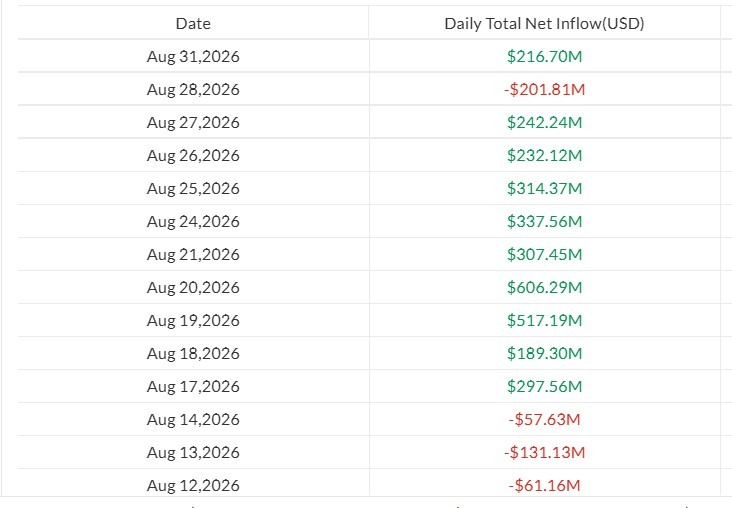
US-listed spot Bitcoin exchange-traded funds (ETFs) have demonstrated a significant return to net positive inflows, reversing a recent dip and signaling renewed investor confidence in the flagship cryptocurrency. On Monday, these instruments collectively attracted $216.7 million, a notable turnaround from the $201.8 million in outflows recorded just last Friday. This resurgence was predominantly driven by BlackRock’s iShares Bitcoin Trust (IBIT), which accounted for the vast majority of the day’s gains, underscoring its dominant position in the burgeoning spot Bitcoin ETF market.
The brief period of outflows on Friday had interrupted a remarkable nine-session streak that saw over $3 billion pour into Bitcoin ETFs. The market’s reaction on Monday suggests that Friday’s withdrawals were likely a temporary fluctuation rather than a fundamental shift in sentiment. As of this reporting, Bitcoin (BTC) was trading around the $78,700 mark, showing a modest but positive increase of approximately 1.5% over the preceding 24 hours, according to data from CoinGecko. This price action, while not dramatic, indicates a stable or slightly upward trajectory, which typically supports positive ETF flows.
Beyond Bitcoin, the appetite for other digital asset ETFs remains robust. Spot Ether ETFs continued their impressive rally, extending their streak of positive inflows to an eleventh consecutive trading session. Similarly, ETFs tracking XRP and Solana (SOL) also marked their tenth consecutive day of attracting capital, highlighting sustained investor interest in a broader spectrum of cryptocurrencies beyond Bitcoin. This consistent inflow into Ether, XRP, and Solana ETFs suggests a growing diversification of investment strategies within the digital asset ETF space, moving beyond a singular focus on Bitcoin.
BlackRock Dominates Bitcoin ETF Inflows, Signalling Market Leadership
The resurgence in Bitcoin ETF inflows on Monday was overwhelmingly spearheaded by BlackRock’s iShares Bitcoin Trust (IBIT). The fund reported net inflows of $205.9 million, a staggering figure that represents approximately 95% of the total inflows for all Bitcoin ETFs on that day, according to data from Farside Investors. This level of concentration in a single issuer’s product underscores BlackRock’s significant influence and market penetration in the spot Bitcoin ETF landscape since their launch.
Following IBIT’s substantial contribution, other major Bitcoin ETFs also saw positive, albeit smaller, inflows. Fidelity’s Wise Origin Bitcoin Fund (FBTC) added $6.9 million, while the Bitwise Bitcoin ETF (BITB) attracted $4.3 million. Morgan Stanley’s Bitcoin Trust recorded inflows of $3.6 million, and Grayscale’s recently launched Bitcoin Mini Trust, which offers a lower fee structure compared to its predecessor, attracted $9.4 million. The participation of these varied issuers, including traditional financial giants and specialized digital asset firms, paints a picture of a competitive and evolving ETF market.
However, not all Bitcoin ETFs experienced inflows. VanEck’s Bitcoin ETF (HODL) was the sole fund to report outflows, with net withdrawals amounting to $13.4 million. The remaining Bitcoin ETFs listed in the US reported no significant flow activity on Monday. This divergence in performance among issuers suggests that investors are becoming increasingly discerning, potentially favouring specific products based on factors such as fee structures, track record, or the perceived strength of the issuing institution. The performance of the Bitcoin Mini Trust, in particular, could indicate a growing sensitivity to management fees among investors.

Ether, XRP, and Solana ETFs Showcase Sustained Momentum
The positive trend extends beyond Bitcoin, with spot Ether ETFs continuing to capture investor attention. On Monday, these funds collectively attracted $87.7 million, extending their unbroken run of inflows to eleven consecutive trading days. This sustained demand for Ether ETFs indicates a strong conviction in the future prospects of Ethereum, the second-largest cryptocurrency by market capitalization, and its underlying blockchain technology.
Within the Ether ETF segment, BlackRock’s iShares Ethereum Trust (ETHA) again emerged as a leading performer, securing $59.9 million in net inflows. Grayscale’s Ethereum Mini Trust, following its Bitcoin counterpart’s strategy, attracted $13.5 million, and Fidelity’s Ethereum Fund added $9.3 million, according to Farside data. The consistent inflows into Ether ETFs suggest that investors are not only interested in Bitcoin as a digital store of value but also in Ethereum as a platform for decentralized applications, smart contracts, and its potential for future technological advancements.
The rally in XRP ETFs has also been notable, with the funds extending their positive streak to ten consecutive trading sessions. On Monday, XRP ETFs garnered $5.64 million in net inflows, according to SoSoValue. This consistent inflow since August 18th signifies a growing investor base for XRP, a cryptocurrency often associated with its role in facilitating cross-border payments and its ongoing legal battles with regulatory bodies, which have seen periods of uncertainty and eventual clarity. The sustained inflows despite past regulatory headwinds suggest a growing confidence in XRP’s long-term utility and potential.
Solana ETFs have similarly maintained their upward momentum, recording their tenth consecutive positive session. While Monday’s inflows for Solana ETFs slowed to $925,010, down from a more substantial $18.1 million on Friday, it still represents a net positive flow. This slowdown in daily inflows, however, marks the weakest inflow figure for the category during its current winning streak. Despite this moderation, the continued positive trend indicates that investors remain interested in Solana, a blockchain known for its high transaction speeds and low fees, which has positioned it as a competitor in the decentralized finance (DeFi) and non-fungible token (NFT) spaces. The sustained interest in these altcoin ETFs demonstrates a maturing digital asset investment landscape, where investors are increasingly comfortable allocating capital to assets beyond Bitcoin and Ether.
Background and Chronology of ETF Flows
The launch of US spot Bitcoin ETFs in January 2024 marked a watershed moment for the cryptocurrency industry, providing traditional investors with a regulated and accessible avenue to gain exposure to Bitcoin. The initial period following their launch was characterized by unprecedented inflows, driving Bitcoin prices to new all-time highs. This success paved the way for the subsequent approval and launch of spot Ether ETFs in May 2024, and more recently, the emergence of ETFs for other digital assets like XRP and Solana.
The recent trend of inflows into Bitcoin ETFs, culminating in Monday’s strong rebound, followed a period of consolidation and minor outflows. The nine-day inflow streak prior to Friday’s dip had injected significant capital into the market, suggesting a strong underlying demand. The brief outflow on Friday might have been influenced by a confluence of factors, including profit-taking after a period of rapid gains, broader market sentiment shifts, or specific news events impacting the cryptocurrency space. However, the swift return to inflows on Monday indicates that these factors were temporary and that the fundamental drivers of demand for Bitcoin ETFs remain intact.
The sustained inflows into Ether, XRP, and Solana ETFs represent a more recent phenomenon, with their positive streaks extending for over a week. This indicates a growing institutional and retail acceptance of these digital assets as investment vehicles. The development of ETFs for these cryptocurrencies signifies a maturation of the digital asset market, moving beyond Bitcoin and Ether to encompass a wider range of blockchain-based assets with diverse use cases and technological innovations.
Analysis of Implications and Broader Impact
The robust inflows into US-listed spot Bitcoin ETFs, particularly led by BlackRock, carry several significant implications for the cryptocurrency market and traditional finance. Firstly, it reinforces the narrative of increasing institutional adoption of digital assets. The sustained demand from major financial players suggests a growing acceptance of Bitcoin and other cryptocurrencies as legitimate asset classes with diversification benefits and long-term growth potential. BlackRock’s dominant position, in particular, lends significant credibility to the Bitcoin ETF market and may encourage other large asset managers to consider similar offerings or increase their allocations.
The consistent inflows into Ether, XRP, and Solana ETFs signal a diversification of investment strategies within the digital asset space. Investors are no longer solely focused on Bitcoin as a store of value but are also recognizing the potential of other cryptocurrencies with distinct technological advantages and use cases. Ether’s role in smart contracts and decentralized finance, XRP’s utility in cross-border payments, and Solana’s high-performance blockchain are all attracting investor capital through the ETF structure. This diversification can lead to a more mature and resilient digital asset ecosystem, reducing reliance on a single asset class.
The continued success of these ETFs could also spur further innovation in the digital asset investment product landscape. We might see the development of ETFs tracking baskets of cryptocurrencies, thematic ETFs focused on specific sectors within the digital economy (e.g., DeFi, NFTs, Web3), or even ETFs offering exposure to decentralized finance protocols. The regulatory clarity provided by the approval of these spot ETFs is crucial for this innovation, offering a framework for investors to engage with digital assets through familiar financial instruments.
Furthermore, the positive sentiment reflected in these ETF flows can have a ripple effect on the underlying cryptocurrency markets. Increased demand for ETFs translates into increased demand for the underlying digital assets, which can support higher prices and greater market liquidity. This can, in turn, attract more retail and institutional investors, creating a virtuous cycle of adoption and growth.
However, it is important to acknowledge the inherent volatility and risks associated with cryptocurrency investments. While ETFs provide a regulated pathway, the underlying assets remain subject to significant price fluctuations. Investors should conduct thorough due diligence and understand the risks before allocating capital. The performance of these ETFs will continue to be closely watched as a key indicator of institutional sentiment and the broader adoption trajectory of digital assets in the global financial system. The sustained inflows suggest a positive outlook, but the market remains dynamic and subject to various external influences.