Sisilia Frederika
The vast expanse of the Milky Way galaxy is populated by an estimated 100 million stellar-mass black holes, yet the vast majority of these cosmic enigmas remain shrouded in darkness. Traditionally, black holes are identified through the high-energy signatures of their "active" phases—moments when they are actively consuming matter from a companion star or the surrounding interstellar medium. During these events, the matter spiraling into the black hole forms a superheated accretion disk that emits intense X-rays, while powerful jets of plasma are often ejected from the poles at near-light speeds. However, these active systems represent only a tiny fraction of the total population. Most black holes are "dormant" or inactive, drifting through space either in isolation or in wide orbits around companion stars without actively feeding. Because they emit no detectable light or radiation, these quiet giants have long been invisible to conventional telescopes.
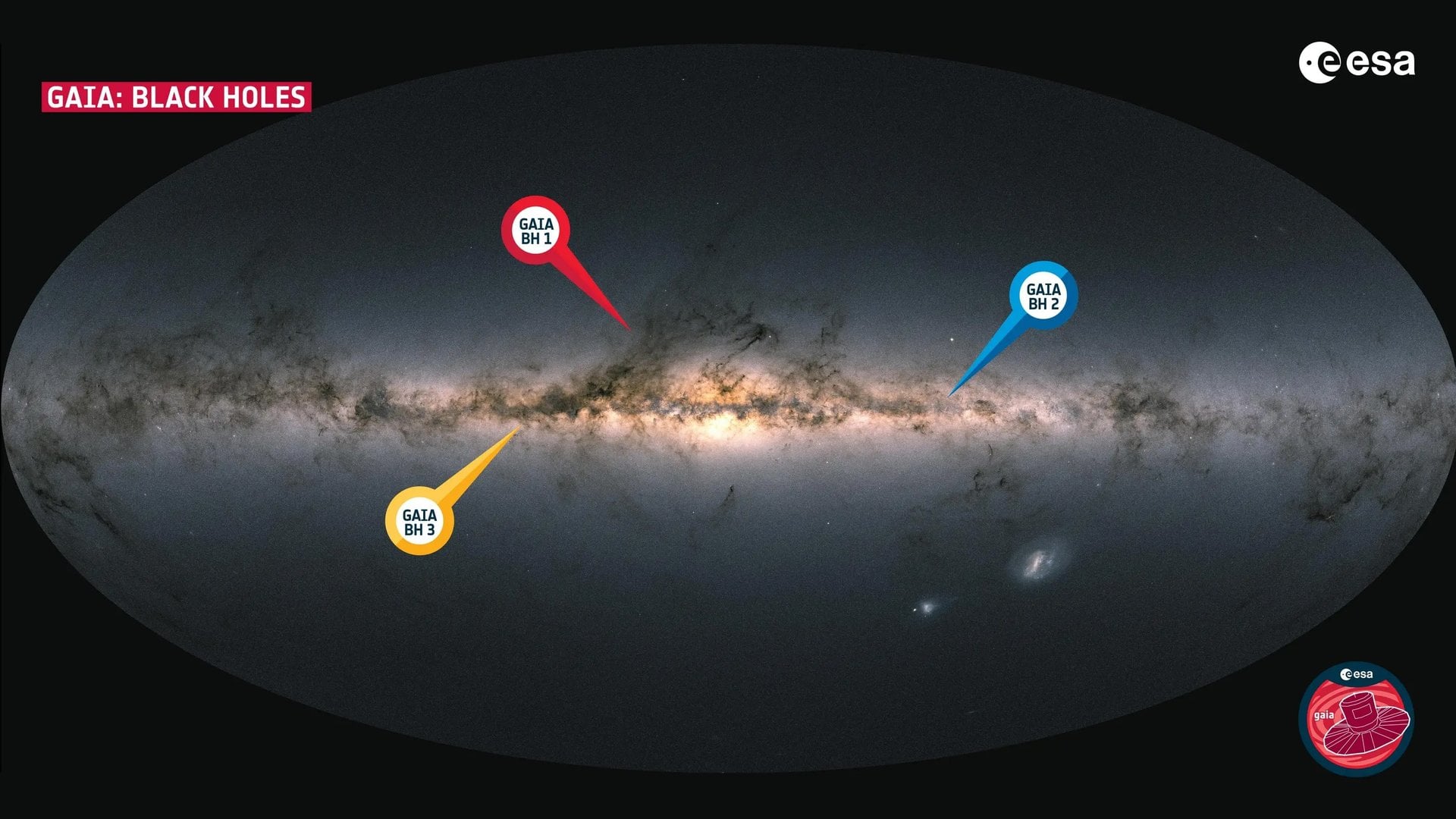
This paradigm shifted with the advent of the European Space Agency’s (ESA) Gaia mission. By employing ultra-precise astrometry—the measurement of stellar positions and motions—Gaia has allowed astronomers to detect the presence of black holes not by the light they emit, but by the gravitational influence they exert on visible stars. To date, this method has successfully identified three remarkable systems: Gaia BH1, BH2, and BH3. The discovery of these objects has not only expanded the census of known black holes but has also challenged existing models of how binary star systems evolve into black hole-star pairings. New research, highlighted by a study from Aleksandra Olejak and colleagues in The Astrophysical Journal, suggests that the survival of these systems requires a complex mechanism known as non-conservative mass transfer via Roche Lobe Overflow, providing a new window into the violent life cycles of the universe’s most massive stars.
The Gaia Mission: A Revolution in Precision Astrometry
The discovery of inactive black holes is a direct result of the unprecedented precision offered by the Gaia spacecraft. Launched in 2013, Gaia’s primary objective is to create the most detailed three-dimensional map of the Milky Way ever assembled. By monitoring more than a billion stars, Gaia tracks minute changes in their positions (proper motion) and distances (parallax). The spacecraft’s sensors are sensitive enough to detect a "wobble" in a star’s path—a subtle, periodic shift in position that indicates the gravitational pull of an unseen companion.
While such wobbles are frequently used to identify exoplanets, the magnitude of the displacement in the Gaia BH systems indicated companions of much higher mass. In the cases of BH1, BH2, and BH3, the calculated mass of the invisible companion exceeded the limit for a neutron star (approximately 2.2 to 3 solar masses), yet no light was detected from the companion itself. This lack of luminosity, combined with the significant gravitational mass, led researchers to the inescapable conclusion: the companions are stellar-mass black holes. Unlike the black holes found in X-ray binaries, these objects are "quiet," meaning they are not currently stripping enough material from their companions to generate a detectable accretion disk.
Characterizing the Trio: BH1, BH2, and BH3
The three systems discovered thus far offer a diverse look at the dormant black hole population. Gaia BH1, located approximately 1,600 light-years away in the constellation Ophiuchus, consists of a Sun-like star orbiting a black hole roughly 9.6 times the mass of the Sun. Its discovery in 2022 marked the first time a black hole was found via astrometry, and it remains the closest known black hole to Earth.
Gaia BH2, discovered shortly thereafter, is situated about 3,800 light-years away in the constellation Centaurus. This system features a red giant star orbiting a black hole of approximately 8.9 solar masses. The orbit of BH2 is considerably wider than that of BH1, with a period of roughly 1,277 days, compared to BH1’s 185-day orbit.
The most recent and perhaps most startling discovery is Gaia BH3. Found in the constellation Aquila at a distance of 2,000 light-years, BH3 contains a black hole with a staggering 33 solar masses. This is the most massive stellar-mass black hole ever found in the Milky Way, rivaling the sizes of black holes detected through gravitational waves by LIGO-Virgo-KAGRA. The companion star in the BH3 system is a very old, metal-poor star, suggesting that the system formed in the early stages of galactic history or perhaps originated in a globular cluster that was later absorbed by the Milky Way.
The Evolutionary Paradox of Close Binaries
The existence of BH1 and BH2 poses a significant challenge to the standard theory of stellar evolution. These systems are "asymmetrical binaries," meaning they began as two stars of vastly different masses. In such a pair, the more massive star evolves much faster than its smaller companion. As the massive star exhausts its nuclear fuel, it enters the red giant or supergiant phase, expanding to hundreds of times its original size.
In close or intermediate-period binaries, this expansion should theoretically lead to a "Common Envelope" (CE) phase. During this stage, the smaller companion star becomes engulfed by the outer layers of the dying giant star. The resulting friction causes the companion to spiral inward, while the orbital energy is transferred to the envelope, eventually blowing it off into space. Historically, it was believed that for a system to survive this phase without the two stars merging, the final orbit would have to be extremely tight. However, the orbits of BH1 and BH2 are in a "middle ground"—too wide to have been formed by a standard Common Envelope event, yet too close to have avoided interaction entirely during the giant phase.
Roche Lobe Overflow: A Path to Survival
To explain how these systems survived the death of the primary star, researchers have turned to the model of Roche Lobe Overflow (RLO). Every star in a binary system is surrounded by a teardrop-shaped region called the Roche lobe, within which its gravity is the dominant force. If a star expands beyond its Roche lobe, its outer layers are no longer gravitationally bound to it and can be pulled away by the companion star.
In the case of the Gaia black hole systems, the study by Olejak et al. proposes a "non-conservative" mass transfer model. In this scenario, as the massive progenitor of the black hole expands, it transfers mass to the smaller companion. However, instead of the companion absorbing all the material (which would likely cause it to spiral inward), much of the mass is lost from the system entirely. This mass loss carries away angular momentum, which can actually cause the orbit to widen or stabilize.
This "slow-feed" mechanism allows the smaller star to remain at a safe distance while the larger star sheds its outer layers. Eventually, the core of the massive star collapses into a black hole without having swallowed its partner. This model provides a viable explanation for why BH1 and BH2 exist in their current configurations, suggesting that the transition from a binary star system to a black hole-star system is more nuanced and less catastrophic than previously assumed.
Chronology of Discovery and Research Milestones
The timeline of these discoveries highlights the rapid pace of progress in galactic archaeology:
- December 2020: ESA releases Gaia Data Release 3 (DR3) early metrics, providing the foundation for high-precision orbital searches.
- September 2022: A team led by Kareem El-Badry announces the discovery of Gaia BH1, the first dormant black hole identified through astrometry.
- February 2023: The discovery of Gaia BH2 is confirmed, demonstrating that BH1 was not an isolated anomaly.
- April 2024: The Gaia collaboration announces the discovery of Gaia BH3, the 33-solar-mass giant, during the preparation for Data Release 4.
- 2025-2026: Advanced theoretical modeling, including the work by Olejak et al., begins to reconcile these observations with stellar evolution physics, focusing on non-conservative mass transfer.
Scientific Implications and Future Outlook
The implications of these findings reach far beyond the three specific systems. By proving that black holes can exist in wide, quiet orbits with Sun-like stars, Gaia has opened a new frontier in astrophysics. These systems are essentially the "missing link" in our understanding of binary evolution. They represent a population of objects that could eventually evolve into the tight binary black holes that merge and produce gravitational waves detectable by LIGO.
Furthermore, the discovery of BH3 suggests that our current understanding of how many massive black holes exist in the Milky Way may be an underestimate. If 30-plus solar mass black holes can hide in plain sight just 2,000 light-years away, there may be thousands more scattered throughout the galaxy.
The scientific community is now looking forward to Gaia’s Data Release 4 (DR4), expected in the coming years. DR4 will include a much larger baseline of observations, potentially revealing dozens or even hundreds of additional dormant black holes. Astronomers also plan to use the James Webb Space Telescope (JWST) and ground-based observatories like the Extremely Large Telescope (ELT) to perform follow-up spectroscopy on the companion stars. By analyzing the chemical composition of these stars, researchers can determine if they were "polluted" by the material ejected during the primary star’s supernova or mass-transfer phase, further validating the Roche Lobe Overflow model.
The study of Gaia BH1, BH2, and BH3 marks the beginning of a census of the "dark population" of our galaxy. As we refine our models of non-conservative mass transfer and continue to map the heavens with pinpoint accuracy, the silent sentinels of the Milky Way are finally beginning to tell their stories, revealing a universe that is far more complex and interconnected than we once imagined.