Sisilia Frederika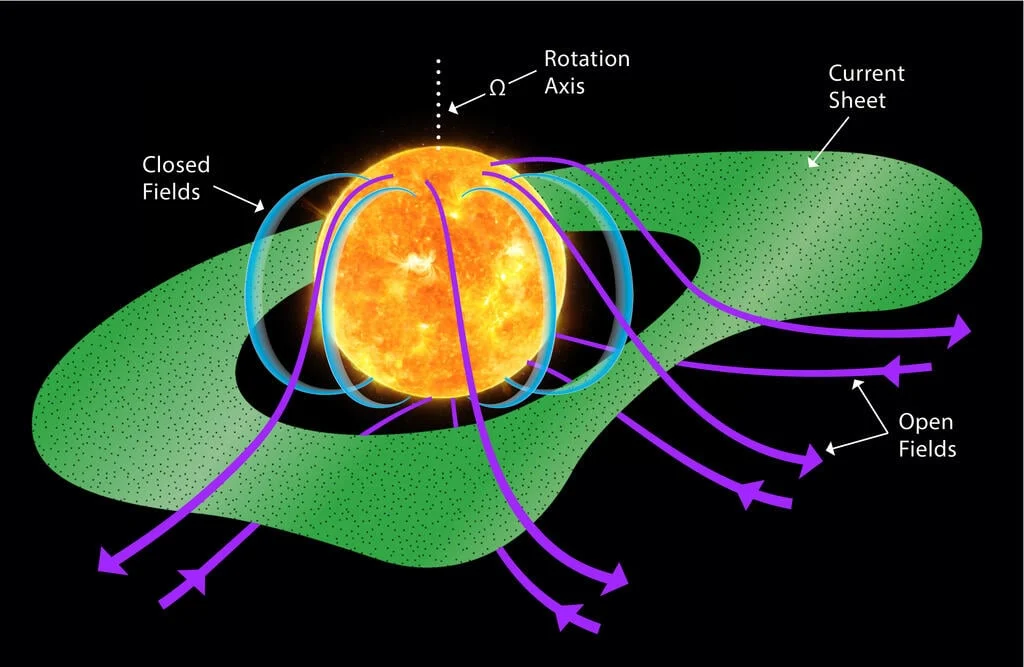
The solar system is dominated by a structure so vast it dwarfs the planets, a rippling, electrified curtain of plasma known as the Heliospheric Current Sheet (HCS). For decades, this "ballerina’s skirt" of the sun has been observed primarily from the vicinity of Earth, nearly 93 million miles away from its source. However, a landmark study led by Keiichi Ogasawara and a team of researchers from the Southwest Research Institute (SwRI) has provided the most intimate look yet at this celestial phenomenon. Utilizing data from the joint European Space Agency (ESA) and NASA Solar Orbiter mission, scientists have successfully mapped the HCS at a distance of just 0.3 astronomical units (AU)—roughly one-third the distance between the Earth and the Sun. This breakthrough, detailed in a new paper published in The Astrophysical Journal, offers an unprecedented glimpse into the fundamental composition and chaotic dynamics of the solar system’s largest coherent structure before it is altered by its journey through interstellar space.
The Nature and Scale of the Heliospheric Current Sheet
To understand the significance of the Solar Orbiter’s findings, one must first grasp the scale and function of the Heliospheric Current Sheet. The HCS is essentially the magnetic equator of the sun, representing the surface where the polarity of the sun’s magnetic field changes from north to south. As the sun rotates, its complex magnetic field twists and ripples, causing the HCS to undulate like a giant, waving sheet. This structure originates from "helmet streamers"—large, glowing loops of plasma that extend from the sun’s corona into space.
Because the HCS carries a small electric current, it acts as the boundary between the two hemispheres of the solar wind. While it has long been studied by Earth-based instruments such as the Solar and Heliospheric Observatory (SOHO) and the Wind spacecraft, these observations occur after the solar wind has traveled a vast distance. By the time the HCS reaches 1 AU, interactions with the turbulent solar wind and the broader interplanetary medium have often blurred its finer details. The April 2023 encounter by Solar Orbiter marks a transition from viewing the HCS as a distant silhouette to examining it as a complex, multi-dimensional environment.
Chronology of the April 2023 Encounter
The data that fueled this discovery was captured during a high-priority window on April 13, 2023. At this time, Solar Orbiter was positioned in its highly elliptical orbit at just 0.3 AU from the solar surface. As the spacecraft crossed the HCS, its suite of ten scientific instruments was activated to perform a comprehensive "in-situ" analysis of the plasma environment.
A central player in this data collection was the Solar Wind Analyser’s Heavy Ion Sensor (SWA-HIS). Unlike standard sensors that might only measure general plasma density or magnetic field strength, the HIS is designed to distinguish between different types of ions and their respective charge states. This capability allowed the SwRI team to look beyond the magnetic "line" of the HCS and instead see a "multi-layered highway" of plasma. The crossing was not a simple transition from one magnetic state to another; rather, it was a passage through a zone filled with magnetic anomalies, fluctuating plasma pressures, and varying chemical signatures.
Magnetic Reconnection and the Disappearance of Electron Strahls
One of the most striking observations made during the crossing involved the behavior of electrons. In the solar wind, high-energy electrons typically form "strahls"—narrow, focused beams that move rapidly away from the sun along magnetic field lines. However, as Solar Orbiter approached the core of the HCS, these strahls suddenly vanished.
Simultaneously, the researchers noted that protons in the surrounding solar wind experienced a sudden acceleration, increasing in speed by approximately 50 kilometers per second. This correlation—the cessation of electron beams paired with proton acceleration—is a classic signature of magnetic reconnection. This process occurs when opposing magnetic field lines snap and reconfigure, releasing massive bursts of energy and flinging plasma into space. The Solar Orbiter data suggests that the HCS is not merely a static boundary but a dynamic site of constant magnetic "explosions" that reshape the solar wind as it begins its journey through the solar system.
The "Freeze-in Height" and Ionic Stability
Despite the magnetic turbulence and reconnection events, the study revealed a surprising level of stability in certain chemical ratios. Specifically, the ratios of different charge states for carbon and oxygen remained remarkably consistent throughout the HCS crossing.
This stability is tied to a concept known as the "freeze-in height." Near the sun’s surface, in the lower corona, atoms frequently collide, losing or gaining electrons in a state of constant flux. As the solar wind carries these atoms outward, the plasma density drops. Eventually, the atoms reach a point—typically between 1.5 and 2 solar radii—where collisions become so infrequent that their ionization states become "locked" or "frozen."
The Solar Orbiter’s findings confirm that the chaotic magnetic environment of the HCS does not alter these ionic ratios once they have passed the freeze-in height. For heliophysicists, this is a vital discovery. It means that the chemical composition measured at 0.3 AU (or even at Earth) can be used as a reliable "fingerprint" to trace the solar wind back to its specific point of origin on the sun’s surface, regardless of the magnetic drama it encounters along the way.
Gravitational Settling: Why Iron Sinks Near the Sun
While the charge state ratios remained stable, the overall concentration of elements showed significant variation. The researchers observed a sharp decrease in the ratio of iron to oxygen (Fe/O) as the spacecraft moved toward the center of the HCS.
To explain this, the team looked at the First Ionization Potential (FIP) effect. Elements with a low FIP, such as iron, are easily ionized and are usually more abundant in the solar wind than elements with a high FIP, like oxygen. However, inside the HCS, the Fe/O ratio dropped to levels similar to those found in the sun’s photosphere—the visible "surface" of the sun—rather than the typical solar wind.
The SwRI team concluded that gravity is the primary driver of this phenomenon. In the regions of the sun where the HCS originates, plasma is often trapped within giant, closed magnetic loops for extended periods. During this confinement, heavier ions like iron literally begin to sink back toward the sun due to gravitational pull, while lighter elements remain suspended. When these magnetic loops eventually break or open up to release the solar wind, the resulting plasma is depleted of iron. This finding provides a new understanding of how gravity and magnetism compete to shape the composition of the interplanetary medium.
Alfven Cyclotron Waves and Selective Heating
The study also delved into the thermal dynamics of the HCS, specifically comparing the temperature of oxygen ions to that of protons. At 0.3 AU, the oxygen ions had not yet reached thermal equilibrium with the surrounding plasma, allowing researchers to observe "selective heating."
The data showed that oxygen experienced frequent temperature spikes, often exceeding the "super-mass-proportional limit"—a theoretical threshold based on the ion’s mass relative to protons. Interestingly, these spikes in oxygen temperature correlated with an increase in specific oxygen charge states (O7+ / O6+) but showed a negative correlation with carbon charge states.
Scientists believe this selective heating is the work of Alfven cyclotron waves. These are electromagnetic waves that travel along magnetic field lines and transfer energy to ions. The research suggests that these waves selectively dump their energy into oxygen ions in a direction perpendicular to the magnetic field. Meanwhile, alpha particles (helium nuclei) appear to absorb the energy that would otherwise be available to carbon atoms, effectively "starving" the carbon of a temperature increase. This complex interplay of waves and particles highlights the sophisticated physics occurring within the HCS.
Broader Implications for Space Weather and Earth
The findings from Ogasawara’s team have implications that extend far beyond the academic study of plasma. Understanding the HCS is critical for space weather forecasting. The HCS acts as a conduit for solar energetic particles (SEPs), which can pose significant risks to satellite electronics, disrupt GPS communications, and even threaten power grids on Earth.
By resolving the composition and structure of the HCS at 0.3 AU, scientists can build more accurate models of how the solar wind evolves. Knowing that the HCS is a "multi-layered highway" rather than a thin sheet allows for better predictions of how solar storms will propagate through the solar system. Furthermore, the ability to trace solar wind back to its source using "frozen-in" ionic ratios will help researchers predict which regions of the sun are most likely to produce high-speed solar wind streams that can trigger geomagnetic storms.
The Future of Solar Observation
The Solar Orbiter mission is far from over. As it continues its journey, the spacecraft will use gravitational assists from Venus to tilt its orbit, eventually providing the first-ever direct images of the sun’s poles. This will offer a new perspective on the solar cycle and the mechanisms that drive the flipping of the magnetic poles, which in turn creates the HCS.
The mission also works in tandem with the Parker Solar Probe, which flies even closer to the sun. While Parker Solar Probe dives into the sun’s corona to measure the environment at its most extreme, Solar Orbiter provides the contextual imaging and detailed chemical analysis that Parker cannot. Together, these missions are ushering in a "golden age" of heliophysics.
The SwRI study represents a milestone in this era. By capturing the clearest picture to date of the solar system’s largest structure, Keiichi Ogasawara and his colleagues have provided a foundational map of the magnetic and chemical landscape of our local neighborhood in space. As we continue to push the boundaries of how close we can get to our star, we move closer to solving the enduring mysteries of the sun’s corona and its profound influence on the solar system.