Sisilia Frederika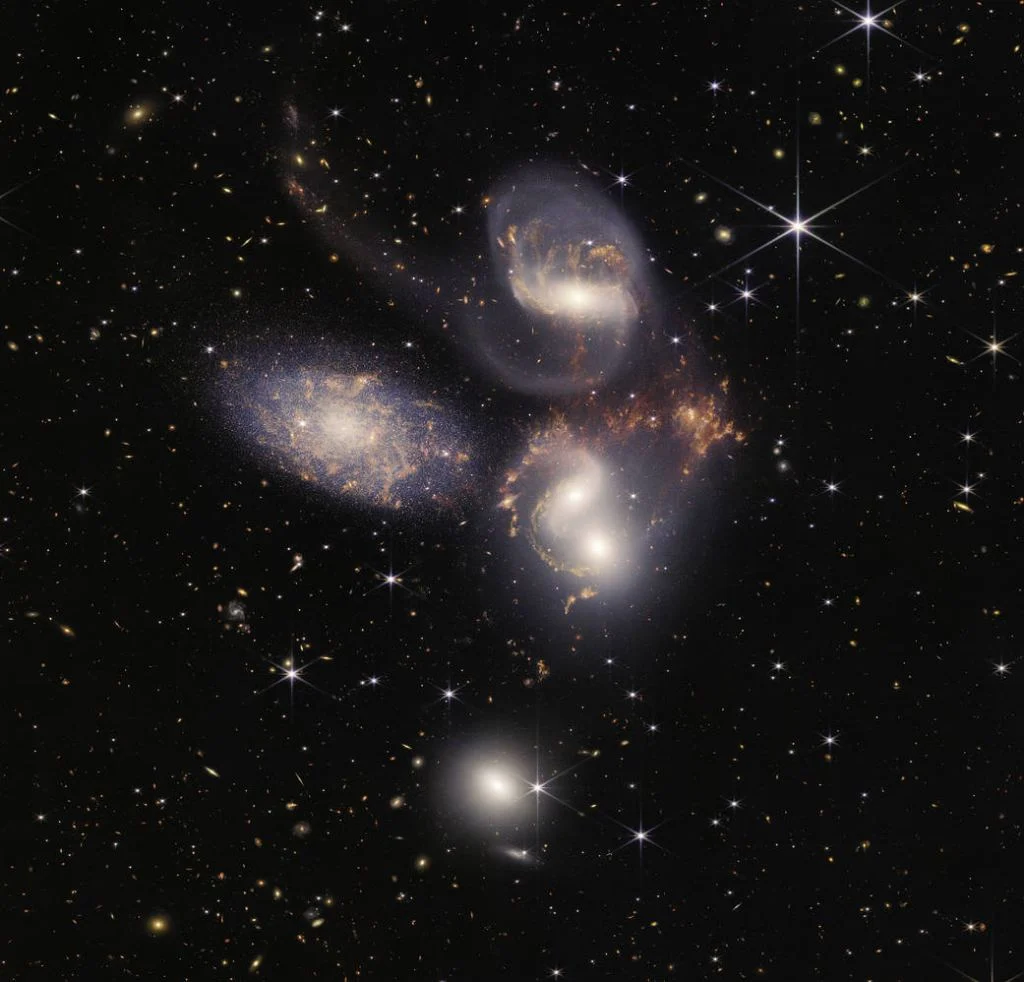
The Galactic Laboratory: Stephan’s Quintet
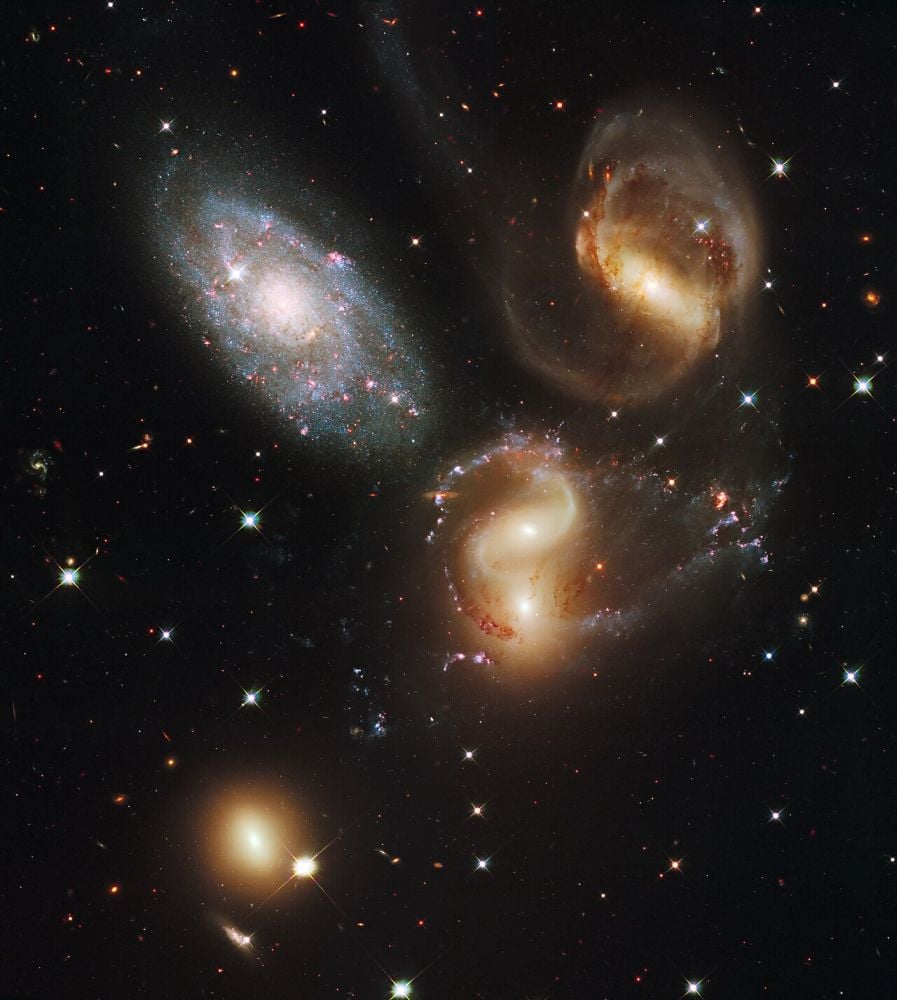
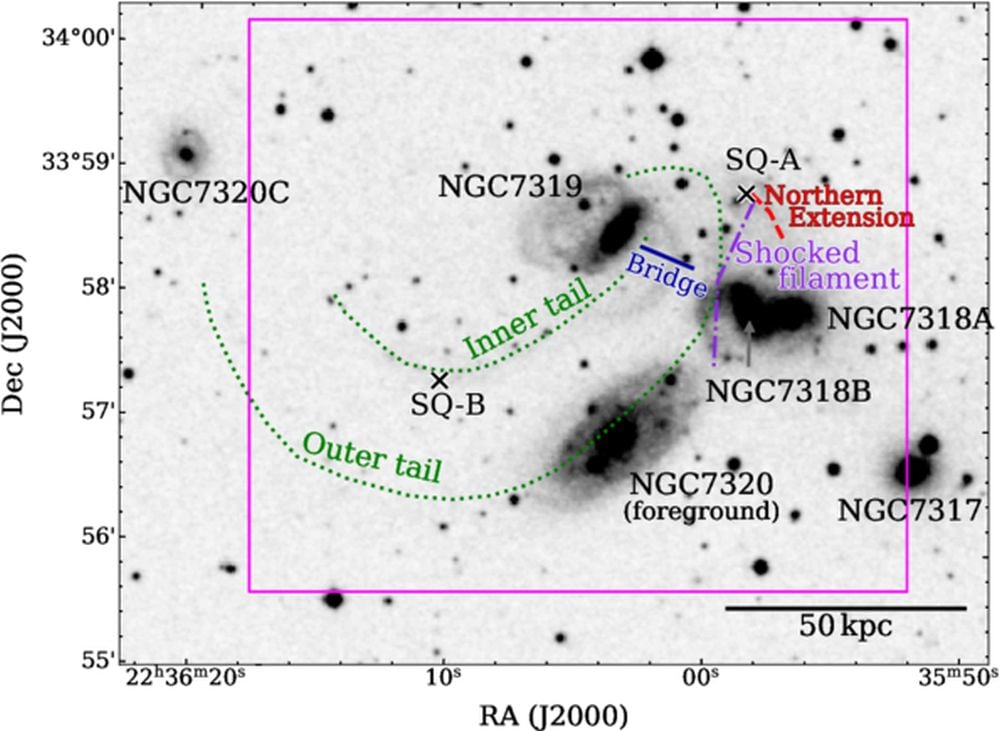
Stephan’s Quintet, also known as Hickson Compact Group 92 (HCG 92), has long been a focal point for astronomical study since its discovery by French astronomer Édouard Stephan in 1877. Located approximately 290 million light-years away in the constellation Pegasus, it represents the first compact galaxy group ever identified. The group is a visual masterpiece of cosmic interaction, featuring four galaxies—NGC 7317, NGC 7318a, NGC 7318b, and NGC 7319—that are physically bound in a violent gravitational dance. A fifth galaxy, NGC 7320, appears to be part of the group but is actually a foreground object located only about 40 million light-years from Earth, making it seven times closer than the actual compact group.
The true members of the quintet are undergoing extreme structural transformations. Tidal forces have stripped gas and stars from the individual galaxies, creating long, glowing tails and massive bridges of material that span the intergalactic medium. One of the most striking features of the group is a massive shock filament, a region larger than the Milky Way itself, created as one galaxy, NGC 7318b, plummets into the center of the group at speeds exceeding 800 kilometers per second. This high-velocity collision compresses the interstellar medium, creating a unique environment for studying the physics of gas and star formation.
Challenges in Observing Star-Forming Gas
At the heart of galaxy evolution is the lifecycle of molecular gas, primarily molecular hydrogen ($H_2$). This gas serves as the raw material for star formation; when it becomes sufficiently dense and cold, gravity causes it to collapse into new stars. However, $H_2$ is notoriously difficult to observe directly in the cold, dark conditions of giant molecular clouds. Because the $H_2$ molecule is symmetric, it lacks a permanent dipole moment, meaning it does not emit detectable radiation at the low temperatures (around 10 to 20 Kelvin) typical of these regions.
To circumvent this, astronomers rely on "proxy" molecules. Carbon monoxide (CO) is the most common choice. Although CO makes up only a tiny fraction of the gas in a molecular cloud, it is the second most abundant molecule and emits strong spectral lines even at very low temperatures. By mapping the 12CO(1–0) transition—the rotation of the molecule from its first excited state to its ground state—researchers can infer the distribution, mass, and velocity of the underlying molecular hydrogen.

Previous studies of Stephan’s Quintet have attempted to map this CO distribution, but they often faced a trade-off between sensitivity and field of view. The recent study by Yamamoto and her team utilized the Atacama Compact Array (ACA), also known as the Morita Array. This subset of ALMA consists of smaller 7-meter antennas and 12-meter "Total Power" antennas designed specifically to capture the large-scale structures of molecular clouds that larger, more spread-out interferometers might filter out. This allowed the team to create the first spatially resolved molecular gas map of the entire compact group at a resolution of approximately 5.5 kiloparsecs.
Mapping the Turbulence: Key Findings
The ACA observations revealed that the molecular gas in Stephan’s Quintet is not confined to the centers of the galaxies. Instead, a significant portion of the gas has been redistributed into the intergalactic space. The highest concentrations of molecular gas were found in the disk of the spiral galaxy NGC 7319, along the famous shocked filament, and within a massive tidal tail extending eastward from NGC 7319.
The study’s most significant contribution lies in its analysis of "velocity dispersion." In astronomy, velocity dispersion refers to the range of speeds at which gas is moving within a specific region. A high velocity dispersion indicates significant turbulence—gas is being tossed around violently by shocks and gravitational pulls. The researchers found that while gas is abundant in many parts of the quintet, the efficiency with which that gas forms stars varies wildly depending on this turbulence.
In regions with low velocity dispersion (roughly 10 to 30 kilometers per second), such as certain clumps along the tidal tail, star formation efficiency (SFE) was found to be comparable to that of normal, isolated disk galaxies. In these areas, the gas is "quiet" enough to allow gravity to take hold and begin the collapse into stars. However, in the "shocked filament"—where NGC 7318b is colliding with the group’s gas—the velocity dispersion reaches staggering levels of 50 to 150 kilometers per second. In these turbulent zones, star formation is strongly suppressed despite the presence of massive amounts of gas.
Data and Statistical Analysis
The researchers identified four distinct discrete CO clumps along the tidal tail and its surroundings. These clumps possess molecular gas masses ranging from $10^7$ to $10^8$ solar masses. By comparing the CO data with ultraviolet and infrared observations (which trace young stars), the team could calculate the Star Formation Efficiency (SFE).
The data demonstrated a clear negative correlation between SFE and CO velocity dispersion. This suggests that the kinetic energy injected into the gas by the galactic collision is preventing the gas from reaching the densities required for gravitational collapse. The turbulence acts as a support mechanism, "puffing up" the gas and keeping it in a diffuse, non-star-forming state. This finding is crucial because it explains why some gas-rich regions in the universe remain surprisingly dark, while others burst with star clusters.
Furthermore, the map revealed that the member galaxies of Stephan’s Quintet are "hydrogen deficient." Most of the neutral hydrogen (HI) that would normally reside in the galactic disks has been stripped away by past interactions, forming the large-scale structures observed in the intergalactic medium. The molecular gas (CO) appears to be following a similar fate, being pulled from the galaxies and subjected to the chaotic environment of the group’s interior.
Chronology of Interaction and Evolution
The current state of Stephan’s Quintet is the result of a complex history of encounters spanning hundreds of millions of years. Astronomers believe the group has experienced at least two major stages of interaction:
- The Early Encounters: Millions of years ago, NGC 7319 and other members likely underwent a series of close passes. These gravitational interactions stripped the initial "tidal tails" of gas from the galaxies, creating the large-scale neutral hydrogen structures that now envelop the group.
- The Intruder Arrival: The current "active" phase is dominated by the arrival of NGC 7318b. Moving at high speed toward the group, it is currently plowing through the gas stripped during the earlier encounters. This is what has created the 24,000-light-year-long shock front that emits X-rays and hosts the turbulent, non-star-forming molecular gas observed by the ACA.
This timeline suggests that Stephan’s Quintet is an "evolved" compact group. It provides a snapshot of what happens to galaxies after they have already lost much of their internal gas to the intergalactic medium, a process that eventually leads to the "quenching" of star formation and the transformation of spiral galaxies into elliptical ones.
Official Responses and Scientific Context
Lead author Misaki Yamamoto emphasized the dual nature of galactic interactions in the team’s press release. “Interactions between galaxies can both compress and disperse molecular gas, creating dramatic differences in star formation activity,” Yamamoto stated. “The findings pointed to turbulence as an important factor in regulating where stars can form.”
Co-author Kazuyuki Muraoka highlighted the broader cosmological implications of the study. “Star formation is one of the most fundamental processes in galaxy evolution. Studies like ours help refine our picture of the universe and encourage us to reflect on our place within it,” Muraoka said. He further noted that understanding how these collisions enhance or suppress star formation provides a better tool for tracing the history of galaxy evolution across cosmic time, particularly in the early universe where galaxy mergers were much more frequent.
The scientific community has noted that this work sets a new standard for mapping compact groups. By providing a spatially resolved view of the entire system, the Japanese team has bridged the gap between detailed studies of individual galaxies and large-scale surveys of the cosmic web.
Broader Impact and Future Implications
The results from the ACA mapping of Stephan’s Quintet have significant implications for our understanding of the "Cosmic Noon"—the period about 10 billion years ago when star formation in the universe was at its peak. During that era, galaxy interactions and mergers were the norm rather than the exception. By studying Stephan’s Quintet, which serves as a relatively nearby analog, astronomers can better interpret the light coming from distant, unresolved galaxies in the deep universe.
The study also raises new questions about the role of magnetic fields and cosmic rays in these shocked regions. Turbulence is only one part of the equation; the energy injected by the collision of NGC 7318b also generates heat and potentially strong magnetic fields that could further inhibit star formation. Future observations with the full ALMA array and the James Webb Space Telescope (JWST) are expected to probe these clumps at even higher resolution, looking for individual star-forming cores within the turbulent gas.
In conclusion, the ACA CO(1–0) mapping of Stephan’s Quintet proves that the environment of a galaxy is just as important as its internal composition when it comes to the birth of stars. The "diversity" of star formation seen in the quintet—ranging from productive tidal clumps to "sterile" shocked filaments—highlights the chaotic and transformative power of galactic gravity. As researchers continue to analyze the data, Stephan’s Quintet remains a vital laboratory for witnessing the violent processes that have shaped the visible universe over billions of years.