Sisilia Frederika
The scientific community has reached a significant milestone in the study of deep space as researchers have successfully decoded the chemical signature of 3I/ATLAS, the third interstellar object (ISO) ever detected passing through our Solar System. Following its high-speed transit past the Sun, a comprehensive analysis of the material ejected from the comet’s interior has provided unprecedented insights into its birth environment. According to a study published in the Monthly Notices of the Royal Astronomical Society, 3I/ATLAS likely originated in the extreme, frigid outskirts of a distant star system, forming in temperatures that plummeted below -240°C (-400°F). This discovery offers a rare, tangible link to the formative processes of planetary systems beyond our own, suggesting that the "blueprints" for solar systems may share more similarities across the galaxy than previously confirmed.
A New Era of Interstellar Discovery
The detection of 3I/ATLAS represents a burgeoning field of "opportunistic astronomy." For decades, the study of other star systems was limited to remote sensing of light from exoplanets and their host stars. The arrival of interstellar objects—rogue fragments of rock and ice ejected from their home systems—has changed the paradigm, allowing scientists to analyze physical matter that originated light-years away.
3I/ATLAS follows in the footsteps of two previous confirmed visitors: 1I/‘Oumuamua, discovered in 2017, and 2I/Borisov, identified in 2019. While ‘Oumuamua baffled scientists with its unusual shape and lack of a visible coma, and 2I/Borisov appeared strikingly similar to local comets, 3I/ATLAS has provided the most detailed look yet at the volatile chemistry of an interstellar traveler. The comet’s journey through the inner Solar System acted as a natural laboratory; as solar radiation heated its surface, frozen gases trapped for eons within its core sublimated, creating a glowing tail of gas and dust that carried the chemical "fingerprints" of its home.
The Role of the WEAVE Spectrograph
The breakthrough in understanding 3I/ATLAS was made possible by the WHT Enhanced Area Velocity Explorer (WEAVE), a sophisticated multi-object spectrograph recently installed on the 4.2-meter William Herschel Telescope (WHT) at the Roque de los Muchachos Observatory in La Palma, Spain. The timing of the comet’s passage coincided with the early operational phase of WEAVE, allowing researchers to utilize its Large Integral Field Unit (LIFU) to capture high-resolution data.
Spectroscopy is the process of breaking down light into its constituent wavelengths to identify the chemical elements present in a source. The WEAVE-LIFU system is particularly adept at this, as it can capture spectral data across a wide field of view simultaneously. This allowed the research team, led by Dr. Léa Ferellec of Northumbria University, to map the distribution of various gases as they were stripped away from the comet by the solar wind. By combining this technology with the WHT’s advanced guiding capabilities, the team achieved a level of precision that was impossible during the transit of previous ISOs.
Chemical Fingerprints: The Dinitrogen Revelation
The core of the study’s findings lies in the detection of five specific ions within the comet’s coma and tail: dinitrogen ($N_2^+$), carbon monoxide ($CO^+$), carbon dioxide ($CO_2^+$), water ($H_2O^+$), and hydrocarbons ($CH^+$). While water and carbon oxides are common in comets within our own Solar System, the presence and abundance of dinitrogen ($N_2$) are of particular interest to astrophysicists.
Dinitrogen is a highly volatile molecule that requires extremely low temperatures to freeze into ice. In the early stages of a star system’s formation, $N_2$ can only be incorporated into solid bodies if those bodies form in the "deep freeze" regions far from the central star. By measuring the ratio of dinitrogen to carbon monoxide, the research team was able to calculate the temperature of the environment where 3I/ATLAS first coalesced.
The results indicate that the comet formed in conditions colder than -240°C. This temperature profile suggests an origin point in the ultra-distant reaches of a protoplanetary disk, analogous to the Kuiper Belt or the Oort Cloud in our own Solar System. The fact that 3I/ATLAS is so rich in nitrogen indicates that it has remained largely undisturbed and frozen since its birth, preserving a pristine record of its home system’s chemistry.
Chronology of the 3I/ATLAS Observation
The trajectory of 3I/ATLAS was monitored closely from the moment of its discovery by the Asteroid Terrestrial-impact Last Alert System (ATLAS). Its path was hyperbolic, a definitive sign that it was not gravitationally bound to our Sun but was merely a traveler passing through.
- Discovery and Approach: Astronomers first flagged the object as it crossed the orbital plane of the outer planets. Initial observations showed a steady increase in brightness, suggesting the onset of outgassing as it neared the Sun.
- Perihelion: The comet made its closest approach to the Sun (perihelion), where the intense heat caused significant "outbursts" of material. This period was critical, as the heat penetrated deep into the comet’s interior, releasing gases that had been shielded for millions of years.
- Post-Perihelion Analysis: As the comet emerged from behind the Sun and began its journey back into interstellar space, the WEAVE team initiated their observation campaign. This phase was vital because the "fresh" material released during perihelion was still visible in the comet’s tail.
- Data Synthesis: Over several months, the spectroscopic data was processed and compared against chemical models of protoplanetary disks.
Insights into Planetary Formation
Dr. Léa Ferellec emphasized the broader implications of these findings. "This object gives us a rare chance to study material that formed somewhere completely different to our own Solar System," Ferellec stated. The richness of nitrogen in 3I/ATLAS provides a benchmark for comparing the "recipe" of our Solar System with others.
In our system, nitrogen is a key component of Earth’s atmosphere and the frozen plains of Pluto. However, many comets in our inner Solar System are depleted in nitrogen compared to the original solar nebula. Finding an interstellar object with a high nitrogen content suggests that the processes that formed the icy bodies of the Kuiper Belt are not unique to our Sun. It implies that other stars also possess vast reservoirs of icy "construction debris" at their edges, which can be ejected into the galaxy through gravitational interactions with large planets or passing stars.
Technical Analysis of the Ion Tail
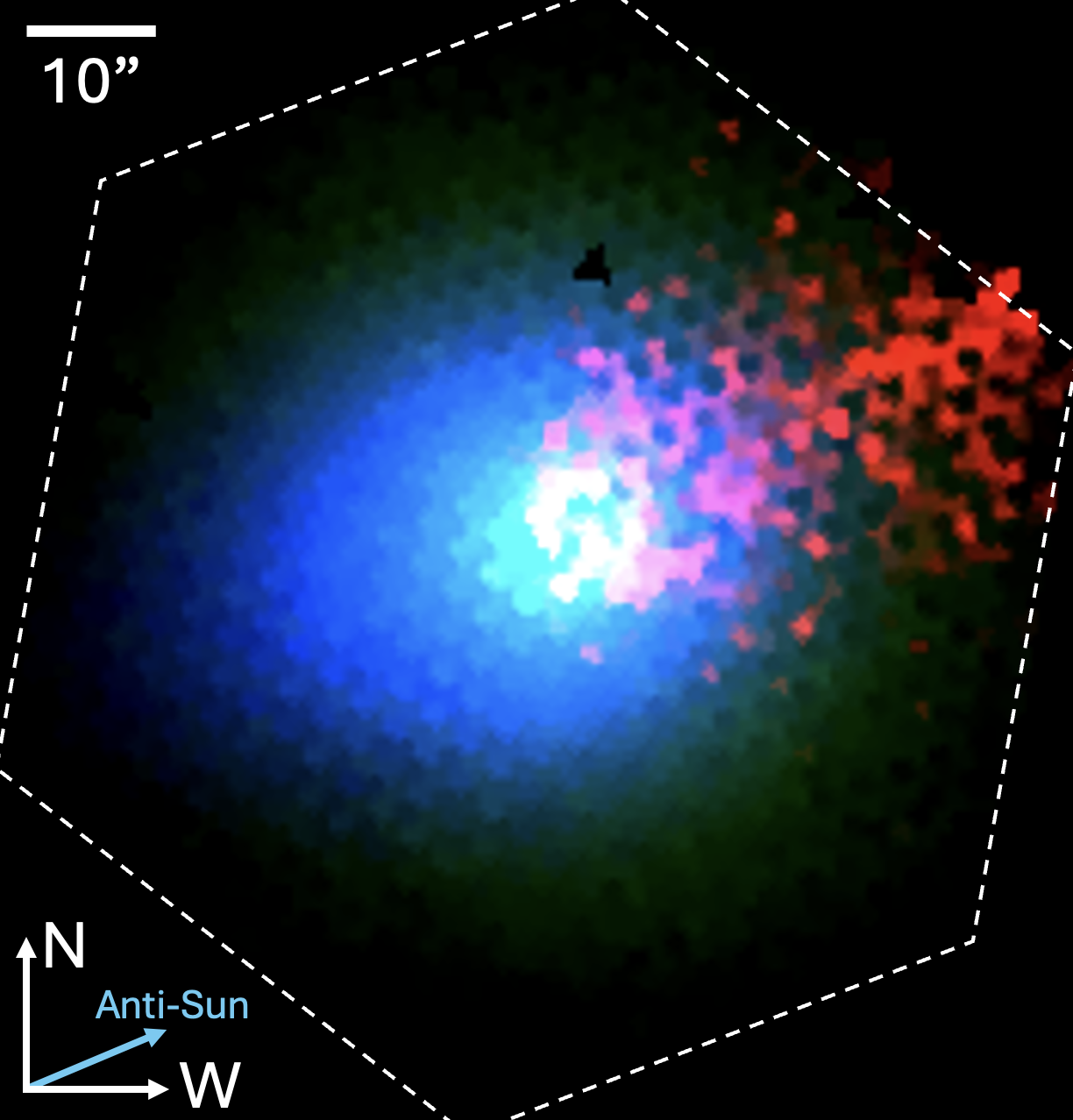
A unique aspect of the research involved studying how the concentration of ions changed as they moved further down the comet’s tail. The tail of a comet is formed by the solar wind—a stream of charged particles from the Sun—which pushes ionized gases away from the nucleus.
The team observed that while most ions dissipated as expected, the hydrocarbon ions ($CH^+$) showed only a marginal decrease in density over distance. This spatial distribution provides clues about the physical structure of the comet’s dust and how organic molecules might be bound to the ice. Co-author Rubén Sánchez-Janssen noted that the sensitivity of the WEAVE-LIFU in the blue optical spectrum was essential for this analysis, as many of these specific ionic signatures appear in shorter wavelengths that are difficult for less sensitive instruments to isolate.
The Significance of Director’s Discretionary Time (DDT)
The study also highlighted the importance of flexibility in modern astronomy. The observations were conducted using Director’s Discretionary Time (DDT), a mechanism that allows observatory directors to bypass the standard, months-long proposal process to observe "targets of opportunity." Interstellar objects, which move at incredible speeds and are only visible for a short window, are the primary beneficiaries of this system. Without the ability to pivot resources quickly toward 3I/ATLAS, the window to capture its internal chemistry would have closed as the object faded into the darkness of the outer Solar System.
Future Outlook: The Search for 4I
The study of 3I/ATLAS has set a new standard for the analysis of interstellar visitors. As observational technology improves, astronomers expect the rate of ISO detections to increase. The upcoming Vera C. Rubin Observatory in Chile, equipped with an 8.4-meter telescope and a 3,200-megapixel camera, is expected to identify dozens of interstellar objects in the coming decade.
Furthermore, the European Space Agency (ESA) is currently developing the "Comet Interceptor" mission, slated for launch in 2029. Unlike traditional missions that target a specific comet years in advance, the Comet Interceptor will "park" in space and wait for a pristine comet—potentially another interstellar object—to enter the inner Solar System. It will then deploy smaller probes to perform a flyby and capture up-close data.
The findings from 3I/ATLAS provide the foundational data needed to calibrate these future missions. By knowing that ISOs can carry high concentrations of volatile gases like dinitrogen, mission planners can ensure that future probes are equipped with the right sensors to detect the chemical precursors of life and planetary building blocks.
As 3I/ATLAS continues its journey toward the stars of the Milky Way, it leaves behind a wealth of data that has effectively shrunk the vast distances of space. It has confirmed that the cold, dark reaches of distant star systems operate under the same laws of chemistry and physics as our own, reinforcing the idea that our Solar System is part of a much larger, interconnected galactic neighborhood.