admin
admin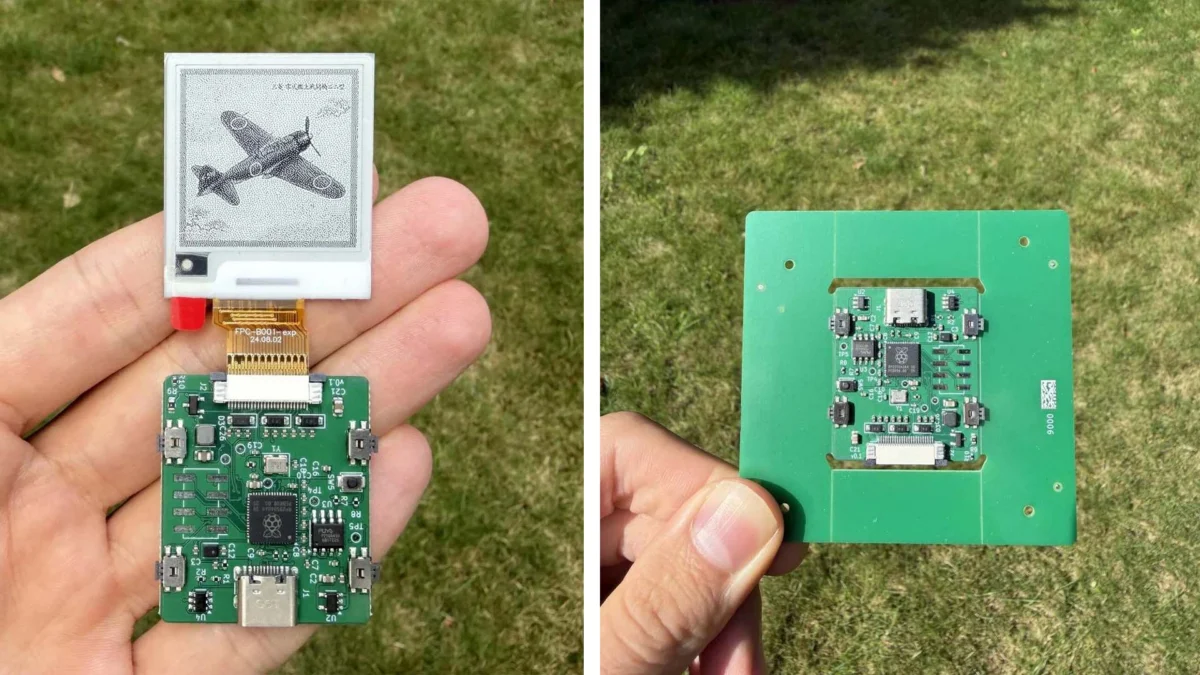
The Genesis of the AI-Driven Hardware Project
The project began as an experiment to test the limits of Claude Fable 5’s reasoning and spatial understanding capabilities. While previous iterations of large language models (LLMs), such as Claude Opus 4.5, reportedly struggled with the intricate requirements of electrical engineering, the Fable 5 model demonstrated a superior grasp of the relationship between schematic design and physical layout. The user established a rigorous set of constraints to ensure the integrity of the experiment: first, there would be no manual edits or human verification of the board’s traces or components prior to manufacturing; and second, every obstacle encountered during the design phase had to be resolved exclusively through prompts directed at the AI.
The initial prompt provided to the AI was highly specific, requiring the integration of a Raspberry Pi Pico 2350 microcontroller, a four-button interface (utilizing "Watchy" style buttons), and a GDEY0154D67-FL04 e-ink display. The user requested that the PCB dimensions match the size of the display exactly and instructed the AI to utilize the KiCad MCP (Model Context Protocol) to interface with industry-standard design software. This level of complexity is typically reserved for experienced electrical engineers, as it requires managing power distribution, signal integrity for the display interface, and the physical footprinting of diverse components.

Technical Specifications and Iterative Refinement
The hardware at the center of this milestone is the Raspberry Pi Pico 2350, a high-performance microcontroller featuring the RP2350 chip. Designing a board for this chip involves managing high-speed digital signals and ensuring the GPIO (General Purpose Input/Output) pins are correctly mapped to the peripheral components. The addition of a 1.54-inch e-ink display—a GDEY0154D67-FL04 model—added a layer of complexity regarding the SPI (Serial Peripheral Interface) communication and voltage regulation required for bi-stable displays.
Throughout the design process, the AI was tasked with generating the schematic and the subsequent board layout. This involved "routing," the process of drawing the electrical connections (traces) between components. In traditional engineering, routing is a meticulous task where designers must avoid short circuits and minimize electromagnetic interference. Claude Fable 5 managed this by interacting with KiCad, an open-source electronics design automation (EDA) suite. Despite the success, the process was not without friction. The user noted that the AI occasionally selected incorrect component footprints or made errors in part selection that required multiple rounds of prompting to rectify. This iterative "back-and-forth" highlights both the potential and the current limitations of AI in hardware design: while the model can solve the problem, it requires significant "computational hand-holding" and precise prompting to arrive at a viable solution.
The Financial Cost of Automated Engineering
One of the most striking aspects of this project is the financial investment required to achieve a successful result. The user reported spending approximately $450 in API credits alone to power the Claude Fable 5 sessions. This high cost is attributed to the massive amount of data processed during the design iterations; every time the AI reviews a schematic or suggests a change to a trace, it consumes thousands of tokens. When added to the €130 (roughly $150) cost for the manufacturing and assembly of five physical boards, the total project cost exceeded $600.

For a hobbyist, a $450 software fee is substantial. However, when viewed through the lens of professional engineering, the economics change. A freelance electrical engineer might charge between $75 and $150 per hour. A project of this complexity—taking a design from concept to a manufactured, multi-layer PCB—could easily take 20 to 40 hours of professional labor, resulting in a cost of $1,500 to $6,000 in human capital. From this perspective, the $450 API fee represents a potential 70% to 90% reduction in design costs, provided the user has the patience to manage the AI’s iterative cycles.
Chronology of the Design and Manufacturing Process
The timeline of the project moved from a text-based prompt to a physical device in a matter of weeks, a pace that rivals traditional rapid prototyping cycles.
- Conceptualization and Prompting: The user defined the hardware stack and established the "no-manual-intervention" rule.
- Schematic Capture: Claude Fable 5 generated the netlist and wiring diagrams, identifying the necessary pins on the RP2350 to drive the e-ink display and the I2C peripherals.
- Layout and Routing: Using the KiCad MCP, the AI placed components on a virtual board and routed the copper traces. This stage involved several failures where the AI had to be corrected on component spacing and board dimensions.
- Software Development: In a parallel effort, the user employed Claude Opus 5 to write the firmware for the board. Remarkably, the AI-written code worked with the AI-designed hardware on the first attempt.
- Manufacturing: The design files (Gerber files) were sent to a PCB fabrication house. The resulting boards were professionally assembled with Surface Mount Technology (SMT) components.
- Testing and Validation: Upon receiving the boards, the user connected the e-ink display. The device successfully booted, displaying a functional user interface with options for an e-reader, notes, and a stopwatch.
Broader Context: The Rise of Vibe-Coding and Vibe-Engineering
This PCB achievement does not exist in a vacuum. It follows a series of high-profile successes where AI has bridged the gap between complex technical requirements and novice users. Earlier this year, an iOS developer utilized "vibe-coding" to create a capybara-themed game featuring 27,000 lines of code, eventually winning a $25,000 prize. Similarly, another user utilized Claude AI to write a functional macOS driver for an HP printer that lacked official software support, solving a compatibility issue that had persisted for years.

The transition from software (coding) to hardware (engineering) is significant because hardware has a "physical penalty" for failure. In software, a bug can be patched with a new line of code at zero cost. In hardware, a "bug" in the PCB layout—such as a crossed power line—can result in a short circuit that destroys the components, leading to wasted manufacturing costs and lead times. The fact that Claude Fable 5 produced a board that did not "release the magic smoke" (a common engineering term for a catastrophic electrical failure) on its first power-up is a testament to the model’s increasing reliability.
Implications for the Electronics Industry
The success of the "a6m–zero" project suggests several long-term implications for the electronics industry and the field of Electronic Design Automation (EDA).
1. Democratization of Hardware Design:
The primary barrier to entry for hardware design has always been the steep learning curve of EDA tools and the deep knowledge required of electronics theory. If AI can handle the "heavy lifting" of routing and component selection, the barrier to entry drops significantly. This could lead to a surge in custom, niche hardware devices designed by individuals who lack formal engineering degrees.

2. Accelerated Prototyping for Professionals:
Even for experienced engineers, the initial phases of PCB layout are often tedious. AI tools that can generate a "first draft" of a board based on a schematic could save days of manual labor. Companies like Altium and Cadence are already looking into AI integration, but the use of general-purpose LLMs like Claude suggests that specialized software may face competition from versatile AI agents.
3. The Risk of Hidden Errors:
While this project was a success, the user noted that the process was "far from perfect." The reliance on AI for hardware design introduces the risk of subtle errors that might not be caught until thousands of units are manufactured. Without manual verification, a design might work in a prototype but fail under different thermal conditions or electromagnetic environments.
4. The Evolution of the Engineering Role:
As AI takes over the tactical tasks of routing and part selection, the role of the human engineer may shift toward "system architecture" and "verification." The engineer becomes the curator of the AI’s output, ensuring that the high-level logic remains sound while the AI handles the execution.

Conclusion
The creation of a functional PCB by Claude Fable 5 marks a definitive point in the evolution of artificial intelligence. It proves that LLMs are moving beyond the manipulation of language and into the manipulation of physical constraints and engineering standards. While the $450 price tag for API credits suggests that we are not yet at the point of "free" automated engineering, the trend line is clear. As models become more efficient and their spatial reasoning improves, the distance between a human’s idea and a physical, working device will continue to shrink. For now, the "vibe-engineered" e-ink device stands as a functional proof of concept for a future where hardware is as malleable as software.