Sisilia Frederika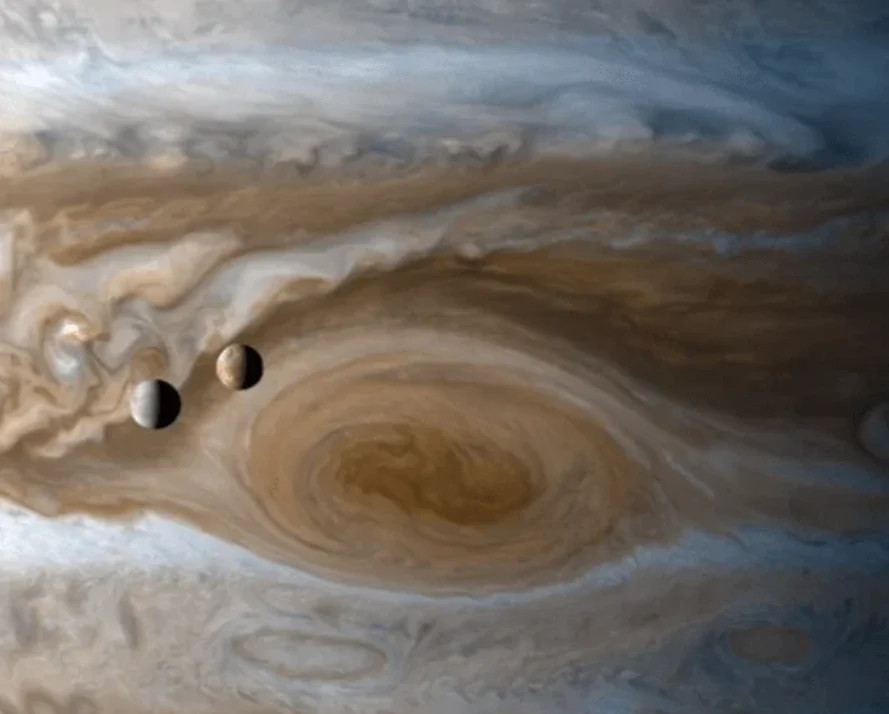
The astronomical community is preparing for a significant celestial alignment as the Jovian system enters a rare and visually complex phase known as the mutual transit-eclipse season. Beginning in late 2026 and extending into early 2027, the four largest moons of Jupiter—Io, Europa, Ganymede, and Callisto—will engage in a series of intricate maneuvers where they appear to pass in front of one another or cast shadows upon their neighbors as seen from Earth. This bidecadal phenomenon, occurring approximately every five to six years, offers a unique window for both professional astronomers and amateur observers to study the orbital dynamics of the solar system’s largest planetary satellite system.
The upcoming season represents the culmination of orbital geometries that align only twice during Jupiter’s 11.86-year journey around the Sun. Because the orbits of the Galilean moons are nearly, but not perfectly, aligned with the plane of Jupiter’s orbit and the Earth’s ecliptic, these mutual events are not a nightly occurrence. Instead, they require a specific alignment where the Earth and Sun pass through the equatorial plane of Jupiter. This alignment allows for a perspective where the moons do not merely orbit the planet, but intersect one another’s paths from our line of sight, creating a theatrical display of shadows and light.
The Orbital Mechanics of a Bidecadal Event
To understand the rarity of the 2026-2027 season, one must examine the precise tilts of the Jovian system. Jupiter’s equatorial plane is tilted by approximately 3.13 degrees relative to its orbital path around the Sun. Furthermore, Jupiter’s orbit is inclined by about 1.3 degrees relative to the ecliptic, the plane in which Earth orbits. The Galilean moons themselves have orbits with very low inclinations—less than one degree—relative to Jupiter’s equator.
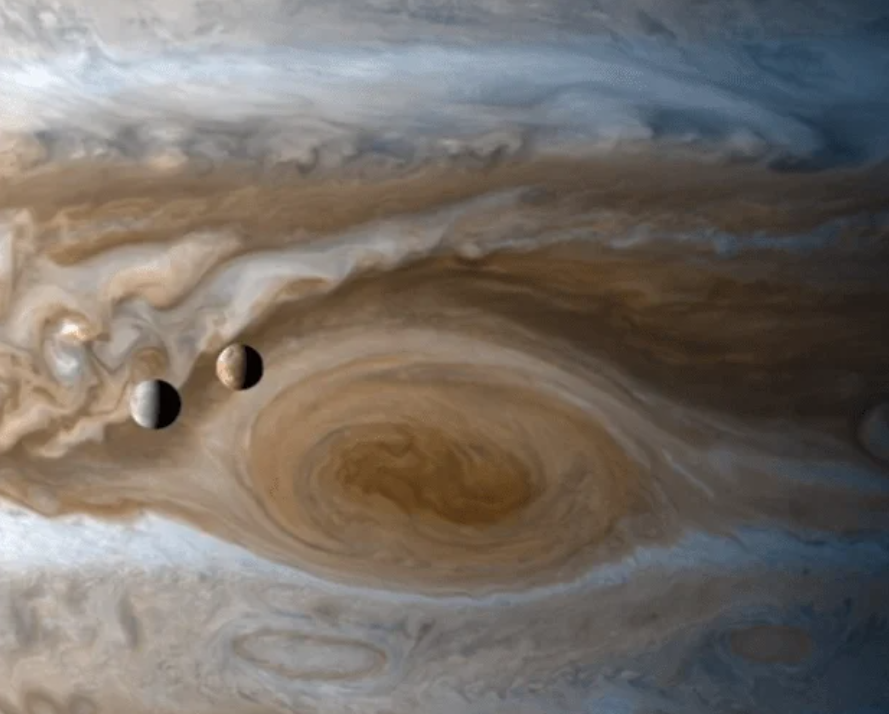
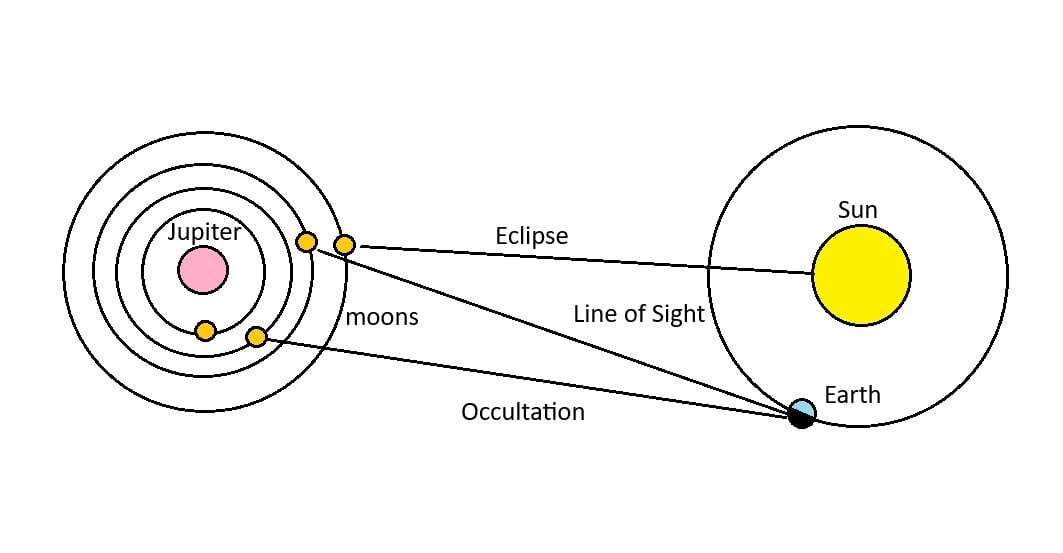
For most of Jupiter’s year, these slight tilts mean that as the moons pass each other, they appear to "miss" from our perspective, passing slightly above or below one another. However, as Jupiter approaches its equinox, the Sun and Earth cross the plane of the moons’ orbits. This creates a window of several months where the moons are seen edge-on. During this period, the moons can occult one another (one moon passing in front of another) or eclipse one another (the shadow of one moon falling upon the surface of another).
The 2026-2027 season is the third such event in recent memory, following the 2015-2016 and 2020-2021 cycles. Each cycle provides fresh data for refining the ephemerides—the mathematical tables used to predict the positions of celestial bodies—of the Jovian moons.
Chronology of the 2026-2027 Observation Window
The current cycle officially commenced as Jupiter passed through solar conjunction on July 29, 2026. During conjunction, Jupiter is positioned on the opposite side of the Sun from Earth, making observation impossible. However, as the planet emerged into the pre-dawn sky in late August and early September 2026, the frequency of mutual events began to increase.
The timeline for the season is marked by several key milestones:
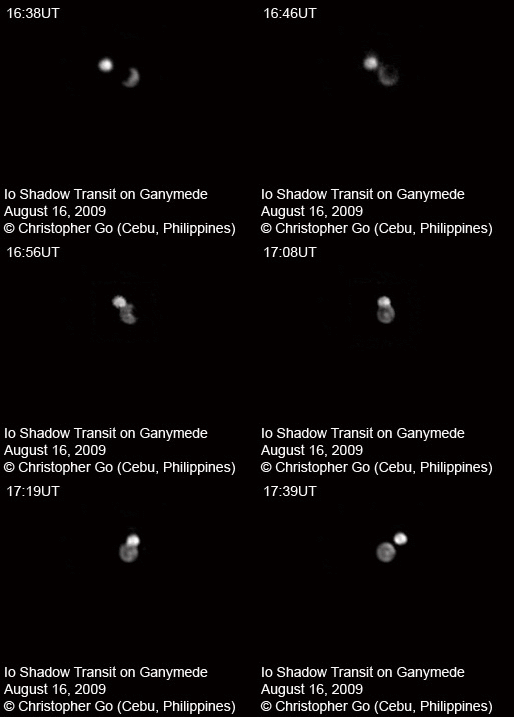
- Mid-October 2026: This period marks the formal peak of the eclipse season. During this time, the alignment is at its most precise, resulting in the highest frequency of total and annular events.
- November 18, 2026: Jupiter reaches quadrature, positioned 90 degrees west of the Sun. At this stage, the shadows of the moons are cast at their widest angles relative to the moons themselves. This provides a distinct visual separation between a moon and its shadow, a period favored by astrophotographers for capturing the three-dimensional depth of the Jovian system.
- February 11, 2027: Jupiter reaches opposition. At this point, the planet is at its closest approach to Earth and is visible throughout the entire night. Because the Sun, Earth, and Jupiter are nearly in a straight line, the shadows of the moons fall almost directly behind them, often resulting in occultations and eclipses occurring simultaneously.
- August 5, 2028: While the primary mutual events between the inner three moons conclude in early 2027, the outermost moon, Callisto, continues its shadow-casting cycle. Callisto’s orbit is wide enough that it frequently "misses" Jupiter entirely; however, its current shadow-casting phase, which began in May 2025, will persist until mid-2028.
The Laplace Resonance and Triple Shadow Transits
A defining characteristic of the Jovian system is the Laplace resonance, a gravitational locking between the three innermost Galilean moons. Io, Europa, and Ganymede maintain an orbital ratio of 4:2:1. For every one orbit Ganymede completes, Europa completes two, and Io completes four. This resonance ensures that the moons never occupy the same relative positions in a way that would destabilize the system, but it also creates predictable patterns for mutual events.
Despite this regularity, "triple shadow transits"—where three moons cast shadows on Jupiter simultaneously—remain exceptionally rare. The resonance generally prevents all three from lining up on the same side of the planet in a specific way. The last triple shadow transit occurred on January 24, 2015, and observers will have to wait until March 20, 2032, for the next occurrence. The 2026-2027 season, while rich in mutual occultations and double transits, is not expected to produce a triple event, making the individual mutual eclipses between the moons the primary focus for researchers.
Classifying Mutual Events: Occultations and Eclipses
During this season, observers can categorize events into two primary types, each with three distinct variations.
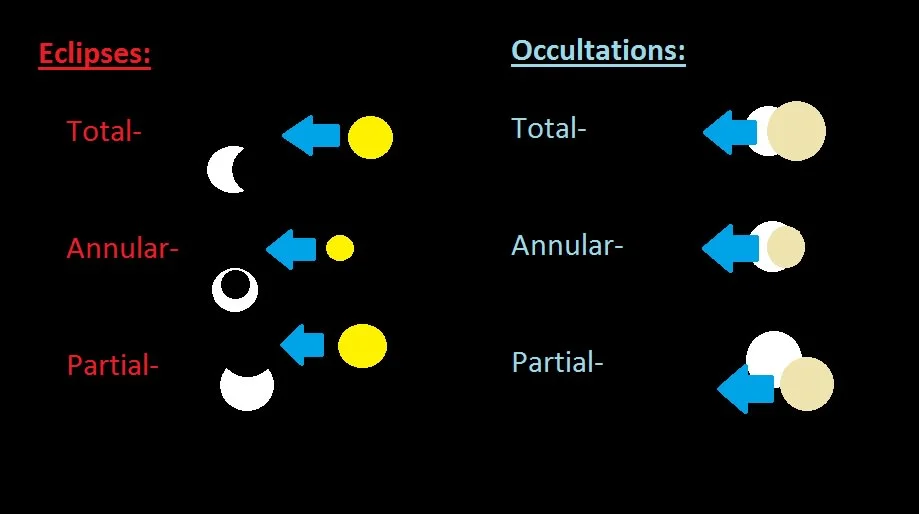
Mutual Occultations occur when one moon passes directly in front of another from the perspective of an observer on Earth. These are classified as:
- Partial: Only a portion of the rear moon is covered.
- Total: The closer moon completely obscures the more distant moon.
- Annular: The closer moon is smaller in apparent size than the distant moon, leaving a "ring" of the background moon visible.
Mutual Eclipses occur when one moon passes through the shadow of another. These are often more scientifically valuable because they allow astronomers to measure the drop in light (light curves) to determine the precise diameter and atmospheric characteristics (if any) of the moons. Like occultations, these can be partial, total, or penumbral.
The visual appearance of these shadows varies significantly. Io, being closest to the planet, casts a sharp, inky-black shadow. In contrast, Callisto, located much further away, casts a larger, more diffuse shadow with a less defined edge, a result of the Sun’s disk not being a singular point source of light at that distance.
Scientific Implications and Professional Coordination
While amateur astronomers enjoy the aesthetic beauty of these events, professional organizations such as the Institut de Mécanique Céleste et de Calcul des Éphémérides (IMCCE) and the SETI Institute’s Planetary Data System (PDS) Rings Node use these observations for high-precision science.
By timing the exact moment a moon enters or leaves a shadow, researchers can calculate orbital positions with an accuracy of a few kilometers—an incredible feat for objects hundreds of millions of kilometers away. These measurements are vital for the navigation of deep-space missions. Currently, NASA’s Juno spacecraft continues to orbit Jupiter, and the upcoming Europa Clipper and the European Space Agency’s JUICE (Jovian Icy Moons Explorer) missions rely on these precise orbital models to plan their flybys of the icy moons.
Statements from the astronomical community emphasize the collaborative nature of this season. The IMCCE often solicits observations from a global network of telescopes to ensure that no event goes unrecorded due to local weather conditions. This "citizen science" aspect allows for a continuous data stream that professional observatories, which are often booked for other research, cannot always provide.
Observation Challenges and Tools
Observing mutual events requires specialized equipment and patience. Even at its closest, the largest moon, Ganymede, presents a disk only 1.3 arcseconds in diameter. For context, the full moon is roughly 1,800 arcseconds across. To distinguish two moons merging or a shadow crossing a tiny disk, high-magnification telescopes and steady atmospheric conditions (good "seeing") are essential.
Digital resources have become indispensable for modern observers. Software such as Stellarium provides real-time simulations, while the SETI PDS "Jovian Tracker" tool allows users to generate custom tables of events based on their specific geographic coordinates. These tools have democratized the observation of the Jovian system, allowing hobbyists to contribute meaningful data to the broader scientific record.
A Testament to Celestial Harmony
As the 2026-2027 mutual transit-eclipse season progresses, it serves as a vivid reminder of the clockwork precision of our solar system. The "dance" of the Jovian moons is more than a visual spectacle; it is a complex gravitational interaction that has persisted for billions of years.
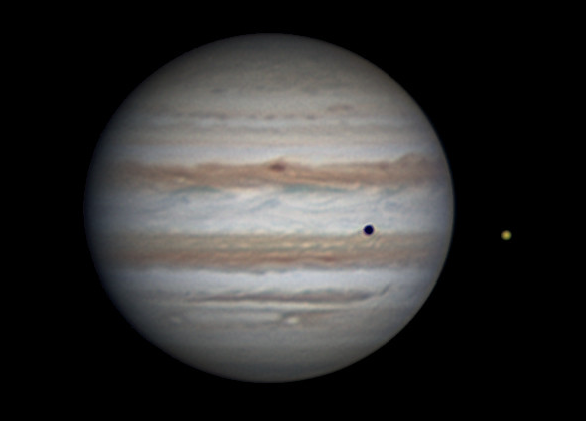
For the observer on Earth, these events offer a rare sense of motion in a seemingly static night sky. Watching a moon slowly fade as it enters the shadow of a neighbor provides a tangible sense of the three-dimensional reality of space. As Jupiter dominates the night sky through early 2027, the global astronomical community will be watching closely, capturing every shadow and occultation of this rare celestial season.