Lina Irawan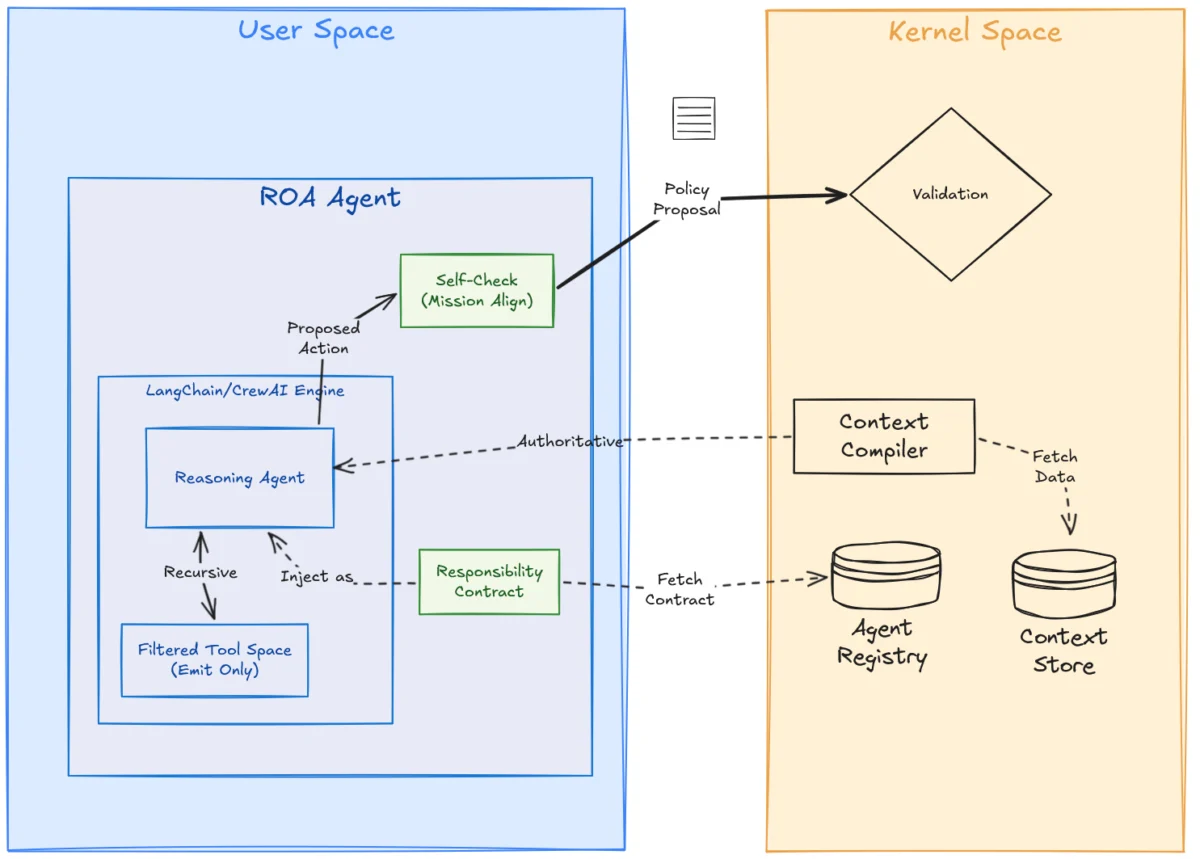
The rapid evolution of artificial intelligence from passive chatbots to autonomous agentic systems has introduced a fundamental crisis in enterprise governance: the inability to safely manage AI agents that possess the power to mutate external state. As organizations move beyond Retrieval-Augmented Generation (RAG) and research copilots toward high-stakes systems capable of moving capital, altering infrastructure, and modifying medical records, the industry’s reliance on "capabilities-based" design is proving insufficient. A new architectural paradigm, known as the Responsibility-Oriented Agent (ROA) pattern, is emerging as a critical solution to bridge the gap between probabilistic AI reasoning and deterministic business requirements.
The Scalability Trap of Human-in-the-Loop Systems
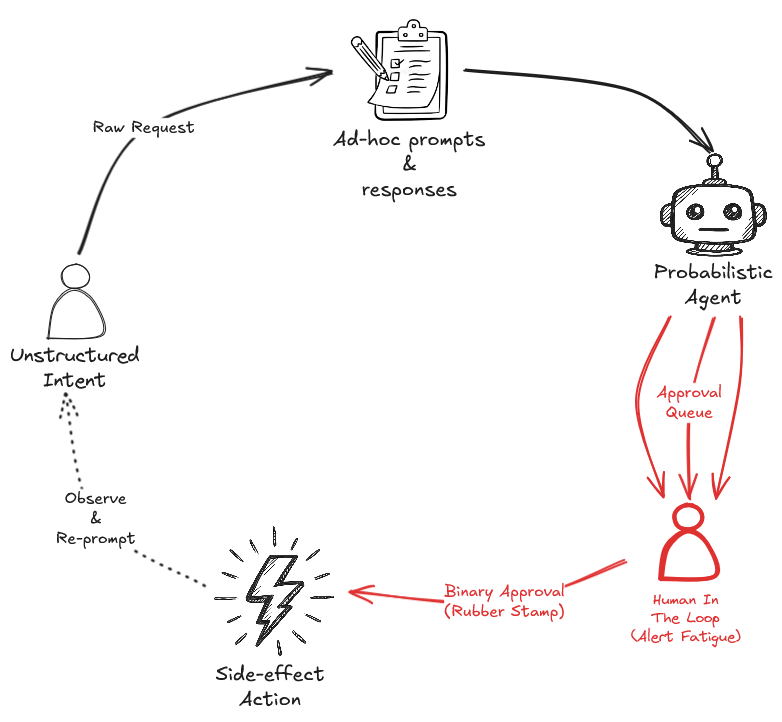
For the past two years, the standard safety net for autonomous agents has been the Human-in-the-Loop (HITL) model. Under this framework, any high-stakes decision made by an AI is routed to a human operator for approval. While defensible in low-frequency development environments, this model has become what architects call a "Scalability Trap" in production settings.
When a system operates dozens of agents making hundreds of decisions per hour, the human reviewer becomes an operational bottleneck. This leads to a phenomenon known as alert fatigue. As queues grow and backlogs pile up, human operators often stop scrutinizing complex JSON payloads and begin clicking "Approve" simply to maintain throughput. This degradation of governance into manual throughput management represents a significant form of technical debt. It effectively substitutes true oversight with unverified execution, creating a veneer of safety while increasing the risk of catastrophic failure.
Industry veterans, including Tyler Akidau and Tim O’Reilly, have noted that while the technology sector has invested billions into enhancing agent capabilities, it has neglected the infrastructure required for authority, constraint, and accountability. The ROA framework addresses this by shifting the focus from what an agent can do to what an agent is responsible for.

Transitioning from Capabilities to Responsibilities
In traditional software design, Role-Based Access Control (RBAC) defines what a user is authorized to do regardless of their specific task. The capabilities-based frame in AI asks, "What tools does this agent have?" This approach relies on prompts—essentially suggestions—to guide behavior. In high-stakes environments, prompts such as "be careful with position sizing" are fragile; they can be bypassed by adversarial inputs, unusual market conditions, or prompt injection attacks.
In contrast, the responsibility-oriented frame asks, "What is this agent’s mandate?" This distinction is best illustrated by the difference between a capability and a responsibility. A capability might be "access to the trade execution API," whereas a responsibility is "managing a $10,000 portfolio with a maximum single-trade limit of $500." The former is a permission; the latter is a boundary.
By defining agents through strict responsibility statements, developers can create a "Kernel Space"—a privileged, deterministic execution layer that validates every proposed action before it affects the real world. This ensures that the agent’s intelligence remains in "User Space," where it can reason and iterate, but its authority is governed by hard-coded, machine-readable contracts in the Kernel.
The Five Pillars of Responsibility-Oriented Architecture
To transform a probabilistic Large Language Model (LLM) into a governable production component, the ROA pattern relies on five core engineering pillars. These pillars address specific failure modes at the intersection of AI reasoning and execution.
1. The Responsibility Contract
The Responsibility Contract is a versioned, machine-readable document registered in an Agent Registry. Unlike a prompt, which the LLM interprets, the contract is enforced by the deterministic runtime. For example, if an underwriting agent proposes a policy with a value of £15 million, but its contract caps its authority at £10 million, the runtime will reject the action regardless of how "confident" the agent claims to be. This ensures that "code is enforcement," while "prompts are suggestions."
2. Mission Integrity
The Mission defines the optimization logic within the boundaries of the contract. It distinguishes between what an agent may do (Contract) and what it should do (Mission). In an ROA architecture, the mission is a deployment artifact with a unique cryptographic hash. If a prompt injection attempt or runtime drift alters the agent’s objective, the hash will no longer match the registered mission, and the proposal will be rejected by the runtime.
3. Epistemic Isolation
ROA agents interact with the world exclusively through structured, typed "Policy Proposals." The agent does not have direct access to execution channels like execute_trade() or delete_record(). Instead, it emits a claim of intent. This isolation ensures that even if an LLM’s reasoning is compromised, it cannot cause damage because it lacks the physical ability to trigger state-mutating actions without passing through the deterministic validation gate.
4. Decision Longevity
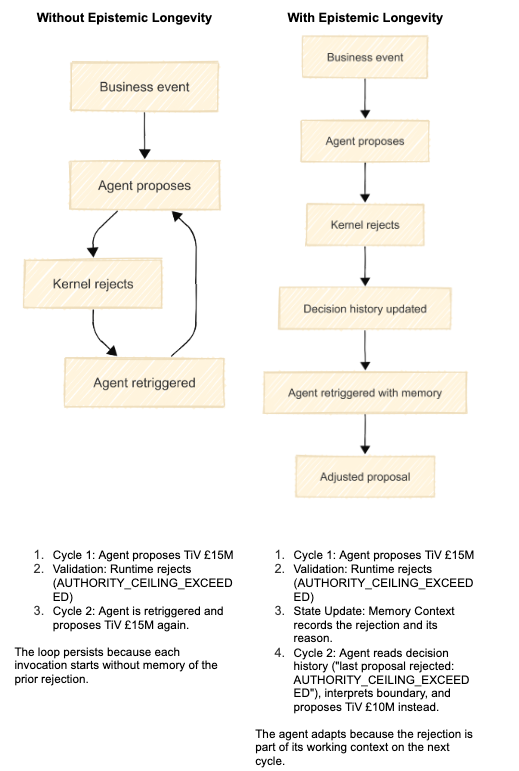
Most current AI implementations treat every inference call as a stateless event. This leads to "decision amnesia," where an agent might repeat a previously rejected action because it has no memory of the rejection. ROA agents maintain a "decision trajectory"—a managed record of prior proposals and outcomes. This longevity allows the agent to accumulate context within its specific role, improving reliability and preventing infinite rejection loops.
5. Structured Auditability and DFID
Every action in an ROA system is bound by a Decision Flow ID (DFID). This creates a relational trace connecting the agent’s internal reasoning (the "Explain" narrative) to the machine-enforceable action (the "Policy"). This telemetry allows organizations to reconstruct any decision for regulatory compliance, such as those required by the EU AI Act, without relying on mutable text logs.
Chronology of AI Governance Evolution
The shift toward ROA represents the third major phase in the evolution of AI integration:
- Phase 1: The Assistant Era (2022-2023): Focused on RAG and conversational interfaces where the risk was limited to misinformation.
- Phase 2: The Tool-Use Era (2023-2024): Introduction of "Function Calling," where agents were given direct API access. This phase highlighted the dangers of unconstrained capabilities.
- Phase 3: The Responsibility Era (2025-Present): The current shift toward deterministic kernels and responsibility-oriented design to support high-stakes, autonomous production systems.
Human-Over-The-Loop: A Scalable Governance Model
The alternative to the failing HITL model is Human-Over-The-Loop (HOTL). In this model, the human moves from the execution queue to the design loop. Instead of approving every transaction, the human acts as a Policy Designer, defining the contracts that the system enforces autonomously.
HOTL relies on "Governance by Exception." The system only escalates to a human operator when a proposal violates a contract, when the agent signals low confidence, or when the "Escalation Budget" is exceeded. This budget acts as a circuit breaker; if an agent triggers too many escalations within an hour, it is automatically suspended to prevent "Escalation DDoS" attacks or runaway reasoning costs.
Furthermore, HOTL utilizes "Frozen Context" and "Just-In-Time (JIT) Verification." When an operator reviews an escalated case, they see exactly what the agent saw at the moment of the decision. However, if the operator chooses to override a rejection, the runtime performs a JIT check to ensure the state of the world hasn’t changed (e.g., the stock price hasn’t moved) since the original proposal.
Broader Implications and Industry Impact
The adoption of ROA has significant implications for the future of enterprise AI. By wrapping existing orchestration frameworks like LangChain, AutoGen, or CrewAI in a Responsibility-Oriented boundary, companies can leverage the reasoning power of these tools while maintaining a strict safety profile.
From a regulatory perspective, the ROA pattern provides a clear path to compliance with emerging global standards. The EU AI Act, for instance, emphasizes the need for human oversight and high-quality logging for high-risk AI systems. The structured telemetry and deterministic enforcement of ROA directly satisfy these requirements by providing an immutable, reconstructible audit trail of every autonomous decision.
Data suggests that as agents become more complex, they often suffer from "Lost in the Middle" syndrome, where their reasoning degrades as context windows expand. By strictly scoping an agent’s role through a Responsibility Contract, developers naturally narrow the data context required. This makes agents more reliable and efficient, as they only process information relevant to their specific mandate.
Conclusion: The End of the AI Demo Era
The industry is moving past the era of AI demos and entering the era of AI production systems. In this new landscape, the value of a system will not be measured solely by the intelligence of its underlying model, but by the rigor of its governance.
The Responsibility-Oriented Agent pattern acknowledges a fundamental truth: an agent that cannot be trusted to govern itself must operate within a system that governs it instead. By replacing informal trust with explicit, deterministic boundaries, organizations can finally deploy agentic AI in high-stakes environments with the confidence that their systems are not only capable but responsible. Responsibility is no longer just a prompt; it is an architectural commitment.