Sisilia Frederika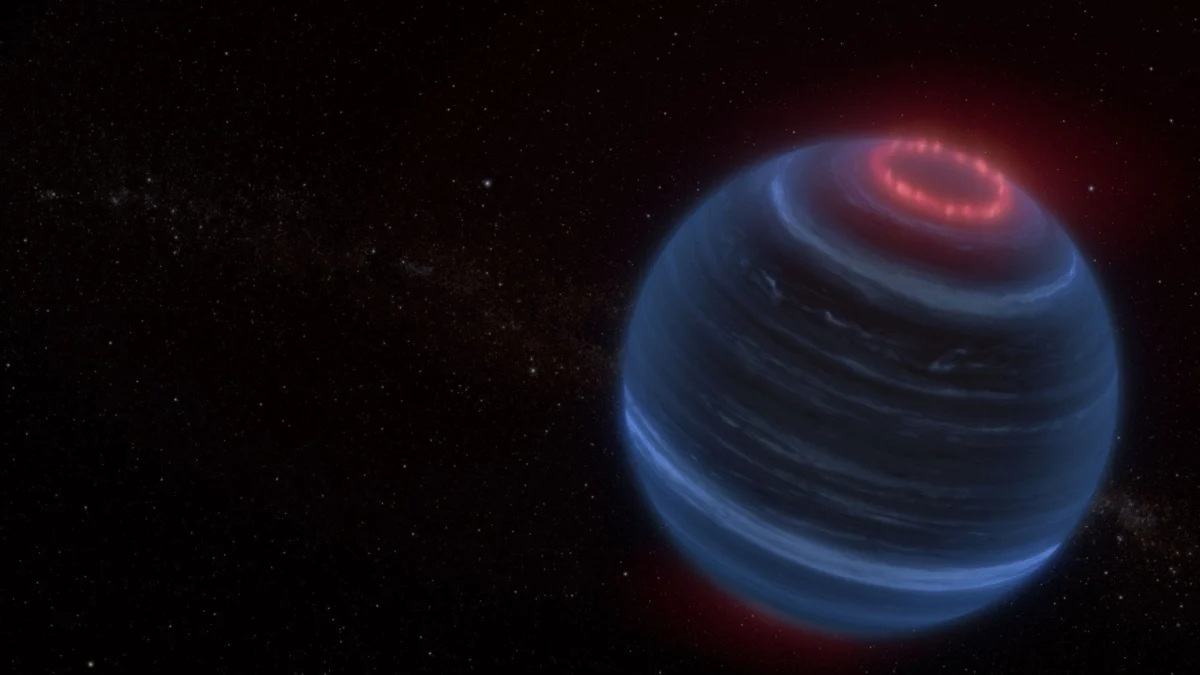
In a landmark study published in the journal Astronomy & Astrophysics, an international team of researchers has successfully mapped the dynamic atmospheric conditions of the brown dwarf SIMP J0136+09, located approximately 20 light-years from Earth. Utilizing the unprecedented sensitivity of the James Webb Space Telescope (JWST), the team employed a sophisticated statistical technique known as Principal Component Analysis (PCA) to isolate and identify the primary drivers of weather on this distant world. The findings reveal a complex environment dominated by shifting temperatures and massive, vertically extended cloud structures, offering a rare glimpse into the meteorological processes of objects that sit on the boundary between planets and stars.
The Target: SIMP J0136+09 and the Nature of Brown Dwarfs
SIMP J0136+09, situated in the constellation Pisces, has long been a subject of intense astronomical interest. Classified as a brown dwarf, it is often colloquially referred to as a "failed star." Brown dwarfs are celestial objects that possess a mass greater than the most massive gas giant planets but remain below the threshold necessary to sustain hydrogen fusion in their cores—the process that powers stars like our Sun. Generally, this mass range falls between 13 and 80 times the mass of Jupiter.
Despite their inability to ignite as stars, brown dwarfs like SIMP 0136 are far from dormant. They retain significant heat from their formation and exhibit complex atmospheric phenomena. SIMP 0136 is particularly notable because it resides at the "L/T transition," a phase in a brown dwarf’s life where its atmosphere shifts from being dominated by thick, iron and silicate clouds to clearer atmospheres where methane signatures become prominent. This transition is characterized by extreme variability in brightness, which astronomers have now linked to "patchy" cloud covers and high-velocity storm systems.
For the researchers involved in the JWST General Observer Program 3548, SIMP 0136 provided an ideal laboratory. Its relative proximity to Earth and its high level of variability allowed for high-signal-to-noise observations, making it possible to test new analytical methods that could eventually be applied to smaller, more distant exoplanets.
Technological Implementation: NIRSpec and MIRI Observations
The study relied on the dual power of two of Webb’s primary instruments: the Near-Infrared Spectrograph (NIRSpec) and the Mid-Infrared Instrument (MIRI). By conducting Time Series Observations (TSO), the telescope monitored the brown dwarf over a continuous period, capturing how its light changed as it rotated. Because SIMP 0136 rotates rapidly, completing a full turn in just a few hours, the JWST was able to observe different "faces" of the object, recording the fluctuations in brightness caused by moving weather systems.
NIRSpec provided low-resolution spectroscopy, allowing the team to see how different chemical signatures—such as water vapor and methane—fluctuated in intensity. Meanwhile, MIRI’s mid-infrared capabilities allowed the researchers to peer deeper into the atmosphere, sensing the thermal emission from the object’s interior. By combining these datasets, the team could construct a multi-layered view of the atmosphere, effectively seeing how clouds at different altitudes interacted with the rising heat from the core.
The sensitivity required for this task cannot be overstated. The changes in brightness being measured are often less than 1%, requiring the JWST to maintain extreme stability over several hours of observation. This level of precision is what differentiates the JWST from its predecessors, the Spitzer and Hubble Space Telescopes, which provided earlier but less detailed looks at SIMP 0136.
Methodology: The Power of Principal Component Analysis
The core innovation of this research lies in the application of Principal Component Analysis (PCA) to exoplanetary data. In traditional atmospheric modeling, scientists create complex 3D simulations based on physics and chemistry, then try to match these simulations to the observed data. This process is computationally expensive and often relies on numerous assumptions about the planet’s composition.
PCA takes a different, data-driven approach. It is a statistical technique that simplifies large datasets by identifying "principal components"—variables that change in sync with one another. In the case of SIMP 0136, the "noise" of the data—random fluctuations or instrumental artifacts—was separated from the meaningful signals. The PCA revealed that the vast majority of the variations in the brown dwarf’s light could be explained by just a few underlying processes.
"In relative terms, SIMP 0136 is one of the easier brown dwarfs for us to capture high-quality data from," explained Merle Schrader, a PhD Candidate at Trinity College Dublin’s School of Physics and the lead author of the study. "The technique has helped us develop a better understanding of what drives the weather on this faraway world and how these weather patterns interact and co-exist."
By using PCA, the team identified three recurring patterns that dominate the atmosphere. These patterns represent the interplay between "hot spots"—regions where the atmosphere is thinner and heat escapes more easily—and "cold spots," where thick, vertically extended clouds block the thermal radiation.
Findings: A World of Vertical Clouds and Shifting Heat
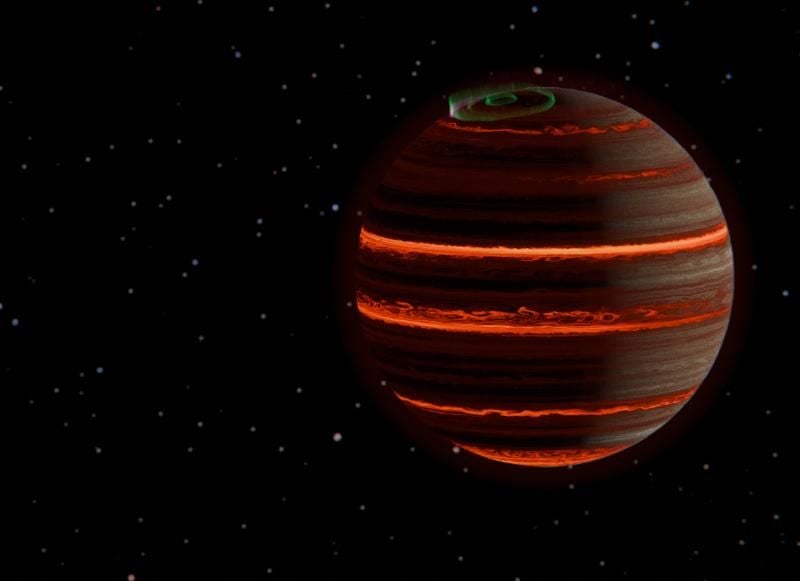
The results of the analysis paint a picture of a world with weather far more violent and structured than anything found in our Solar System. The primary driver of the observed brightness changes is the vertical structure of the clouds. Unlike Earth, where clouds are relatively thin layers of water or ice, the clouds on SIMP 0136 are thought to be composed of hot minerals and "sand" (silicates) that extend deep into the atmosphere.
The researchers found that as the brown dwarf rotates, the telescope sees a rotating mosaic of different atmospheric states:
- Clearer, Hotter Regions: Areas where the cloud deck is lower or thinner, allowing infrared light from the warmer interior to escape.
- Thick Cloud Banks: High-altitude, vertically extended clouds that act as a blanket, cooling the observed temperature of the object.
- Transition Zones: Areas where the atmosphere is in flux, showing rapid changes in temperature and pressure as storms circulate.
These findings suggest that the weather on SIMP 0136 is not just a surface phenomenon but is deeply integrated with the internal cooling of the object. The "organized" nature of these patterns, despite the chaotic appearance of the storms, suggests that large-scale atmospheric circulation—similar to the jet streams on Jupiter—plays a crucial role in maintaining these weather systems.
Expert Reactions and Scientific Implications
The scientific community has reacted with optimism toward the success of the PCA method. Professor Johanna Vos, an Associate Professor at Trinity College Dublin and co-author of the study, highlighted the efficiency of this approach. "Our findings will transform how astronomers analyze future JWST observations. Since our approach rapidly identifies the dominant components of the atmosphere, it offers an efficient first step before we begin computationally intensive modeling."
This efficiency is vital as the JWST continues to collect massive amounts of data from hundreds of different targets. By using PCA as a "first pass," astronomers can quickly determine which planets or brown dwarfs have the most interesting atmospheric chemistry, allowing them to prioritize their most powerful computational resources for the most promising candidates.
Furthermore, the study of brown dwarfs serves as a vital proxy for the study of gas giant exoplanets. Because brown dwarfs often exist in isolation—rather than orbiting close to a bright star—they are much easier to image directly. The physics of cloud formation, heat transport, and atmospheric chemistry observed on SIMP 0136 are directly applicable to the "hot Jupiters" and "super-Earths" that astronomers hope to characterize in the coming years.
Future Outlook: From Brown Dwarfs to Habitable Worlds
The success of the SIMP 0136 observations marks a significant milestone in the broader mission of the JWST. One of the telescope’s primary goals is to analyze the chemical composition of exoplanet atmospheres to search for "biosignatures"—gases like oxygen, methane, and carbon dioxide that might indicate the presence of life.
While SIMP 0136 is far too hot and massive to support life as we know it, the techniques developed to decode its weather are the same ones that will be used on smaller, rockier worlds. The ability to distinguish between a planet’s actual surface/atmospheric composition and the "noise" of its weather patterns is essential for determining habitability.
The timing of this discovery is also significant given the upcoming milestones in space exploration. With the Nancy Grace Roman Space Telescope expected to begin operations in the near future, the field of direct imaging is set to explode. The Roman telescope will use advanced coronagraphs to block out starlight, allowing for the direct observation of Earth-like planets in the "habitable zones" of their parent stars. The statistical frameworks established by the Trinity College Dublin team will be instrumental in processing the data from these future missions.
As the JWST continues its tenure at the second Lagrange point (L2), more time series observations are planned for a variety of objects. The decoding of SIMP 0136’s weather is not just an isolated success but a proof-of-concept for a new era of "exometeorology." Astronomers are no longer content with simply finding planets; they are now beginning the complex work of understanding the daily weather, seasons, and climates of worlds trillions of miles away.
The research conducted by Schrader, Vos, and their international collaborators demonstrates that even the most distant and alien environments follow physical laws that can be unraveled through a combination of cutting-edge technology and innovative mathematics. As we refine our ability to see through the clouds of distant "failed stars," we move one step closer to understanding the atmospheric diversity of the universe and, ultimately, our own place within it.