George Chandra Eka
NASA’s Psyche spacecraft recently unveiled a captivating timelapse video showcasing its close encounter with Mars in May, a critical maneuver that provided a gravity assist to propel the mission toward its primary target, the metallic asteroid Psyche. The detailed imagery, captured by the spacecraft’s multispectral imager, offers rare perspectives of the Red Planet, from its delicate crescent phase upon approach to intricate surface details and the expansive icy south pole during its departure. This successful flyby not only validated the spacecraft’s navigation and imaging systems but also provided invaluable data, demonstrating the instrument’s capability to detect distant celestial bodies, a crucial test for its future observations around the eponymous asteroid.
A Pivotal Martian Encounter: Chronology and Purpose
The Psyche mission, launched on October 13, 2023, embarked on a journey designed to explore a unique world: a metal-rich asteroid believed to be the exposed core of an early protoplanet. Such a mission requires precise navigation and efficient propulsion, making gravity assist maneuvers indispensable. The encounter with Mars was the first major orbital adjustment for the spacecraft, leveraging the planet’s gravitational pull to accelerate and redirect its trajectory without expending significant onboard propellant.
The spacecraft began its approach to Mars on May 2, meticulously adjusting its course over nearly two weeks. The closest approach occurred on May 15, when Psyche passed within approximately 6,000 kilometers (about 3,700 miles) of the Martian surface. During this period, its state-of-the-art multispectral imager, one of the mission’s primary scientific instruments, was actively collecting thousands of images. These images were then painstakingly stitched together by NASA’s Jet Propulsion Laboratory (JPL) and Arizona State University (ASU) to create the recently released timelapse, offering a dynamic perspective rarely seen by Earth-based observers or other Mars-orbiting missions. The successful execution of this flyby confirmed the mission’s trajectory remains on target for its intended 2029 arrival at asteroid Psyche, significantly optimizing the overall mission timeline and fuel budget.
The Ingenuity of a Gravity Assist: A Deep Dive into Orbital Mechanics
A gravity assist, often referred to as a "slingshot maneuver," is a fundamental technique in interplanetary travel, allowing spacecraft to gain or lose speed and alter their trajectory by harnessing the gravitational pull of a planet or other celestial body. For the Psyche mission, the Mars flyby served primarily to increase the spacecraft’s velocity relative to the Sun and bend its flight path, effectively shifting its orbital plane to align with that of the asteroid Psyche.
The principle is elegant: as the spacecraft approaches Mars, it is accelerated by the planet’s gravity. While Mars’s gravity pulls on the spacecraft, the spacecraft’s own gravity exerts an equal and opposite pull on Mars, though due to the immense mass difference, the effect on Mars is negligible. As the spacecraft swings around Mars, it "steals" a small amount of orbital energy from the planet, translating it into a significant boost in its own speed and a change in direction. This maneuver is far more efficient than relying solely on chemical propulsion, which would require carrying an impractical amount of fuel for a multi-year deep-space journey. The successful execution of the Mars gravity assist for Psyche saved hundreds of kilograms of propellant, directly extending the potential operational lifespan of the mission once it reaches its destination and enabling more complex scientific operations. Such precision in orbital mechanics underscores the sophisticated capabilities of NASA’s navigation teams and the robustness of the spacecraft’s propulsion and guidance systems.
The Psyche Mission: Unveiling a Unique Metallic World
The Psyche mission is an ambitious endeavor to study a celestial body unlike any other previously explored: 16 Psyche, a massive asteroid located in the outer part of the main asteroid belt, between Mars and Jupiter. This asteroid, measuring approximately 226 kilometers (140 miles) in diameter, stands out due to its exceptionally high density and radar-bright surface, which strongly suggest it is composed primarily of nickel-iron metal. Scientists hypothesize that 16 Psyche could be the exposed core of an early planetesimal—a building block of planets—that lost its rocky outer layers due to violent collisions during the tumultuous early solar system.
The primary objectives of the Psyche mission are multifaceted:
- Determine if Psyche is indeed a core: By mapping its surface, topography, and gravitational field, scientists aim to understand if it truly represents the remnant of a protoplanetary core.
- Characterize its geology and composition: Instruments will analyze the asteroid’s surface mineralogy and elemental composition to understand its formation and evolution.
- Search for a magnetic field: If Psyche is a remnant core, it might retain a fossil magnetic field, providing insights into the dynamo processes that generated magnetic fields in early planetary bodies.
- Understand the formation of rocky and metallic planetary cores: Studying Psyche offers a unique window into the processes that led to the differentiation of planets into metallic cores and rocky mantles.
The journey to Psyche is projected to take approximately five and a half years, culminating in orbit insertion in 2029. Once in orbit, the spacecraft will spend at least 21 months systematically mapping and studying the asteroid from various altitudes, gradually descending closer to achieve higher-resolution data. The data gathered will revolutionize our understanding of planet formation, offering direct insights into the building blocks of terrestrial planets like Earth.
Unprecedented Views: The Multispectral Imager’s Stellar Performance
The images captured during the Mars flyby were not merely aesthetically pleasing; they provided critical validation for the Psyche spacecraft’s multispectral imager. This instrument is designed to acquire high-resolution images across different wavelengths, allowing scientists to discern variations in surface composition and geological features. During the flyby, the imager performed flawlessly, capturing a diverse range of views that underscore its capabilities.
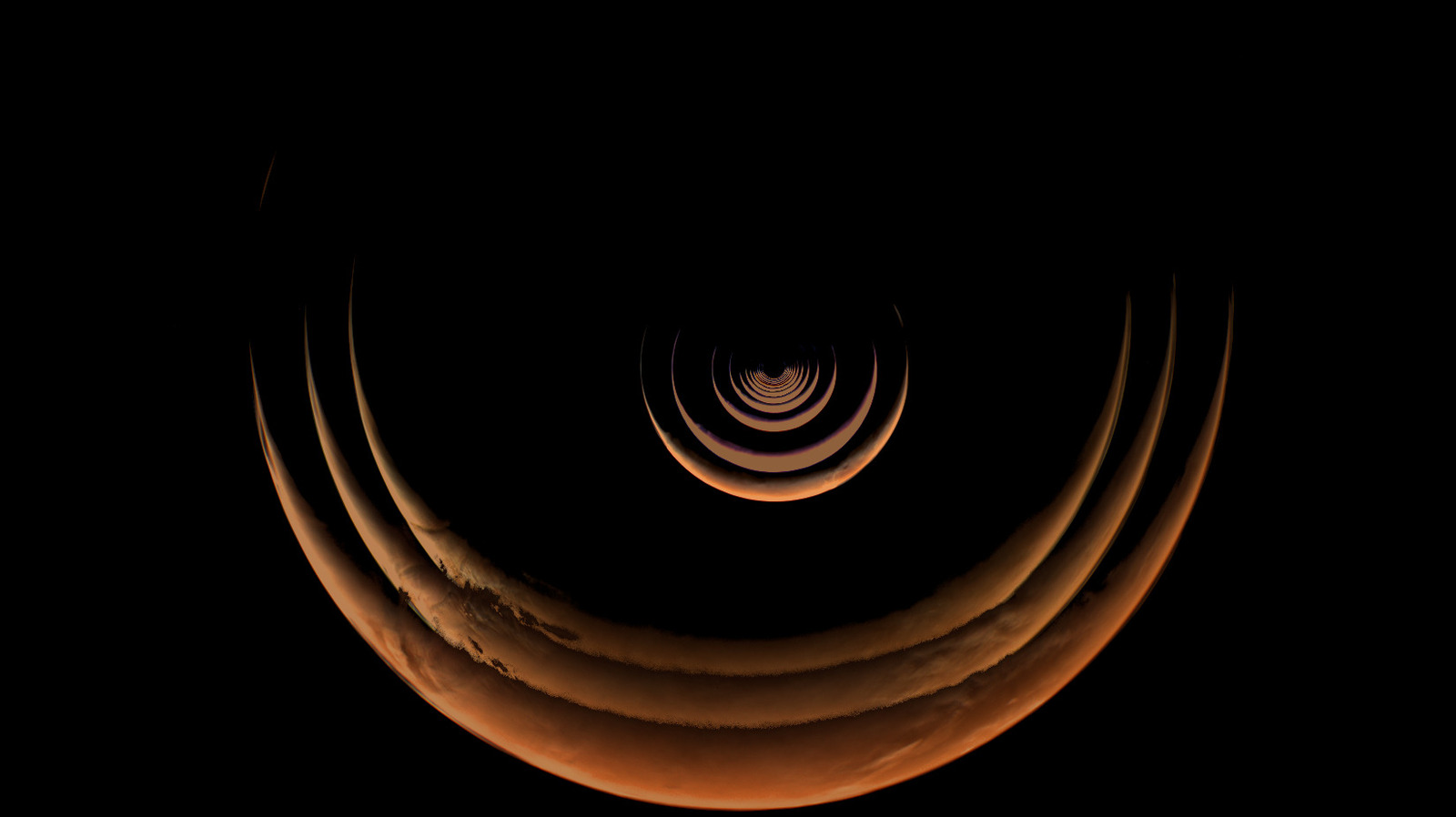
"The imager performed brilliantly, delivering some rarely seen views of the red planet," stated Jim Bell, the Psyche imager instrument lead at Arizona State University. Bell’s enthusiasm is well-founded, as the captured sequence vividly illustrates Mars transitioning from a delicate crescent, illuminated only partially by the Sun, to a fully visible disk revealing its complex topography. The timelapse then follows the spacecraft’s trajectory, showcasing detailed views of the Martian surface, including vast plains, impact craters, and the distinct white cap of the icy south pole as the planet receded into the distance.
Beyond the "obvious beauty of the photos," Bell emphasized the scientific and technical achievements of this imaging sequence. "We were also able to fully test its calibration and sensitivity to scattered light," he explained. Understanding how the instrument responds to scattered sunlight—light bouncing off dust particles or the atmosphere—is crucial for accurate data interpretation in deep space, where lighting conditions can vary dramatically. This calibration ensures that future scientific measurements of asteroid Psyche’s surface composition are precise and reliable.
Furthermore, a significant component of the imager’s testing involved "picking out the Martian moons Phobos and Deimos from very far away." This exercise was not just an observational curiosity; it was a critical practice run for the mission’s primary objective of searching for any potential moonlets orbiting the asteroid Psyche. Detecting small, irregularly shaped natural satellites around an asteroid requires extreme sensitivity and sophisticated image processing techniques. The successful detection of Phobos and Deimos, even from a considerable distance, instills confidence in the imager’s ability to locate and characterize any such companions that might be present around 16 Psyche, which would offer additional insights into the asteroid’s formation and evolution.
The Scientific Context: Why Mars Flybys Offer Dual Benefits
While the primary purpose of the Mars flyby was propulsive, these opportunistic close encounters often yield valuable secondary scientific data. Even though Psyche is not a dedicated Mars mission, its instruments are sophisticated enough to gather meaningful observations during such passes. The detailed imagery of Mars, especially from unique angles and lighting conditions that are not continuously monitored by dedicated Mars orbiters, adds to our collective understanding of the planet.
For instance, observing the Martian south pole during its seasonal cycle or capturing global views can complement data from missions like NASA’s Mars Reconnaissance Orbiter (MRO) or the European Space Agency’s Mars Express. These brief snapshots contribute to a broader temporal and spatial understanding of Martian atmospheric phenomena, surface changes, and polar cap dynamics. Such "bonus science" exemplifies the multi-use potential of advanced spacecraft and the collaborative nature of planetary science, where data from one mission can indirectly support the objectives of another. The successful performance of Psyche’s instruments around Mars validates their readiness for the even more challenging environment and unique target awaiting them in the asteroid belt.
The Road Ahead: Trajectory to a Unique Asteroid
With the successful Mars gravity assist complete, the Psyche spacecraft is now firmly on its path toward 16 Psyche. The next major phase of the journey involves cruising through the vast expanse of the inner solar system, relying on deep-space communication and occasional trajectory correction maneuvers. The planned arrival in 2029 will mark the culmination of years of planning, engineering, and scientific anticipation.
Upon arrival, the spacecraft will enter orbit around 16 Psyche, beginning an extensive observational campaign. The mission phases will involve progressively lower orbits to conduct detailed mapping. The multispectral imager will be crucial for creating high-resolution topographical maps and identifying surface features, while other instruments, such as the gamma-ray and neutron spectrometer, will analyze the elemental composition of the asteroid’s surface. A magnetometer will search for any remnant magnetic field, providing critical clues about its internal structure and past.
The data collected by Psyche will provide the first direct look at a metallic core of a planetary body, offering unprecedented insights into planetary differentiation, a fundamental process in the formation of all rocky planets, including Earth. Understanding 16 Psyche could help answer profound questions about how our own planet’s core formed and how common such metallic worlds might be in the universe.
Broader Implications for Space Exploration and Planetary Science
The Psyche mission’s journey and its successful Mars flyby have broader implications for the future of space exploration. The flawless execution of complex navigation maneuvers in deep space demonstrates the increasing sophistication of autonomous spacecraft operations and ground control capabilities. These achievements pave the way for more ambitious missions to distant and challenging targets, pushing the boundaries of human scientific endeavor.
Furthermore, the public release of stunning visuals like the Mars timelapse serves as a powerful tool for engagement and education. Such imagery not only inspires a new generation of scientists and engineers but also fosters a deeper appreciation for the wonders of our solar system and the incredible feats of engineering required to explore it. As Psyche continues its solitary journey toward its metallic destination, it carries with it the hopes of unlocking some of the most fundamental secrets of planetary formation, contributing invaluable knowledge to humanity’s ongoing quest to understand its place in the cosmos. The data collected will undoubtedly influence future theories about the early solar system and the processes that shaped the diverse array of celestial bodies we observe today.