Galang Taruna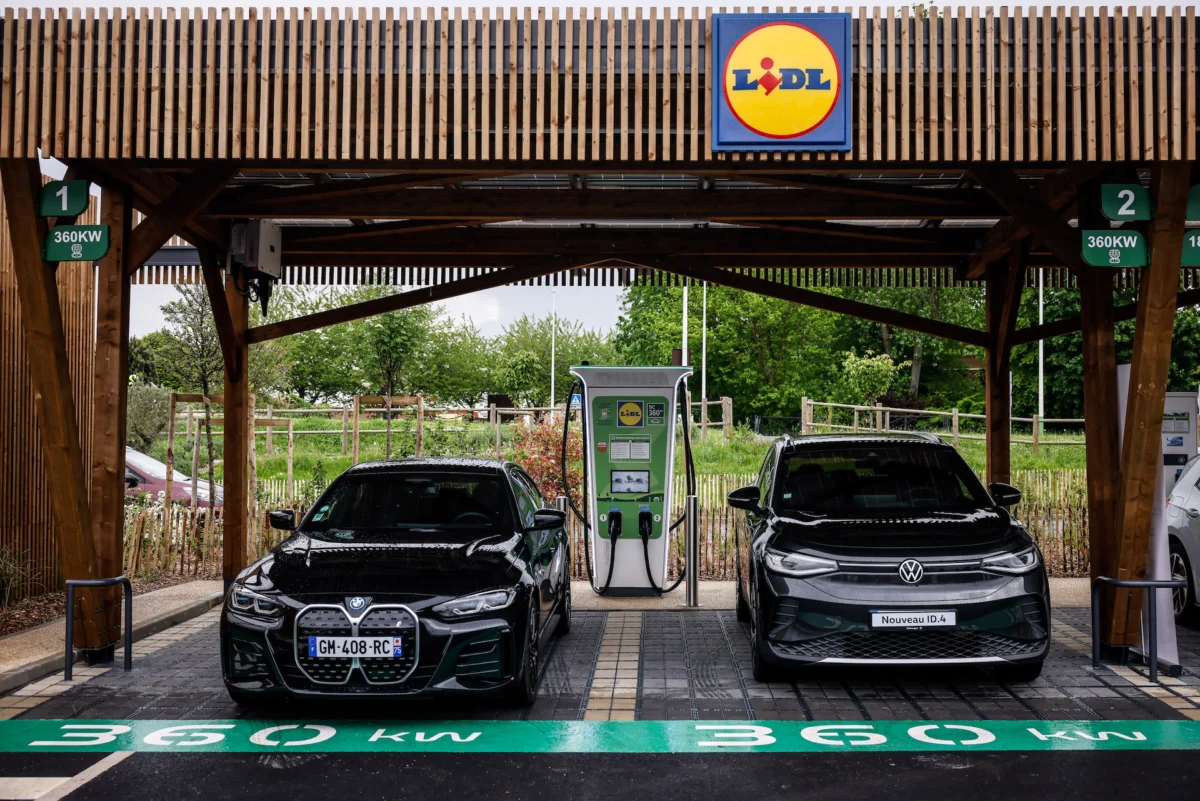
Paris, France – Lidl, the German discount supermarket giant, announced on Friday, September 18th, a significant reduction in its alternating current (AC) electric vehicle (EV) charging prices, setting the new rate at an unprecedented €0.18 per kilowatt-hour (kWh) across its network in France. This competitive new tariff, accessible exclusively through the Lidl Plus application, positions the retailer to claim the title of offering the cheapest AC charging in the country, a move poised to further disrupt the burgeoning electric mobility market. The announcement comes at a time when consumers are increasingly feeling the pinch of elevated conventional fuel prices, making electric vehicles an ever more attractive proposition.
The strategic pricing adjustment specifically targets AC charging, typically slower but perfectly suited for motorists who wish to replenish their vehicle’s battery while shopping. This offering differentiates itself starkly from the often substantially higher rates charged by dedicated rapid charging operators, underscoring Lidl’s commitment to making electric vehicle ownership more accessible and affordable for the everyday consumer.
A Game-Changing Price Drop for EV Drivers
The new €0.18/kWh rate represents a substantial 37.9% reduction from Lidl’s previous AC charging price of €0.29/kWh. To put this into perspective, recharging a 50 kWh battery, such as that found in the upcoming Renault 5 E-Tech, would now cost just €9 at a Lidl station. This stands in stark contrast to the often exorbitant costs incurred at specialized fast-charging networks like Ionity or Electra, where a similar charge can easily exceed €30. The convenience and cost-effectiveness of this offering are likely to be a significant draw for EV owners, transforming a routine grocery trip into an opportunity for highly economical vehicle charging.
Crucially, this attractive tariff applies only to AC charging, which typically provides power up to 22 kW. While Lidl’s charging points are capable of delivering 22 kW, it is important for drivers to note that the actual charging speed will depend on their vehicle’s onboard charger capacity, which often tops out at 11 kW or even 7.4 kW for many models. For instance, the Renault 5 E-Tech, while a popular future model, will not exceed 11 kW in AC charging. This means that while a quick stop for groceries will yield a useful top-up, achieving a full battery charge would necessitate leaving the vehicle connected for a more extended period.
In contrast, direct current (DC) rapid charging, which offers speeds up to 180 kW at some Lidl locations, remains priced at €0.29/kWh. While not as dramatically reduced, this DC rate still represents a highly competitive option in the broader market, particularly for those needing a quicker charge. The access to these discounted AC rates is seamless, requiring only the free Lidl Plus mobile application, which serves as a loyalty program rather than a subscription service, eliminating any additional fees for drivers.
The Broader Context: Rising Fuel Costs and EV Adoption in France
Lidl’s aggressive pricing strategy is unfolding against a backdrop of escalating energy prices and a surging interest in electric mobility across France and Europe. In September 2023, the average price of SP95 petrol in France hovered around €1.90 to €2.00 per litre, reaching near-record highs and placing a significant financial burden on motorists. This economic pressure has accelerated the shift towards electric vehicles, which offer not only environmental benefits but also considerable long-term savings on fuel costs, especially with tariffs like Lidl’s.
France has been a strong proponent of electric vehicle adoption, with the market share of EVs consistently growing. In 2023, electric cars represented approximately 16% of new vehicle registrations, demonstrating a clear upward trajectory. Government initiatives, such as subsidies for EV purchases and ambitious targets for public charging infrastructure deployment, have further stimulated this growth. The French government had set a goal of deploying 100,000 public charging points by the end of 2021, a target that, while challenging to meet precisely, underscored the national commitment to building a robust EV ecosystem. Retailers like Lidl are now playing a pivotal role in complementing these public efforts, leveraging their extensive geographic footprint.
The Supermarket Charging Revolution: A New Battleground
Lidl is not an isolated player in this emerging trend. The supermarket sector in France has increasingly recognized the strategic value of offering EV charging facilities as a powerful "produit d’appel" – a loss leader or attraction product – to draw customers to their stores. The logic is straightforward: if a driver can charge their car affordably while doing their weekly shop, they are more likely to choose that particular supermarket over a competitor. This paradigm shift sees the charging station replacing the traditional petrol station as a key customer magnet.
Other major retailers are also actively participating in this race. Intermarché, another prominent supermarket chain, has deployed rapid charging stations in its car parks. E.Leclerc has launched its own branded charging application, offering competitive rates around €0.24/kWh. Carrefour, too, is actively re-evaluating and refining its EV charging offerings to capture this growing segment of electric vehicle owners.
The significance of this retail-led infrastructure development was underscored by a high-level summit held at the Élysée Palace in May 2023, where representatives from distributors, energy companies, and charging operators convened. The meeting aimed to foster collaboration and accelerate the deployment of charging infrastructure, with discussions focusing on ambitious targets for future expansion and improved accessibility. These retail initiatives are not merely supplementary; they are becoming integral to the national charging network, offering convenient and often cheaper alternatives to specialized charging providers.
Lidl’s Strategic Edge and Market Dominance Claims
Lidl’s scale and business model provide it with distinct advantages in this competitive landscape. The retailer now boasts over 5,700 charging points across its supermarket car parks in France, positioning itself as a leading provider of EV charging infrastructure. With more than 1,000 of its approximately 1,600 supermarkets nationwide already equipped with charging stations, there remains substantial room for further expansion, solidifying its presence across the country.
The core of Lidl’s strategic advantage lies in its ability to subsidize charging costs. Unlike specialized charging operators, whose entire business model relies on profiting from the sale of electricity, Lidl can afford to sell electricity at or even below cost. The primary objective is not to generate revenue directly from charging, but rather to increase footfall in its stores and boost the average basket size of its customers. This cross-subsidization strategy creates a structural handicap for specialized operators, who must ensure profitability on every kWh sold. For Lidl, the charging service acts as an invaluable customer loyalty tool, integrating seamlessly into the shopping experience.
Implications for Consumers and the Future of Charging
For the electric vehicle driver, the mechanics are elegantly simple: plug in, do your shopping, and drive away with a significantly replenished battery at an unbeatable price. This combination of convenience and cost-effectiveness makes Lidl’s offering incredibly compelling. The ability to reclaim several kilowatt-hours of range during a typical grocery run provides a practical solution for daily commutes and reduces range anxiety, particularly for those with limited home charging options.
However, a caveat remains regarding the speed of AC charging. While the 22 kW capability of Lidl’s stations is impressive, the reality is that most electric cars currently on the market have onboard AC chargers that limit the input to 11 kW or even 7.4 kW. This means that even at a 22 kW station, a car with an 11 kW onboard charger will only draw 11 kW, and one with a 7.4 kW charger will only draw 7.4 kW. Consequently, while the €0.18/kWh tariff is indeed unbeatable, it primarily benefits those who can leave their vehicle plugged in for an extended period, maximizing the slow-charging opportunity. For quick top-ups during short errands, the recovered range might be modest, though still valuable.
The retailer is also exploring other avenues in electric mobility, even offering its own domestic charging stations for home use, further integrating itself into the EV ecosystem. Curiously, the original article even mentioned instances of some motorists attempting to charge their cars using the free electric bicycle charging sockets on Lidl car parks, a practice whose legality remains questionable and certainly not endorsed by the retailer for safety and capacity reasons.
Challenges and the Evolving Charging Landscape
Lidl’s aggressive pricing is undoubtedly putting significant pressure on the entire EV charging market. Specialized operators, who have invested heavily in high-speed infrastructure, now face a formidable competitor with a different business model and a vast network. This could potentially lead to a downward pressure on charging prices across the board, benefiting consumers in the long run.
The future of EV charging infrastructure in France appears to be a hybrid model, with a combination of dedicated rapid charging hubs for long-distance travel and ubiquitous, affordable AC charging options at retail locations for daily convenience. As the number of electric vehicles on the road continues to climb, the demand for both types of charging will only intensify. The challenge for all players will be to maintain reliability, expand capacity, and ensure grid stability as more drivers rely on these networks.
Lidl’s latest move solidifies its position as a frontrunner in the retail-led EV charging revolution. By making electric vehicle charging remarkably affordable and convenient, the supermarket chain is not only attracting new customers but also playing a crucial role in accelerating the transition to sustainable transportation in France. This strategy underscores a profound understanding of evolving consumer needs and the strategic power of integrating essential services with everyday retail, setting a new benchmark for the industry.