Clarissa Hana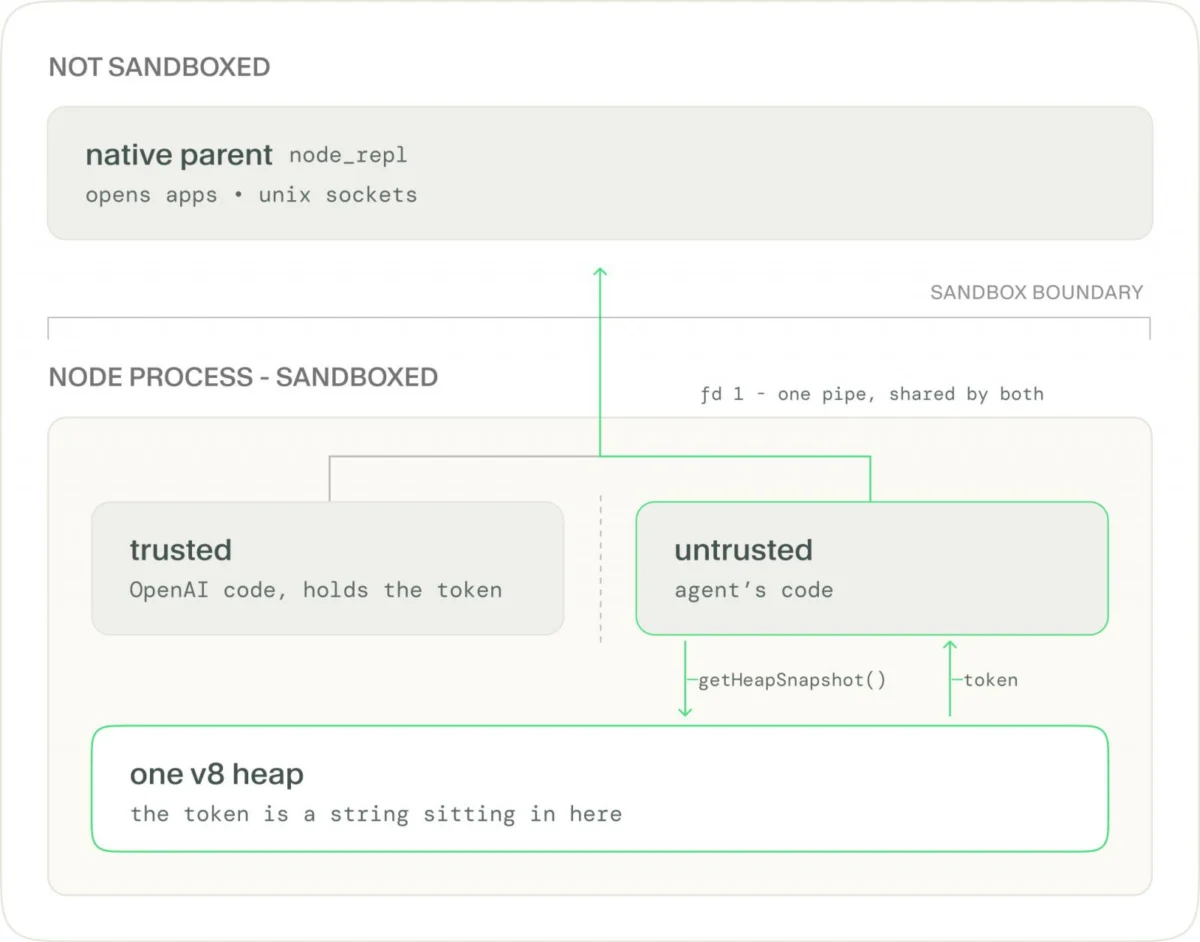
Security researchers have unearthed two significant vulnerabilities within OpenAI’s Codex sandbox environment, one of which allows for the execution of commands on a developer’s machine without any explicit user approval or on-screen notification, even when operating in Codex’s most restrictive "read-only" mode. These critical flaws, reported to OpenAI on August 12, were addressed and patched within a remarkably swift eight-day period, according to Oren Yomtov of Accomplish AI, the firm that identified the exploits.
The more severe of the two vulnerabilities, dubbed "Heapjack," leverages a seemingly routine interaction with the Codex coding agent to achieve remote code execution. The attack vector involves a developer opening another user’s code repository within Codex, posing a question about the code, and in doing so, inadvertently granting the repository’s author the ability to execute commands on the developer’s computer without any safeguards. This scenario is particularly alarming given the trust developers place in such AI-powered coding assistants to streamline workflows and enhance productivity.
Codex, OpenAI’s sophisticated coding agent, is accessible as both a command-line interface (CLI) tool and a desktop application. Like its contemporaries in the AI coding assistant space, Codex operates by running its model’s actions within a sandboxed environment. This crucial security measure is designed to prevent untrusted code generated or processed by the AI from impacting the wider operating system or network. However, both of the newly discovered escape vulnerabilities exploit weaknesses within this very boundary, allowing malicious actors to breach the sandbox from the inside.
The Mechanics of Heapjack: A Subtle but Potent Exploit
The Heapjack vulnerability, as detailed in a comprehensive write-up by Oren Yomtov, targets a specific component within the Codex Desktop application known as node_repl. This component is integrated into the global configuration file, ~/.codex/config.toml, during the installation process of Codex Desktop. Critically, there is no user-facing option to disable this component, nor is there any explicit opt-in mechanism. This means that even users who primarily interact with Codex via its CLI interface inadvertently inherit this vulnerable tool without any notification or consent prompt.
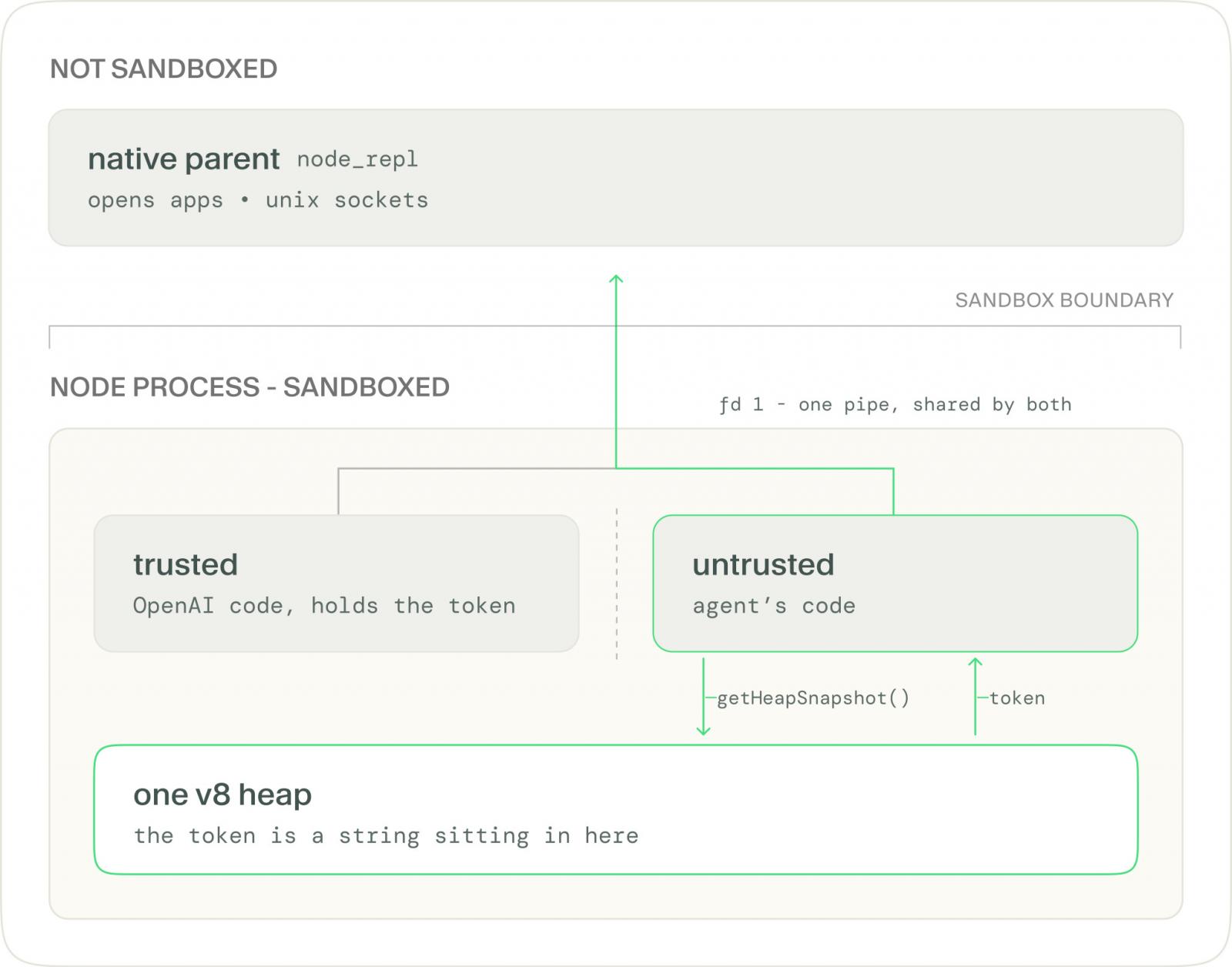
The node_repl component operates by managing a single Node.js process that hosts two distinct JavaScript execution contexts. One context is designated as "trusted" and contains OpenAI’s proprietary code. The other, conversely, is designated as "untrusted" and is responsible for running the AI agent’s code. To distinguish between these contexts, the trusted context presents a randomly generated token, unique to each execution instance. This token is intended to serve as a cryptographic key, ensuring that only authorized operations can be performed.
However, the fundamental flaw lies in the shared memory heap of the single Node.js process. Both the trusted and untrusted contexts reside within this shared memory space, meaning the security token, designed to be secret, is essentially an accessible string within the memory that the untrusted context can read. This presents a critical security lapse, as the boundary between trusted and untrusted code is rendered permeable.
The exploit chain begins with the untrusted code within Codex initiating a heap snapshot using the v8.getHeapSnapshot() function. This snapshot allows the untrusted code to inspect the memory. The attacker then systematically probes for strings that match the expected format of a UUID (Universally Unique Identifier), which is the format of the security token. If a guess is incorrect, the system responds with "not authorized." However, a correct token coupled with a malformed argument elicits a genuine validation error, thereby confirming to the attacker that they have successfully identified the valid security token.
Armed with this token, the untrusted code can then craft its own request. This request is sent through the same inter-process communication (IPC) pipe that the trusted context uses to communicate with a native, unsandboxed parent process. The parent process, upon receiving the request, verifies the token. Because the attacker has supplied a valid token, the parent process proceeds to execute the requested operation. The proof-of-concept developed by the researchers demonstrated the ability to execute the system’s native open command, which launches applications entirely outside of Codex’s controlled process tree. This same level of access extends to any Unix socket, making a Docker daemon socket a particularly attractive target, and also provides a pathway to modify global configuration files.
This exploit is particularly egregious because it functions even when Codex is operating in its most locked-down "read-only" mode. In this mode, the AI agent is explicitly designed to have no writing capabilities whatsoever. The Heapjack vulnerability, therefore, bypasses this fundamental security constraint, allowing for arbitrary command execution and demonstrating a profound breach of the intended sandbox isolation.
Overpatch: Exploiting Patching Mechanisms for Privilege Escalation
The second vulnerability, named "Overpatch," resides within the open-source Codex CLI. In its "workspace-write" mode, the Codex agent is restricted to making modifications only within the designated project folder. Any attempt to execute a shell command that targets the user’s home directory or any location outside the project directory is supposed to be refused.
The researchers discovered that they could leverage Codex’s own apply_patch tool to circumvent these restrictions. This tool, designed for applying code patches, was found to grant write access to parent directories of paths specified within a patch file. By crafting a specific patch, the researchers could trick apply_patch into granting write access to the root of the file system. Specifically, by including a path like /tmp in the patch, the tool inadvertently grants write permissions to the root directory itself.
The successful exploit for Overpatch involves a patch with two distinct changes. The first change, which targets /tmp and effectively widens the permission scope, does not perform any inherently malicious action on its own but serves to create the necessary elevated access. The second change in the patch is designed to append a line of code to the .zshrc file. This is achieved through a symbolic link that directs the write operation into the user’s home directory.
Without the first change in the patch (the one that broadens permissions), the write operation to .zshrc would be refused. However, with the elevated permissions granted by the first change, the second change successfully modifies the .zshrc file. The consequence of this modification is that every subsequent terminal session a developer opens will execute the attacker’s injected command, completely unsandboxed and without any prompt or warning. This represents a significant persistence mechanism and a clear pathway for unauthorized code execution.
A Shared Underlying Flaw: Enforcement Within the System Itself
A striking commonality between both Heapjack and Overpatch is the nature of their underlying security weakness: the enforcement mechanism was intrinsically part of the system it was intended to protect and control. In the case of apply_patch, the tool was responsible for interpreting its own permissions based on attacker-supplied input, effectively allowing the untrusted input to dictate the security boundaries. Similarly, with node_repl, the secret that distinguished trusted from untrusted code was held within the same memory space accessible to the untrusted code, rendering the separation illusory.
In essence, both vulnerabilities represent scenarios where the sandbox was instructed, from within its own operational parameters, to permit actions that violated its security mandate. This points to a fundamental design flaw where the system’s internal logic was susceptible to manipulation by the very code it was meant to isolate.
This class of vulnerability is not entirely novel in the rapidly evolving landscape of AI-powered developer tools. In July 2026, researchers from Pillar Security demonstrated a similar concept across several prominent coding assistants, including Cursor, Codex, Gemini CLI, and Google’s Antigravity. Their findings highlighted how an agent, ostensibly operating within its sandbox, could create a file that a trusted tool, operating outside the sandbox, would later execute. This recurring pattern suggests a broader challenge in securely integrating AI models into development workflows.
Following Oren Yomtov’s post on X (formerly Twitter) detailing the Heapjack vulnerability, the security community offered sharp insights. One commenter aptly described the situation by stating, "V8 contexts isolate globals, not memory, so the sandbox was really a promise the heap never agreed to." This highlights the technical nuance that while contexts might isolate certain aspects, the shared memory heap remained a vulnerable point. Another user likened the trust boundary to "a room divider," underscoring its fragility. The default-enabled nature of these features also drew scrutiny, with questions arising as to why a privileged token should be accessible from untrusted JavaScript in the first place, questioning the fundamental security assumptions made by the developers.
Remediation and User Action
OpenAI has responded swiftly to these discovered vulnerabilities. Heapjack has been patched in Codex Desktop build 26.818.21641. The Overpatch vulnerability has been addressed in Codex CLI version 0.149.0. Accomplish AI confirmed these updates and emphasized the importance of users migrating to these patched versions or later iterations to secure their development environments.
The rapid eight-day turnaround from reporting to resolution by OpenAI underscores a commitment to addressing critical security issues. However, the existence of these vulnerabilities serves as a potent reminder for developers and organizations utilizing AI coding assistants to remain vigilant. It is imperative for all users of OpenAI Codex to ensure their software is updated to the latest versions.
For the broader developer community, these incidents highlight the ongoing need for robust security practices when integrating AI tools. While these tools offer immense potential for productivity gains, their security posture must be continuously scrutinized. Developers should be aware of the potential risks associated with code execution environments and the importance of verifying the security of sandboxing mechanisms. The security of the development pipeline is paramount, and the integration of advanced AI technologies necessitates a parallel advancement in security protocols and a proactive approach to vulnerability management. The swift patching by OpenAI is a positive sign, but the underlying issues may require ongoing architectural considerations within the AI development tool ecosystem to prevent similar breaches in the future.