Sisilia Frederika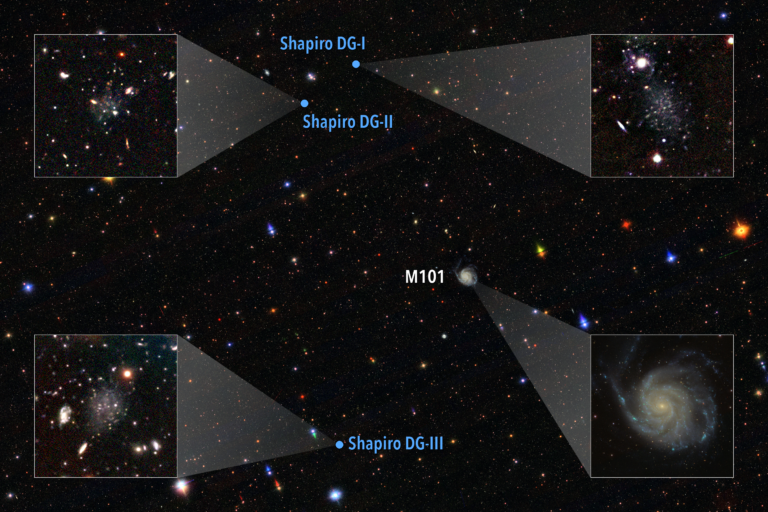
In the complex and vast field of astrophysics, it is exceptionally rare for a researcher to have celestial bodies named after them before completing an undergraduate degree. However, Julian Shapiro, currently an astrophysics student at the University of California, Berkeley, has achieved this distinction through the discovery of three unique dwarf galaxies. Now officially designated as Shapiro I, II, and III, these systems were identified while Shapiro was still a high school student conducting independent research. Located in the galactic neighborhood of the large spiral galaxy Messier 101 (M101), these galaxies are challenging established models of star formation and providing new insights into the "backsplash" phenomenon in cosmic evolution.
The discovery has garnered significant attention within the scientific community, not only for the age of the researcher but for the specific physical characteristics of the galaxies themselves. These dwarf galaxies appear to be "quenched," meaning they have ceased the process of star formation, despite existing in relatively isolated regions of space. Under standard cosmological models, isolated dwarf galaxies should possess enough cold gas to continue birthing stars. The fact that Shapiro I, II, and III do not suggests a more violent and interactive history than their current positions would imply.
The Nature and Significance of Dwarf Galaxies
To understand the weight of Shapiro’s discovery, one must first look at the role of dwarf galaxies in the broader context of the universe. Dwarf galaxies are the most common type of galaxy in the cosmos, yet they remain among the most difficult to study due to their low luminosity and small mass. They can contain anywhere from a few thousand to several billion stars—a stark contrast to the hundreds of billions of stars found in larger spirals like the Milky Way or M101.
Dwarf galaxies are often categorized by their shapes and stellar populations, ranging from dwarf ellipticals and spheroidals to irregulars. Astronomers view these smaller systems as the "building blocks" of the universe. According to the hierarchical model of galaxy formation, larger galaxies are built through the merger and accretion of these smaller dwarf systems. Consequently, studying the behavior of dwarf galaxies provides a window into the conditions of the early universe and the mechanics of galactic growth.
The primary mystery surrounding Shapiro I, II, and III involves their "quenched" status. In the local universe, dwarf galaxies generally follow a predictable pattern: those located near massive host galaxies tend to be quenched because the larger galaxy’s gravity and radiation strip away the smaller galaxy’s star-forming gas. Conversely, those found in isolation—the "field galaxies"—are typically rich in gas and actively forming new stars. The Shapiro galaxies break this rule, existing in isolation while remaining devoid of new star birth.
The Backsplash Hypothesis and Galactic Dynamics
Shapiro’s research, recently published in The Astrophysical Journal, proposes a compelling solution to this paradox: the "backsplash" galaxy theory. This hypothesis suggests that these dwarf galaxies were not always isolated. Instead, they likely followed a trajectory that took them deep into the gravitational well of a larger neighbor—most likely the Pinwheel Galaxy (M101)—before being "slung" back out into intergalactic space.
During this close encounter, the dwarf galaxies would have experienced "ram-pressure stripping." This occurs when a galaxy moves through the hot, tenuous gas (the circumgalactic medium) surrounding a larger galaxy. The resulting pressure acts like a wind, blowing the cold star-forming gas out of the smaller galaxy. Once this gas is removed, the dwarf galaxy can no longer produce stars. Following this interaction, gravitational three-body effects or high-velocity trajectories can eject the dwarf galaxy to its current, isolated position.
While the Lambda-Cold Dark Matter (ΛCDM) model—the current standard model of cosmology—predicts the existence of such backsplash galaxies, they have proven notoriously difficult to identify in the local universe. The discovery of Shapiro I, II, and III provides critical observational evidence that supports these theoretical simulations. Shapiro utilized complex simulations to determine that the low star-formation rates in these three galaxies could not have occurred naturally in isolation; an external gravitational influence was a mathematical necessity.
Chronology of a Discovery
The journey toward this discovery began several years ago when Shapiro, then a high school student, began mining public archival telescope data. Accessing databases from major observatories, he focused on the region surrounding M101, a face-on spiral galaxy approximately 21 million light-years from Earth. By analyzing the light signatures and positions of faint objects in the field, he identified three candidates that did not fit the profile of typical satellite galaxies or distant background objects.
Shapiro’s work involved meticulous distance estimation to confirm that these galaxies were indeed in the vicinity of M101 and not vastly more distant systems appearing small due to perspective. His sophisticated methodology and the resulting paper earned him the prestigious Davidson Fellowship, a scholarship awarded to students who have completed "significant work" with the potential to make a positive contribution to society.
Upon transitioning to undergraduate studies at UC Berkeley, Shapiro joined the research group of Alexei Filippenko, one of the world’s most highly cited astrophysicists. Filippenko’s team is renowned for its work on supernovae, black holes, and the expansion of the universe. Shapiro is currently contributing to cosmological measurements related to the Hubble Constant—the unit of measurement used to describe the expansion rate of the universe—while continuing follow-up research on his eponymous galaxies.
Mentorship and Academic Reaction
The academic community has reacted with high praise for both the discovery and the initiative shown by the young researcher. Alexei Filippenko noted that the level of sophistication in Shapiro’s high school research was "highly unusual."
"I feel very fortunate that he chose UC Berkeley for his undergraduate studies in astrophysics, and especially that he decided to join my research team," Filippenko stated. He emphasized that Shapiro’s ability to navigate complex data sets and produce a peer-reviewed paper in a top-tier journal like The Astrophysical Journal speaks to a high level of maturity and technical skill.
For Shapiro, the work is about more than just personal achievement; it is about the democratization of science. "I envision my work serving as inspiration for young people aspiring to pursue research in astrophysics," Shapiro said. He pointed out that while school curriculums often offer only a cursory glance at astronomy, the availability of public archival data means that the barriers to entry are lower than ever for motivated students.
"My paper demonstrates that public archival telescope data is a critical tool for new discoveries in our understanding of cosmology and how our universe evolved, and that young astronomers are capable of uncovering these findings," he added.
Supporting Data and Technical Challenges
The identification of Shapiro II provides an interesting subset of the data. While Shapiro I and III are more clearly associated with the M101 group, Shapiro II lies in close proximity to the spiral galaxy NGC 5585. This raises the possibility that Shapiro II might be a satellite of that specific galaxy rather than a backsplash candidate from M101.
Determining the exact three-dimensional positions of these galaxies requires precise distance measurements, often using the "Tip of the Red Giant Branch" (TRGB) method. This involves observing the brightest red giant stars in a galaxy to calculate how far away the system is. Shapiro has emphasized that follow-up observations using high-resolution space-based assets, such as the Hubble Space Telescope or the James Webb Space Telescope (JWST), will be necessary to confirm the backsplash status of these objects with absolute certainty.
Furthermore, the research highlights a "missing link" in galactic evolution. If backsplash galaxies are as common as models suggest, there should be many more of them scattered throughout the local volume of the universe. The Shapiro galaxies serve as a proof-of-concept for how to identify these "quenched isolates" by looking for specific markers of gas depletion in regions where gas should otherwise be abundant.
Future Implications and the Vera C. Rubin Observatory
The discovery of Shapiro I, II, and III sets the stage for a new era of "big data" astronomy. The upcoming Vera C. Rubin Observatory, currently under construction in Chile, is expected to revolutionize this field. The observatory’s Legacy Survey of Space and Time (LSST) will conduct a decade-long session of imaging the entire southern sky every few nights.
The Rubin Observatory is expected to uncover thousands of previously unknown dwarf galaxies, many of which will likely be identified as backsplash candidates. Shapiro’s current work provides the foundational modeling and analysis code that future researchers will use to process the massive influx of data from the Rubin Observatory.
By mapping the exact positions and star-formation histories of these galaxies, astronomers can better understand the "environmental quenching" process. This, in turn, allows for more accurate refinements of the ΛCDM model, helping to solve long-standing puzzles such as the "missing satellite problem"—the discrepancy between the number of dwarf galaxies predicted by dark matter simulations and the number actually observed.
A New Generation of Astrophysical Inquiry
As Julian Shapiro continues his studies at UC Berkeley, the "Shapiro Three" remain a testament to the power of independent research and the utility of open-access scientific data. His success highlights a shift in the scientific landscape, where high-level research is no longer confined to those with decades of experience, provided they have access to the right tools and mentorship.
The implications of his discovery extend from the immediate dynamics of the M101 group to the very edge of cosmological theory. By proving that isolated, quenched dwarf galaxies exist and can be found through diligent archival search, Shapiro has opened a new door for understanding how galaxies interact, lose their life-sustaining gas, and navigate the gravitational tides of the local universe. The scientific community now looks toward future high-resolution observations to further validate these findings and to see what other secrets the Shapiro galaxies might hold about the history of our cosmic neighborhood.