Lina Irawan
The initial allure of building a bespoke internal Artificial Intelligence (AI) knowledge system has become a siren song for modern engineering departments. For teams possessing the technical acumen to deploy a vector database and configure a basic Retrieval-Augmented Generation (RAG) pipeline, the project often begins with a sense of deceptive simplicity. By connecting a few data sources and indexing documentation, a functional prototype can frequently be realized within a weekend. However, industry data and emerging post-mortems from enterprise AI initiatives suggest that this "weekend project" frequently transforms into a permanent, high-maintenance burden for platform teams within six months of deployment.
The discrepancy between the perceived ease of construction and the reality of long-term operation stems from a fundamental misunderstanding of the problem space. While a vector database is a commodity component, a governed knowledge pipeline is a complex institutional asset. The former is a technical implementation; the latter is a challenge of trust, compliance, and continuous maintenance that scales non-linearly with every new data source, stale document, and AI agent integrated into the ecosystem. As organizations move beyond the experimental phase of generative AI, the focus is shifting from simple retrieval to the creation of robust, "production-grade" knowledge lifecycles.
The Architecture of a Production-Grade Knowledge Pipeline
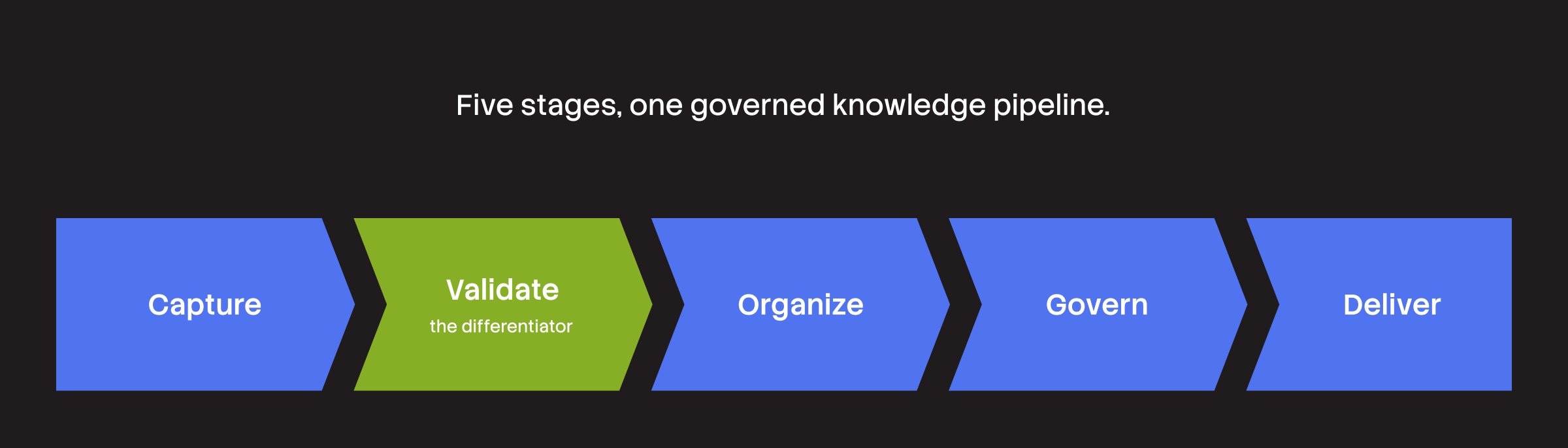
To understand the operational costs, it is necessary to deconstruct the internal AI knowledge system into its five constituent stages: Capture, Validate, Organize, Govern, and Deliver. While each stage appears manageable in isolation, the compounding complexity of maintaining these systems creates a significant "technical tax" on engineering resources.
1. Capture: Beyond Simple Connectivity
The first stage, Capture, involves pulling data from disparate tools like Slack, Confluence, GitHub, and Jira. While writing an initial connector is straightforward, the long-term challenge lies in API evolution. Enterprise software vendors frequently update their APIs, modify permission structures, and change data schemas. A pipeline built on bespoke connectors requires constant vigilance; every update from a third-party vendor can break the ingestion flow, necessitating manual intervention to reconnect tools and adjust permissions.
Furthermore, the Capture stage must address the problem of data redundancy. Without sophisticated deduplication, the system may ingest the same document through three different channels, leading to conflicting versions and "hallucination" risks when the AI retrieves multiple, slightly different answers to the same query.
2. Validation and the "Knowledge Node"
The most critical differentiator in modern systems is the Validation stage. Traditional RAG pipelines often treat all captured content as equally trustworthy, a strategy that many experts now identify as the single greatest mistake in enterprise AI. Some knowledge is authoritative, such as a finalized company policy, while other data might be a discarded Slack decision that was never officially labeled as obsolete.
To solve this, advanced systems are moving toward the concept of a "knowledge node." Unlike a raw stored copy of a document, a knowledge node is a living record that carries metadata regarding its substance, origin, ownership, and current trust level. This ensures that if a source tool is decommissioned, the intrinsic knowledge remains accessible and contextualized.
3. Organization and Scoping
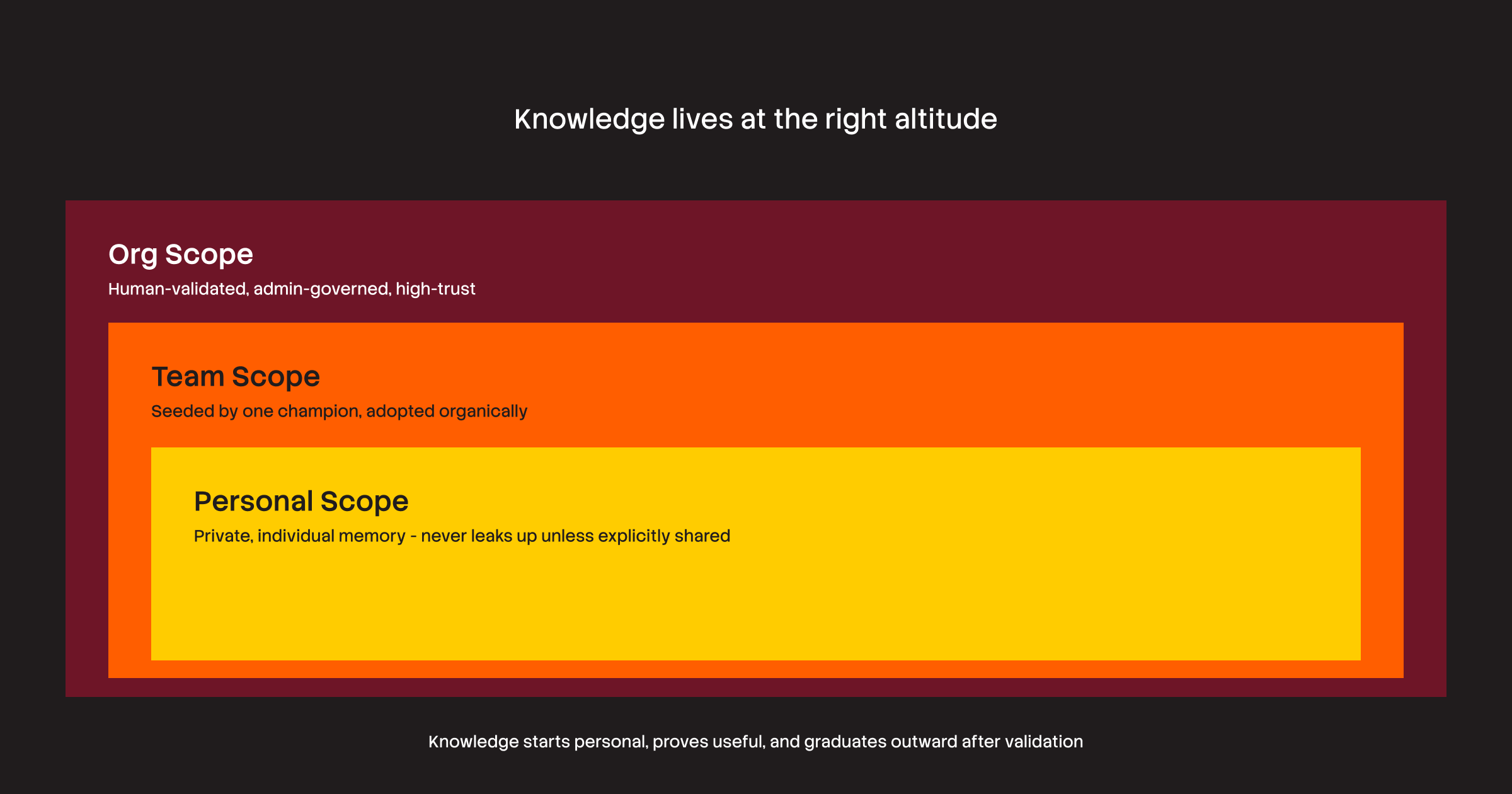
Organization involves more than just sorting content by team. It requires logic that understands the "altitude" of knowledge. Information typically follows a trajectory from personal notes to team-level collaboration and, eventually, to the organizational source of truth. A production-grade system must automate this migration. If an engineer repeatedly explains a specific service architecture to an AI tool, that information should eventually settle into a team-wide scope without requiring manual filing. This prevents the "undifferentiated room" problem, where users must wade through a sea of irrelevant data to find specific answers.
4. Governance and Compliance
Governance is often the stage that catches engineering teams off guard during the first security audit. Security and compliance departments require more than basic access controls; they demand granular permissioning, approval rules, and a comprehensive audit history. As AI agents take on more consequential tasks—such as informing product decisions or answering support queries—the ability to trace an AI’s output back to a specific, validated piece of content approved by a named reviewer becomes a legal and operational requirement.
5. Delivery and the Model Context Protocol (MCP)
Finally, the Delivery stage must ensure that every AI agent in the company is working from the same up-to-date, trustworthy dataset. This is increasingly being facilitated by the Model Context Protocol (MCP), a standardized interface that allows for composable retrieval. By using a standardized protocol, organizations can query the current state of a knowledge graph rather than relying on stale snapshots, ensuring that the AI’s responses are both proactive and accurate.
Chronology of the Enterprise AI Knowledge Evolution
The shift from "Build" to "Buy" in the knowledge infrastructure space follows a clear chronological path over the last two years:
- Phase 1: The Exploration Era (Late 2022 – Early 2023): Following the release of ChatGPT, enterprises began experimenting with LLMs. Initial efforts focused on "chatting with your docs" using basic PDF parsers and open-source vector databases.
- Phase 2: The RAG Proliferation (Mid 2023): Engineering teams realized that LLMs required external context to be useful. RAG became the standard architecture. Teams built internal pipelines, viewing them as a competitive advantage.
- Phase 3: The Maintenance Wall (Early 2024): Organizations that built internal systems in 2023 began to see the "six-month decay." Platform teams reported that 70-80% of their time was spent fixing broken connectors and addressing user complaints about stale or inaccurate AI responses.
- Phase 4: The Industrialization Era (Present): Enterprises are now seeking "governed knowledge platforms." The focus has shifted from the underlying database to the workflows of validation, trust decay management, and compliance.
Supporting Data and Economic Implications
The decision to build versus buy knowledge infrastructure is increasingly driven by Total Cost of Ownership (TCO) analysis. Industry benchmarks suggest that maintaining a custom-built, production-grade knowledge pipeline requires a minimum of two to three dedicated full-time engineers. In the current market, where senior platform engineer salaries range from $150,000 to $250,000, the baseline operational cost of a "homegrown" system can exceed $500,000 annually, excluding infrastructure and API costs.
Moreover, the opportunity cost is significant. Engineering hours spent maintaining connectors and tuning trust models are hours not spent on a company’s core product. According to a 2023 Gartner report on AI adoption, "the complexity of data integration and the lack of specialized talent are the two primary reasons why 80% of enterprise AI projects fail to scale beyond the pilot phase."
The Trust Decay Model: A Fact-Based Analysis
One of the most complex technical challenges identified in the original article is "trust decay." Information is not static; a technical specification that was accurate six months ago may be misleading today. Advanced platforms now utilize a dual-mode validation system to manage this:
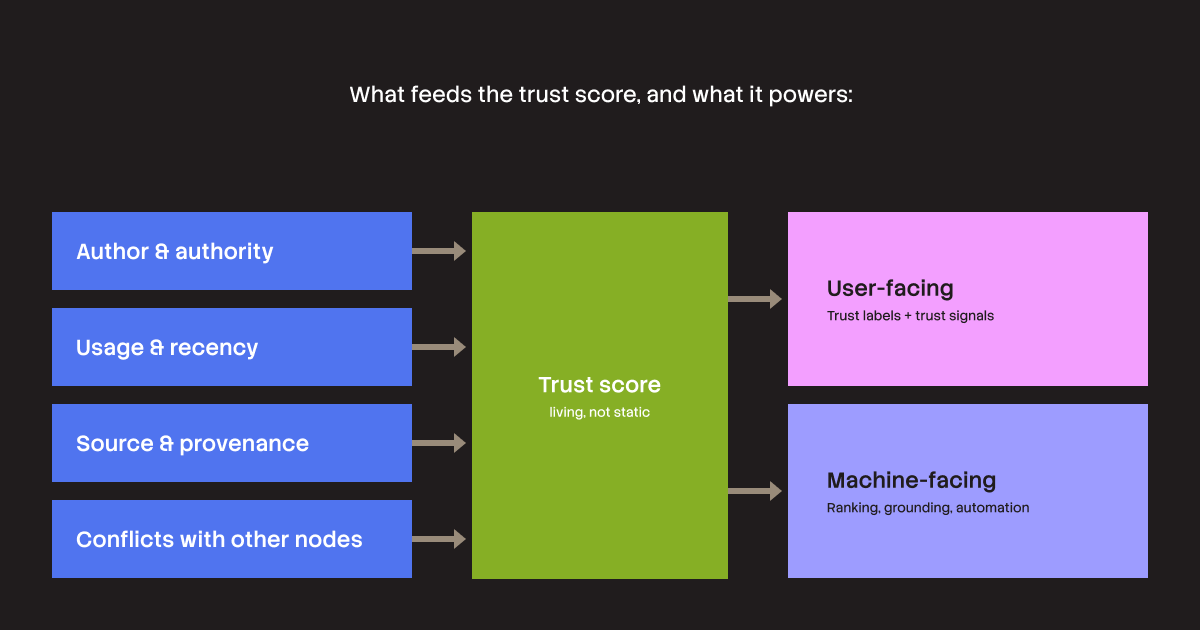
- Implicit Trust: This is the default mode where the system automatically assigns trust scores based on authorship, usage, and recency. For example, a merged Pull Request from a principal engineer might automatically receive a high trust score.
- Explicit Trust: This serves as a human-in-the-loop fallback. When a piece of knowledge falls below a certain confidence threshold—perhaps because it hasn’t been accessed in months or conflicts with a newer document—the system triggers a "one-tap revalidation" request to the content owner.
The health of a knowledge system is increasingly measured by the "Human Interruption Metric." A high-performing system handles the vast majority of validation automatically, driving the number of human interruptions toward zero while maintaining high accuracy.
Industry Perspectives and Strategic Responses
Industry analysts have noted that the "Build" approach is only justifiable for companies where knowledge infrastructure itself is the primary product or a unique competitive differentiator. For the vast majority of product-focused companies, the pipeline is viewed as a utility that must work reliably without draining engineering resources.
"We are seeing a maturation of the AI stack," says one industry analyst specializing in developer tools. "In the same way that companies stopped building their own database engines or cloud infrastructure, we are seeing a shift away from building bespoke knowledge pipelines. The focus is now on the quality of the data and the governance of the output."
Platforms like Stack Internal are positioning themselves to absorb these operational costs. By providing a stable connector framework, automated validation workflows, and native MCP support, these platforms allow engineering teams to focus on application-level innovation rather than the "plumbing" of AI context layers.
Broader Impact and Implications for the Future
The move toward governed, trusted knowledge pipelines has implications that extend beyond simple search and retrieval. As AI agents become more autonomous, their reliance on a "source of truth" becomes absolute. An autonomous agent tasked with processing a customer refund or updating a deployment script cannot operate on "maybe" or "stale" information.
The emergence of the Model Context Protocol (MCP) suggests a future where knowledge is not just stored, but is "composable." In this future, different AI agents—from coding assistants to HR bots—will all plug into a centralized, governed knowledge graph. This standardization will likely lead to a new category of "Knowledge Administrators" within IT departments, responsible for overseeing the health and governance of the institutional brain, rather than just the underlying servers.
Ultimately, the build vs. buy decision for knowledge infrastructure boils down to organizational focus. While building a vector database is a task within reach for most competent engineering teams, building a system that maintains trust, ensures compliance, and scales with the sophistication of the modern AI stack is a different class of problem entirely. For most, the path forward involves leveraging specialized platforms that treat knowledge not as a static file, but as a living, governed asset.