Lina Irawan
For many modern engineering teams, the decision to construct an internal artificial intelligence knowledge system begins with a deceptive sense of simplicity. In the current technological landscape, the components required to build a basic Retrieval-Augmented Generation (RAG) pipeline are readily available: a vector database, a set of standard connectors, and an orchestration layer to point the system at existing documentation. However, industry data suggests that while the initial prototype may take only a weekend to assemble, the transition to a production-grade system often transforms into a permanent maintenance burden for platform teams within six months. This shift occurs because a "vector database" and a "governed knowledge pipeline" represent two fundamentally different classes of engineering challenges. The former is a storage solution, while the latter is a complex infrastructure involving trust, compliance, and continuous validation that compounds in difficulty with every new data source and AI agent integrated into the stack.
The Lifecycle of Internal AI Development: A Chronology of Complexity
The trajectory of an internal AI knowledge project typically follows a predictable timeline that highlights the hidden costs of custom-built infrastructure. In the first month, the "Experimental Phase," a small team successfully connects a vector database to primary documentation sources like Confluence or GitHub. The initial results are promising, as the AI can answer basic queries using retrieved snippets. By month three, the "Integration Phase," the team attempts to expand the system to include more dynamic sources such as Slack threads and Jira tickets. At this stage, the first significant hurdles emerge: duplicate data, outdated information being prioritized over current policies, and the realization that vendor API updates frequently break custom-built connectors.
By the six-month mark, known as the "Governance Crisis," the project often reaches a tipping point. Security and compliance departments begin to raise questions regarding data residency, permission inheritance, and the risk of sensitive information leaking across departmental boundaries. What began as a streamlined engineering project evolves into a full-time operational commitment. At this stage, the platform team is no longer building new features; instead, they are consumed by "janitorial" tasks—re-validating stale data, fixing broken connectors, and manually adjusting access controls. This progression underscores the reality that the primary cost of AI infrastructure is not the initial build, but the long-term governance and maintenance required to keep the system trustworthy.
The Five Pillars of a Production-Grade Knowledge Pipeline
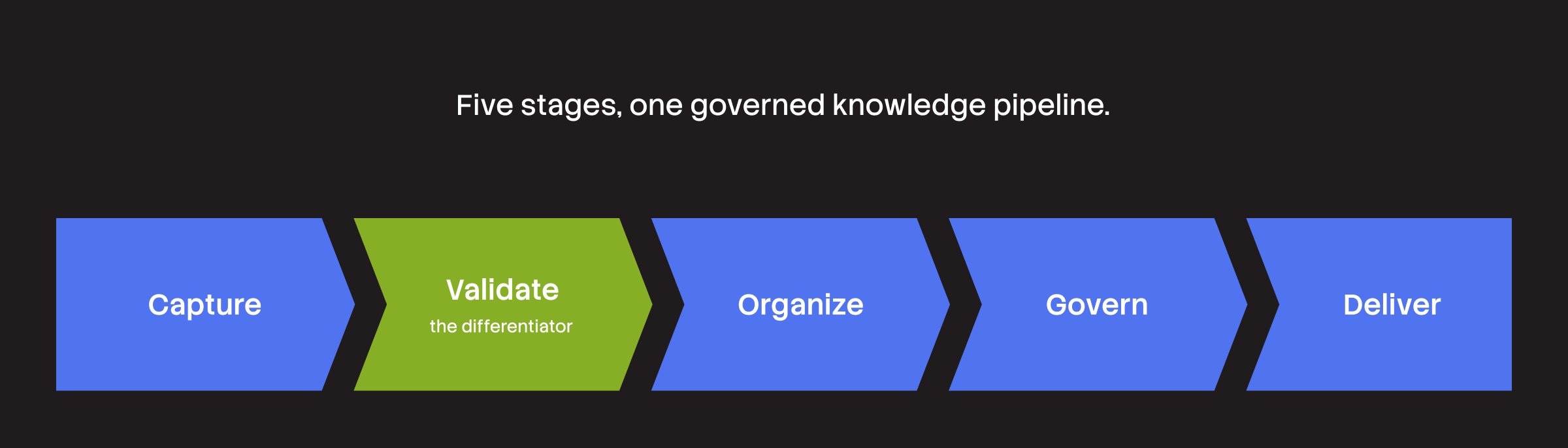
To understand why internal builds often falter, it is necessary to deconstruct the five essential stages of a professional knowledge pipeline: Capture, Validate, Organize, Govern, and Deliver. Each stage presents unique challenges that scale non-linearly with the size of the organization.
1. Capture: Moving Beyond Simple Connectors
The "Capture" stage is often underestimated as a simple matter of data ingestion. However, professional-grade capture requires maintaining stable connections across a shifting landscape of third-party APIs. When a vendor updates their authentication protocol or data schema, a custom-built connector often fails, requiring immediate developer intervention to prevent data gaps. Furthermore, effective capture must handle "de-duplication." Without sophisticated logic, an AI might ingest three different versions of the same policy from three different platforms, leading to conflicting answers.
The objective of a modern capture layer is to produce a "knowledge node" rather than a mere copy of a document. A knowledge node is a living record that carries metadata regarding its origin, ownership, and reliability. This ensures that even if the original source tool is deprecated, the institutional knowledge remains intact and contextually grounded.
2. Validation: The Differentiator of Trust
Validation is the most critical stage for enterprise adoption. Treating all captured content as equally authoritative is a common failure point in DIY pipelines. In an enterprise environment, some information is definitive (e.g., a finalized HR policy), while other information is transient or speculative (e.g., a brainstorm in a Slack channel).
A robust pipeline utilizes a dual-mode validation system:
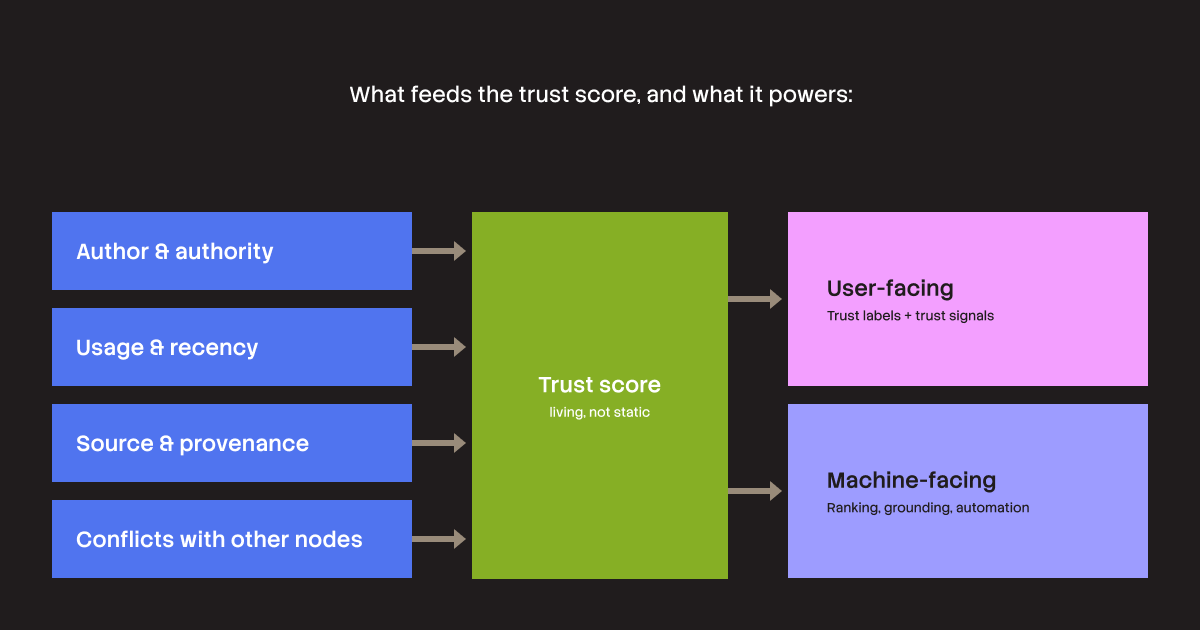
- Implicit Trust: The system automatically assigns trust scores based on authorship authority, usage frequency, and recency. For example, a merged pull request from a principal engineer naturally carries more weight than a draft note.
- Explicit Trust: This serves as a human-in-the-loop fallback. When the system detects a "trust decay"—such as a document that hasn’t been updated in six months or conflicting information between two sources—it triggers a lightweight re-validation request to the content owner.
3. Organization: Scoping and Contextual Altitude
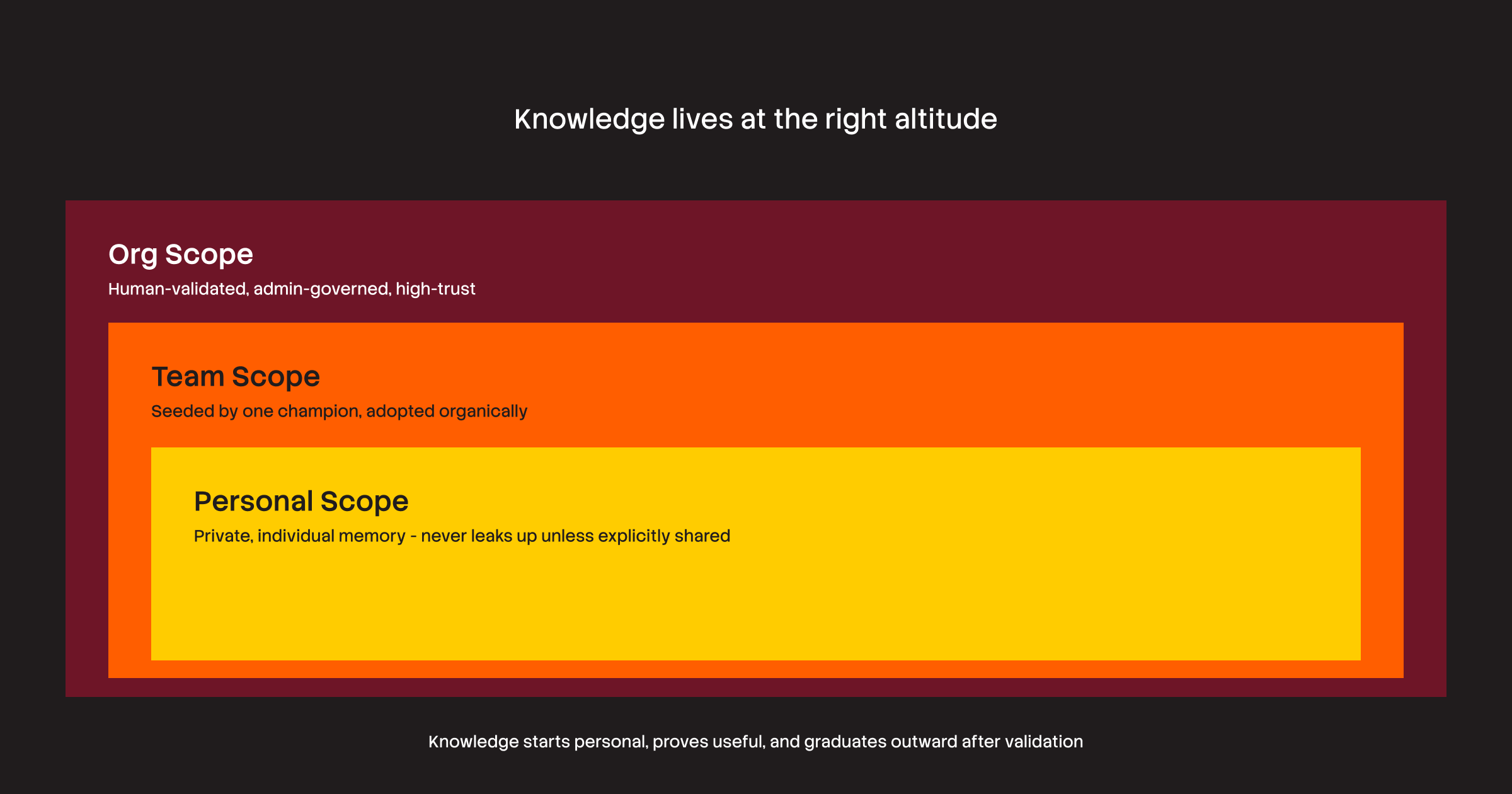
Not all knowledge is intended for a company-wide audience. A decision made by a specific engineering squad regarding their microservice architecture should not necessarily influence the global AI’s response to a general product query. Effective organization solves this through "scopes." Knowledge should naturally settle into Personal, Team, or Organizational altitudes.
In a professional pipeline, this organization is auto-populated rather than manually filed. By inheriting permissions from the source (such as a private GitHub repo), the system ensures that a developer’s personal notes do not leak to the wider organization unless explicitly shared. This prevents the "undifferentiated data pool" problem, where users must wade through irrelevant search results to find pertinent information.
4. Governance: Compliance and Auditability
As AI agents take on more consequential tasks—such as informing financial decisions or interacting with customers—the "Govern" stage becomes a legal necessity. Governance requires more than basic access controls; it demands a full audit trail. Organizations must be able to trace any AI-generated output back to a specific, validated piece of content, approved by a verified reviewer on a specific date.
Furthermore, governance must integrate with existing Enterprise IT tools. This includes bulk provisioning via Identity Providers (IDPs), setting agent guardrails per context, and providing observability into "knowledge health." Without these features, AI systems often fail to pass the rigorous security audits required for company-wide rollouts.
5. Delivery: Proactive vs. Reactive Retrieval
The final stage is the delivery of information to the end-user or agent. While most DIY systems are reactive (answering a prompt), production-grade systems are increasingly proactive. A proactive delivery system surfaces relevant knowledge before a user even asks—for instance, providing a "lessons learned" document when an engineer opens a new service ticket for a known recurring issue.
The emergence of the Model Context Protocol (MCP) has standardized this delivery layer. By using a standardized interface, organizations can ensure their AI agents are querying a current, validated state of the "knowledge graph" rather than a stale snapshot stored in a basic vector database.
Supporting Data: The Economic Reality of Build vs. Buy
The economic argument for buying a managed knowledge platform over building an internal one is supported by recent industry trends. According to data from the 2023 McKinsey Global Survey on AI, organizations that successfully scale AI initiatives spend significantly more on "data readiness" and "governance infrastructure" than on the models themselves. Specifically, for every dollar spent on AI model development, successful firms spend approximately three dollars on data management and integration.
Furthermore, the "opportunity cost" for engineering teams is a major factor. A 2024 report on developer productivity found that engineers at mid-to-large enterprises spend up to 42% of their time dealing with technical debt and maintenance of internal tools. For a product-focused company, diverting a platform team to maintain an AI pipeline can delay the core product roadmap by months, if not years.
Industry Perspectives and Strategic Implications
Market analysts suggest that the "Build vs. Buy" decision for AI infrastructure is currently undergoing a shift similar to the one seen in the cloud computing market a decade ago. Initially, many large firms attempted to build their own private clouds, only to realize that the operational overhead was unsustainable compared to managed services like AWS or Azure.
"The challenge isn’t just the technology; it’s the sociology of knowledge," notes one industry analyst specializing in enterprise AI. "Building a database is an engineering task. Building a system that ensures 5,000 employees are looking at the same ‘single source of truth’ is a management and governance task. Most engineering teams are not equipped, nor do they want, to be the ‘truth police’ for the entire company."
This sentiment is echoed by security officers who emphasize that the stakes for AI are higher than for traditional search. If a search engine returns a wrong link, the user ignores it. If an AI agent provides a confident but incorrect answer based on a stale document, it can lead to costly operational errors or compliance violations.
Conclusion: The Path Toward Managed Knowledge Infrastructure
As the AI landscape matures, the distinction between a "project" and a "platform" becomes clearer. While building a custom RAG pipeline remains an excellent way for teams to understand the mechanics of LLMs, it is increasingly viewed as an inefficient way to manage enterprise-scale knowledge. The move toward platforms like Stack Internal reflects a broader industry trend toward "absorbing the complexity" of the five-stage pipeline.
By automating the capture, validation, and governance of knowledge, organizations can ensure their AI initiatives remain focused on delivering value rather than maintaining infrastructure. The ultimate metric for success in this space is not how many documents are in the database, but how many human interruptions were avoided because the system automatically identified, validated, and delivered the right information at the right time. For most companies, the strategic advantage lies not in owning the pipeline, but in the speed and accuracy with which they can utilize the knowledge flowing through it.