Clarissa Hana
The modern workplace is increasingly intertwined with artificial intelligence, with tools like ChatGPT becoming ubiquitous for tasks ranging from drafting emails to complex problem-solving. However, this rapid adoption presents significant security challenges, particularly when employees use personal accounts for AI interactions on company-managed devices. A hypothetical scenario, detailed by Vakaris Noreika, VP of Product Research and Development at NordLayer, vividly illustrates the potential pitfalls and the critical need for robust security measures. This article expands upon that scenario, delving into the broader implications and providing a comprehensive overview of the risks and solutions involved.
The Hypothetical Breach: A Monday Morning Wake-Up Call
Imagine a typical Monday morning in a corporate security operations center (SOC). Security tools, meticulously configured to monitor network activity, suddenly trigger an alert. The notification points to the personal use of ChatGPT on a managed laptop, a concerning development given that the organization subscribes to ChatGPT Enterprise, the sanctioned corporate solution. This immediate discrepancy—personal use coinciding with available enterprise access—raises a cascade of urgent questions for the security team.
The critical unknown is the nature of the data submitted to the personal ChatGPT instance. Could it be a publicly available job description, a relatively benign piece of information? Or, more alarmingly, could it be a customer support ticket containing sensitive contact details, internal account information, or even proprietary data? For organizations operating in sensitive sectors, such as government or defense, the potential exposure is even graver. The acting director of the Cybersecurity and Infrastructure Security Agency (CISA), Madhu Gottumukkala, himself acknowledged the risks in 2025, reportedly using ChatGPT for sensitive governmental tasks, underscoring the pervasive nature of this challenge across industries.
This scenario, while hypothetical, serves as a powerful case study for examining the gaps in current security postures and the efficacy of advanced solutions. We will explore two distinct pathways of this event: one representing a company with standard security controls, and the other, a company leveraging a specialized AI security tool.
Scenario 1: The Standard Security Protocol – A Reactive Approach
In the first version of this event, the organization’s existing security infrastructure detects the use of a personal ChatGPT account on a corporate laptop. The alert flags the personal account login, but crucially, the current configuration lacks the granular visibility to inspect the actual content being inputted into the AI model. This leaves the security team in a reactive position, armed with an alert but without immediate insight into the nature of the potential breach.
Step 1: Identifying the User and the Discrepancy
The initial investigative step involves correlating the flagged activity with a specific employee. The security team accesses the event logs, which may reveal that while the employee logged into the corporate network with their work email, the ChatGPT session originated from a personal Gmail address. This immediately establishes a disconnect: one employee, two distinct digital identities, and the inevitable need for a direct, potentially uncomfortable conversation. The process of linking the corporate identity to the personal AI usage is a manual and time-consuming endeavor.
Step 2: Unraveling the Data Submission – The Manual Inquiry
Without prompt-level visibility, the retained event data offers little more than the fact of personal account usage. There is no record of the actual prompt text or any direct identification of sensitive data. To ascertain what was shared, the security team must initiate an incident review procedure. This typically involves directly requesting the employee to produce the relevant conversation history. The request needs to be carefully worded to avoid an exhaustive and irrelevant deep dive into the employee’s personal queries.
Let’s assume, for the sake of this example, that the employee readily provides the information, and the prompt clearly shows a customer support ticket, complete with contact information and account details, being pasted into ChatGPT. The AI’s response further elaborates on the ticket’s content, confirming that sensitive customer data has indeed been shared with an external, unmanaged service. This revelation triggers a formal data breach investigation, requiring the involvement of legal, compliance, and privacy teams.
Step 3: Addressing the Unused Corporate Resource
A critical question arises: why did the employee opt for a personal ChatGPT account when a corporate enterprise subscription is available and paid for? The explanation is often a mundane, yet significant, operational hurdle. The corporate ChatGPT session may have expired, the multi-factor authentication (MFA) process might have been cumbersome or experienced delays, or the employee, facing an urgent customer issue, simply defaulted to the readily available personal tool. This highlights a common disconnect between security policy and user workflow. The employee, under pressure, likely sought the quickest solution, inadvertently bypassing established security protocols.
Without proactive prompt-level controls, the security team is left to rely on the employee’s recollection of past behavior. They must inquire about previous instances of pasting entire tickets, uploading attachments, or creating shared conversation links using personal accounts. Furthermore, they need to assess the employee’s understanding of the company’s AI usage policy, which often mandates the use of approved enterprise solutions for any work-related AI interactions. Misunderstandings about the scope of approved tools and data can lead to unintentional policy violations.
Step 4: Responding to the Confirmed Data Exposure
The confirmed ingress of customer data into a personal ChatGPT account necessitates a formal response. The security team must meticulously preserve all relevant evidence, including screenshots, timestamps, and conversation logs, to facilitate an accurate assessment of the incident’s severity. This evidence is then presented to the incident response team, data privacy officers, and relevant data owners.
The gravity of the situation is judged based on the nature of the exposed data. If credentials were compromised, immediate action is required for revocation or rotation. If customer records were involved, a thorough privacy impact assessment becomes paramount. Even if only publicly available text was shared, it still warrants a conversation with the employee, reinforcing the benefits and proper usage of the paid ChatGPT Enterprise seat. It is crucial to avoid embellishment or speculation; the fact that company data entered an unapproved personal account is, in itself, a significant security concern, regardless of whether it entered model training or became publicly accessible.
Step 5: Rectifying Workflows and Policy Enforcement
The immediate aftermath involves addressing the operational bottleneck that led to the incident. The employee is guided to properly authenticate and utilize the corporate ChatGPT Enterprise workspace to complete the original task. Crucially, this also presents an opportunity to verify that the data and task being performed are within the scope of permitted usage for the Enterprise account.
In this standard security scenario, the security team reviews existing restrictions on personal AI tool usage and relevant data loss prevention (DLP) policies. The focus is on understanding what went wrong in the existing framework and how to reinforce it.
Scenario 2: The Proactive Defense – NordLayer AI Scout in Action
Now, let’s contrast this with the experience of an organization that has deployed NordLayer AI Scout on its managed browsers.
Step 1: Seamless Identity and Contextualization
With NordLayer AI Scout in place, the security alert is far more informative. Not only does it flag the use of a personal ChatGPT account, but it also displays the specific ChatGPT account details alongside the user’s corporate identity. The tool automatically classifies the conversation as either "Personal" or "Corporate," providing immediate context. Furthermore, through directory synchronization with identity providers like Entra ID, Okta, or HiBob, the system enriches the alert with vital information such as the employee’s department, team, and role. This eliminates the ambiguity of a manual correlation process.
Step 2: Real-time Prompt Inspection and Prevention
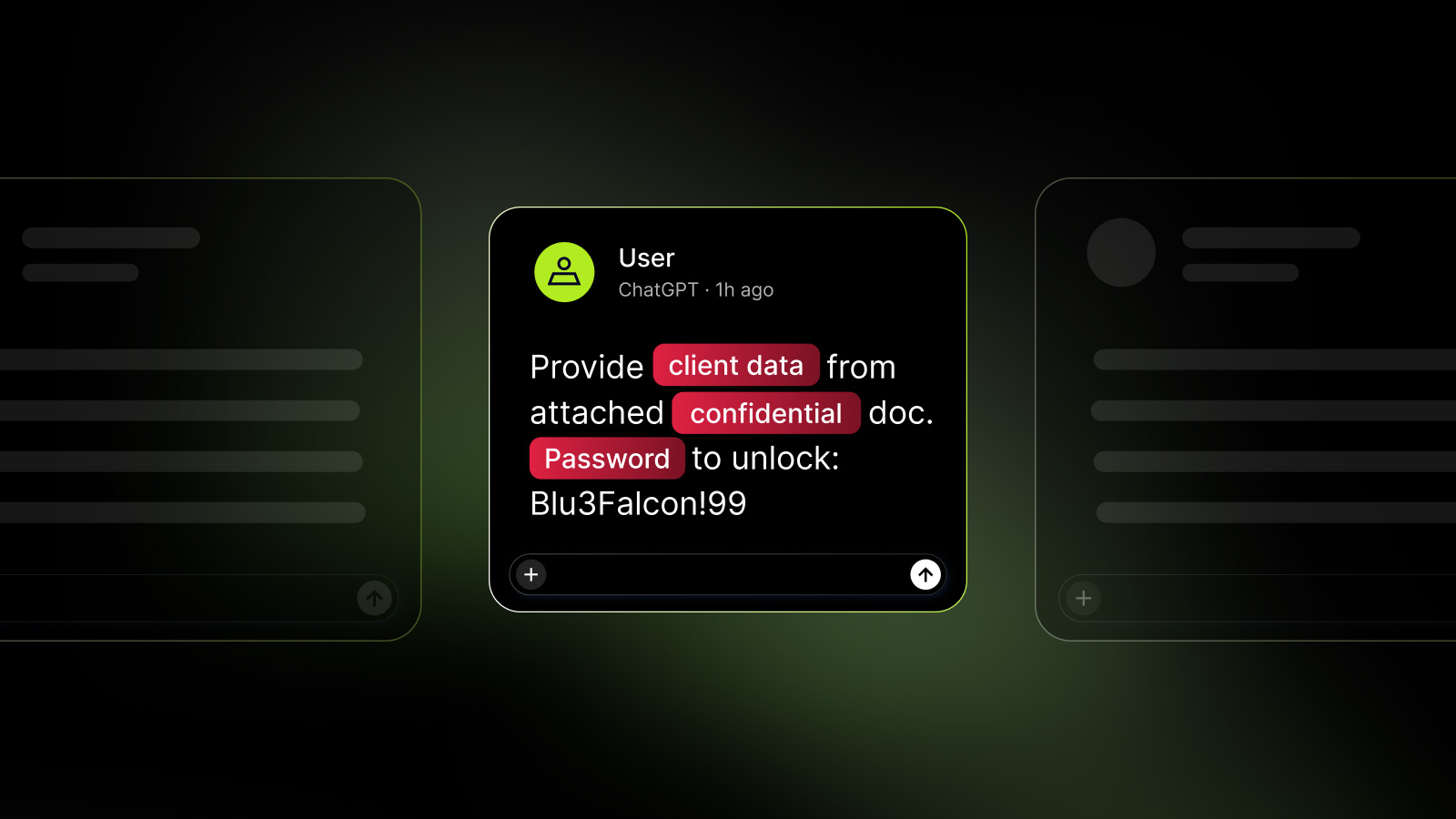
The true power of NordLayer AI Scout lies in its ability to inspect prompts in real-time, before they leave the user’s device. In this scenario, a custom detector is configured within AI Scout to identify patterns matching the organization’s customer account number format, with an action set to "Block." As the employee attempts to paste the customer support ticket into their personal ChatGPT session, AI Scout intercepts the input. The configured detector identifies the sensitive data, and the "Block" action is triggered, preventing the prompt from being submitted.
The employee is immediately presented with an on-page notification informing them that their prompt has been blocked due to a policy violation. Crucially, this action is taken without requiring any security team member to manually review the sensitive content of the prompt.
Step 3: Proactive Policy Enforcement and Reduced Friction
The need to ask "why" the corporate access was unused is still relevant, but the response is fundamentally different. The employee might still encounter issues with MFA or session expiry. However, the presence of AI Scout means that any attempt to circumvent these issues by using a personal account with sensitive data will be immediately flagged and blocked. The system proactively enforces policy, reducing the reliance on employee self-reporting or post-incident investigations. The employee’s understanding of the policy is reinforced through immediate, actionable feedback.
Step 4: Streamlined Incident Management and Audit Trail
When NordLayer AI Scout is in use, the event record simply shows that a configured rule successfully blocked a submission. This constitutes an attempted policy violation, effectively contained by the deployed control. If the employee subsequently mentions prior use of their personal account, this can be assessed as a separate, less critical, or potentially historical issue. The system provides a clear audit trail of attempted policy violations and the preventative measures taken, significantly streamlining incident management.
Step 5: Granular Control and Workflow Optimization
The resolution process shifts from damage control to workflow optimization and policy refinement. The security team confirms that the prompt policy, enforced by the browser extension, effectively prevented the data exposure. They can then explore different enforcement actions beyond "Block," such as "Warn" or "Redact."
- Warn: This action pauses the submission, allowing the employee to choose whether to proceed with sending the prompt or to go back and edit the text. This is suitable for less critical data types where user discretion is acceptable.
- Redact: This option automatically removes the matched sensitive value from the prompt before sending the rest of the content. This is useful when partial data submission is acceptable.
- Block: This action completely stops the submission, preventing any sensitive data from reaching the AI model. This is the most stringent control, ideal for highly sensitive information.
The security team can select the appropriate action for each data category, ensuring a layered security approach. The incident is documented with details about the account, device, confirmed content (or attempted content), the outcome of the enforcement action, and the ownership of the response. Finally, the access fix is confirmed, and a follow-up check is scheduled to monitor for any repeat events, demonstrating a commitment to continuous improvement and proactive security.
Broader Impact and Implications
The implications of unmanaged AI usage on corporate devices extend far beyond the immediate incident. Organizations that fail to address this gap face several significant risks:
- Data Breaches and Intellectual Property Theft: The accidental or intentional leakage of sensitive customer data, trade secrets, or proprietary code to public AI models can have severe financial and reputational consequences.
- Regulatory Non-Compliance: Many industries are subject to stringent data privacy regulations (e.g., GDPR, CCPA). The use of unmanaged AI tools can lead to violations, resulting in substantial fines and legal repercussions.
- Reputational Damage: A public data breach stemming from employee misuse of AI can severely erode customer trust and damage an organization’s brand image.
- Erosion of Security Culture: When security policies are perceived as overly burdensome or difficult to follow, employees may resort to workarounds, undermining the overall security culture of the organization.
- Increased Operational Overhead: Investigating every instance of personal AI use as a potential data breach is resource-intensive and diverts valuable security personnel from other critical tasks.
The rise of AI necessitates a paradigm shift in cybersecurity. Traditional perimeter-based security models are no longer sufficient in an era of ubiquitous cloud-based applications and remote workforces. Solutions like NordLayer AI Scout represent a proactive approach, moving security from a reactive investigation model to one of real-time prevention and granular control.
The Path Forward: Embracing Secure AI Adoption
As AI continues to evolve and integrate into business operations, organizations must prioritize comprehensive strategies for its secure adoption. This includes:
- Clear AI Usage Policies: Establishing well-defined policies that outline permissible AI tools, data handling guidelines, and acceptable use cases.
- Employee Training and Awareness: Educating employees on the risks associated with AI, the company’s policies, and the proper use of sanctioned tools.
- Deployment of Specialized Security Tools: Investing in solutions that provide visibility into AI usage, inspect data inputs, and enforce security policies in real-time.
- Integration with Existing Security Infrastructure: Ensuring that AI security tools can integrate seamlessly with existing security information and event management (SIEM) systems and identity and access management (IAM) solutions.
- Continuous Monitoring and Adaptation: Regularly reviewing AI usage patterns, updating security policies, and adapting security controls to address emerging threats and evolving AI capabilities.
The hypothetical scenario serves as a stark reminder that the benefits of AI must be balanced with robust security measures. By understanding the risks and implementing proactive solutions, organizations can harness the power of AI while safeguarding their sensitive data and maintaining a strong security posture in the digital age. The choice between a reactive, investigative approach and a proactive, preventative one can be the difference between a minor policy infraction and a catastrophic data breach.
About the author:
Vakaris Noreika, VP of Product Research and Development at NordLayer, is a seasoned cybersecurity expert dedicated to developing effective business security solutions. His extensive experience in threat intelligence, network security, data privacy, and automated monitoring informs his focus on creating controls that enhance security without adding unnecessary operational burdens.