Clarissa Hana
BeyondTrust, a prominent provider of identity security solutions, issued an urgent warning to its customers on Thursday, urging them to immediately patch a critical vulnerability within its Remote Support (RS) product. This severe security flaw, identified as CVE-2026-102764, has been actively exploited in a series of zero-day attacks since late August, allowing unprivileged remote attackers to execute arbitrary file operations on vulnerable systems. The exploitation has been linked to a sophisticated espionage actor with suspected ties to China, raising significant concerns for organizations relying on BeyondTrust’s enterprise-grade remote assistance technology.
The Remote Support solution is a cornerstone for many IT service desks, help desks, and customer support teams, enabling them to efficiently troubleshoot and resolve technical issues for users remotely. Its widespread deployment across various industries, including government agencies and a substantial portion of Fortune 100 companies, amplifies the potential impact of such a breach. BeyondTrust, serving over 20,000 customers globally, including a significant number of high-profile organizations, faces the challenge of ensuring prompt remediation across its diverse customer base.
A Sophisticated Exploitation Chain Uncovered
The vulnerability, tracked as CVE-2026-102764, is classified as an authentication bypass flaw. This means that attackers can circumvent normal security protocols, gaining unauthorized access to perform file operations on unpatched appliances. The vulnerability specifically affects Remote Support versions 26.2.3 and earlier. BeyondTrust confirmed that a patch was released for all Remote Support and Privileged Remote Access SaaS customers on October 8. However, for organizations operating self-hosted installations, manual patching is imperative if automatic update mechanisms are not enabled or configured.
While BeyondTrust has been relatively guarded with specific technical details regarding the vulnerability, security researchers from Mandiant and Google Threat Intelligence Group (GTIG) have shed light on its exploitation. They attribute the zero-day attacks to a threat actor group they track as "Armory Castle," previously identified as "UNC5221." Cybersecurity firm CrowdStrike also independently tracks the same actor under the moniker "Warp Panda." This actor is known for its persistent focus on exploiting zero-day vulnerabilities in network edge appliances.
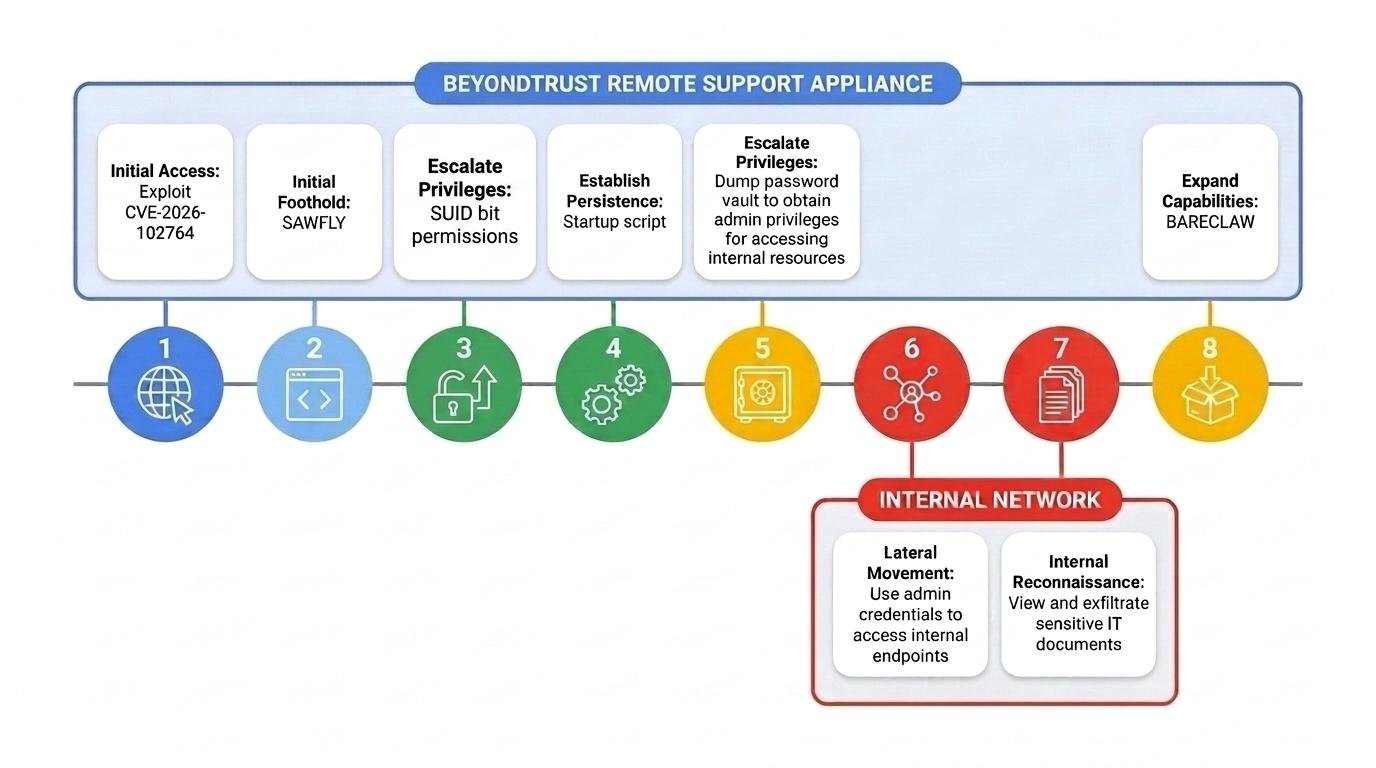
Mandiant researchers, who initially detected the exploitation, detailed how Armory Castle hackers leveraged CVE-2026-102764 to achieve initial access. Following the initial breach, the attackers escalated their privileges to root level on the compromised devices. This was achieved by enabling Set User ID (SUID) permissions, a powerful system configuration that allows programs to execute with the privileges of the user who owns the file.

Once root access was secured, the attackers deployed a new suite of custom malware. This included the "Sawfly" web shell, a common tool for maintaining persistent access and executing commands, and the "Bareclaw" tunneler malware, likely used to establish covert communication channels or facilitate lateral movement. To further evade detection, the threat actors meticulously wiped logs, obscuring their tracks and making forensic analysis more challenging. Their subsequent actions involved moving laterally across the victim’s network by leveraging compromised Administrator credentials. This allowed them to initiate remote sessions on downstream systems, effectively expanding their reach within the compromised network.
"After establishing a foothold through the web shell, the actor elevated from the web service account to root-level control of the appliance host," Mandiant stated in a blog post. "This gave them access to every credential the appliance stored or brokered and the ability to modify files that survive reboot and configuration reset." This indicates a deep compromise, allowing the attackers to potentially access sensitive information and maintain a persistent presence even after reboots or configuration resets. Mandiant further warned, "Any appliance that was reachable from the internet on a vulnerable version during the exploitation window should be treated as potentially compromised until it has been reviewed."
A Pattern of Exploiting Network Edge Devices
The modus operandi of Armory Castle aligns with its established history of targeting zero-day vulnerabilities in network edge appliances. Prior to this incident, the group has been linked to the exploitation of critical flaws in other widely used devices. These include:
- Citrix NetScaler: In October 2023, the group exploited CVE-2023-4966 in Citrix NetScaler appliances, demonstrating their proficiency in targeting remote access infrastructure.
- Ivanti Connect Secure: The actor has been particularly active in exploiting vulnerabilities in Ivanti Connect Secure devices. Since at least October 2023, they have chained zero-day exploits like CVE-2023-46805 and CVE-2024-21887, and later CVE-2025-0282, to breach enterprise networks. Threat intelligence firm Volexity reported in January 2024 that UNC5221 had backdoored over 2,100 Ivanti appliances using the "GiftedVisitor" webshell in attacks leveraging these chained zero-days.
This consistent targeting of network edge devices, which often serve as the gateway into an organization’s internal network, highlights a strategic focus by Armory Castle. By exploiting these critical points of entry, they can gain initial access and then systematically compromise the rest of the network.
Mandiant’s analysis suggests a concerning trend: "In past campaigns, ARMORY CASTLE has conducted widespread and opportunistic exploitation following the public disclosure of vulnerabilities it had exploited selectively as zero-days, racing to infiltrate target organizations before patches are deployed. It is possible that we will observe similar widespread exploitation attempts associated with CVE-2026-102764." This warning underscores the urgency for organizations to patch, as the window of opportunity for attackers to exploit unpatched systems may widen as information about the vulnerability becomes more widely known.
Broader Context: A String of BeyondTrust Vulnerabilities
The exploitation of CVE-2026-102764 is not an isolated incident for BeyondTrust. The company’s products have been targeted by threat actors in recent years, underscoring the critical importance of robust security practices and timely patching.
- CVE-2026-1731: In a more recent past incident, attackers exploited another critical remote code execution (RCE) vulnerability affecting Remote Support and Privileged Remote Access appliances. This RCE flaw allowed attackers to establish WebSocket channels and deploy ransomware, demonstrating the destructive potential of such vulnerabilities.
- Chinese State-Backed Actors: BeyondTrust’s systems have also been targeted by other state-sponsored groups. The Chinese state-backed Silk Typhoon hacking group is believed to have exploited two zero-days (CVE-2024-12356 and CVE-2024-12686) to breach BeyondTrust’s own systems. In a highly sophisticated attack, they leveraged a stolen API key to compromise 17 Remote Support SaaS instances, including the instance used by the U.S. Treasury Department. This breach had significant implications, as Silk Typhoon also targeted the Office of Foreign Assets Control (OFAC) and the Committee on Foreign Investment in the United States (CFIUS), both critical U.S. government entities.
These past incidents paint a picture of BeyondTrust products being a recurring target for sophisticated threat actors, including those with state-sponsored backing. This necessitates a heightened state of vigilance and a proactive approach to security patching and monitoring for all BeyondTrust customers.
Monitoring and Potential Impact
Internet threat watchdog Shadowserver tracks over 1,400 BeyondTrust remote support instances exposed online. While this number provides an indication of the potential attack surface, it offers no specific insight into how many of these instances have already been secured or are intentionally configured as honeypots for threat intelligence gathering. The sheer volume of exposed instances, however, suggests a significant number of organizations may be vulnerable if they have not yet applied the necessary patches.
The implications of this zero-day exploitation are far-reaching. For organizations that have been compromised, the immediate concern is the extent of the breach. Armory Castle’s ability to gain root access, deploy custom malware, and move laterally within networks poses a significant risk to sensitive data, intellectual property, and operational continuity. The use of stolen credentials and the ability to tamper with system configurations mean that even after the initial vulnerability is patched, residual risks may persist.
The fact that this vulnerability was exploited in zero-day attacks for an extended period (since late August) means that many organizations could have been compromised for weeks or even months before the public disclosure and patch release. This extended dwell time allows attackers to establish deep footholds, exfiltrate data, and conduct reconnaissance with a reduced risk of detection.
Recommendations and Next Steps
BeyondTrust’s urgent advisory emphasizes the critical need for immediate action. Organizations utilizing Remote Support versions 26.2.3 or earlier are strongly advised to:
- Apply the Patch Immediately: For SaaS customers, BeyondTrust has already applied the fix. However, self-hosted installations must be manually updated by administrators.
- Review System Logs: Conduct thorough log analysis to detect any signs of unauthorized access or malicious activity that may have occurred prior to patching.
- Perform Security Audits: Consider a comprehensive security audit of the Remote Support infrastructure and the broader network to identify any signs of lateral movement or persistent threats.
- Investigate Compromised Appliances: Any appliance reachable from the internet on a vulnerable version during the exploitation window should be treated as potentially compromised and thoroughly investigated.
- Enhance Monitoring: Implement enhanced security monitoring and alerting mechanisms to detect suspicious activities, especially those related to authentication bypass and file operations.
The ongoing exploitation of critical vulnerabilities in remote support solutions like BeyondTrust’s underscores a persistent challenge in the cybersecurity landscape. As remote work and hybrid models continue to be prevalent, the security of remote access tools remains a paramount concern for organizations worldwide. The actions of sophisticated threat actors like Armory Castle serve as a stark reminder of the need for continuous vigilance, proactive threat hunting, and rapid response to emerging security threats.