Chandra Wibowo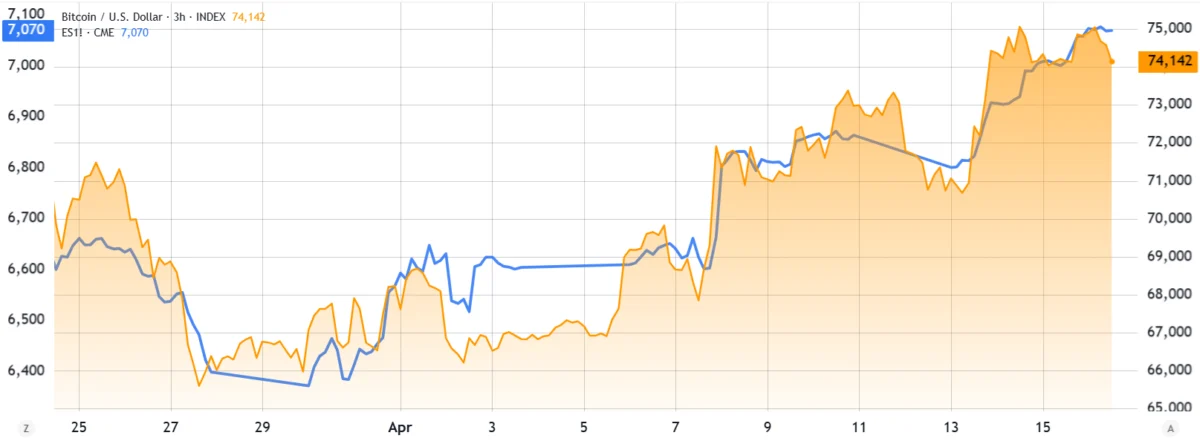
Bitcoin (BTC) endured a tumultuous trading session early in the US stock market hours, experiencing a sharp sell-off that saw it briefly dip below the crucial $75,000 support level before a subsequent recovery. This abrupt price swing triggered substantial liquidations in the leveraged futures market, with approximately $120 million in long (buy) positions being forcibly closed. Compounding the volatility, the Bitcoin funding rate has remained in negative territory, a development that analysts suggest could signal further downside pressure and potentially embolden bearish sentiment.
The persistent negative funding rate, a trend observed since Monday, indicates a prevailing lack of demand for bullish leverage in the perpetual futures market. In this scenario, traders holding short positions are paying a premium to maintain their trades open, as opposed to the usual dynamic where longs compensate shorts in a bullish market. Ideally, under neutral market conditions, funding rates typically hover between 5% and 10% annually to account for capital costs and exchange-related risks. While an annualized rate reaching 20% might initially suggest strong conviction from either bulls or bears, a deeper examination of the market mechanics reveals a more nuanced picture.

Unpacking the Negative Funding Rate: Liquidations as a Driver
The calculation of perpetual contract funding rates occurs every eight hours across most major cryptocurrency exchanges. Short-term spikes, whether positive or negative, to rates as high as 20% are often viewed with less concern by seasoned traders, as they translate to a daily fee of approximately 0.05%. Even for positions employing significant leverage, such as 20x, this cost equates to a manageable 1% risk, which is unlikely to pose a substantial burden unless sustained over an extended period.
However, the recent data suggests a different narrative. Over the past few days, Bitcoin bearish positions have faced aggressive liquidation, with an aggregate of $365 million being forcefully unwound since Monday. This consistent purging of short positions has naturally eroded the collateral backing these bearish bets. It is plausible that traders, rather than rushing to inject additional margin to defend their positions, have opted to hold their ground, anticipating a natural adjustment in funding rates. Consequently, the current negative funding rate appears to be a reflection of losses incurred by bears rather than a testament to their unwavering conviction.
Correlation with Equities and Shifting Economic Narratives
For the past couple of weeks, Bitcoin’s intraday price movements have largely mirrored those of the S&P 500 index. While the US stock market reached an all-time high on Thursday, Bitcoin has struggled to reclaim its previous peak of $126,200. The recurring inability to re-establish the $76,000 level has contributed to a palpable lack of enthusiasm in the Bitcoin derivatives market. Despite this, recent US economic data has provided a supportive backdrop for risk assets, including Bitcoin.

On Thursday, the Federal Reserve released data indicating a 0.5% decrease in US industrial production for March compared to the previous month. Consumer durable goods were a significant drag, with automotive production declining by 2.8%. In parallel, continuing jobless claims rose by 31,000 to a seasonally adjusted 1.818 million for the week ending April 4.
Counterintuitively, the S&P 500 has shown resilience, and even benefited, from indications of an increasing economic slowdown. This trend has prompted the government to accelerate stimulus measures, a development that can inject liquidity into financial markets. Furthermore, upward pressure on inflation, exacerbated by a surge in oil prices, diminishes the attractiveness of holding fixed-income investments, potentially redirecting capital towards riskier assets like equities and cryptocurrencies.
Options Market Signals and Institutional Confidence
The Bitcoin options market, a key indicator of investor sentiment and future price expectations, provides no overt signs of excessive demand for downside protection. Over the past week, the premium paid for put options (which bet on price declines) on the Deribit exchange has lagged behind the premiums for equivalent call options (which bet on price increases). This suggests that traders are not heavily hedging against potential price drops.

The continued inflows into US-listed Bitcoin spot Exchange Traded Funds (ETFs), which have seen $921 million in net inflows over the past five days, alongside ongoing accumulation by MicroStrategy (MSTR), a prominent corporate holder of Bitcoin, have further bolstered investor confidence. These sustained inflows into regulated investment vehicles signal robust institutional demand, providing a foundational support for the Bitcoin market.
Broader Market Implications and Future Outlook
The current scenario, characterized by a negative funding rate in Bitcoin futures alongside strong institutional demand in the spot market, presents a complex interplay of forces. While the negative funding rate might be interpreted by some as a bearish signal, the underlying drivers appear to be linked to forced liquidations rather than a fundamental shift in bearish conviction. The correlation with the S&P 500 highlights Bitcoin’s increasing integration into broader risk asset markets, influenced by macroeconomic factors and government policy responses.
The recent economic data, while pointing to a potential slowdown, has paradoxically supported risk assets through expectations of continued stimulus. This environment, where inflation concerns are juxtaposed with recessionary signals, creates a unique backdrop for assets like Bitcoin. The resilience shown by Bitcoin in the face of intraday volatility, coupled with consistent institutional buying, suggests that underlying demand remains strong.

However, the inability of Bitcoin to decisively break through previous resistance levels, such as the $76,000 mark, indicates that the path higher may not be entirely smooth. Traders will be closely monitoring the interplay between futures market dynamics, spot ETF inflows, and macroeconomic developments for further clues on Bitcoin’s trajectory. The current negative funding rate, therefore, does not automatically translate to an impending crash, especially when viewed in conjunction with the robust institutional participation in the spot market, which provides a significant counterbalancing force. The coming weeks will likely reveal whether the current market structure can sustain Bitcoin’s upward momentum or if further consolidation and price discovery are on the horizon.