Sisilia Frederika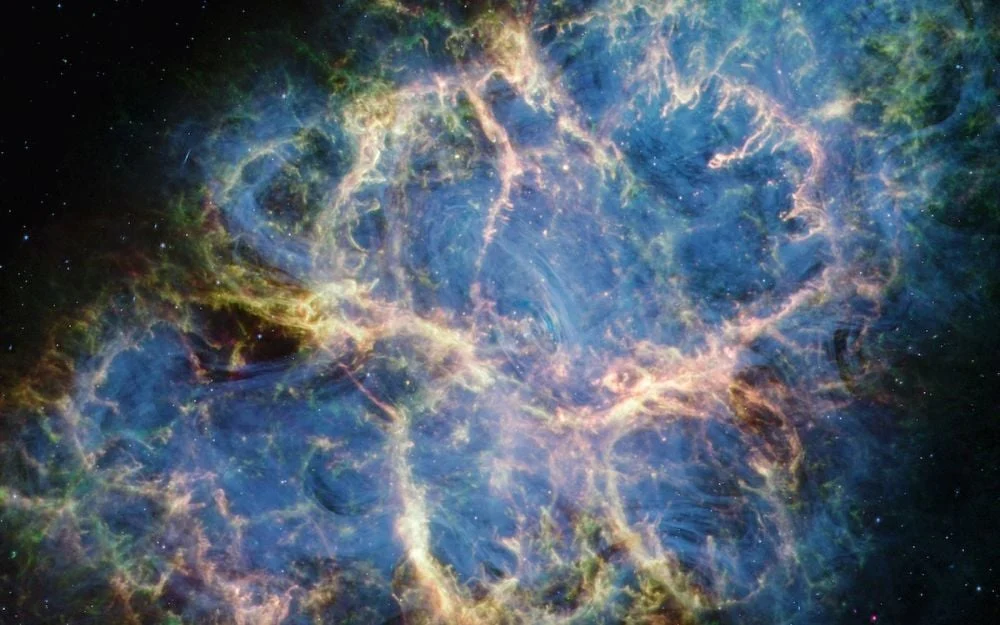
The Crab Nebula stands as a singular anomaly in the vast catalog of the cosmos, representing one of the few celestial objects whose entire life cycle—from catastrophic birth to its current state as a complex remnant—has been documented by human civilization. While most astronomical phenomena, such as the supermassive black holes at the centers of galaxies or the slow fusion within the Sun, operate on timescales of millions or billions of years, the Crab Nebula is a relative newcomer. Located approximately 6,500 light-years from Earth in the constellation Taurus, it is the remnant of a supernova explosion that reached the eyes of ancient observers in the year 1054 AD. Today, it serves as a premier natural laboratory for high-energy physics, but it has long guarded a secret regarding its radio emissions: a bizarre, zebra-like pattern in its high-frequency spectrum that has eluded explanation for nearly two decades.
New research conducted by Mikhail Medvedev, a professor of physics and astronomy at the University of Kansas, and published in the Journal of Plasma Physics, appears to have finally solved this "zebra stripe" puzzle. The study, titled "Theory of striped dynamic spectra of the Crab pulsar high-frequency interpulse," suggests that the pattern is the result of a complex gravitational and plasma-based "tug-of-war" occurring within the pulsar’s intense magnetosphere. This discovery not only clarifies a long-standing mystery regarding the Crab Nebula but also provides a new framework for understanding the fundamental physics of neutron stars and the behavior of light in extreme environments.
The Historical Context of the Crab Nebula
The story of the Crab Nebula began nearly a millennium ago. On July 4, 1054, astronomers in China recorded the appearance of a "guest star" that was so bright it was visible in the daylight sky for 23 days and remained visible to the naked eye at night for nearly two years. Similar records appear in Japanese and Arab astronomical texts, and some historians suggest that petroglyphs found in the American Southwest may also represent the event. This supernova, now designated SN 1054, was the explosive death of a massive star, an event that ejected layers of gas into space at thousands of kilometers per second while its core collapsed into an incredibly dense neutron star.
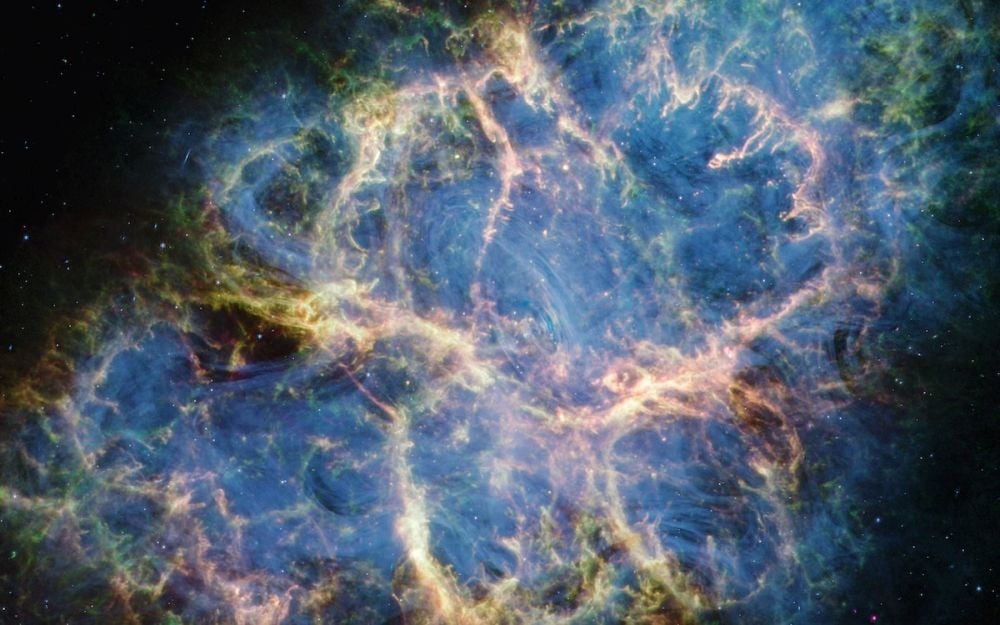
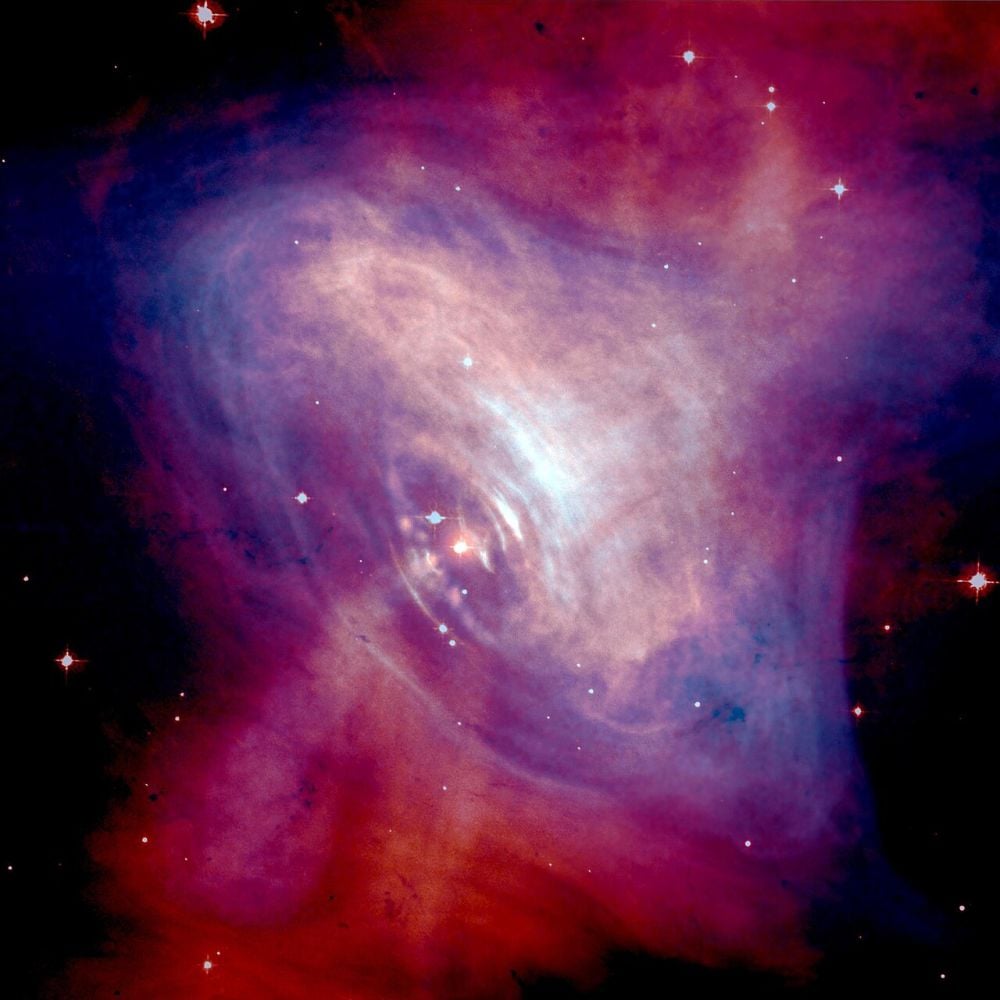
In the centuries that followed, the ejected gas expanded to form the intricate, shell-like structure we now recognize as the Crab Nebula (M1). It was Charles Messier who first cataloged it in 1758, and Lord Rosse who gave it its "Crab" moniker in the 1840s due to its spindly, filamentary appearance. However, it was not until the 1960s that scientists discovered the heart of the nebula: a pulsar. This rapidly rotating neutron star spins approximately 30 times per second, emitting beams of electromagnetic radiation across the spectrum, from radio waves to high-energy gamma rays.
The Mystery of the Zebra Stripes
The Crab Pulsar is distinct from the thousands of other known pulsars due to the complexity of its emission profile. While most pulsars emit a single pulse per rotation, the Crab Pulsar exhibits a "main pulse" and an "interpulse." In 2007, researchers using high-resolution radio telescopes noticed something unprecedented in the high-frequency interpulse of the Crab. Instead of the continuous, broad-spectrum "rainbow" of frequencies typical of cosmic radio sources, the Crab’s emission showed discrete, regularly spaced bands of intensity.
In a dynamic spectrum, these bands look like the stripes of a zebra. There is a bright band of emission, followed by a gap of total darkness, followed by another bright band. This pattern is not found in any other pulsar, making it a unique signature of the Crab. For fifteen years, astrophysicists proposed various theories involving plasma instabilities or complex geometric alignments, but none could fully account for the high contrast of the stripes—the "absolute darkness" between the bands of light.
The Physics of the Magnetosphere: A Multi-Lens System
To understand Medvedev’s solution, one must first look at the environment surrounding a pulsar. A pulsar is essentially a city-sized ball of neutrons with a mass greater than the Sun, creating a gravitational field of immense strength. Furthermore, it possesses a magnetic field a trillion times stronger than Earth’s. This magnetic field traps a cloud of charged particles, known as plasma, creating a magnetosphere.
Medvedev’s research posits that the zebra stripes are an interference pattern caused by two competing forces acting on the radio waves as they escape the pulsar. The first force is the plasma itself. In the realm of optics, plasma acts as a "dispersive medium" or a defocusing lens. As radio waves pass through the plasma in the pulsar’s magnetosphere, the plasma tends to bend and spread the light rays apart.
The second force is gravity. According to Albert Einstein’s General Theory of Relativity, massive objects warp the fabric of spacetime. This curvature causes light to travel along curved paths rather than straight lines—a phenomenon known as gravitational lensing. In the vicinity of a neutron star, gravity acts as a powerful focusing lens, pulling light rays inward.
"The plasma in the pulsar’s magnetosphere can be thought of as a lens—but a defocusing lens," Medvedev explained. "Gravity, by contrast, acts as a focusing lens. Plasma tends to spread light rays apart; gravity pulls them inward. When these two effects are superimposed, there are specific paths where they compensate each other."
The Interferometer Effect
This "tug-of-war" between the defocusing plasma and the focusing gravity creates a unique optical condition. Medvedev’s model shows that for certain frequencies, these two effects balance out so perfectly that light can take multiple paths to reach an observer on Earth. Because these paths are slightly different in length and pass through different densities of plasma, the light waves arrive at the telescope with different phases.
When these waves combine, they undergo interference. In "constructive interference," the peaks of the waves align, creating a bright band of light. In "destructive interference," the peak of one wave meets the trough of another, canceling the signal out entirely and creating a gap of darkness. This is essentially the same principle behind a laboratory interferometer, but scaled up to a galactic level.
While Medvedev’s earlier models using only plasma could produce some level of striation, they could not explain why the gaps were so dark. By introducing the curvature of spacetime (gravity) into the equations, the model finally matched the high-contrast observations recorded by telescopes. The gravity of the neutron star provides the necessary "focus" to ensure the interference is sharp enough to create the distinct zebra pattern.
Scientific Implications and the Height of Emission
The resolution of the zebra stripe mystery has profound implications for our understanding of pulsar anatomy. One of the most debated topics in pulsar astronomy is the "emission height"—the exact location above the neutron star’s surface where radio pulses are generated. Some theories suggest the pulses originate near the polar caps, just a few kilometers above the surface, while others suggest they form much further out in the magnetosphere.
Medvedev’s model provides a new tool for "mapping" the pulsar. Because the interference pattern is highly sensitive to the local gravitational field and plasma density, the specific spacing of the zebra stripes can be used to calculate exactly where the light originated. Preliminary findings suggest that the radio emission source must be relatively close to the star for gravity to have such a pronounced focusing effect.
Furthermore, this research represents the first time that the combined effects of plasma lensing and gravitational lensing have been used to explain a specific spectral feature in an astronomical object. While gravitational lensing is commonly used to study distant galaxies and black holes, those models usually assume the light is traveling through a vacuum. The Crab Pulsar provides a rare instance where we can observe how gravity and matter (plasma) interact to shape the light we see.
Future Research and Global Observation
The study of the Crab Nebula remains a collaborative international effort. The data used to validate Medvedev’s theory comes from a suite of the world’s most powerful observatories, including the Very Large Array (VLA) in New Mexico, the Hubble Space Telescope, and the Chandra X-ray Observatory. By combining radio, optical, and X-ray data, scientists can build a three-dimensional model of the pulsar’s environment.
Moving forward, Medvedev notes that the model could be refined by accounting for the pulsar’s rapid rotation. While the current research explains the "qualitative" nature of the stripes—why they exist and why they are so dark—including rotational effects (the Doppler shift and frame-dragging) could provide "quantitative" refinements to the exact spacing of the bands.
The scientific community has reacted with interest to these findings. The ability to use spectral patterns as a diagnostic tool for spacetime curvature opens up new possibilities for studying other neutron stars and potentially even the environments surrounding black holes. As telescopes become more sensitive, astronomers may discover similar "zebra" patterns in other high-energy objects, allowing us to test the laws of physics in the most extreme conditions the universe has to offer.
Conclusion
The Crab Nebula continues to be a gift to the scientific community. Nearly a thousand years after it first appeared as a "guest star" in the ancient skies, it is still providing the data necessary to solve the most complex puzzles of modern astrophysics. Mikhail Medvedev’s work demonstrates that the most baffling mysteries of the cosmos often require a return to first principles—in this case, the fundamental interplay between mass, light, and the medium through which they travel. By reconciling the "tug-of-war" between gravity and plasma, we have moved one step closer to understanding the heart of the most famous explosion in human history.