George Chandra Eka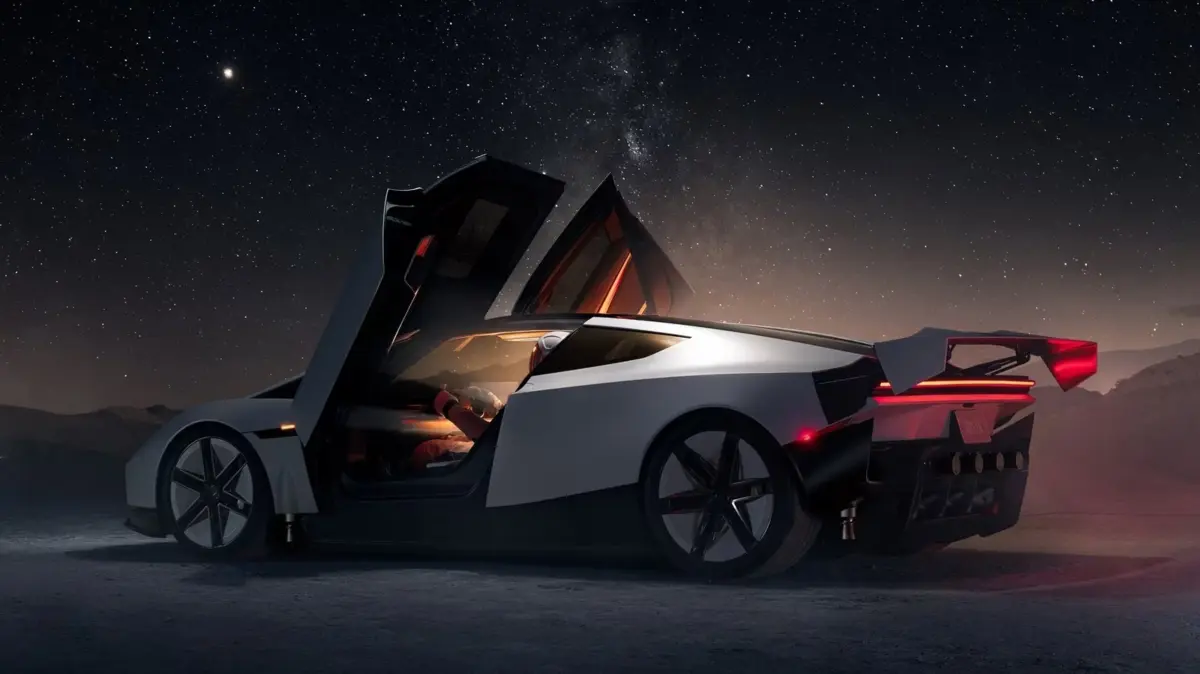
Tesla once again captured global attention on Thursday with a spectacular re-unveiling of its redesigned Roadster, featuring an audacious stunt that saw the electric sports car driving upside down on a C-shaped ramp before dramatically floating to the ground on rocket boosters. The event, held on October 15, was designed to showcase the vehicle’s futuristic capabilities and reignite excitement for a project that has been plagued by years of delays. Accompanying the visual spectacle was the announcement of a targeted 2028 production window and the availability of a "Thrust" trim level, equipped with cold-gas thrusters, requiring a substantial $250,000 reservation. CEO Elon Musk, addressing the audience, emphasized the seriousness of the new timeline, stating, "We enter production in 2028. Actually, for real." However, for many industry observers and long-waiting reservation holders, the announcement evoked a strong sense of déjà vu, raising critical questions about the company’s ability to finally deliver on its ambitious promises for its second-generation sports car.
A Spectacular Re-Unveiling with a Familiar Echo
The October 15 event was undeniably a masterclass in automotive theatrics. The image of the Roadster, equipped with a specialized suction rig, defying gravity as it navigated an inverted C-shaped track before engaging what appeared to be its integrated cold-gas thrusters for a controlled descent, instantly went viral. This dramatic demonstration was intended to highlight the extreme engineering prowess behind the new Roadster, particularly its much-touted "SpaceX" package, now formally branded as the "Thrust" trim. This innovative option, utilizing small, integrated cold-gas thrusters, promises not just enhanced acceleration, but also improved top speed, braking, and cornering capabilities, pushing the boundaries of what is conventionally thought possible for a road-legal vehicle.
The technical specifications reiterated at the event were equally ambitious, targeting unprecedented performance figures that would firmly place the Roadster at the apex of the hypercar segment. While exact numbers were not fully detailed, previous iterations of the Roadster’s promises included a 0-60 mph acceleration in 1.9 seconds for the base model, and even faster for the thruster-equipped version, along with a top speed exceeding 250 mph and a range of 620 miles on a single charge. These figures, if achieved, would make the Roadster one of the fastest and most capable production vehicles ever created, regardless of powertrain. However, the staggering $250,000 reservation fee for the "Thrust" trim, on top of the already significant base price, underscores the exclusivity and high-stakes nature of this project. Despite the excitement generated by the stunt, the immediate question among many was whether this re-announcement represented a genuine commitment to production or another iteration of what critics have termed a "paper launch."
The Genesis of an Icon: The First-Generation Roadster’s Legacy
To understand the weight of anticipation and skepticism surrounding the new Roadster, it is crucial to revisit the legacy of its predecessor. The original Tesla Roadster, launched in 2008, was a monumental achievement that firmly established Tesla as a serious contender in the automotive industry. Ideated by Tesla’s co-founder Martin Eberhard, before Elon Musk’s significant investment and eventual leadership, the car was a bold statement that electric vehicles could be not only practical but also exhilarating.
Crammed within the lightweight chassis of a Lotus Elise, the first Roadster shattered preconceived notions about electric cars. At a time when electric vehicles were largely seen as glorified golf carts or niche curiosities, the Roadster delivered impressive performance. It could accelerate from 0 to 60 mph in under 4 seconds and, crucially, boasted a then-revolutionary range of 244 miles on a single charge – a figure that dwarfed any other commercially available EV. Its limited production run, with just over 2,400 units sold globally, made it an instant collector’s item and a symbol of a nascent revolution. The Roadster was more than just a car; it was a proof of concept that battery-electric technology could power high-performance vehicles, laying the groundwork for Tesla’s subsequent models and inspiring a new wave of EV development across the industry. Musk’s early investment in Tesla in 2004 was largely driven by his conviction in the Roadster’s potential, making it a foundational project for the company’s very existence.
A Promise Unfulfilled: The 2017 Unveiling and Subsequent Delays
The journey of the second-generation Roadster began with equally grand ambitions. It was first unveiled in a dramatic surprise announcement in November 2017, at the conclusion of the Tesla Semi launch event. Positioned as the ultimate expression of Tesla’s engineering and design capabilities, Musk famously declared it "a hardcore smackdown to gasoline cars," promising performance figures that would redefine the hypercar segment. The initial target for production was set for 2020.
At this initial unveiling, Tesla began accepting reservations, requiring deposits ranging from $50,000 for the standard model to a full $250,000 upfront for the "Founders Series." The prospect of owning such a groundbreaking vehicle, combined with Tesla’s growing reputation for innovation, led to a significant number of early reservations. In February 2018, Musk further stoked excitement by promising the "SpaceX" package, which would "include ~10 small rocket thrusters arranged seamlessly around the car" and "dramatically improve acceleration, top speed, braking and cornering." This vision of a thruster-equipped road car, seemingly pulled from science fiction, cemented the Roadster’s status as a technological marvel in waiting. However, the 2017 unveiling also coincided with the reveal of the Tesla Semi, another ambitious project that, like the Roadster, would face significant and prolonged production delays before its eventual, albeit limited, delivery years later.
Navigating Production Hurdles: A Chronology of Postponements
The initial 2020 production window for the redesigned Roadster came and went without a single unit rolling off the assembly line. This marked the beginning of a protracted series of delays that would test the patience of even the most ardent Tesla enthusiasts and reservation holders.
In July 2020, amidst the initial global disruptions of the public health crisis, Musk addressed the Roadster’s timeline during an earnings call, suggesting that production would commence within the "following year to 18 months." While global events provided some context for the delay, it was also revealed that Tesla was prioritizing other projects, notably the Cybertruck. Musk explicitly stated his desire to bring the Cybertruck to market first, a decision that further pushed the Roadster down the company’s development roadmap. The Cybertruck itself would experience its own well-documented and extensive delays, eventually entering production years behind schedule.
As 2021 began, the "12 to 18 months" projection proved overly optimistic. Early in the year, Musk announced another postponement, pushing the Roadster’s release to 2022. By the end of 2021, even that revised target seemed unattainable, with projections slipping further into 2023. The cycle of delays continued, with subsequent announcements from the CEO pushing the anticipated production dates into 2024, and now, finally, to the recently stated 2028. Each new delay chipped away at customer confidence, transforming the once highly anticipated launch into a symbol of Tesla’s over-ambition and inconsistent delivery timelines. Industry analysts frequently highlighted these repeated postponements as a sign of the immense engineering challenges involved in bringing such a revolutionary vehicle to fruition, coupled with Tesla’s tendency to unveil products far in advance of their readiness for mass production.
Musk’s Transformative Years and Tesla’s Reputation
The period between 2023 and 2025, as described in the provided narrative, proved to be particularly tumultuous for Elon Musk and, by extension, for Tesla’s public image. During these years, Musk reportedly underwent a significant public transformation, shifting from a perceived environmentalist pioneer to a figure increasingly associated with far-right political circles. This period culminated in his alleged appointment to head President Donald Trump’s newly formed Department of Government Efficiency (DOGE), a role that, according to the narrative, saw him orchestrate a "slash-and-burn of the Federal government."
This intense political involvement and the stated radical policy implementations had severe consequences. The narrative indicates that by July 2025, The Lancet published a study projecting that these governmental cuts could lead to more than 14 million deaths by 2030. While Musk reportedly disputed these figures, the reputational damage resulting from his stint in government allegedly spilled over significantly to Tesla. The company reportedly faced widespread global protests, impacting its sales and brand perception. Amidst allegations of substance abuse and escalating family drama, Musk reportedly stepped down from DOGE in May 2025. In this turbulent context, it is plausible that the development and production of a niche luxury sports car like the Roadster might not have remained at the forefront of the billionaire’s extensive and increasingly complex priorities. This turbulent backdrop, as presented in the provided context, adds another layer of complexity to the Roadster’s prolonged development cycle, suggesting that external factors, including the CEO’s personal and political engagements, may have further contributed to its repeated postponements.
The Price of Patience: Customer Frustration and Financial Implications
The protracted delays have come at a significant cost, most notably borne by the thousands of customers who placed substantial deposits for the Roadster years ago. With initial reservations taken as far back as 2017, many individuals have had their funds – ranging from $50,000 to a quarter-million dollars – tied up with Tesla for eight years or more, with no vehicle in sight. This situation has led to widespread frustration and a noticeable erosion of customer trust.
The financial implications for both customers and Tesla are considerable. For customers, these deposits represent a substantial, interest-free loan to Tesla, effectively locking up capital that could have been invested elsewhere. High-profile figures have publicly voiced their discontent. YouTuber Marques Brownlee, known for his extensive tech reviews and multiple interviews with Musk, lamented on his Waveform podcast in September 2025, "Tesla has been sitting with my 50 grand for eight years and hasn’t done anything with it." Similarly, Sam Altman, CEO of OpenAI and a former business associate and current rival of Musk, also reportedly expressed frustration over his Roadster reservation.
For Tesla, holding these deposits carries a different kind of burden. While the funds provide a capital boost, the accompanying reputational damage from unfulfilled promises can be far more costly in the long run. The company’s credibility, particularly regarding its ability to deliver on ambitious timelines, has been consistently questioned. Analysts have pointed out that while Tesla’s mainstream models like the Model 3 and Model Y have achieved tremendous success, the repeated failures to launch high-profile, innovative products like the Roadster and the Semi on schedule can foster a perception of over-promising and under-delivering, potentially impacting future customer loyalty and investment confidence. The Roadster’s extended gestation period has also made it a frequent subject of pop-cultural jokes, further diminishing its aura of revolutionary innovation.
Industry Context and Competitive Landscape
In the years since the Roadster’s initial unveiling, the high-performance electric vehicle landscape has evolved dramatically, intensifying the competitive pressure. When first announced, the Roadster’s performance targets were largely unchallenged by other EVs. However, today, a new generation of electric hypercars and performance sedans has emerged, some of which are already in production or nearing market.
Vehicles like the Rimac Nevera, a Croatian-made electric hypercar, has already achieved world-record-breaking performance figures, including a 0-60 mph time of 1.74 seconds, surpassing the Roadster’s initial promises. Similarly, the Lucid Air Sapphire, a high-performance electric sedan, offers over 1,200 horsepower and blistering acceleration, directly challenging the performance claims of high-end EVs. While the Roadster’s "Thrust" trim with cold-gas thrusters still offers a unique proposition, the competitive field is no longer barren. Tesla must now not only deliver on its promises but also demonstrate a significant leap beyond what is already available or soon to be available from rivals. This necessitates not just raw power but also unparalleled engineering, range, and luxury to justify its premium price and extended wait time. The challenge for Tesla is to ensure that by 2028, the Roadster still represents a truly cutting-edge vehicle, rather than one playing catch-up to the innovations that have emerged during its prolonged development.
Skepticism Lingers: Analysts and the Road Ahead
Even after the impressive October event, a palpable skepticism continues to surround the Roadster’s prospects. Industry analysts and market observers are accustomed to Tesla’s dramatic announcements, often followed by significant delays. The company’s track record with products like the Cybertruck and the Semi serves as a potent reminder that ambitious unveiling events do not necessarily translate into prompt production.
For many, a "launch event" without a firm, verifiable production timeline and demonstrable progress on the manufacturing front remains largely a marketing exercise. The "actually, for real" assertion from Musk, while intended to reassure, paradoxically highlights the history of unfulfilled promises. To truly convince potential customers and the broader market that the Roadster is finally on track for its 2028 delivery, Tesla will need to move beyond theatrical stunts and provide concrete evidence of manufacturing progress, supply chain stability, and robust testing protocols. The challenge now for Musk and Tesla is to rebuild trust, demonstrating that placing a quarter-million-dollar deposit for the Roadster is a sound investment in a tangible future, rather than, as the original article wryly suggested, a less effective use of funds than purchasing a Boring Company flamethrower. The road ahead for the Roadster remains long and, despite the recent dazzling display, still shrouded in uncertainty.