Clarissa Hana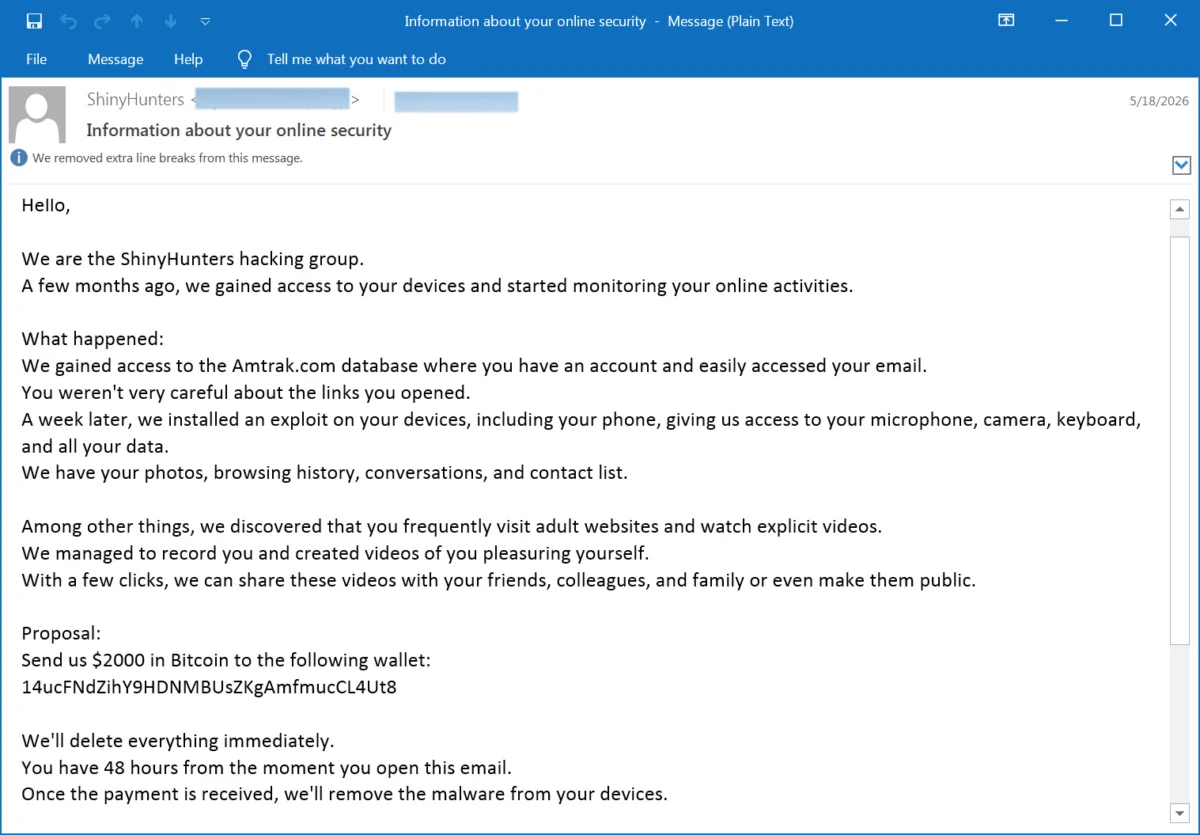
Threat actors are leveraging email addresses previously exposed in data breaches orchestrated by the notorious ShinyHunters extortion group to perpetrate a wave of sophisticated sextortion scams. These emails, demanding $2,000 in Bitcoin, falsely claim to originate from ShinyHunters and allege that the recipients’ devices have been compromised, with their email addresses obtained from compromised company databases. While the emails aim to instill fear by impersonating a known hacking entity, security researchers and affected organizations suggest these campaigns are likely conducted by unrelated threat actors who have acquired and repurposed data previously leaked by ShinyHunters. This tactic, while appearing to lend legitimacy to the threats, is a calculated deception designed to exploit the fear and embarrassment associated with potential exposure of private information.
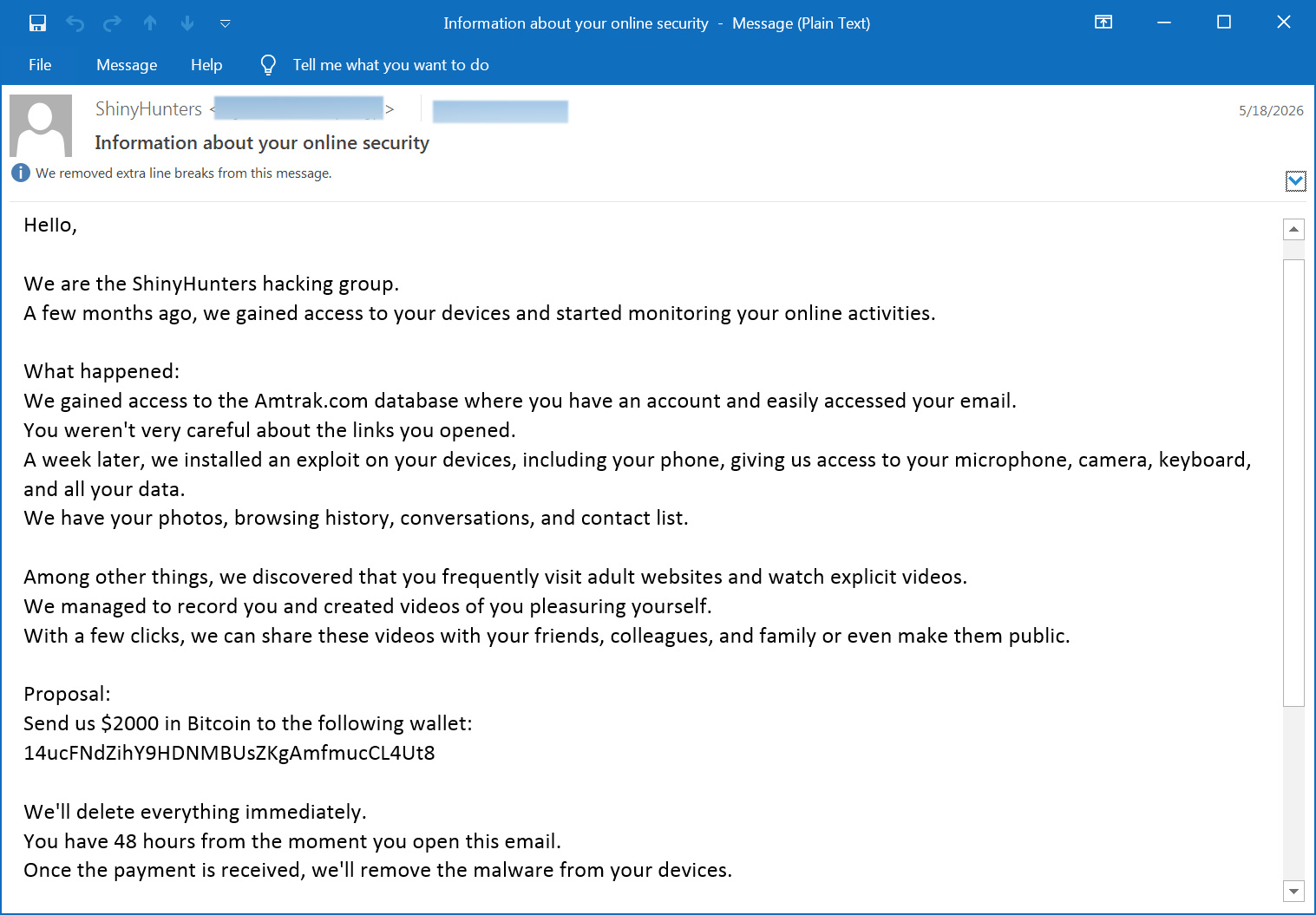
The malicious emails typically adopt the guise of being sent by the "ShinyHunters hacking group," with subjects like "Information about your online security." Recipients are informed that their devices were compromised months prior, and that their email address was accessed through a breach of a specific company with which they have an account. The attackers then fabricate a narrative of deep intrusion, claiming to have installed exploits on both computers and phones, granting them access to microphones, cameras, keyboards, photos, browsing history, conversations, and contact lists. The core of the scam involves fabricated claims of recording the victim engaging with adult websites, coupled with threats to disseminate compromising material to friends, family, and colleagues unless a ransom of $2,000 in Bitcoin is paid within a strict 48-hour deadline. The perpetrators often include warnings against contacting law enforcement, replying to the message, or attempting to reset devices, asserting that the illicitly obtained data is stored on remote servers, further amplifying the pressure on the victim.
The Mechanics of Deception: Leveraging Leaked Data
The effectiveness of these sextortion scams hinges on the perceived authenticity provided by the use of real data. BleepingComputer has identified that data from significant breaches, including those affecting Amtrak, Hallmark, Substack, Betterment, CarGurus, ADT, Panera Bread, and McGraw Hill, has been exploited in this ongoing campaign. For numerous confirmed cases, the email addresses targeted in these sextortion demands were indeed found within the data previously published by ShinyHunters. This direct correlation between the leaked data and the targeted individuals lends a veneer of credibility to the otherwise baseless accusations.
Historically, extortion gangs have employed tactics of warning victims about the potential exposure of sensitive information, including customer and employee data, to coerce payments. This current campaign, however, illustrates a more insidious evolution: the repurposing of previously leaked data by unrelated threat actors for their own malicious ends. While the presence of a victim’s email address in a data breach might seem innocuous on its own, in the context of these sextortion emails, it serves as a powerful psychological weapon. It creates a believable, albeit false, narrative of a sophisticated attack that has compromised personal devices and monitored intimate activities.
Despite the alarming claims made within the emails, security experts emphasize that there is no evidence to suggest that the senders have actually compromised recipients’ devices, installed malware, accessed cameras, or monitored their online activities on adult websites. The core of the scam relies on fear, not on actual technological prowess. The attackers are effectively using publicly available information from past data breaches to craft personalized threats that exploit common anxieties about privacy and reputation.
A Timeline of Exploitation: The Campaign’s Genesis
The current wave of fake ShinyHunters sextortion emails appears to have commenced around April. Since then, a multitude of individuals and organizations have reported receiving similar messages or have issued warnings advising the public to disregard them. Social media platforms and cybersecurity forums have become conduits for individuals sharing their experiences and seeking advice. Numerous reports have surfaced across platforms like Reddit, Facebook, and through consumer protection agencies such as the Better Business Bureau (BBB), all detailing the receipt of these deceptive communications.
One particularly notable instance involved a recipient who received an email referencing the Betterment data breach. This individual shared their experience on the Betterment subreddit, prompting a swift response from the financial services company. Betterment acknowledged that some of their clients had indeed received threatening emails falsely attributed to a hacking group. The company issued a statement clarifying that these messages are part of a "common extortion scam designed to intimidate recipients," and importantly, that "knowing an email address does not provide the ability to install malware or access someone’s device."

Betterment provided clear guidance to its clients, advising them not to reply to the emails, send any payments, click on links, or open attachments. Instead, they recommended deleting the messages and, for those who had unfortunately interacted with the emails, contacting Betterment’s fraud team. This response from a targeted company underscores the widespread nature of the scam and highlights the importance of official communication in dispelling misinformation and guiding victims.
The ShinyHunters Connection: Denials and Distinctions
In response to the escalating concerns and the direct attribution in the scam emails, BleepingComputer reached out to the ShinyHunters extortion group. The group has explicitly denied any involvement in this particular sextortion email campaign. This denial, while expected, is crucial in differentiating the current scam from the actual activities of the ShinyHunters collective. It reinforces the analysis that these emails are likely the work of opportunistic threat actors who have acquired and repurposed data previously released by ShinyHunters, rather than the group itself directly engaging in this specific type of sextortion.
The modus operandi of ShinyHunters has historically been focused on data extortion, where they threaten to release stolen data unless a ransom is paid. While their activities have caused significant harm through data breaches, this sextortion campaign represents a different vector of attack, leveraging past breaches for a more direct and personal form of blackmail. The distinction is important for understanding the threat landscape and for law enforcement and cybersecurity professionals to accurately attribute and combat these criminal activities.
A History of Deception: The Evolution of Sextortion Scams
Sextortion scams, characterized by threats of exposing compromising personal information, are not a new phenomenon. These types of scams first gained significant traction around 2018, proving remarkably profitable for perpetrators. Initial campaigns reportedly generated over $50,000 in a single week, demonstrating the efficacy of preying on individuals’ fears of reputational damage.
Since their inception, these scams have evolved considerably, with threat actors constantly devising new and more alarming narratives to maximize their impact. Over the years, a diverse array of extortion email scams has emerged, employing various scare tactics. These have included threats of hiring hitmen, fabricating stories about cheating spouses, issuing bomb threats, falsely claiming CIA investigations, and even threatening the deployment of ransomware or denial-of-service attacks on networks. The current campaign, by impersonating ShinyHunters and fabricating device compromise, represents a sophisticated iteration within this ongoing trend of evolving extortion tactics.
Broader Implications and Protective Measures
The widespread nature of this sextortion campaign highlights several critical issues in the current cybersecurity landscape. Firstly, it underscores the persistent threat posed by data breaches and the long-term consequences of exposed personal information. Even years after a breach, the data can be weaponized by malicious actors. Secondly, it demonstrates the adaptability and resourcefulness of cybercriminals, who are adept at leveraging existing tools and information to create new attack vectors.
The primary implication for individuals is the heightened need for vigilance and skepticism. The appearance of personal information, such as an email address, within a threat message should not be automatically interpreted as proof of compromise. Instead, it should serve as a trigger for critical evaluation. The advice from cybersecurity experts and affected organizations remains consistent: do not engage with the sender, do not pay the ransom, do not click on any links, and do not open any attachments. Deleting the email and, if possible, reporting the incident to relevant authorities or cybersecurity platforms are the recommended courses of action.
For organizations, this trend reinforces the imperative of robust data security measures, including regular security audits, employee training on phishing and social engineering, and prompt incident response plans. Furthermore, transparent communication with customers and employees in the event of a data breach is crucial to mitigate the potential for such information to be exploited in subsequent scams. By understanding the tactics employed by these threat actors and by taking appropriate precautionary measures, individuals and organizations can better defend themselves against this evolving wave of digital extortion. The continued exploitation of past breaches serves as a stark reminder that the digital footprint left by data compromises can have far-reaching and lasting negative consequences.