Chandra Wibowo

Crypto investors who may have inadvertently or intentionally failed to report their digital asset trades in previous tax years could soon find a pathway to compliance and potential relief. Legislation currently advancing through the U.S. Congress, specifically Section 502 of the Digital Asset Tax Certainty Act (H.R. 10357), proposes the establishment of a Digital Asset Voluntary Disclosure Program. This program, if enacted, would empower the Treasury Secretary to create a structured mechanism for taxpayers to rectify past omissions or errors related to their cryptocurrency transactions. The bill, which has garnered bipartisan support in key committees, aims to address a significant gap in the existing tax framework, offering a more predictable and less punitive route for individuals to come forward and settle their tax obligations.
The proposed Digital Asset Voluntary Disclosure Program would require eligible taxpayers to file amended tax returns for the relevant periods and remit the outstanding tax owed, along with applicable interest and a program-specific penalty. This initiative is seen by proponents as a crucial step toward resolving the complexities that have long plagued cryptocurrency taxation in the United States, particularly for the average investor who may have struggled with the evolving regulatory landscape.
Legislative Journey and Committee Approval
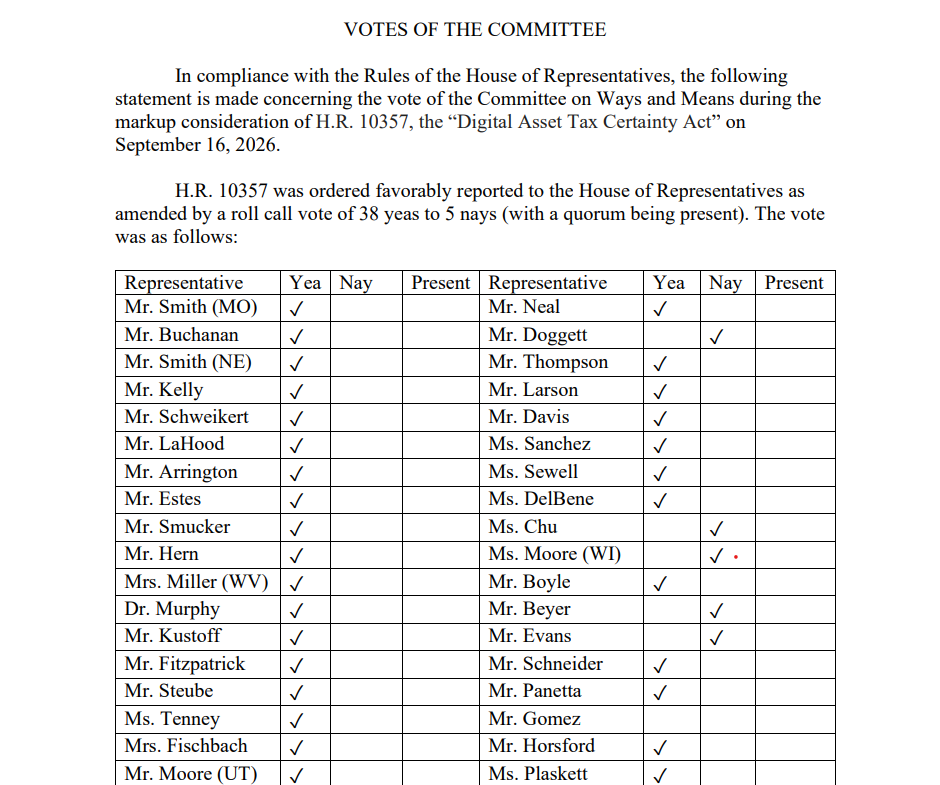
The Digital Asset Tax Certainty Act has been making its way through the legislative process, with Section 502 forming a critical component of its proposed reforms. On September 16th, the House Ways and Means Committee demonstrated significant backing for the bill, approving it by a substantial margin of 38-5. This vote signifies a crucial step in the legislative process, indicating that a key committee with jurisdiction over tax matters has reviewed and endorsed the proposed measures.
However, the bill’s journey is far from over. For H.R. 10357 to become law, it must successfully navigate the remaining legislative hurdles. This includes passing both the full House of Representatives and the Senate. Following congressional approval, the legislation will then require the signature of the President to be officially enacted. The timeline for these subsequent stages remains fluid, subject to the legislative calendar and the broader political agenda.
Andrew Gordon, executive director of Digital Asset Tax Action, highlighted the potential impact of this legislation, stating, "It’s a big change that would help a lot of ordinary taxpayers, and it has gotten very little attention." His comments underscore the significant, yet underreported, nature of the proposed reforms and their potential to benefit a broad segment of the investing public.
The Evolving Landscape of Crypto Taxation
The push for a voluntary disclosure program comes at a time when cryptocurrency investors in the U.S. are already facing increased scrutiny and reporting requirements. The recent implementation of new 1099-DA broker reporting rules has significantly enhanced the Internal Revenue Service’s (IRS) visibility into cryptocurrency transactions. These rules, designed to streamline reporting and ensure greater compliance, compel cryptocurrency exchanges and other digital asset service providers to report customer transactions to the IRS.
While these new reporting mandates are expected to simplify tax compliance for ongoing transactions, they do not retroactively address the tax implications of past trades that may have been overlooked or misinterpreted. This creates a persistent "gap in the system," as described by tax experts, leaving many individuals with unaddressed tax liabilities from prior years.

A Historical Perspective on Reporting Challenges
The complexities of cryptocurrency taxation have long been a source of confusion and concern for investors. Unlike traditional financial assets, digital assets often involve intricate transaction types, such as crypto-to-crypto trades, staking rewards, airdrops, and transactions across multiple decentralized platforms. Many investors, especially those who entered the crypto market in its earlier stages, may have lacked a clear understanding of how these activities were subject to tax laws.
Sharon Yip, a Certified Public Accountant (CPA) and founder of Crypto Tax Advisors, noted the prevalence of reporting errors among ordinary crypto investors. She explained, "In our firm’s experience, some clients did not report crypto because they believed no tax was due until they cashed out, while others relied on incomplete exchange records or incorrectly classified transactions." This highlights the varied reasons behind non-compliance, ranging from genuine misunderstandings of tax principles to reliance on inadequate data.
The absence of a clear and predictable framework for resolving these past reporting issues has been a significant challenge. Existing IRS procedures, such as the Voluntary Disclosure Practice, are primarily designed for taxpayers who have willfully violated tax laws and may face potential criminal prosecution. For individuals who made honest mistakes or had a good-faith belief that their reporting was correct, the current avenues for rectification can be uncertain and potentially costly.
"Today, a crypto investor who learns they didn’t properly report their crypto or has not reported at all has no good way to fix it," Gordon elaborated. "Investors can discover years later that they misunderstood the tax treatment of crypto-to-crypto trades or reporting activity across multiple platforms." This lack of a defined resolution path can create significant anxiety and financial risk for individuals seeking to correct their tax affairs.
The Proposed Solution: A Crypto-Specific Disclosure Program
Section 502 of the Digital Asset Tax Certainty Act aims to fill this void by establishing a program tailored specifically to digital asset tax violations. This program is designed to offer a more accessible and predictable pathway for taxpayers to come into compliance, distinguishing itself from the more stringent voluntary disclosure practice.
Yip believes that a dedicated crypto program could "fill this gap" by providing "a defined correction period, reduced and predictable penalties, and greater certainty for taxpayers who come forward voluntarily." This structured approach is expected to encourage more individuals to proactively address their tax liabilities without the fear of excessive penalties or legal repercussions associated with willful non-compliance.
Key Provisions and Benefits of Section 502
The proposed legislation outlines a framework for the voluntary disclosure program, including specific timelines and penalty structures. Under Section 502, taxpayers would generally be required to file amended returns within 24 months of the program’s establishment. The bill introduces two distinct penalty tracks, designed to differentiate between taxpayers whose violations were non-willful and those whose actions may have been more intentional.
Penalty Track 1: Non-Willful Violations
For taxpayers who can certify, under penalty of perjury, that their past reporting violations were neither fraudulent nor willful, the program offers significantly reduced penalties. These individuals would face a 0% penalty on the first $25,000 of tax deficiency per year and a 5% penalty on amounts exceeding that threshold, provided they come forward within the first 12 months of the program’s implementation. This tiered approach incentivizes prompt action and rewards those who can demonstrate a lack of intent to evade taxes.
Penalty Track 2: Uncertified or Potentially Willful Violations
For taxpayers who do not certify their violations as non-willful, or for whom the intent remains unclear, higher penalty rates would apply. These rates are set at 25% on the first $25,000 of tax deficiency and 40% on amounts above that. Furthermore, the bill indicates that these rates could increase if taxpayers miss the initial 12-month window for coming forward.
Beyond these penalty structures, the program also offers relief from specified civil penalties that might otherwise apply to unreported income. Crucially, even for those in the higher penalty track, taxpayers who properly disclose their tax offenses covered by the provision are protected from criminal referrals based on that disclosed information. This provides a significant layer of protection against potential criminal investigations related to past crypto tax issues.
Guidance for Taxpayers and Professional Advice
Experts are advising crypto investors to take proactive steps to assess their tax situation. Yip recommends that taxpayers meticulously review their transaction histories across all exchanges and wallets to identify specific years where reporting may have been incomplete or inaccurate. This due diligence is essential for determining whether their past reporting errors can be classified as non-willful.
Given the serious implications of falsely certifying one’s intent, Yip strongly advises seeking professional guidance. "Because falsely certifying carries a penalty of perjury, she advises seeking professional guidance where taxpayers are unsure," she stated. CPAs and tax attorneys specializing in cryptocurrency can provide invaluable assistance in navigating the complexities of tax law, assessing the nature of reporting errors, and preparing accurate amended returns.
Broader Implications and the Need for Clarity
The potential enactment of Section 502 comes at a critical juncture for the digital asset industry. A 2026 report by CoinTracker and Coinbase revealed that only 49% of crypto users correctly understood that selling cryptocurrency can be a taxable event. This statistic underscores the widespread misunderstanding of basic tax principles related to digital assets, highlighting the need for clearer guidance and accessible compliance pathways.
The proposed voluntary disclosure program represents a significant step towards providing that clarity. By offering a structured and predictable framework for resolving past tax discrepancies, the legislation aims to reduce the burden on individual taxpayers and foster a more compliant ecosystem. This could lead to a substantial increase in tax revenue for the government while simultaneously offering peace of mind to a large number of cryptocurrency holders who may have been living with the uncertainty of unaddressed tax liabilities.
The successful passage of H.R. 10357 would not only benefit individual investors but also contribute to the maturation of the digital asset market in the United States. A clearer and more defined tax environment can encourage greater mainstream adoption and investment by reducing regulatory uncertainty. The legislative process is ongoing, and the crypto community, along with tax professionals, will be closely watching the bill’s progress as it moves through Congress.