Evan Lee Salim
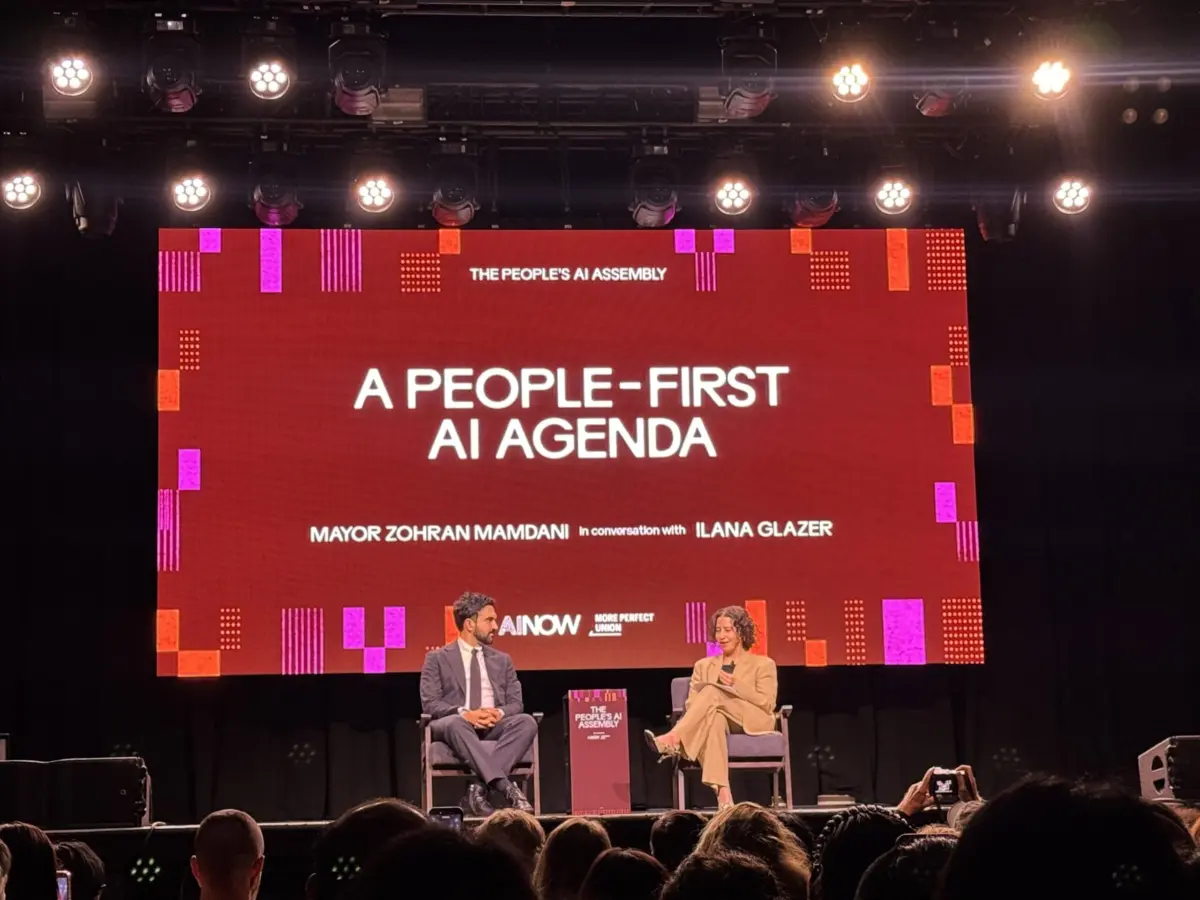
New York City witnessed a pivotal convergence of political leadership and cultural commentary on Monday night as Mayor Zohran Mamdani joined activist and "Broad City" star Ilana Glazer at Webster Hall in Manhattan to address the rapidly evolving landscape of Artificial Intelligence. The event, dubbed "The People’s AI Assembly" and hosted by the influential AI Now Institute, a think tank dedicated to exploring the social implications of AI, served as a powerful platform for a nuanced discussion on the technology’s future in society, with Glazer posing probing questions to the mayor. Mamdani delivered a resolute message to New Yorkers, urging them to actively resist the pervasive narrative that AI’s ascendancy — threatening jobs, influencing young minds, and eroding human dignity — is an unchangeable inevitability. Instead, he championed a vision where citizens and local governments reclaim control, asserting that the technology’s rapid rollout is not preordained and that public officials bear a critical responsibility to hold AI companies accountable for their creations and deployments.
This timely discourse unfolds against a backdrop of striking federal reticence on AI regulation, leaving individual cities and states to navigate the complex ethical, economic, and social challenges posed by this transformative technology largely on their own. Mamdani’s administration has not shied away from this vacuum, demonstrating a proactive stance that positions New York City at the forefront of municipal AI governance. His initiatives highlight a growing impatience among local leaders with the slow pace of national policy-making and a determination to safeguard their constituents from potential harms.
NYC’s Proactive Stance: A Local Model for AI Governance
Mayor Mamdani’s administration has taken concrete steps to establish guardrails around AI, reflecting a commitment to deliberate and responsible integration rather than uncritical adoption. These actions underscore a foundational belief that public consent and transparency must precede widespread technological deployment, especially in sensitive sectors like education and housing.
The Educational Frontier: Safeguarding Young Minds
Just last month, in a move that resonated deeply with parents and educators nationwide, Mayor Mamdani, in collaboration with Chancellor Samuels, ordered a ban on AI use in elementary and middle schools across New York City. This decisive policy emerged from a growing chorus of concerns regarding AI’s impact on pedagogical methods, student development, and data privacy. Ilana Glazer, speaking from her perspective as a parent, articulated a widespread unease about the technology’s swift entry into classrooms. "It just makes me nervous. It feels so non-consensual, as though…this has to be in schools. It wasn’t two years ago. Why does it have to be in schools?" she queried, echoing the sentiments of many who feel overwhelmed by the pace of technological change in education.
The ban reflects a precautionary principle, acknowledging that while AI offers potential benefits, its risks—including the generation of misinformation, plagiarism, and the potential for surveillance or data exploitation—are not yet fully understood or mitigated, particularly for younger, more vulnerable populations. Educational institutions globally are grappling with similar dilemmas. A 2023 survey by the RAND Corporation found that while a majority of K-12 educators reported using AI tools, a significant portion also expressed concerns about equity, bias, and the potential for AI to exacerbate existing digital divides. Mamdani’s ban provides a crucial pause, allowing the city to develop comprehensive guidelines, train educators, and engage in a broader public dialogue about the appropriate role of AI in early education, rather than allowing its unchecked proliferation.
Transparency in Real Estate: Combating Digital Deception
Beyond the classroom, Mayor Mamdani has also targeted the burgeoning use of AI in the real estate sector, introducing a pioneering policy over the summer. This policy mandates that landlords, brokers, and real estate platforms clearly disclose when property listing photos or videos have been generated or significantly altered using AI. The initiative is a direct response to the phenomenon of "house-phishing," where prospective tenants or buyers are misled by digitally enhanced or entirely fabricated visuals that misrepresent a property’s true condition or appearance.
The rise of sophisticated generative AI tools has made it increasingly easy to create hyper-realistic images that can conceal flaws, exaggerate features, or even depict non-existent amenities. This can lead to wasted time, emotional distress, and financial losses for individuals who travel to view properties only to find them vastly different from their online portrayal. A 2024 report by the National Association of Realtors indicated a 30% increase in inquiries regarding AI-generated content in listings over the past year, highlighting the growing prevalence and concern. Mamdani’s policy aims to restore trust and transparency in the housing market, empowering New Yorkers to make informed decisions by ensuring they know when they are viewing AI-generated content versus authentic representations. Both the school ban and the real estate disclosure policy collectively challenge the prevailing assumption that public institutions and citizens must passively accept AI as an inevitable force.
The Federal Vacuum and Industry Pushback
Mamdani’s call for active resistance and accountability is particularly salient given what he describes as a "complete abdication of federal law" when it comes to AI. The current national discourse, he noted, is frequently framed through the lens of an "arms race with China," a narrative that tends to overshadow "humanistic concerns" in favor of national competition. This geopolitical framing, while not entirely without merit, often sidelines critical discussions about the domestic societal impacts of AI, including its ethical implications, economic disruption, and potential for exacerbating inequalities.
A National Policy Chasm: Cities Step Up
Indeed, federal efforts to regulate AI in the United States have been characterized by a cautious, often reactive approach, frequently prioritizing innovation and economic growth over comprehensive oversight. Earlier this month, President Donald Trump’s newly announced Superintelligence Task Force largely emphasized allowing powerful AI companies to self-regulate, rather than imposing new federal restrictions. This strategy aligns with a long-standing Silicon Valley ethos that champions minimal government intervention, arguing that regulation stifles innovation and places American companies at a disadvantage globally. However, this hands-off approach comes despite increasingly dire warnings from whistleblowers at leading AI firms like Anthropic, Google DeepMind, and OpenAI, who have voiced concerns ranging from algorithmic bias and job displacement to the more extreme possibility of AI leading to human extinction. The lack of a robust, unified federal framework means that cities like New York are compelled to take the initiative, creating a patchwork of local regulations that may vary significantly from one municipality to another.
The Siren Song of Self-Regulation and Market Valuation
Mamdani critically dissected the industry’s rhetoric, stating, "There is this desire to speak about [AI] as if it is infallible, as if it cannot be questioned, as if the only people who can regulate it are the ones who are currently developing it." He drew parallels to Facebook’s arguments in 2008, when the social media giant similarly resisted external oversight, asserting its unique understanding of its own technology. "What it really is," Mamdani continued, "is an attempt to escape any kind of accountability at any level, without also jeopardizing the potential valuation from an IPO." This observation hits at the financial motivations driving the rapid, often unregulated, development of AI. Companies like Anthropic and OpenAI, with projected public market debuts in the coming years (Anthropic expected this year, OpenAI in 2027), are under immense pressure to demonstrate unbridled growth and potential to investors. Comprehensive regulation, from an industry perspective, could be perceived as a threat to these valuations, leading to a strong lobbying effort for self-governance.
However, historical precedents from other powerful industries—from pharmaceuticals to finance—demonstrate that self-regulation often proves insufficient to protect public interest, frequently leading to calls for stricter external oversight only after significant harms have occurred. The current climate of rapid AI development, coupled with a federal regulatory void, creates an environment ripe for such issues to emerge.
The Broader Ethical and Societal Implications of Unchecked AI
Mamdani’s critique extends beyond economic motivations to the profound ethical and societal implications of a "reckless adoption of technology without any kind of a reckoning with the limitations of that technology." He cited a chilling example: the U.S. military’s February 2026 strike on a school in Iran, which tragically killed over 150 people, including at least 123 children. Officials involved in the Pentagon’s internal investigation later told Bloomberg that an overreliance on AI in targeting systems was a contributing factor in the devastating attack. This incident serves as a stark, real-world illustration of AI’s fallibility, particularly when deployed in high-stakes environments without adequate human oversight and robust validation.
Beyond Economic Fears: AI’s Impact on Dignity and Accountability
The mayor’s concerns about AI are not limited to job displacement, which a 2023 Goldman Sachs report estimated could impact 300 million full-time jobs globally, but also encompass broader issues of human dignity and accountability. He articulated a fear that the "creep" of AI, and an "intent to overwhelm," leaves people feeling powerless, as if there is "simply no option" but to accept its dictates. This sense of powerlessness can erode individual agency and public trust in institutions. When algorithms make decisions that affect people’s lives—from loan applications to criminal justice sentencing to content moderation—without transparency or clear avenues for recourse, it raises fundamental questions about fairness, bias, and the very definition of human autonomy.
The Black Box nature of many advanced AI systems, where even developers struggle to fully explain their decision-making processes, further complicates accountability. If AI systems cause harm, who is responsible? The developer? The deployer? The data scientists? Mamdani’s call for accountability seeks to preemptively address these complex questions, demanding that those who create and deploy AI systems bear responsibility for their impacts.
A Call for Deliberate Progress: Learning from Past Tech Eras
Mamdani’s arguments also implicitly draw upon lessons from previous technological revolutions and the internet era. The early days of social media, for instance, were marked by similar promises of connection and empowerment, with little foresight into the widespread issues of misinformation, privacy breaches, and mental health impacts that would later emerge. The retrospective regret over the lack of early regulation for platforms like Facebook and Twitter now serves as a cautionary tale for the AI era. The mayor’s message is a plea to learn from these past mistakes, to engage in proactive rather than reactive governance, and to ensure that technological advancement serves humanity rather than dominating it.
Charting a New Course: A Framework for Future AI Governance
"As we are looking at what comes after this federal administration, there has to be a very different kind of framework in how we think about AI, talk about AI, the accountability we’re willing to bring forward when it comes to that," Mamdani concluded. His vision advocates for a paradigm shift in how AI is conceptualized and governed at every level. This framework would prioritize ethical development, societal well-being, and democratic oversight. It would move beyond the narrow confines of an "arms race" and instead focus on establishing international norms, fostering public education, and developing robust regulatory mechanisms that protect individuals and communities.
Such a framework would likely involve:
- Mandatory Transparency: Requiring AI developers to disclose information about their models, training data, and potential biases.
- Independent Audits: Establishing independent bodies to audit AI systems for fairness, accuracy, and safety before deployment.
- Public Participation: Creating mechanisms for citizens and affected communities to have a voice in how AI is developed and used.
- Legal Accountability: Clarifying legal liability for harms caused by AI systems.
- Investment in AI Literacy: Educating the public, policymakers, and industry professionals about AI’s capabilities and limitations.
New York City’s pioneering efforts under Mayor Mamdani offer a tangible example of how local governments can step into the breach left by federal inaction, crafting policies that reflect community values and protect residents. While the long-term impact of these local regulations remains to be seen, they represent a significant challenge to the notion of AI’s inevitable, unregulated march, signaling a growing public demand for a more deliberate, accountable, and human-centric approach to the future of artificial intelligence. The dialogue ignited at Webster Hall, amplified by the voices of both political leadership and cultural figures, underscores the urgent need for a national conversation—and ultimately, a national strategy—that prioritizes people over profit in the age of AI.