Sisilia Frederika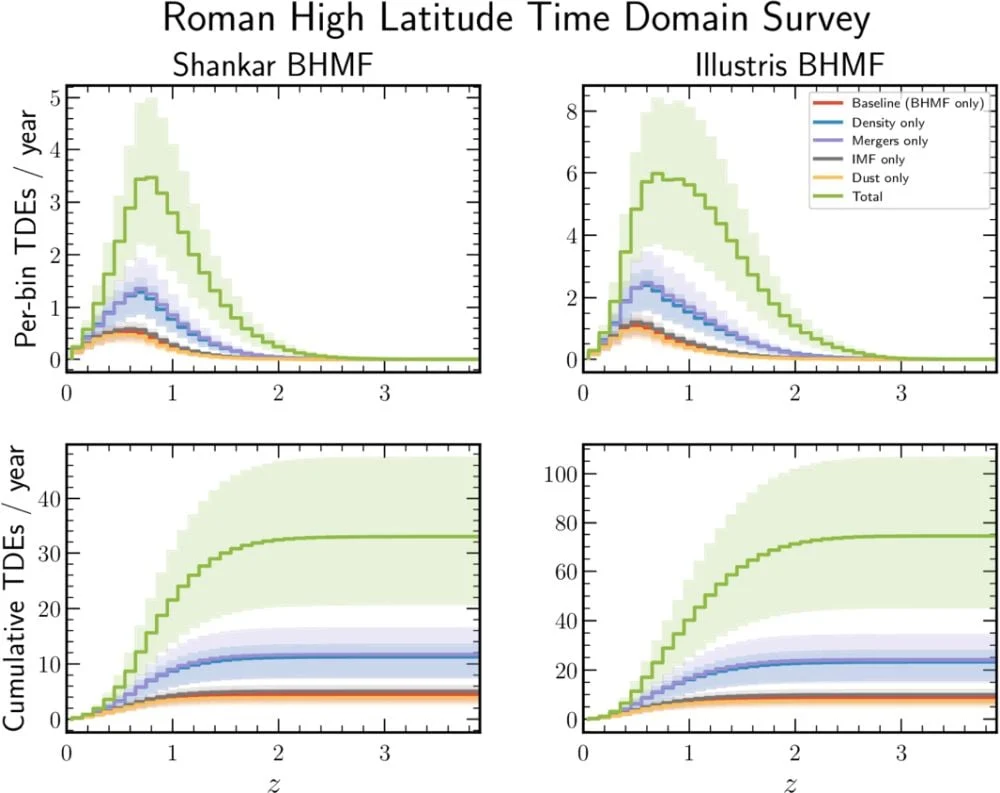
The Mechanics and Significance of Tidal Disruption
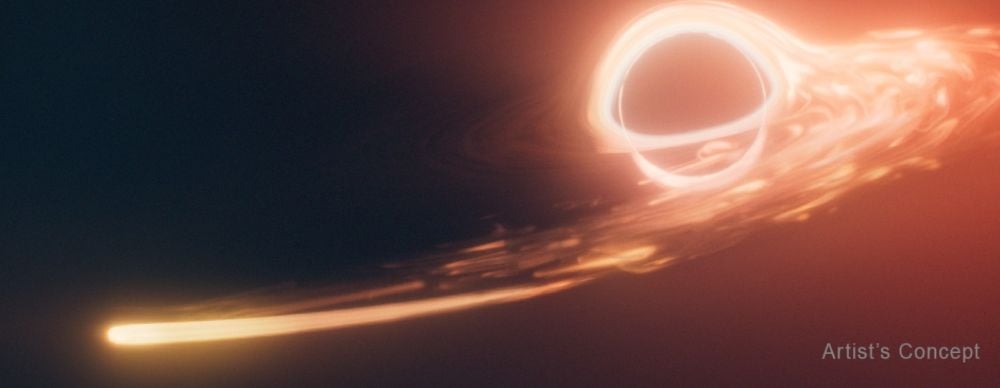
A Tidal Disruption Event is more than a cosmic spectacle; it is a critical diagnostic tool for astrophysicists. For an SMBH to disrupt a star rather than swallow it whole, the star must pass within a specific distance known as the tidal radius. If the black hole is too massive—typically exceeding 100 million solar masses—the tidal radius actually falls within the event horizon. In these cases, the star is consumed in its entirety without producing a visible flare. Consequently, TDEs are uniquely suited for detecting "lower-mass" SMBHs, ranging from 100,000 to 100 million solar masses.
Measuring the mass distribution of these black holes across cosmic time is essential for understanding how the universe evolved. Currently, detecting low-mass SMBHs at high redshifts (z > 1), which corresponds to the early stages of the universe, remains one of the most significant challenges in modern astronomy. By analyzing the frequency and characteristics of TDEs, researchers can infer the "Supermassive Black Hole Mass Function" (BHMF)—a statistical description of how many black holes of various masses exist at different epochs of the universe.
Modeling the Cosmic Evolution of TDE Rates
The research led by Karmen utilizes a semi-empirical model to predict how TDE rates change as the universe ages. The team integrated several variables that evolve over billions of years, including the increasing density of stars in galactic nuclei, the frequency of galaxy mergers, and the effects of dust obscuration that can hide these flares from our view.
According to the study, the volumetric rate of TDEs is expected to increase as we look back in time, peaking near "Cosmic Noon"—the period roughly 10 billion years ago when star formation in the universe was at its zenith. After this peak, the rate is predicted to decline at even higher redshifts, as the universe was then too young for a significant population of SMBHs to have formed.
To refine these predictions, the researchers compared two primary methodologies for estimating black hole populations. The first is the Shankar mass function, an empirical approach that uses observations of existing galaxies to infer the historical population of SMBHs. The second is the Illustris TNG simulation, a sophisticated hydrodynamical model that uses supercomputers to simulate the physics of gas, stars, and dark matter to predict black hole growth. The divergence between these models highlights the need for the high-quality data that upcoming telescope missions are expected to provide.
A Triple Threat: LSST, Roman, and JWST
The study forecasts the performance of three flagship observatories: the Vera C. Rubin Observatory’s Legacy Survey of Space and Time (LSST), the Nancy Grace Roman Space Telescope, and the James Webb Space Telescope (JWST). Each brings a unique capability to the search for TDEs.
The Vera C. Rubin Observatory (LSST)
The LSST, located in Chile, is designed for "volume." It will utilize an 8.4-meter primary mirror and a 3.2-gigapixel camera to survey the entire visible sky every few nights. The research predicts that the LSST will detect tens of thousands of TDEs every year over its decade-long mission. While the LSST will provide an unprecedented statistical sample, its reach is limited primarily to the more recent "local" universe due to its sensitivity in optical wavelengths.
The Nancy Grace Roman Space Telescope
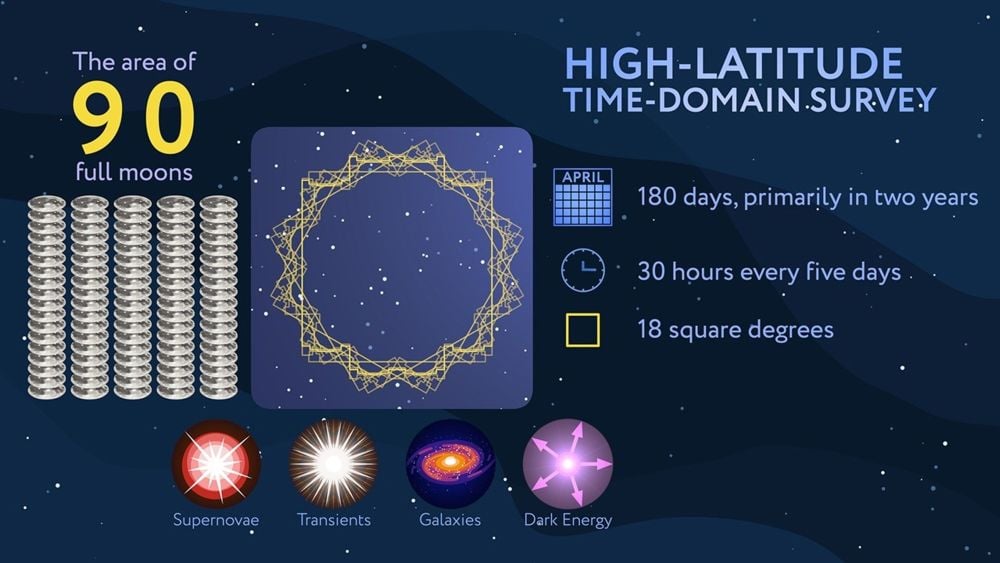
Scheduled for launch in the mid-2020s, the Roman Space Telescope is optimized for "depth" and "clarity." Its High-Latitude Time Domain Survey (HLTDS) will repeatedly monitor the same patches of the sky in infrared light. Because light from the distant universe is "redshifted" into the infrared spectrum by the expansion of space, Roman is uniquely capable of finding TDEs from the ancient universe.
The study predicts that while Roman will find fewer TDEs than the LSST—approximately 100 per year—these detections will be "exceptionally clean and well-characterized." Because Roman observes from space, it is not hindered by Earth’s atmosphere, allowing for more precise measurements of the light curves of distant TDEs. These high-redshift events are vital for distinguishing between different models of SMBH growth.
The James Webb Space Telescope (JWST)
The JWST, currently in operation, is the most powerful infrared telescope ever built. While it is not a survey telescope like the LSST or Roman, its COSMOS-Web survey—the largest contiguous survey JWST will perform—is expected to capture TDEs at the highest redshifts imaginable. Though the total number of TDEs found by JWST will be small, they will represent the "first" black holes in the universe, providing data that no other instrument can reach.
Solving the "Seed" Mystery
One of the most profound questions in cosmology is how SMBHs grew so large so quickly. Observations by the JWST have already revealed massive black holes existing only a few hundred million years after the Big Bang, challenging existing theories of gradual growth. There are two primary hypotheses for the "seeds" of these black holes:
- Light Seeds: This theory suggests that the first generation of massive stars (Population III stars) collapsed into black holes of about 100 solar masses. These seeds then grew through mergers and by accreting surrounding gas over billions of years. If this is true, almost every young galaxy should contain a small SMBH.
- Heavy Seeds: This theory proposes that massive clouds of gas in the early universe collapsed directly into black holes with masses up to one million times that of the sun. This "Direct Collapse" method would result in fewer, but much larger, initial black holes.
By counting TDEs as a function of redshift, the Roman Space Telescope will help scientists determine which of these scenarios is more likely. "Tidal disruption events help us probe the population of light supermassive black holes, which can help us discriminate between these models," Karmen noted. If Roman finds a high frequency of TDEs in the early universe, it would support the light seed model; a lower frequency would suggest that heavy seeds were the starting point for cosmic giants.
Expert Analysis and Future Outlook
Suvi Gezari, a co-author of the study and associate professor at the University of Maryland, emphasized the transformative nature of the upcoming data. "Just like Webb has transformed our understanding of distant, high-redshift galaxies, Roman is poised to transform our understanding of high-redshift transients," Gezari said. The ability to observe how the TDE rate evolves over time allows astronomers to place "meaningful constraints" on the population of million-solar-mass black holes, effectively creating a census of the universe’s hidden mass.
The implications of this research extend beyond black hole physics. TDEs provide information about the stellar environments in the centers of galaxies, the rate of galaxy collisions, and the general expansion of the universe. The "clean" sample provided by the Roman Space Telescope will serve as a gold standard, helping to calibrate the much larger but "noisier" data set from the LSST.
As the astronomical community prepares for the launch of the Nancy Grace Roman Space Telescope and the full activation of the Vera C. Rubin Observatory, the framework established by Karmen and his team provides the necessary roadmap. By leveraging the complementary strengths of these three observatories, scientists are on the verge of solving the mystery of how supermassive black holes came to dominate the centers of galaxies. The next decade of time-domain astronomy promises to turn the violent destruction of stars into a beacon of clarity for our understanding of the early universe.