Sisilia Frederika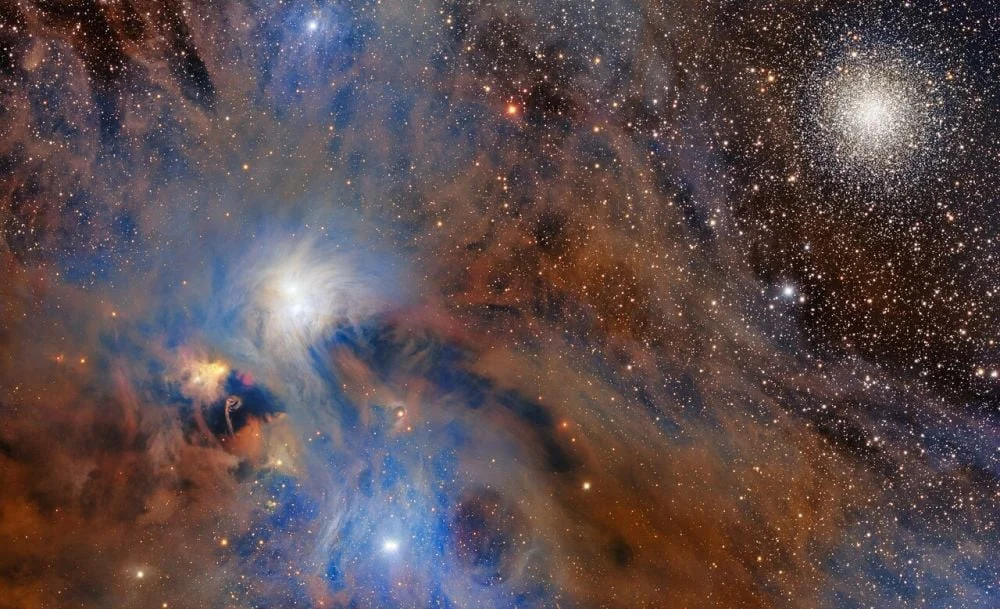
The Dark Energy Camera, a high-performance wide-field imager mounted on the Victor M. Blanco 4-meter Telescope at the Cerro Tololo Inter-American Observatory, has released a breathtaking new image of the Corona Australis molecular cloud. This celestial vista, located approximately 425 light-years from Earth, reveals a chaotic yet beautiful tapestry of gas, dust, and emerging stars that bears a striking resemblance to the swirling brushstrokes of Vincent van Gogh’s 1889 masterpiece, "The Starry Night." While the Corona Australis (CrA) region is one of the closest star-forming nurseries to our solar system, it has historically received less scientific scrutiny than more prominent regions such as the Orion Nebula or the Rho Ophiuchi cloud complex. This latest observation provides a high-resolution look at the intricate dynamics of stellar birth and the complex interplay of light and matter in the southern sky.
The Anatomy of a Molecular Cloud
The Corona Australis molecular cloud is a dark nebula, a dense region of interstellar gas and dust that is cold enough to allow for the formation of molecules, most notably molecular hydrogen. Because of its density, it often obscures the light from stars behind it, appearing as a dark silhouette against the backdrop of the Milky Way. However, when young stars begin to form within these clouds, they illuminate their surroundings, creating a variety of nebular features.
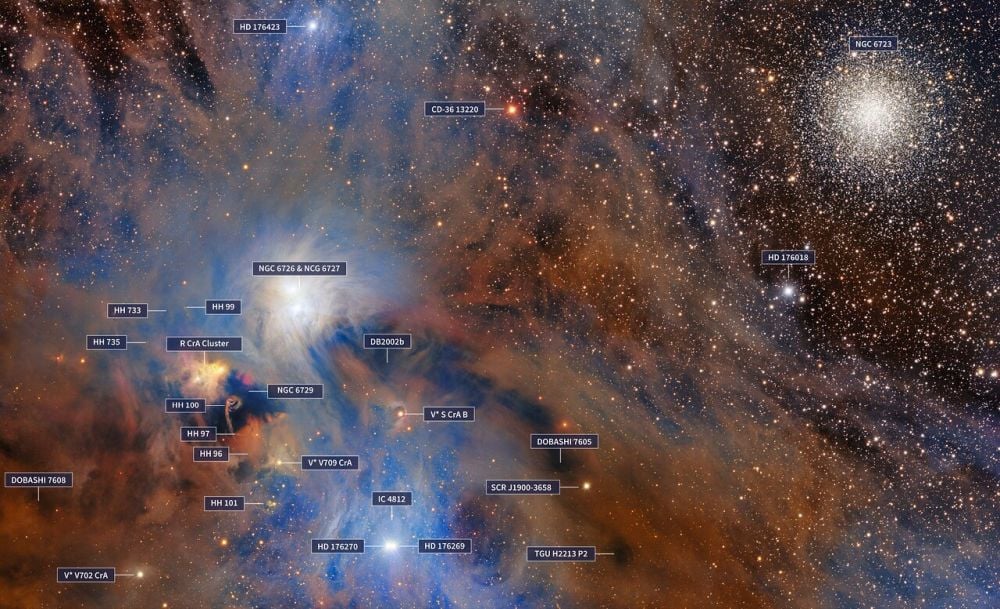
The new image from the Dark Energy Camera (DECam) highlights several key components of the CrA complex. On the left side of the frame, the binary star system R Coronae Australis serves as a primary light source, casting an orange-hued glow onto the surrounding dust clouds. This system consists of a red dwarf and a pre-main-sequence star—a stellar object that has accumulated most of its final mass but has not yet reached the temperatures and pressures required to initiate hydrogen fusion in its core. This "protostellar" phase is a critical window for astronomers seeking to understand how stars like our Sun transition from collapsing gas clouds into stable nuclear furnaces.
The Dance of Reflection and Emission Nebulae
One of the most visually arresting aspects of the DECam image is the contrast between different types of nebulae. Reflection nebulae, such as NGC 6726 and NGC 6727, appear in shades of beige, yellow, and blue. These clouds do not emit their own light; instead, they act like cosmic fog, scattering and reflecting the light from nearby hot, young stars. The blue coloration often seen in these regions is a result of Rayleigh scattering—the same physical process that makes Earth’s sky appear blue—where smaller particles in the dust cloud scatter shorter wavelengths of light more effectively.
In addition to reflection nebulae, the region hosts emission nebulae, most notably NGC 6729, also classified as Caldwell 68. Unlike reflection nebulae, emission nebulae are composed of ionized gas. The intense ultraviolet radiation from massive young stars strips electrons from hydrogen atoms; when these electrons recombine with the nuclei, they emit light at specific wavelengths. In NGC 6729, the brightness and physical shape of the nebula are known to fluctuate. These variations are tied to the orbital dynamics of the central binary star system and the shadows cast by the dense disks of material orbiting the stars.
The lower right of the image shows these gas filaments merging into IC 4812, another reflection nebula. The continuity of these structures suggests a highly interconnected environment where the "wind" from stellar radiation carves out voids and shapes the remaining gas into the "starry night" patterns observed by the DECam.
A Distant Spectator: The Chandelier Cluster
While the Corona Australis cloud dominates the foreground, the DECam image also captures a stunning background object in the upper right corner: NGC 6723. Known colloquially as the Chandelier Cluster, this is a globular cluster—a spherical collection of hundreds of thousands of ancient stars held together by gravity.
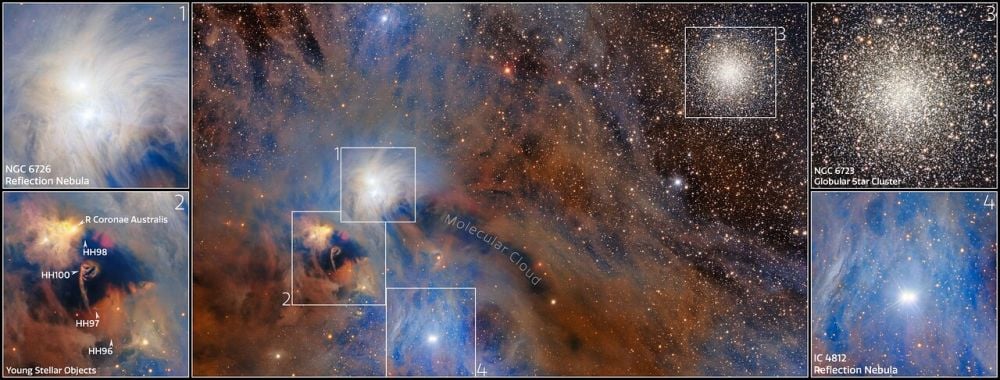
The inclusion of NGC 6723 in the frame provides a profound sense of cosmic scale. While the Corona Australis cloud is a mere 425 light-years away, NGC 6723 resides at a distance of approximately 29,000 light-years. Despite their visual proximity in the sky, they are entirely unrelated structures. The Chandelier Cluster is composed of some of the oldest stars in the galaxy, whereas the Corona Australis cloud is a nursery for some of the youngest. This juxtaposition allows researchers to study two vastly different stages of galactic evolution within a single field of view.
Recent Scientific Discoveries and the Kinetic History of CrA
For decades, Corona Australis was overshadowed by larger star-forming regions, but recent data from space-based observatories like Gaia, Chandra, and XMM-Newton have sparked a renewed interest in the complex. These missions have provided high-precision measurements of the positions and velocities of the stars within the cloud, revealing that the region is far more dynamic than previously thought.
A landmark study published in 2023 utilized Gaia data to track the three-dimensional motion of the CrA complex. The researchers discovered that the entire molecular cloud is accelerating away from the Galactic plane at an unexpected velocity. According to the study’s analysis, the kinetic energy required to propel such a massive amount of gas and dust would be immense. The authors concluded that the most likely catalyst for this movement was the explosive force of two separate supernovae that occurred in the vicinity millions of years ago. These explosions acted like cosmic "shoves," pushing the cloud out of its original equilibrium.
Further research published in 2025 refined this view by dividing the complex into two distinct sub-regions: CrA-Main and CrA-North. While they currently appear as a unified structure, kinematic data suggests that CrA-Main is significantly younger than CrA-North. The two regions were once much closer together but are now drifting apart. This "fragmentation" of the cloud provides vital clues regarding how external forces, such as supernova shockwaves and galactic tides, influence the lifespan and productivity of star-forming regions.
Transient Wonders: Herbig-Haro Objects
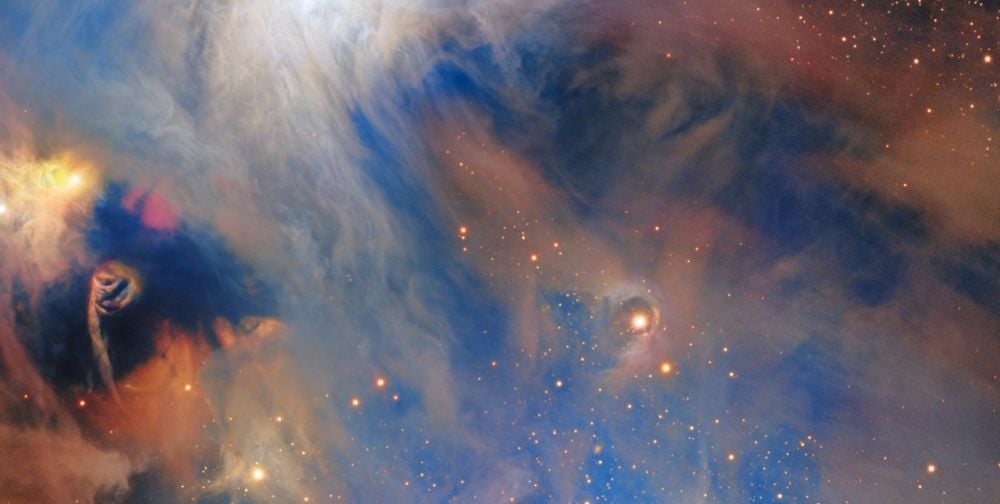
Zoomed-in portions of the DECam image reveal smaller, more violent features known as Herbig-Haro (HH) objects, specifically HH100. These are small patches of nebulosity associated with newly born stars. They are formed when narrow jets of partially ionized gas, ejected by a protostar, collide with nearby clouds of gas and dust at speeds of several hundred kilometers per second.
These collisions create shockwaves that glow brightly, marking the "birth cries" of a new star. However, HH objects are fleeting on a galactic timescale. They are highly transient, often lasting only a few tens of thousands of years before the jets dissipate or the surrounding material is cleared away. The presence of HH100 in the Corona Australis cloud confirms that star formation is currently active and ongoing, offering a real-time laboratory for observing the earliest stages of stellar life.
Technical Prowess of the Dark Energy Camera
The clarity of this image is a testament to the technical capabilities of the Dark Energy Camera. Originally designed for the Dark Energy Survey (DES)—a five-year project to map hundreds of millions of galaxies and understand the accelerating expansion of the universe—the DECam has become one of the most versatile tools in modern astronomy.
The camera features a 570-megapixel CCD array and a wide field of view that allows it to capture large swaths of the sky in a single exposure. This is particularly useful for imaging large molecular clouds like Corona Australis, which cover several degrees of the sky. By capturing the entire region at once, astronomers can see the large-scale connectivity of the gas filaments while still maintaining the resolution necessary to identify individual stars and HH objects.
Implications for the Study of Solar System Origins
Studying regions like Corona Australis is not merely an exercise in celestial photography; it is fundamental to understanding our own origins. Our Sun was born in a similar environment approximately 4.6 billion years ago. By observing the chemical composition of the dust in CrA and the frequency of binary star formation, researchers can build more accurate models of how planetary systems—including our own—emerge from the chaos of a collapsing nebula.
The fact that CrA is relatively close to Earth allows for high-sensitivity observations that are impossible in more distant regions. Data from the Chandra X-ray Observatory, for instance, has allowed scientists to peer through the obscuring dust of the cloud to detect the X-ray emissions of "hidden" young stars. These observations help quantify the total stellar output of the cloud and provide a more complete census of the young stellar population.
Future Outlook
As the astronomical community looks forward to the next generation of observatories, such as the Vera C. Rubin Observatory and its Legacy Survey of Space and Time (LSST), images like this one from DECam serve as a vital bridge. They provide the deep-field context necessary to target specific areas for more detailed study.
The Corona Australis molecular cloud remains a priority for astronomers interested in the feedback mechanisms between young stars and their parental clouds. With its "Starry Night" aesthetic and its complex internal physics, CrA continues to prove that even the less-studied corners of our galaxy hold profound secrets about the nature of the universe. For now, the public and scientific community alike can marvel at this new view, which captures a moment of fleeting beauty in a process that spans millions of years.