Sisilia Frederika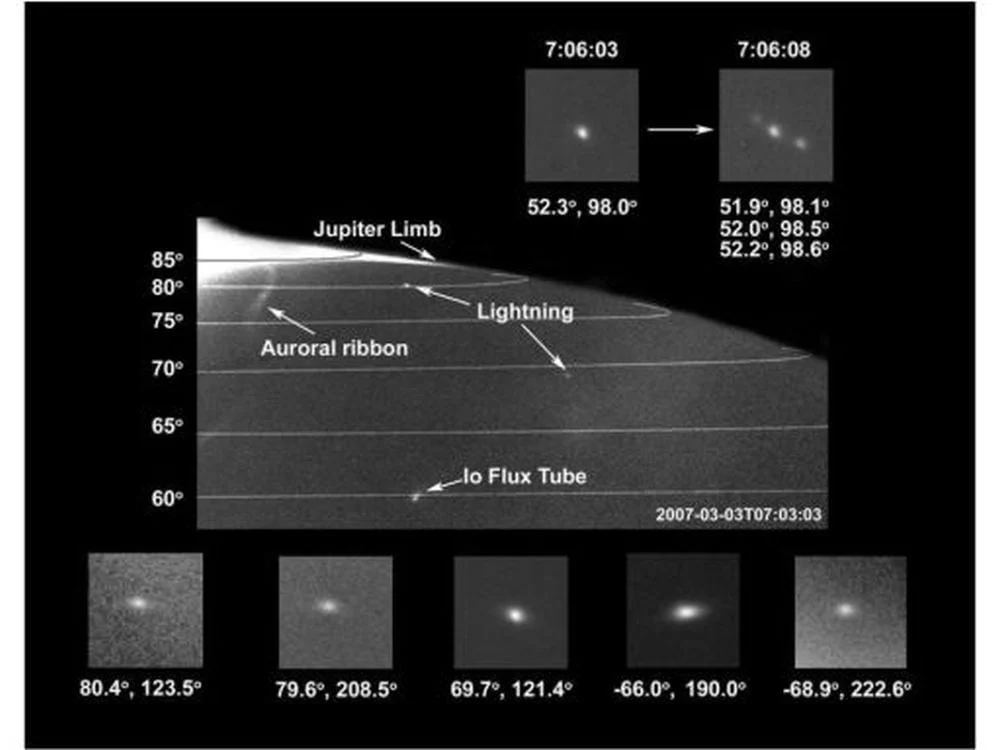
The arrival of NASA’s Juno spacecraft at the Jovian system in 2016 marked a transformative era in planetary science, shifting our understanding of the solar system’s largest planet from speculative models to data-driven certainty. Among the most striking revelations provided by the mission is the sheer scale and intensity of Jupiter’s atmospheric phenomena, specifically its lightning. New research led by Michael Wong, a planetary scientist at the University of California, Berkeley’s Space Sciences Laboratory, indicates that lightning on Jupiter is not merely a larger version of terrestrial weather but a phenomenon that can be up to one million times more powerful than the bolts experienced on Earth. Published in the journal AGU Advances, the study utilizes data from Juno’s Microwave Radiometer (MWR) to provide an unprecedented look at the energy distribution within what researchers have termed "stealth superstorms."
The Evolution of Jovian Lightning Observation
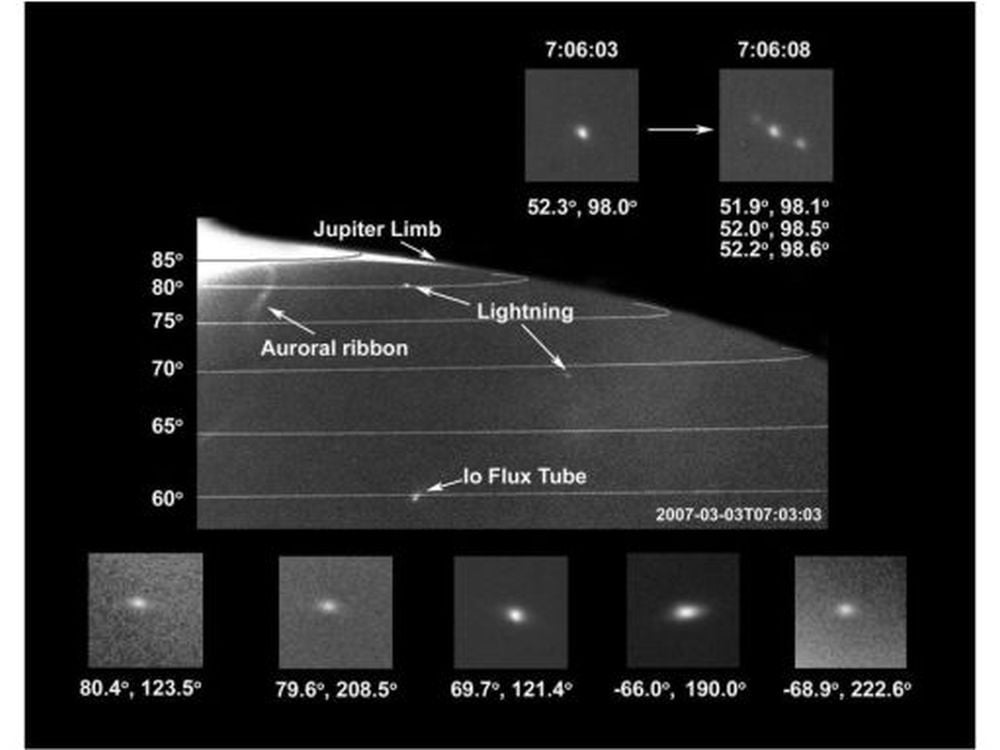
Before the Juno mission, the scientific community’s perspective on Jupiter was largely constrained by an equatorial vantage point. Missions such as Voyager 1 and 2, Galileo, Cassini, and New Horizons provided valuable glimpses of the planet, but their trajectories limited observations to lower latitudes. Lightning was primarily detected on the planet’s nightside, where optical flashes were visible against the dark backdrop of the hydrogen-rich clouds. In 2007, the New Horizons spacecraft, while en route to Pluto, captured images of lightning at polar latitudes—a discovery that hinted at a much more complex atmospheric engine than previously theorized.
However, optical observations have inherent limitations. Jupiter’s atmosphere is incredibly dense and deep, meaning that many lightning discharges occur far below the visible cloud tops. The light from these flashes is often scattered or completely blocked by thick layers of ammonia and water ice, making it difficult for scientists to calculate the true energy output of a given strike. Juno’s polar orbit and its specialized suite of instruments were designed specifically to overcome these barriers, allowing for a three-dimensional mapping of the planet’s internal dynamics.
Technical Superiority of the Microwave Radiometer
The breakthrough in the recent study stems from the use of the Microwave Radiometer (MWR) instrument. Unlike traditional cameras that rely on visible light, the MWR detects electromagnetic waves in the microwave spectrum. This provides two distinct advantages for the study of planetary meteorology. First, it bypasses the "plasma problem" presented by the ionosphere. A planetary ionosphere acts as a barrier to certain radio frequencies; for instance, on Earth, the ionosphere reflects AM radio waves back toward the surface. Jupiter’s ionosphere possesses a specific plasma frequency that blocks lower-frequency signals. Because the MWR operates at frequencies higher than Jupiter’s plasma frequency, the radio pulses generated by lightning can propagate directly from the source to the spacecraft’s sensors without being reflected or distorted.
Second, the MWR is capable of penetrating the deep atmosphere. While optical pulses are obscured by the thick Jovian "smog," radio waves pass through with minimal interference. The MWR utilizes six separate antennas, each tuned to a specific frequency range. This allows the instrument to sample the radio pulses of lightning across a broad spectrum, providing a more statistically reliable measure of a storm’s power. According to the research team, the MWR measures the "typical" pulse power within a storm system rather than just the high-power outliers that might be bright enough to be seen by optical cameras.
The Discovery of Stealth Superstorms
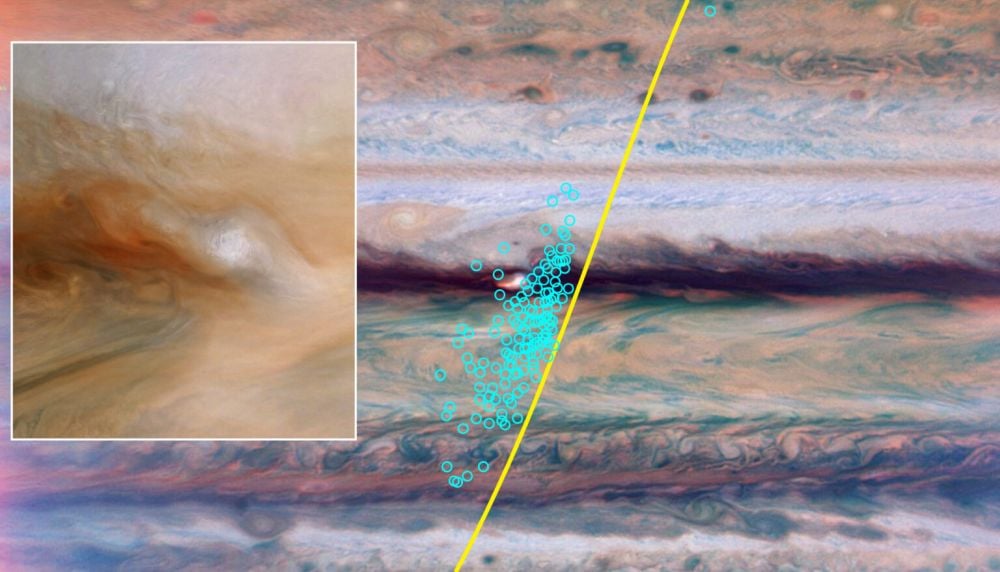
One of the most significant findings of the 2021–2022 observation period was the identification of "stealth superstorms." Typically, a superstorm on Jupiter is identified by its massive vertical extent, with white plumes of ammonia ice punching through the upper atmosphere. However, Wong and his colleagues identified a series of storms in Jupiter’s North Equatorial Belt that were "stealthy" because they did not reach these extreme altitudes, yet they remained active for months and fundamentally altered the surrounding cloud structures.
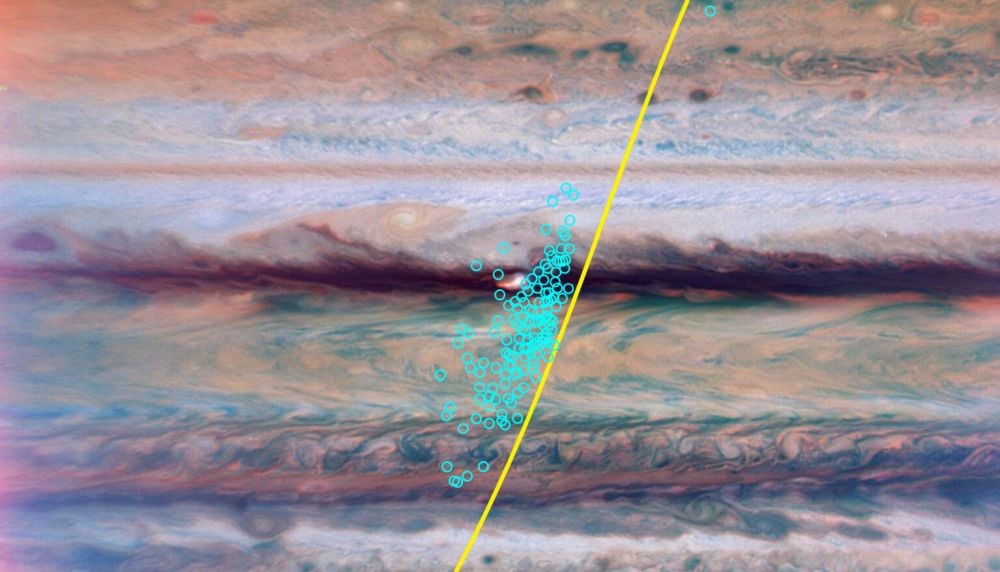
The timing of these observations was fortuitous. Jupiter’s atmosphere is often a chaotic mess of overlapping storm systems, making it nearly impossible to isolate the radio emissions from a single source. During the 2021–2022 window, a rare lull in activity in the North Equatorial Belt allowed researchers to pinpoint individual storms. By coordinating Juno’s flybys with high-resolution imagery from the Hubble Space Telescope, the JunoCam instrument, and a network of amateur astronomers on Earth, the team was able to match specific radio pulses to isolated storm cells.
During one specific orbit in August 2022, Juno detected 206 separate pulses of microwave radiation from a single storm system. Across the entire study period, the spacecraft recorded 613 pulses. The data revealed that even these "modest" stealth storms produced an average of three lightning flashes per second, a rate that highlights the intense convective activity occurring beneath the cloud tops.
Comparative Energy: Earth vs. Jupiter
The comparison between terrestrial and Jovian lightning reveals a staggering disparity in scale. On Earth, a standard lightning bolt releases approximately one gigajoule (one billion joules) of energy. This is enough to power roughly 200 average American homes for an hour. Jupiter’s lightning, however, operates on a different order of magnitude.
The study’s calculations suggest that the median power of the radio pulses detected by the MWR ranged from 27 to 214 Watts within the specific bandpass observed. When extrapolated across the full electromagnetic spectrum, the results are profound. Wong estimates that a single bolt of Jovian lightning can be 500 to 10,000 times more energetic than an Earth bolt. When accounting for uncertainties in how radio power scales with frequency—a factor known as the power-law slope—the researchers noted that some Jovian discharges could be up to one million times more powerful than terrestrial ones.
This extreme energy is a direct result of Jupiter’s unique atmospheric chemistry. Earth’s atmosphere is dominated by nitrogen and oxygen, whereas Jupiter’s is primarily hydrogen and helium. In a hydrogen-dominated environment, moist air is significantly heavier relative to the surrounding dry air than it is on Earth. This creates a "convective inhibition" layer. For a storm to break through this layer, a massive amount of heat and buoyancy must build up in the lower atmosphere. When the storm finally erupts, the energy release is far more violent than the relatively "easy" convection seen in Earth’s nitrogen-dominated sky.
Atmospheric Dynamics and Storm Structure
The physical dimensions of these storms further illustrate the difference between the two planets. A typical convective thunderstorm on Earth reaches an altitude of approximately 10 to 15 kilometers. On Jupiter, storms can exceed 100 kilometers in height. This vertical scale allows for the development of massive electrical potential differences between different cloud layers.
"This is where the details start to get exciting," Wong noted in a statement regarding the research. He raised several questions that the team is currently investigating: "Could the key difference be hydrogen versus nitrogen atmospheres, or could it be that the storms are taller on Jupiter and so there’s greater distances involved? Or could it be that greater energy is available because with moist convection on Jupiter, you have a bigger buildup of heat needed before you can generate the storm to create lightning?"
The researchers also noted that the "stealth" nature of these storms suggests that lightning might be even more prevalent on Jupiter than previously thought. If high-energy lightning can occur in storms that do not produce visible plumes, then the total energy budget of Jupiter’s atmosphere may need to be revised upward.
Implications for Planetary Science and Future Exploration
The findings published in AGU Advances have broad implications for our understanding of gas giants, both within our solar system and beyond. Lightning is a key indicator of vertical mixing—the process by which a planet transports heat from its interior to space. By measuring lightning, scientists can infer the rate of heat flow and the efficiency of the planet’s internal "engine."
Furthermore, the presence of such powerful lightning has chemical implications. The high temperatures within a lightning bolt can break apart stable molecules, leading to the creation of new chemical species. On Jupiter, this process could play a role in the formation of complex organic molecules or the "reddening" agents that give the planet’s clouds their distinctive hues.
The success of the MWR in detecting these pulses also provides a roadmap for future missions. The European Space Agency’s JUICE (JUpiter ICy moons Explorer) and NASA’s Europa Clipper, while focused primarily on the Galilean moons, will benefit from the atmospheric models refined by Juno’s data. Understanding the radiation and electromagnetic environment created by Jovian lightning is crucial for the long-term survival of spacecraft electronics in the vicinity of the planet.
As Juno continues its extended mission, performing closer flybys of the moons and continued orbits of the gas giant, the data set will only grow. Future studies will aim to determine if the power levels found in the 2021–2022 stealth superstorms are the norm for Jupiter or if the spacecraft happened to witness an anomalous period of extreme activity. Regardless of the outcome, the research confirms that Jupiter remains a world of "superlatives," where even the weather operates on a scale that defies terrestrial comparison. The "stealth superstorms" of the North Equatorial Belt have proven that in the study of gas giants, what we cannot see with our eyes is often more powerful than what we can.