Sisilia Frederika
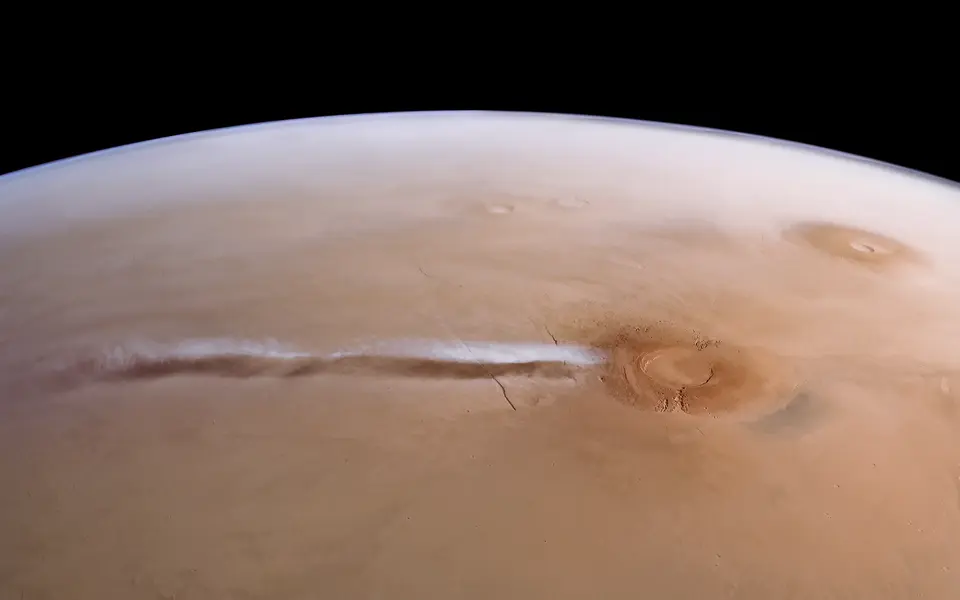
The atmospheric dynamics of Mars have long fascinated planetary scientists, offering a unique laboratory to observe meteorological phenomena that differ significantly from those on Earth. Among the most enduring mysteries of the Red Planet is a recurrent, massive cloud formation that appears with clockwork precision during the Martian southern summer. Known as the Arsia Mons Elongated Cloud (AMEC), this 1,800-kilometer-long streak of water ice emerges daily over the western slope of Arsia Mons, a massive extinct shield volcano standing approximately 20 kilometers high. While researchers have observed this feature for decades, its formation mechanism has remained elusive, defying traditional atmospheric models. However, a landmark study published in Nature Geoscience, led by Dr. Jorge Hernández-Bernal of the Sorbonne University, provides a groundbreaking explanation: the AMEC may represent the first documented natural instance of "homogeneous nucleation," or the flash-freezing of water vapor out of thin air without the assistance of dust particles.
The Seasonal Spectacle of Arsia Mons
Mars, much like Earth, experiences distinct seasons due to its axial tilt. During the southern summer, the atmosphere undergoes complex thermal and dynamic shifts. It is during this period that the AMEC makes its dramatic appearance. Every morning, as the sun rises over the Tharsis volcanic plateau, a thin, bright white cloud begins to stretch westward from the summit of Arsia Mons. Within a few hours, the cloud expands to a staggering length of nearly 2,000 kilometers—roughly the distance from New York City to Jacksonville, Florida—before dissipating by midday as temperatures rise.
Despite its massive scale, the cloud is remarkably thin and transient. It is composed entirely of water ice, yet it forms in an atmosphere that is significantly thinner and drier than Earth’s. For years, the scientific community struggled to reconcile the existence of such a long, stable streak of ice with the known levels of Martian dust. On Mars, dust is typically the primary driver of cloud formation, acting as the "seed" around which water vapor can condense. The failure of traditional models to replicate the AMEC’s specific geometry and brightness suggested that a different, more exotic physical process was at play.
The Physics of Cloud Formation: Heterogeneous vs. Homogeneous Nucleation
To appreciate the significance of Dr. Hernández-Bernal’s findings, one must look at the fundamental physics of how clouds form in any planetary atmosphere. The most common process, and the one taught in introductory physics, is heterogeneous nucleation. In this scenario, water vapor molecules require a solid or liquid surface to latch onto. On Earth, these "condensation nuclei" include sea salt, smoke, volcanic ash, or industrial pollutants. Because water vapor molecules possess high surface tension, they are naturally resistant to clumping together. Without a nucleus to provide a stable base, individual molecules evaporate almost as quickly as they collide.
On Mars, the atmosphere is generally saturated with fine silicate dust, which serves as an abundant source of condensation nuclei. Consequently, meteorologists long assumed that all Martian clouds were the result of heterogeneous nucleation. However, when researchers applied this theory to the AMEC using the Mars Planetary Climate Model, the results were inconsistent. The simulations either produced broad, diffuse hazes or failed to produce a trailing tail of the necessary length and brightness. The "dust-seed" model simply could not explain how such a concentrated streak of ice could remain stable across thousands of kilometers of the Martian desert.
The alternative is homogeneous nucleation, a process where water molecules collide with such force and frequency that they spontaneously coalesce into ice crystals without a pre-existing particle. In scientific textbooks, this has long been regarded as a theoretical possibility or a laboratory curiosity, rather than a natural occurrence. The reason is that homogeneous nucleation requires extreme conditions: specifically, levels of relative humidity so high that they are rarely encountered in nature. In most atmospheres, there is enough dust present that water vapor will condense onto those particles long before the humidity reaches the "breaking point" required for spontaneous freezing.
The Mechanics of the AMEC: Gravity Waves and Superchilling
The research team led by Dr. Hernández-Bernal utilized advanced microphysics packages within the Mars Planetary Climate Model to simulate the unique environment surrounding Arsia Mons. Their findings reveal a perfect storm of topographic and atmospheric conditions that allow the "impossible" to happen.
The process begins with powerful westward winds that slam into the 20-kilometer-high wall of Arsia Mons. This massive geographical obstacle forces the air upward with violent velocity, generating what meteorologists call "gravity waves." These are not gravitational waves in the sense of general relativity, but rather physical ripples or oscillations in the atmosphere caused by the displacement of air over high terrain. As the air is pushed into the upper reaches of the Martian atmosphere by these waves, it undergoes rapid adiabatic expansion.
In physics, adiabatic expansion occurs when the pressure of a gas is reduced without the transfer of heat, causing the temperature to drop precipitously. The study found that as the air clears the peak of Arsia Mons, it cools by as much as 30 degrees Celsius in less than 15 minutes. This rapid cooling brings the local temperature down to a staggering -143 degrees Celsius (-225 degrees Fahrenheit).
Crucially, during the Martian summer, the atmosphere at these high altitudes is relatively pristine. The researchers noted a dust density of only 0.1 grains per cubic centimeter. With almost no dust particles available to act as condensation nuclei, the water vapor remains in a gaseous state even as the temperature plummets. This leads to a state of extreme supersaturation, where the relative humidity reaches an incredible ten million percent. At this threshold, the physical resistance of the water molecules is overcome, and they flash-freeze into hundreds of ice crystals per cubic centimeter. These crystals are then caught by high-altitude winds, which stretch the newly formed cloud into the iconic 1,800-kilometer tail observed by spacecraft.
Chronology of Observation and Discovery
The identification of the AMEC and its subsequent explanation is the result of decades of interplanetary observation.
- 1970s: NASA’s Viking orbiters first captured grainy images of a recurring cloud near the Tharsis volcanoes, though the resolution was insufficient to determine its full extent or composition.
- 2003: The European Space Agency’s (ESA) Mars Express arrived at the Red Planet. Its Visual Monitoring Camera (VMC), originally intended only to confirm the separation of the Beagle 2 lander, became a vital tool for long-term weather monitoring due to its wide field of view.
- 2018: A particularly clear and long-lasting instance of the AMEC was observed during the Martian southern summer solstice, prompting a renewed international effort to solve the mystery.
- 2020-2023: Dr. Hernández-Bernal and his colleagues synthesized data from the Mars Express, the Mars Reconnaissance Orbiter (MRO), and the Maven spacecraft, combining these observations with the Mars Planetary Climate Model.
- 2024: The team published their findings in Nature Geoscience, providing the first evidence-backed argument for homogeneous nucleation in a planetary atmosphere.
Supporting Data and Simulation Results
The study’s conclusions are supported by rigorous data metrics that highlight the disparity between the AMEC and typical Martian clouds. Traditional heterogeneous clouds on Mars usually have a crystal density of about 10 to 100 particles per cubic centimeter. In contrast, the AMEC simulations required a density of nearly 1,000 crystals per cubic centimeter to match the brightness observed by the Mars Express cameras.
Furthermore, the altitude of the cloud—approximately 40 to 50 kilometers above the surface—places it in a region where the atmospheric pressure is less than 1% of Earth’s at sea level. The discovery that such a thin environment can support the spontaneous formation of ice crystals suggests that our understanding of "empty" space in planetary atmospheres needs revision.
Broader Impact and Implications for Planetary Science
The confirmation of homogeneous nucleation on Mars has profound implications for the study of other celestial bodies. For decades, atmospheric scientists have operated under the assumption that "dust is king" when it comes to weather. This new data suggests that in environments where dust is scarce but dynamic forces are high, water and other volatiles can behave in ways previously confined to laboratory vacuum chambers.
One potential application of this research is the study of Enceladus, the icy moon of Saturn. Enceladus is famous for its massive plumes of water vapor and ice grains ejected from its southern pole. While these plumes are driven by cryovolcanic activity, the way the vapor condenses as it enters the vacuum of space may involve similar homogeneous nucleation processes. Similarly, the thick, nitrogen-rich atmosphere of Titan or the extremely thin mesospheres of Earth’s polar regions may host similar phenomena that have yet to be identified.
Within the context of Martian exploration, understanding the AMEC is vital for future missions. As NASA and other space agencies plan for human exploration, accurate weather forecasting—including the formation of high-altitude ice clouds—will be necessary for entry, descent, and landing (EDL) procedures, as well as for managing solar power arrays that can be affected by cloud cover and atmospheric opacity.
Conclusion
The Arsia Mons Elongated Cloud is no longer just a visual curiosity or a "funny cloud" perched atop a volcano. It is a testament to the complex, often counterintuitive physics of the Red Planet. By proving that clouds can indeed "freeze out of thin air," Dr. Hernández-Bernal and his team have bridged the gap between theoretical physics and planetary observation. As the white streak continues to appear every summer morning over the Martian horizon, it serves as a reminder that even in the most desolate deserts of the solar system, nature finds ways to break the rules and create spectacles of immense scale and beauty. The study of the AMEC marks a significant step forward in our quest to understand the atmospheric evolution of our neighboring worlds, proving that sometimes, the most extraordinary events occur in the absence of anything but the molecules themselves.