Sisilia Frederika

The Japan Aerospace Exploration Agency (JAXA) has officially commenced its most ambitious deep-space endeavor to date with the successful launch of the Martian Moons eXploration (MMX) mission. At exactly 04:41:03 JST on October 20, 2026, the mission’s primary spacecraft ascended from the Tanegashima Space Center, Japan’s premier gateway to the cosmos, situated on a picturesque island off the southern coast of Kyushu. Approximately 17 minutes after liftoff, the MMX spacecraft successfully separated from its launch vehicle, entering a planned trajectory that will carry it across the vast void toward Mars and its two enigmatic satellites, Phobos and Deimos. This launch marks a pivotal moment in planetary science, as JAXA seeks to become the first space agency to successfully return a sample from the Martian system to Earth.
A Strategic Timeline for Deep-Space Exploration
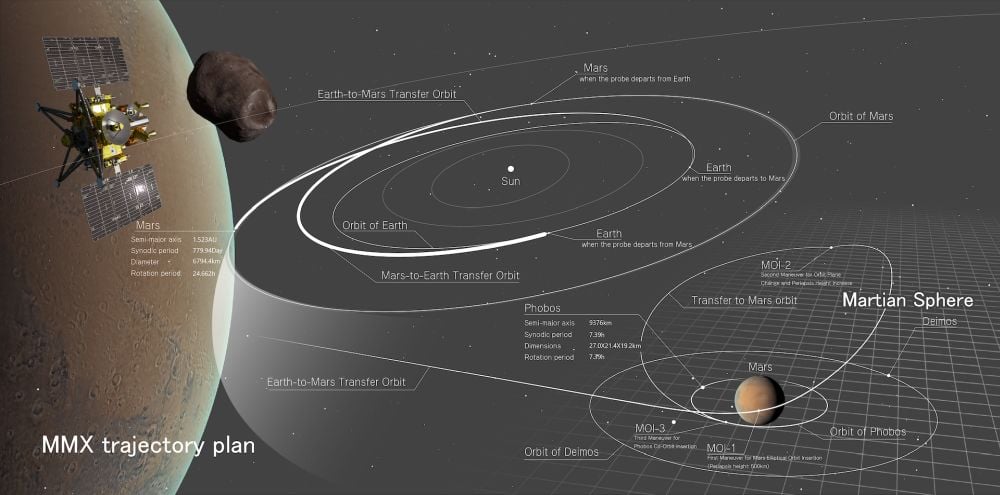
The journey to the Red Planet is a complex celestial dance requiring precise timing and navigation. Following its successful injection into a trans-Mars orbit, the MMX spacecraft is slated to reach the Martian vicinity in August 2027. Upon arrival, the craft will perform a series of braking maneuvers to enter a stable orbit around Mars. For the first month of its arrival, JAXA engineers will conduct rigorous system checks and orbital adjustments before transitioning the spacecraft into a specialized Quasi-Satellite Orbit (QSO) around Phobos, the larger and inner of Mars’ two moons.
The mission is structured into several distinct phases. From late 2027 through 2029, the orbiter will conduct extensive remote sensing of both Phobos and Deimos. This period is critical for mapping the surface of Phobos in unprecedented detail. In early 2030, the mission will enter its most high-stakes phase: the deployment of the Idefix rover and the subsequent landing of the main spacecraft for sample collection. Following the completion of surface operations, the MMX craft will perform several flybys of Deimos before initiating its journey back to Earth. If the mission maintains its current schedule, the sample return capsule is expected to land in the Australian outback in 2031.

International Collaboration: The Idefix Rover
While JAXA leads the mission, MMX is a testament to international scientific cooperation. A centerpiece of the mission is the small, sophisticated lander named Idefix, a joint development by the German Aerospace Center (DLR) and the French National Centre for Space Studies (CNES). Weighing approximately 25 kilograms, Idefix is designed to act as a scout for the primary MMX lander.
The deployment of Idefix is a feat of engineering necessitated by the unique environment of Phobos. Because Phobos possesses an extremely weak gravitational field—roughly 1/2000th of Earth’s gravity—the rover will not utilize a complex landing system. Instead, the MMX orbiter will simply release Idefix from an altitude of between 40 and 100 meters. The rover is designed to tumble onto the surface, where its robust internal mechanisms will allow it to right itself regardless of its initial orientation. Once stabilized, Idefix will spend several months analyzing the surface composition and regolith properties, providing the JAXA team with vital data to ensure the main spacecraft can land safely to collect its samples.
The Quest for Regolith: Objectives of the Sample Return
The primary objective of MMX is to collect at least 10 grams of regolith (surface soil and rock) from Phobos. To achieve this, the main spacecraft is equipped with a sophisticated sampling system capable of drilling into the moon’s surface. JAXA plans for the craft to land once or twice, utilizing a coring mechanism to retrieve material from at least two centimeters below the surface.
This mission architecture draws heavily from JAXA’s previous successes. The agency has established itself as a world leader in sample-return technology, having successfully completed the Hayabusa mission to Asteroid Itokawa in 2010 and the Hayabusa 2 mission to Asteroid Ryugu in 2020. While those missions targeted asteroids, the MMX mission represents a significant step up in complexity due to the gravitational well of Mars and the longer mission duration. The return process involves a sophisticated modular design: the Exploration Module, which houses the landing gear and scientific instruments, will remain on Phobos or in Martian orbit, while the Return Module will carry the sample capsule back toward Earth’s atmosphere.

Resolving the Great Martian Moon Debate
The scientific community remains divided over the origins of Phobos and Deimos, and MMX is specifically designed to provide the data needed to settle this debate. There are currently four primary hypotheses regarding how these moons came to be, each with vastly different implications for our understanding of the early Solar System.
The Giant Impact Hypothesis
One of the leading theories suggests that a massive object, roughly one-third the size of Mars, collided with the planet early in its history. This cataclysmic event would have ejected a massive amount of debris into orbit, forming a ring from which Phobos and Deimos eventually coalesced. This theory explains why the moons have near-circular, equatorial orbits. However, critics point out that debris rings usually form very close to the planet, making the distant orbit of Deimos a mathematical anomaly.
The Captured Asteroid Theory
Alternatively, many scientists believe Phobos and Deimos are "D-type" asteroids that were snagged by Mars’ gravity as they passed through the vicinity. This is supported by the moons’ dark, cratered surfaces and low densities, which resemble objects found in the outer asteroid belt. The primary argument against this theory is the orbits of the moons; it is statistically improbable for two separate asteroids to be captured into such perfectly circular, equatorial paths.
The Single Asteroid Fragmentation Theory
A hybrid theory suggests that Mars captured a single, large asteroid that was subsequently torn apart by tidal forces or a smaller impact. The resulting debris cloud then reformed into the two moons we see today. This would explain why the moons have asteroid-like compositions but follow orbits consistent with a debris-disk origin.
The Multi-Moon System Model
A more recent and complex theory, proposed by researchers at the Royal Observatory of Belgium, suggests that a giant impact created a massive "proto-moon" 1,000 times the size of Phobos. The gravitational influence of this large moon could have facilitated the formation of several smaller moons. Over millions of years, tidal forces would have caused the larger moon and most of the smaller satellites to crash back into Mars, leaving only Phobos and Deimos as the final survivors of a once-crowded Martian sky.
Scientific Instrumentation and Data Analysis
To test these theories, the MMX orbiter is equipped with a suite of seven primary scientific instruments. These include the Telescopic Narrow-angle Camera (TENGOO) for high-resolution surface imaging, the Macroscopic Infrared Spectrometer (MIRS) provided by CNES to analyze mineral composition, and the Gamma Ray and Neutron Spectrometer (MEGANE), developed in collaboration with NASA, which will measure the elemental abundance of the surface.
By analyzing the 10 grams of returned material, scientists will look for specific isotopic ratios. If the material matches the mineralogy of Mars, it would provide "smoking gun" evidence for the Giant Impact Hypothesis. Conversely, if the samples contain volatile-rich organic matter and isotopic signatures consistent with carbonaceous chondrites, the Captured Asteroid Theory would become the most likely explanation.
Global Significance and Future Implications
The success of the MMX mission would be a landmark achievement for international space exploration. For Japan, it solidifies JAXA’s position as a pioneer in sample-return missions and deep-space navigation. For the global scientific community, the data retrieved could rewrite textbooks regarding the formation of terrestrial planets and their satellites.

Furthermore, MMX serves as a precursor to future human exploration of the Martian system. Phobos has often been proposed as a potential "waystation" for astronauts heading to Mars, as its low gravity makes it much easier to land on and launch from than the Martian surface itself. Understanding the moon’s composition is essential for determining if it could provide resources, such as water ice, for future explorers.
As the MMX spacecraft continues its long trek across the inner Solar System, the world’s planetary scientists wait with bated breath. The answers to some of the most stubborn questions in astronomy are currently hurtling through space, contained within a sophisticated Japanese probe. If all goes according to plan, the mystery of the Martian moons will finally be solved in 2031, when the sample return capsule makes its fiery re-entry into Earth’s atmosphere, bringing with it the first-ever physical pieces of the Martian lunar system.