Sisilia Frederika
The Architectural Foundation of Star Formation
At the heart of every galaxy lie Giant Molecular Clouds (GMCs), massive reservoirs of cold, dense molecular hydrogen (H2) that serve as the primary nurseries for new stars. These clouds are not static entities; they are dynamic, turbulent environments where gravity, radiation, and chemistry engage in a constant tug-of-war. When a new, massive star ignites within one of these clouds, it begins to emit intense far-ultraviolet (FUV) radiation. This radiation creates what astronomers call a Photodissociation Region (PDR), an area where the FUV photons dominate the gas chemistry and physical state, essentially "sculpting" the cloud from the inside out.
Stellar feedback—the process by which stars influence their surroundings—is a double-edged sword. While the collapse of gas leads to the birth of stars, the resulting radiation heats the surrounding hydrogen, causing it to disperse and eventually halting further star formation in the immediate vicinity. Understanding the fine-grained details of this feedback is essential for creating accurate models of galactic evolution. However, until recently, the tools used to simulate these regions were unable to match the complexity revealed by modern telescopes.
The Orion Bar: A Benchmark for Astrochemistry
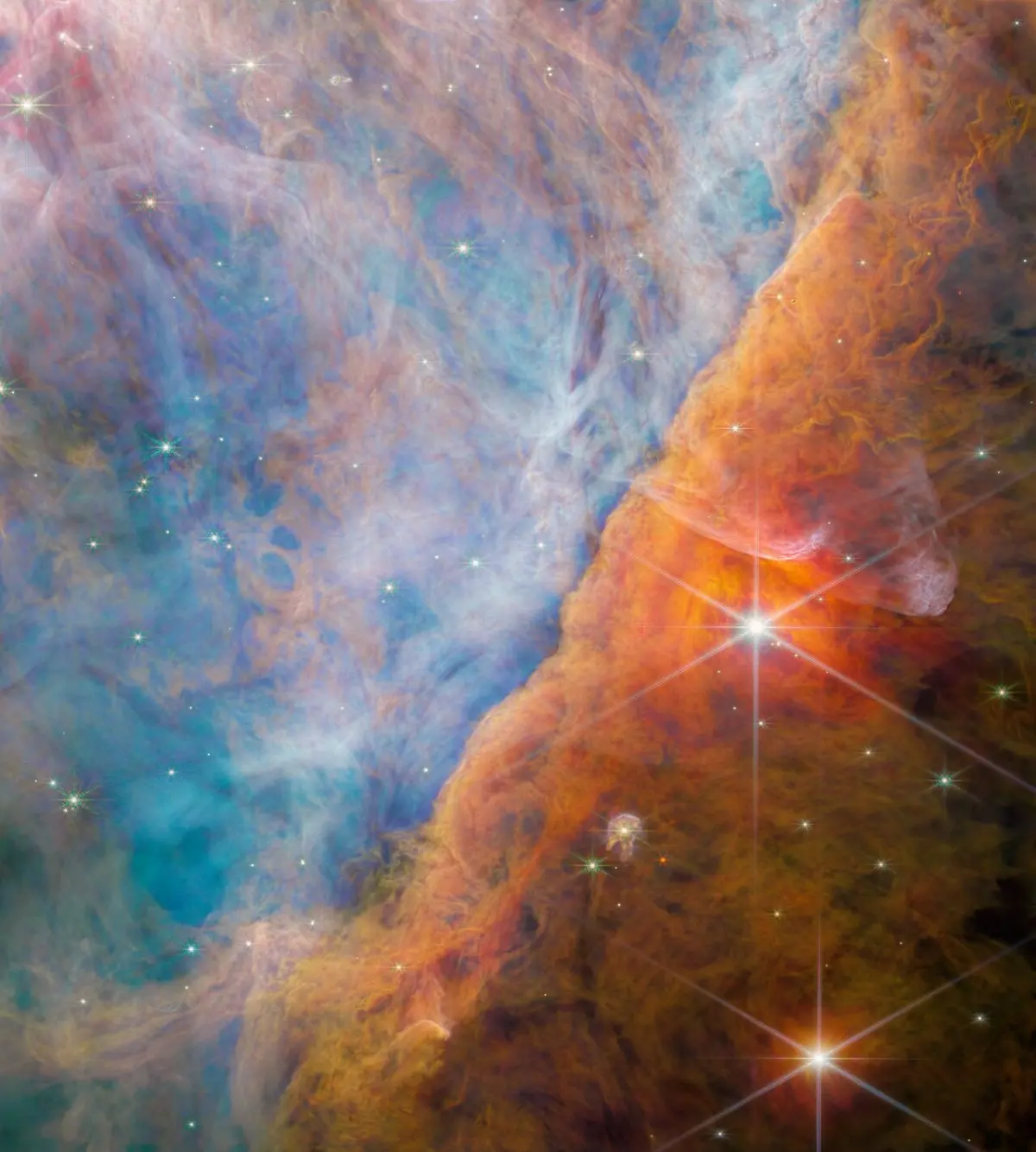
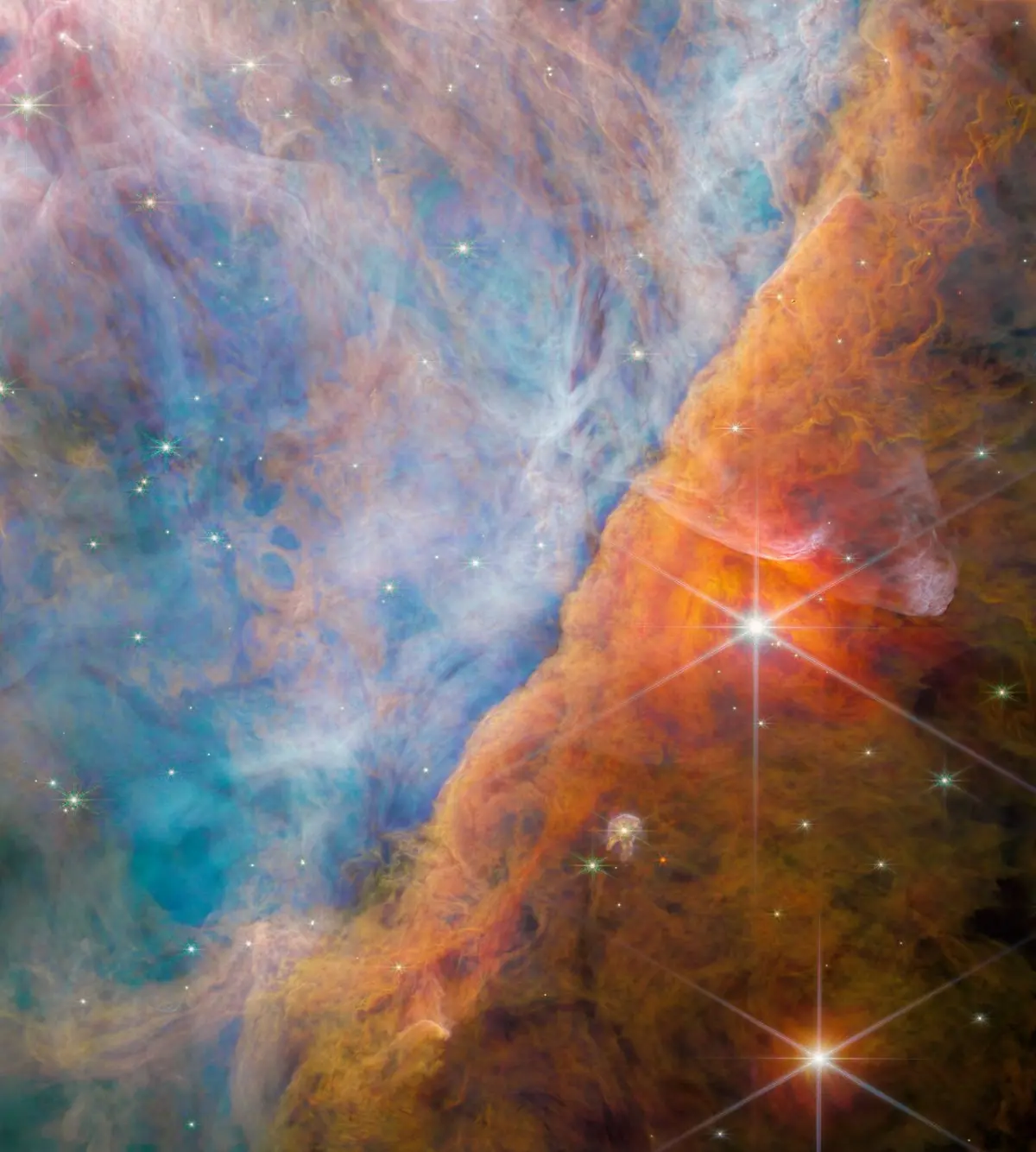
Located approximately 1,350 light-years from Earth within the famous Orion Nebula, the Orion Bar is a dense ridge of gas and dust that has served as the "prototypical" PDR for decades. Its popularity among researchers stems from its unique orientation; it is viewed nearly edge-on from our perspective in the solar system. This vantage point allows scientists to observe the stratified layers of the cloud as if looking at a cross-section of a geological formation.
In the Orion Bar, the transition from ionized gas to neutral atomic gas, and finally to molecular gas, is laid bare. This "atomic-to-molecular transition" is the frontline of stellar feedback. Because of its proximity and favorable orientation, the Orion Bar has become the ultimate natural laboratory for testing theories about how radiation interacts with dense matter.
The Crisis of Dimensionality in Astrophysical Modeling
For years, the standard approach to modeling PDRs relied on 1D simulations. These models assumed that the gas was arranged in neat, stratified layers: a layer of ionized carbon (C+), followed by a layer of neutral carbon, and finally a deep reservoir of molecular hydrogen. While these models were computationally efficient and provided a basic framework for understanding cloud structure, they began to fail as observational technology improved.
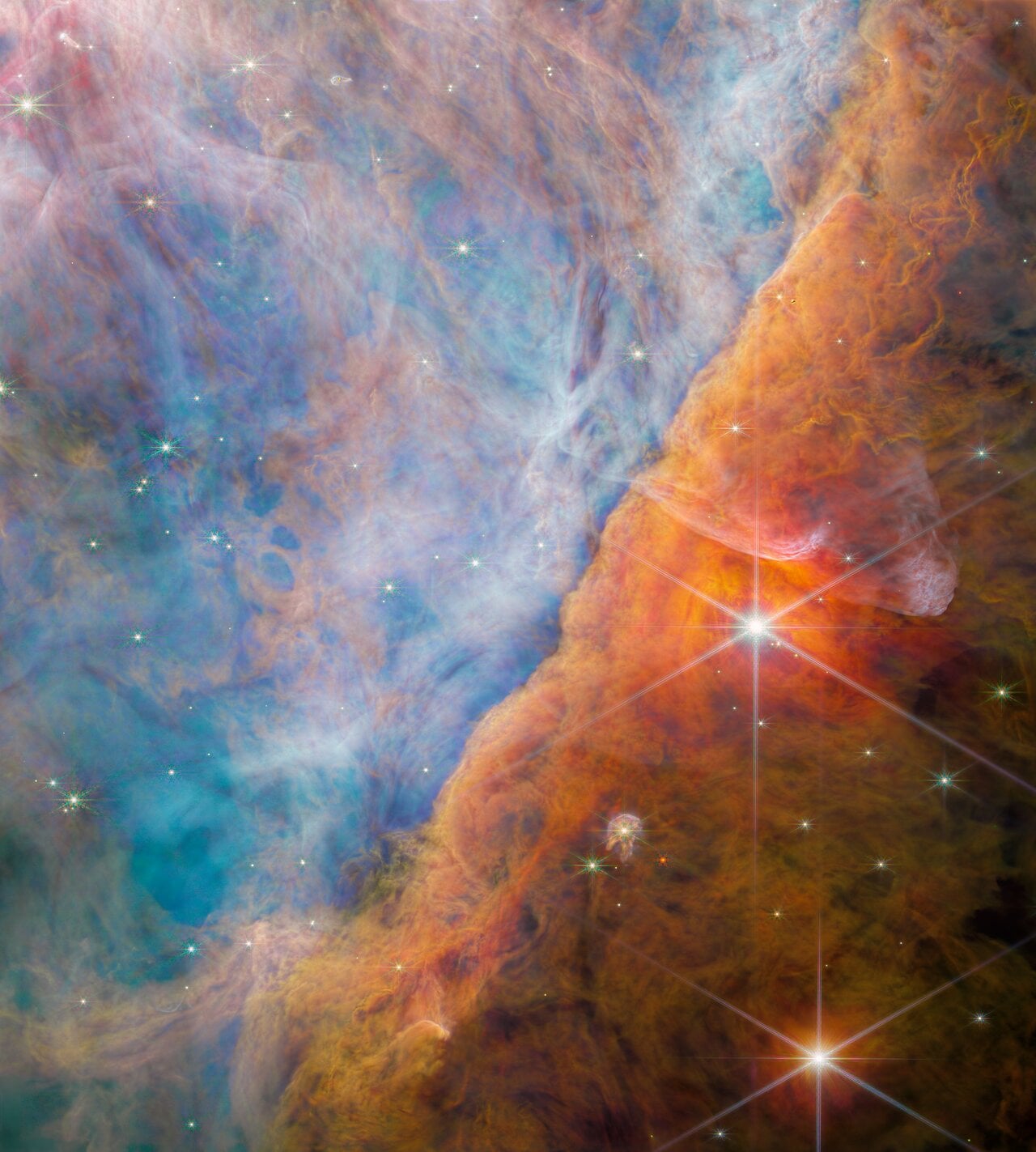
The arrival of the Atacama Large Millimeter/submillimeter Array (ALMA) and the James Webb Space Telescope (JWST) provided a level of detail that 1D models simply could not explain. Observations showed that these "layers" were not distinct or orderly. Instead, the molecular hydrogen dissociation front and the C+ recombination front appeared to overlap significantly. In a 1D world, this was a physical impossibility; in the real universe, it was a mystery that required a three-dimensional solution.
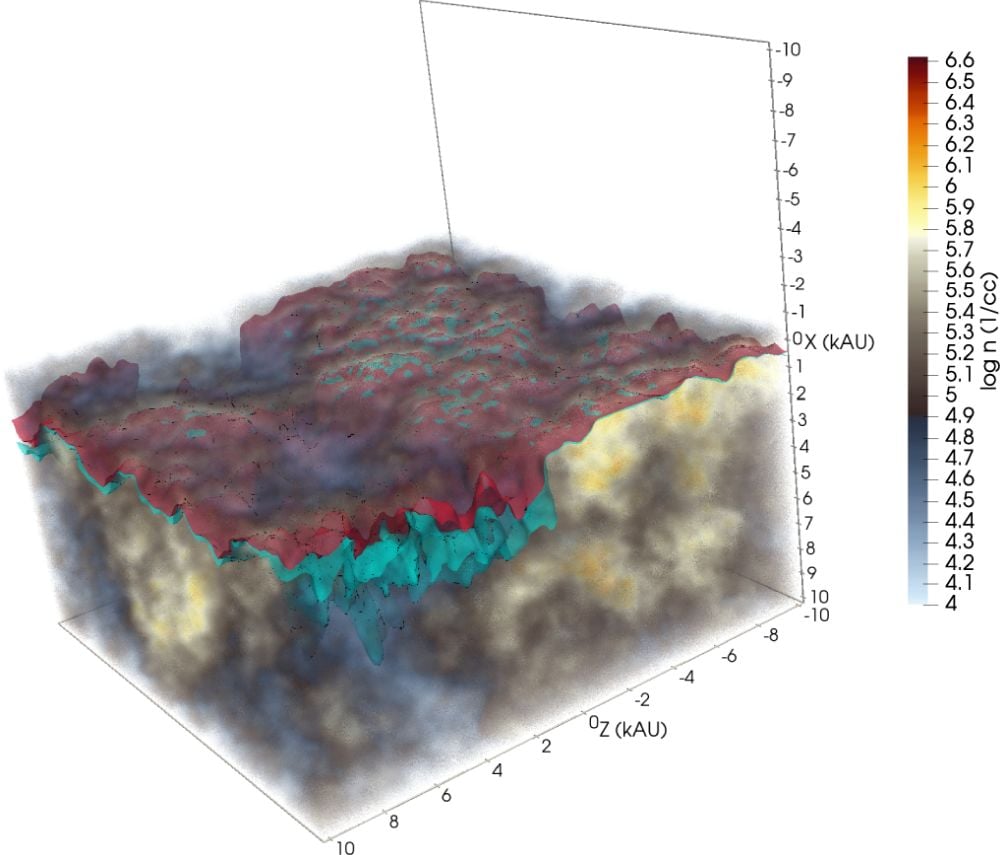
Dr. Brandt Gaches and his team recognized that the "clumpiness" of the interstellar medium was the missing ingredient. "Despite considerable theoretical effort, existing modeling approaches based on simplified geometrical assumptions have difficulties reproducing the spatial emission structure," the researchers noted in their publication. To solve this, they developed the first fully three-dimensional, high-resolution model of an Orion Bar analog.
Findings: Shadows, Shields, and Overlapping Fronts
The 3D model revealed that the geometry of the gas plays a much more critical role in chemistry than previously thought. In a 3D distribution, dense clumps of gas act as shields, casting "shadows" behind them where radiation cannot easily penetrate. This creates a complex tapestry of high-radiation zones and protected pockets existing side-by-side.
This heterogeneity explains why the H2 and C+ fronts appear to overlap in observations. From our perspective, we are seeing light from various depths and densities integrated into a single image. The 3D model successfully reproduced the "arc- and filament-like" features seen in JWST images, proving that these structures are the result of radiation interacting with a non-uniform medium.
Furthermore, the model demonstrated that the overlap of these chemical fronts is a catalyst for "excited-state hydrocarbon chemistry." In these specific overlap zones, chemical pathways that are usually energetically forbidden become active. This leads to the formation of complex molecules, including:
- Methane (CH4): A simple hydrocarbon essential for organic chemistry.
- Acetylene (C2H2): A precursor to more complex organic chains.
- Polycyclic Aromatic Hydrocarbons (PAHs): Large, ring-shaped molecules that act as significant carbon reservoirs in space and are considered potential building blocks for life.
A Chronology of Discovery
The journey to this 3D breakthrough has been decades in the making, following a clear timeline of technological and theoretical advancement:
- Late 20th Century: The Orion Bar is identified as a primary PDR candidate. Early radio and infrared observations establish the basic 1D stratified model of gas clouds.
- 2013-2015: ALMA reaches full operational capacity, providing unprecedented resolution of molecular gas in the Orion Nebula and revealing "clumps" that 1D models struggle to explain.
- 2022-2023: The JWST "PDRs4All" Early Release Science program captures stunningly detailed infrared images of the Orion Bar, showing intricate filaments and overlapping chemical signatures.
- 2024-2025: Theoretical physicists, including Dr. Gaches, begin developing 3D codes capable of handling the complex radiative transfer and chemistry required to simulate these high-resolution observations.
- October 2026: The publication of "Resolving dense photodissociation regions" marks the first time a 3D model has successfully matched the complex morphology and chemical overlap of the Orion Bar.
Implications for the Future of Astrochemistry
The success of this 3D approach marks a "turning point for astrochemistry," according to the research team. It suggests that many of our previous assumptions about the "efficiency" of star formation and the speed of chemical reactions in space may need to be revised. If radiation is being blocked and redirected by 3D structures, the internal temperatures and chemical compositions of star-forming clouds are likely far more diverse than 1D models suggested.
This research also provides a vital framework for interpreting data from other star-forming regions across the Milky Way and in distant galaxies. As telescopes become more powerful, the ability to resolve 3D structures will become more common, and the models developed by Dr. Gaches and his colleagues will be the primary tools used to decode that data.
"Future works can now investigate gas morphologies induced by different physical mechanisms and examine their photochemistry and emissions in three dimensions," the study concludes. This opens the door to studying how different environments—such as the high-pressure regions near the galactic center or the low-density outskirts of the galaxy—affect the building blocks of stars and planets.
Conclusion: A New Lens on the Cosmos
By acknowledging that the universe is "messy," Dr. Brandt Gaches and his team have provided a clearer view of the cosmos. The Orion Bar is no longer just a series of flat layers in a textbook; it is a three-dimensional landscape of light and shadow, where the very chemistry of the interstellar medium is dictated by the peaks and valleys of gas density. This shift from 1D to 3D modeling is more than a technical upgrade; it is a necessary evolution in our quest to understand how the raw materials of the universe are transformed into the stars that light the night sky. As we continue to probe the depths of Giant Molecular Clouds, the lessons learned from the Orion Bar will remain a cornerstone of modern astrophysics.