Sisilia Frederika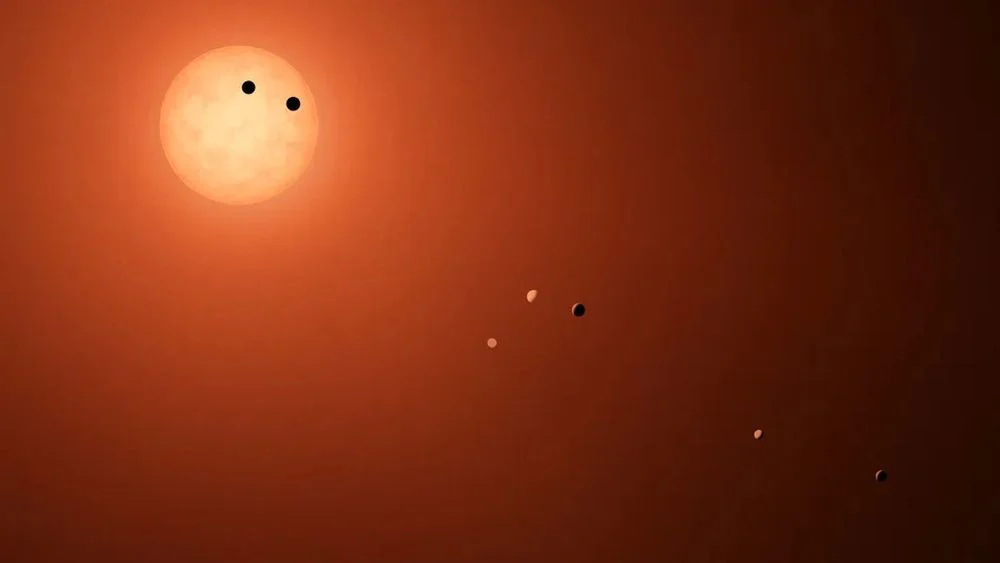
The search for habitable worlds beyond our solar system has faced a significant setback following a comprehensive study of the planetary system surrounding Barnard’s Star. Located a mere six light-years from Earth, Barnard’s Star is a low-mass M-type red dwarf and our closest solitary stellar neighbor. While the discovery of four sub-Earth-sized planets between August 2024 and March 2025 initially sparked excitement within the astronomical community, new findings from the University of Cambridge suggest these worlds are fundamentally inhospitable to life as we know it. The research, published in the Monthly Notices of the Royal Astronomical Society, details a combination of chemical deficiencies, atmospheric stripping, and extreme proximity to the host star that renders the system a "strange and utterly uninhabitable" frontier.
The planets in question represent a class of celestial bodies not found in our own solar system, possessing masses that fall squarely between those of Earth and Mars. Despite their intriguing physical dimensions, the Cambridge team, led by Xander Byrne of the Institute of Astronomy, has concluded that these worlds lack the necessary ingredients for habitability. By analyzing the chemical fingerprints of Barnard’s Star, researchers have inferred the composition of its orbiting planets, revealing a mineralogical makeup dominated by periclase—a form of magnesium oxide that is notoriously poor at sequestering water.
A Unique Planetary Configuration and Discovery Timeline
Barnard’s Star has long been a focal point for exoplanet hunters due to its proximity and its status as a "high proper motion" star, moving across the sky faster than any other known stellar object. Historically, the star was the subject of disputed claims of planetary companions as far back as the 1960s. However, it was not until the mid-2020s that advanced radial velocity measurements and transit photometry confirmed a suite of four small, rocky worlds.
The timeline of these discoveries marks a rapid evolution in our understanding of the system. Between late 2024 and early 2025, successive data releases from ground-based observatories and space-tethered assets confirmed the existence of four distinct signals. These planets orbit their parent star at distances ranging from just 1% to 4% of the distance between the Earth and the Sun. To put this into perspective, even the outermost planet in this system orbits ten times closer to Barnard’s Star than Mercury orbits our Sun.
This extreme proximity is the primary driver of the system’s hostile environment. While Barnard’s Star is much cooler and dimmer than the Sun, the sheer closeness of the planets subjects them to intense stellar winds and high-energy radiation. This environment has persisted for nearly 10 billion years—roughly double the age of our own solar system—giving the star ample time to strip away any potential for life.
The Chemical Signature: Why Periclase Matters
The habitability of a planet is not determined solely by its distance from a star, but also by its internal geochemistry. The Cambridge study highlights a critical disparity between the composition of Earth and the planets of Barnard’s Star. The research team utilized high-resolution spectroscopy to determine the elemental abundances of the host star, which serves as a proxy for the material available during the formation of its planets.
"Barnard’s Star has an enormous amount of the element magnesium compared to other stars, so its planets are likely to be rich in magnesium too," explained Xander Byrne. On Earth, magnesium is a primary component of silicate minerals like olivine and pyroxene. These minerals are vital to the planetary water cycle because they can incorporate water into their crystal structures and transport it into the mantle through subduction.
However, the high magnesium-to-silicon ratio in the Barnard’s Star system favors the formation of periclase (MgO) over more complex silicates. Periclase is a mineral that exists on Earth only at extreme depths, several hundred kilometers beneath the surface where pressures are immense. Unlike olivine, periclase does not store water well. Consequently, the planets orbiting Barnard’s Star are likely "dry" from the moment of their inception, lacking the internal reservoirs of volatiles necessary to sustain long-term surface oceans or a stable climate.
Atmospheric Erosion and the Impact of Tidal Locking
Beyond their chemical shortcomings, the physical environment of these four planets is dominated by the effects of their parent star. Because they orbit so closely, all four planets are believed to be tidally locked. This phenomenon, similar to how the Moon always shows the same face to Earth, means that one side of each planet is in perpetual daylight while the other remains in eternal darkness.
For 10 billion years, the daysides of these planets have been subjected to constant bombardment from stellar flares and ultraviolet radiation. Red dwarfs like Barnard’s Star are known for their longevity, but they are also prone to violent outbursts, especially in their youth. The Cambridge team’s models suggest that while these planets may have initially possessed substantial atmospheres, they were likely lost to space within the first two billion years of the system’s existence.
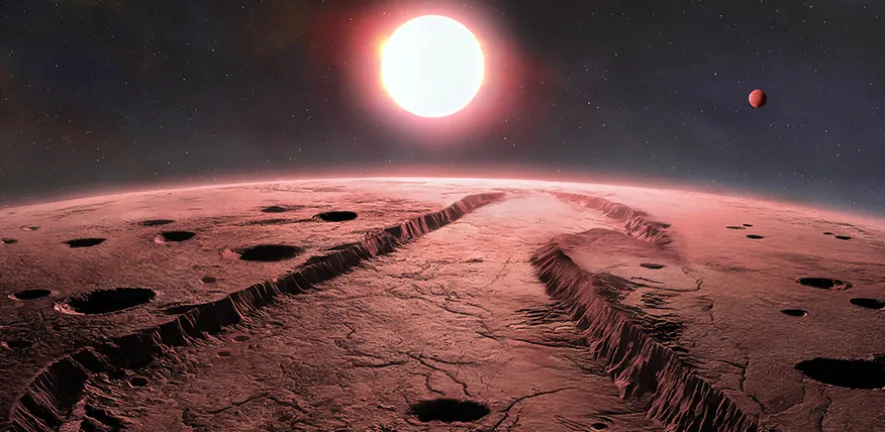
The combination of low planetary gravity—due to their small size—and high radiation pressure creates an environment where gas molecules are easily energized and "blown off" into the vacuum of space. "When you’re that close to your star, and have such little gravity, your atmosphere just gets blown off," Byrne noted. Without an atmosphere to distribute heat or provide pressure, any liquid water that might have existed would have either frozen on the nightside or evaporated and been lost to space on the dayside.
Stability in a Compact System: The Role of Resonance
One of the more surprising findings of the study concerns the long-term stability of the system. Compact planetary systems are often chaotic; the gravitational tug-of-war between closely packed planets can lead to orbital instability, resulting in collisions or the ejection of planets into interstellar space as "rogue planets."
However, the Barnard’s Star system appears to have found a way to survive for 10 billion years. The Cambridge researchers discovered that the three innermost planets exist in a complex orbital resonance of 9:12:16. This is a mathematical relationship where the orbital periods of the planets are integer ratios of one another. This configuration is reminiscent of the Laplace resonance shared by Jupiter’s moons Io, Europa, and Ganymede (1:2:4).
This resonance acts as a gravitational "anchor," preventing the planets from drifting into unstable orbits. While this stability has allowed the planets to remain in their current positions for eons, it has also ensured their continued exposure to the star’s sterilizing radiation. The very mechanism that keeps the system together has also condemned its worlds to a slow, multi-billion-year process of desiccation.
Broader Implications for Exoplanet Research
The study of Barnard’s Star serves as a cautionary tale for astrobiologists and astronomers alike. It demonstrates that proximity to Earth and the presence of rocky planets do not guarantee habitability. The research underscores the necessity of looking beyond the "Habitable Zone"—the region where liquid water can exist on a surface—and considering the "Geochemical Habitable Zone."
The link between stellar composition and planetary mineralogy is a burgeoning field of study. By understanding what a star is made of, scientists can predict the interior structure of its planets, including whether they have plate tectonics, volcanic activity, or the ability to store water. The findings at Barnard’s Star suggest that many M-dwarf systems, which are the most common type of system in the galaxy, may be hindered by the same chemical and atmospheric constraints.
However, the news is not entirely pessimistic for the future of space exploration. The discovery of these sub-Earth-sized planets is a testament to the increasing sensitivity of our detection methods. Historically, "Hot Jupiters" and "Super-Earths" dominated the exoplanet census because they are easier to spot. The ability to find and characterize worlds smaller than Earth marks a significant technological milestone.
The Future of Sub-Earth Detection
As the scientific community moves forward, upcoming missions like the European Space Agency’s (ESA) PLAnetary Transits and Oscillations of stars (PLATO) and the Ariel mission are expected to refine our search for truly Earth-like worlds. PLATO, scheduled for launch in late 2026, will specifically target bright, nearby stars to find and characterize rocky planets in their habitable zones.
The data gathered from the Barnard’s Star study will provide a vital framework for these future missions. By identifying the specific chemical markers—such as the magnesium-to-silicon ratio—that lead to "dry" periclase-rich worlds, astronomers can better prioritize targets that are more likely to host life-sustaining minerals.
"Larger planets are much easier to detect than small ones, so we know about very few sub-Earth planets like the ones in this system," said Byrne. "But the sensitivity of these new missions will help to reduce this bias, allowing us to discover more and more planets that are small and rocky, like Earth."
In the grander context of the cosmos, Barnard’s Star remains a critical laboratory. While its planets may be barren, scorched, and airless, they provide essential data on the diversity of planetary systems. They remind us that while the universe is teeming with worlds, the specific conditions that allowed Earth to flourish—a protective atmosphere, a balanced chemical composition, and a stable, middle-aged star—may be rarer than we once hoped. As we look toward the next generation of telescopes, the lessons learned from our closest neighbor will be instrumental in finding a world that is not just small and rocky, but also truly alive.