Sisilia Frederika
The fundamental architecture of the universe is built upon molecular hydrogen, the primary ingredient for the birth of stars. Within the vast expanses of the interstellar medium, this hydrogen gathers into gargantuan structures known as Giant Molecular Clouds (GMCs). These clouds serve as the nurseries of the cosmos, providing the cold, dense environment necessary for gravity to collapse gas into protostars. However, the very process of creation initiates a transformative feedback loop; as young stars ignite, they emit intense ultraviolet radiation that heats and disperses the surrounding hydrogen, eventually halting further star formation in their immediate vicinity. While the basic mechanics of this stellar feedback have been understood for decades, the intricate chemical transitions and structural shifts occurring within these regions have remained a subject of intense theoretical debate.
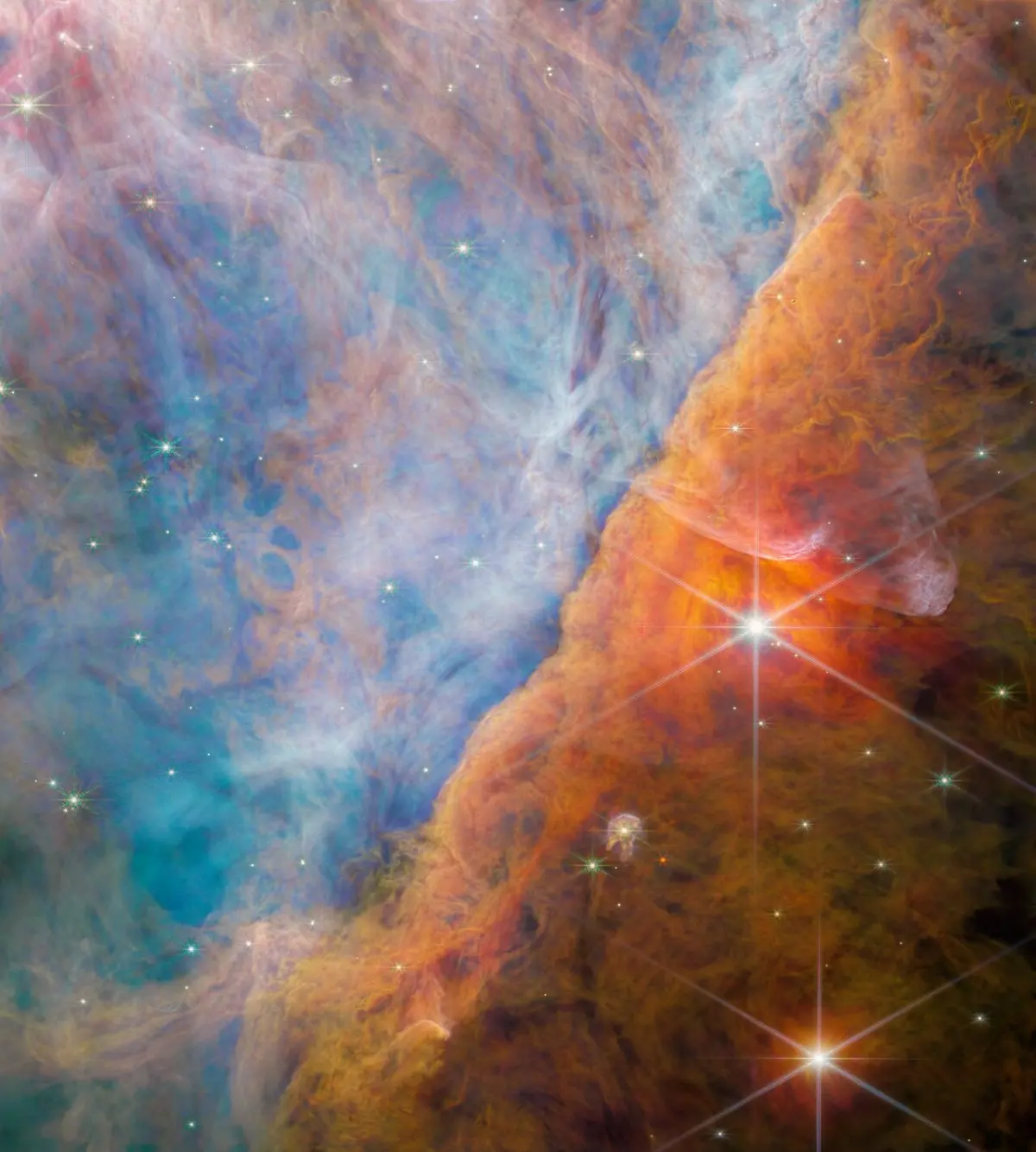
A groundbreaking study led by Dr. Brandt Gaches of the University of Duisburg-Essen, published in the journal Astronomy and Astrophysics, has provided a new window into these processes. By focusing on the Orion Bar—a prominent ridge of gas and dust within the Orion Nebula—researchers have successfully developed the first fully three-dimensional, high-resolution model of a photodissociation region (PDR). This model challenges long-held assumptions about the stratified nature of gas clouds and reveals a much more complex, overlapping chemical landscape that better aligns with the high-definition observations provided by modern observatories like the Atacama Large Millimeter/submillimeter Array (ALMA) and the James Webb Space Telescope (JWST).
The Orion Bar: A Prototypical Cosmic Laboratory
Located approximately 1,350 light-years from Earth, the Orion Bar is part of the larger Orion Nebula (M42), a massive star-forming region visible even to the naked eye in the constellation of Orion. The Bar itself is a "photodissociation region," an area where the intense far-ultraviolet (FUV) radiation from massive stars—specifically those in the Trapezium Cluster—dominates the chemistry and physical state of the gas.
The Orion Bar is uniquely valuable to astronomers because of its orientation. Viewed nearly "edge-on" from Earth’s perspective, it allows scientists to observe the transition from ionized gas to atomic gas, and finally to molecular gas, as if looking at a cross-section of a planetary atmosphere. For years, this "stratified" view supported the use of one-dimensional (1D) models, which treated the cloud as a series of neat, distinct layers. However, as imaging technology has improved, these simplified models have increasingly failed to account for the actual data being returned from deep-space missions.
The Shift from 1D Stratification to 3D Complexity
Historically, the modeling of PDRs relied on the assumption of steady-state, plane-parallel geometry. In these 1D simulations, radiation would hit a flat surface of gas, creating a predictable sequence of chemical zones: first a zone of ionized hydrogen, then a dissociation front where molecular hydrogen (H2) is broken into atoms, and finally a recombination front where ionized carbon (C+) becomes neutral carbon.
The recent study by Dr. Gaches and his colleagues demonstrates that this linear progression is an oversimplification. Data from ALMA and the JWST have shown that the molecular hydrogen dissociation front and the C+ recombination front do not always follow one after the other in a tidy sequence. Instead, they frequently overlap. This spatial coincidence suggests that the physical structure of the gas is not a flat wall but a chaotic landscape of clumps, filaments, and voids.
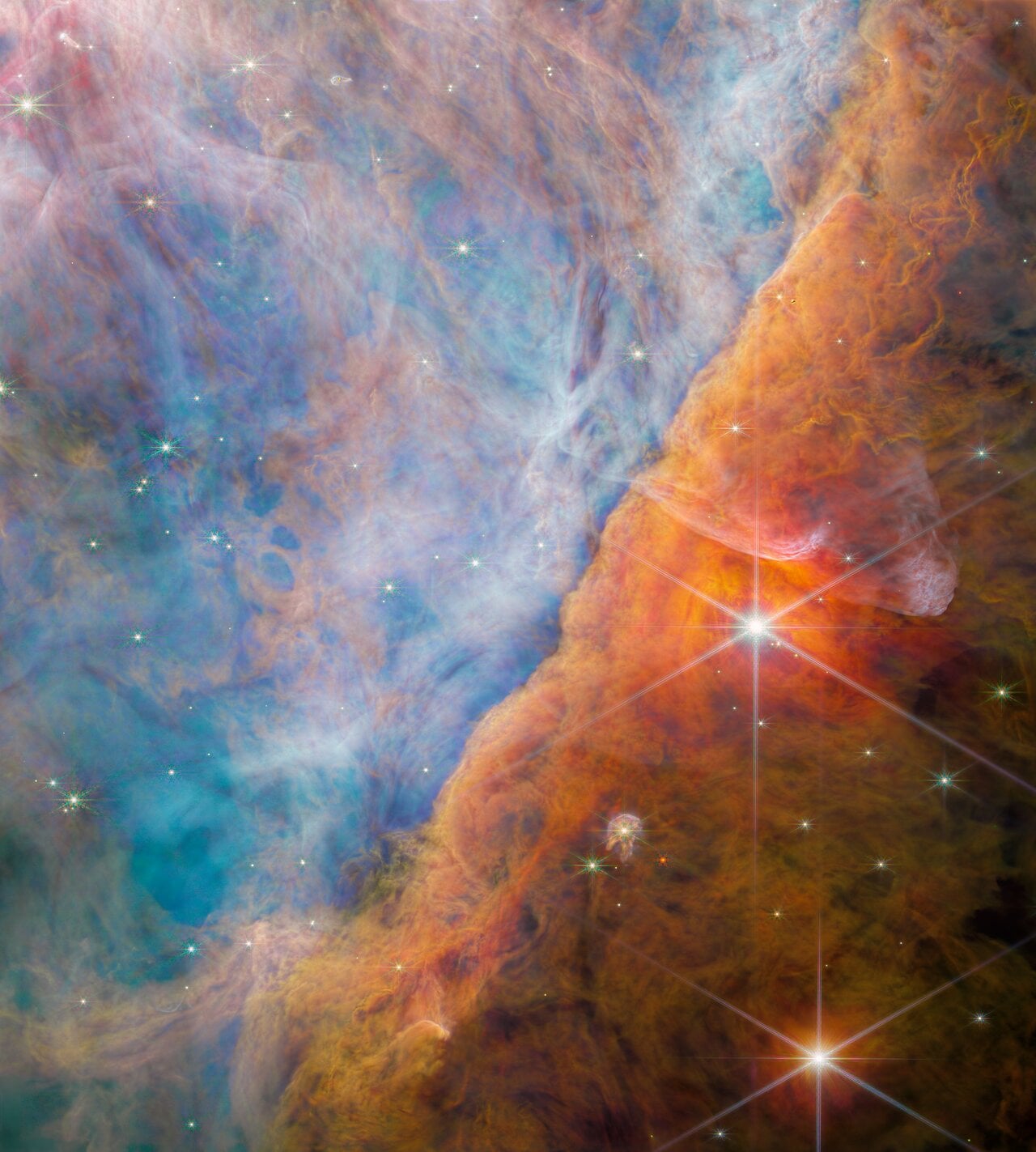
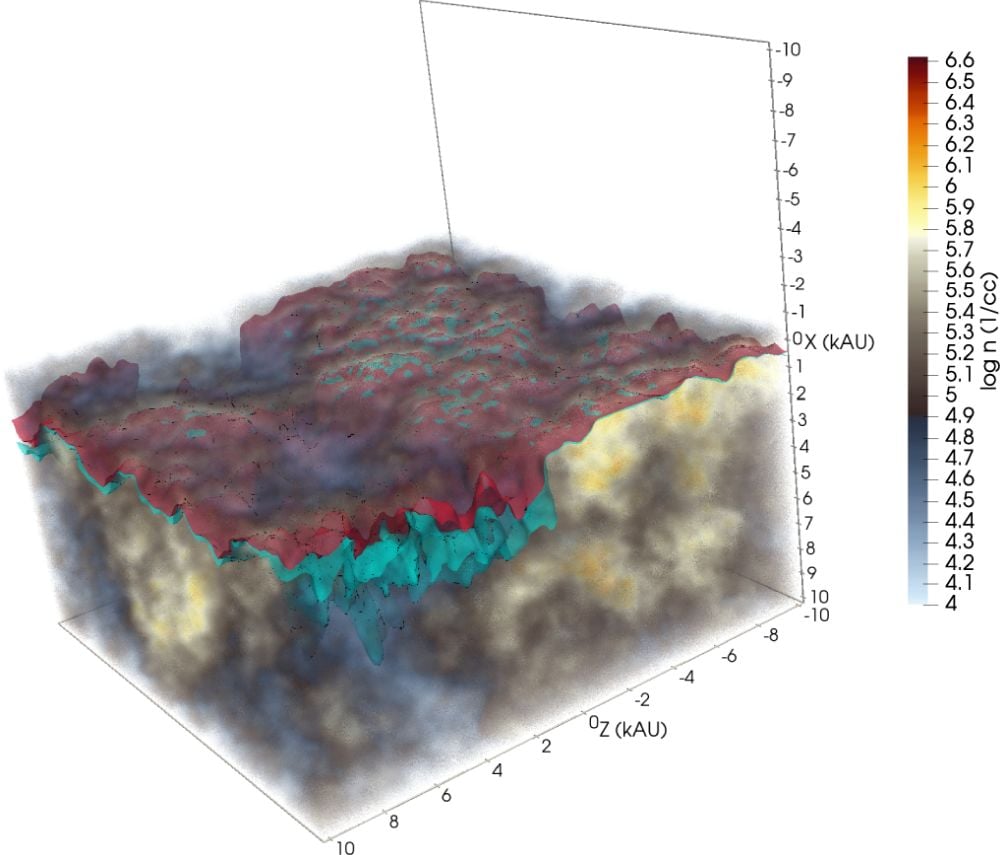
"Despite considerable theoretical effort, existing modeling approaches based on simplified geometrical assumptions have difficulties reproducing the spatial emission structure," the research team noted. By moving to a 3D distribution, the researchers were able to simulate how radiation permeates a "messy" cloud. This realistic density distribution allows for the creation of shadows—areas where dense clumps of gas shield the regions behind them from the full force of stellar radiation. These shadows allow molecular hydrogen to persist in areas where 1D models would predict it should be destroyed.
Chemical Implications and the Rise of Organic Compounds
The overlap of the H2 and C+ fronts is not merely a structural curiosity; it has profound implications for astrochemistry. When molecular hydrogen and ionized carbon coexist in the presence of intense radiation, it triggers "excited-state hydrocarbon chemistry."
In standard conditions, certain chemical pathways are energetically "forbidden" or highly unlikely. However, the high-energy environment of the PDR front provides the necessary excitation to bypass these barriers. This leads to the synthesis of complex hydrocarbons, including:
- Methane (CH4): A simple but essential hydrocarbon.
- Acetylene (C2H2): A precursor to more complex organic molecules.
- Polycyclic Aromatic Hydrocarbons (PAHs): Large, ring-shaped carbon molecules that are ubiquitous in the universe.
PAHs are of particular interest to astrobiologists and astronomers alike. They act as significant reservoirs of carbon in the interstellar medium and are considered potential building blocks for the organic matter that eventually finds its way into planetary systems. By accurately modeling the 3D structure of the Orion Bar, scientists can now better predict where these organic precursors are likely to form and how they are distributed throughout a star-forming galaxy.
Technological Synergy: ALMA and JWST
The development of this 3D model was necessitated by the sheer quality of data provided by current-generation telescopes. ALMA, located in the Chilean Andes, provides unparalleled resolution in the radio and submillimeter wavelengths, allowing scientists to map the distribution of cold gas and dust. Meanwhile, the JWST’s infrared capabilities allow it to peer through the dust and see the glowing signatures of molecular hydrogen and hydrocarbons.
When the observations from these two powerhouses were combined, they revealed a "clumpy" morphology in the Orion Bar that 1D models simply could not replicate. The JWST’s "PDRs4All" Early Release Science program, in particular, provided images showing intricate filaments and arcs within the Bar. The new 3D model developed by Dr. Gaches’ team is the first to successfully reproduce these arc-like and filamentary features, providing a physical explanation for the light signatures captured by the telescopes.
A Chronology of PDR Research
The journey to this 3D model represents decades of incremental progress in astrophysics:
- Late 20th Century: The Orion Bar is identified as a prototypical PDR. Early 1D models establish the concept of stratified chemical layers.
- Early 2000s: Higher resolution radio telescopes begin to suggest that PDRs are not uniform, but "clumpy."
- 2013-Present: ALMA begins providing high-resolution maps of the Orion Nebula, revealing the detailed structure of the gas.
- 2022: The launch and subsequent observations of the JWST provide high-sensitivity infrared data, showing the overlap of chemical fronts.
- 2024-2026: Researchers recognize the "modeling gap" between 1D theory and 3D observations. Dr. Gaches and his team publish their 3D photochemical model, marking a "turning point" for the field.
Official Reactions and Future Outlook
The astrophysical community has greeted the research as a necessary evolution in the study of the interstellar medium. Dr. Gaches emphasized the importance of the Orion Bar’s unique position, stating, "The Orion Bar is an ideal natural laboratory for studying these processes. We see it nearly edge-on, so its different chemical layers are particularly easy to distinguish. That makes it a benchmark for testing models of photon-dominated regions."
The researchers believe that their work sets the stage for a new era of "3D steady-state models" that can be applied to other star-forming regions across the Milky Way and in other galaxies. By understanding how the three-dimensional structure of gas creates shadows and shields, astronomers can more accurately interpret the light coming from distant reaches of the universe.
In their conclusion, the authors noted that while their primary goal was not to create a perfect "fit" for the Orion Bar, the fact that the 3D model naturally reproduced so many of its features confirms that spatial dimension is a critical factor in determining chemical emissions. "Future works can now investigate gas morphologies induced by different physical mechanisms and examine their photochemistry and emissions in three dimensions," the team stated.
Broader Impact on Galactic Evolution
This research does more than just explain a single ridge in the Orion Nebula; it provides a framework for understanding how galaxies evolve. Stellar feedback is the primary regulator of star formation. If we cannot accurately model how stars destroy their parent clouds, we cannot accurately predict the rate at which galaxies grow or how many stars they will eventually produce.
Furthermore, the discovery that complex organic chemistry is driven by the specific 3D overlap of chemical fronts suggests that the "cradle of life"—the organic molecules that eventually form planets—is shaped by the chaotic, clumpy nature of the gas clouds themselves. As we continue to explore the cosmos with tools like the JWST, the ability to bridge the gap between theoretical models and observed reality will be the key to unlocking the history of our own solar system’s origins within the molecular clouds of the ancient Milky Way.