Sisilia Frederika
The quest to determine whether Mars once harbored life has taken a significant leap forward as an international research team, led by the Institute of Science Tokyo, has successfully modeled the distribution of ancient formaldehyde rainfall across the Red Planet. By reconstructing the atmospheric conditions of Mars as they existed billions of years ago, the team has produced a global map identifying specific regions where prebiotic molecules—the essential building blocks of life—were most likely to accumulate. This breakthrough offers a potential "treasure map" for future robotic and crewed missions, narrowing the search for evidence of ancient microbial life to high-priority "hotspots" where the chemical precursors of biology were delivered by prehistoric rains.
The Role of Formaldehyde in the Origins of Life
Formaldehyde (H₂CO) is often viewed through the lens of industrial use on Earth, but in the context of astrobiology, it is one of the most vital organic molecules in the universe. As a simple aldehyde, formaldehyde serves as a primary precursor for more complex organic compounds. Under the right conditions, particularly when dissolved in water, it can participate in the formose reaction, a series of chemical steps that lead to the synthesis of various sugars, including ribose. Ribose is a fundamental component of RNA (ribonucleic acid), which many scientists believe was the primary genetic material for the earliest life forms on Earth—a theory known as the "RNA World" hypothesis.
Furthermore, formaldehyde can react with other simple molecules to form amino acids, the building blocks of proteins. The presence of formaldehyde on ancient Mars would not have guaranteed the emergence of life, but it would have provided the necessary "starter kit" for organic chemistry to evolve toward biological complexity. The research team, led by Dr. Shungo Koyama, an astrobiologist at the Institute of Science Tokyo and a Research Fellow at Tohoku University, sought to answer a fundamental question: if formaldehyde was forming in the Martian atmosphere, where exactly did it end up on the surface?
Reconstructing the Martian Paleoclimate
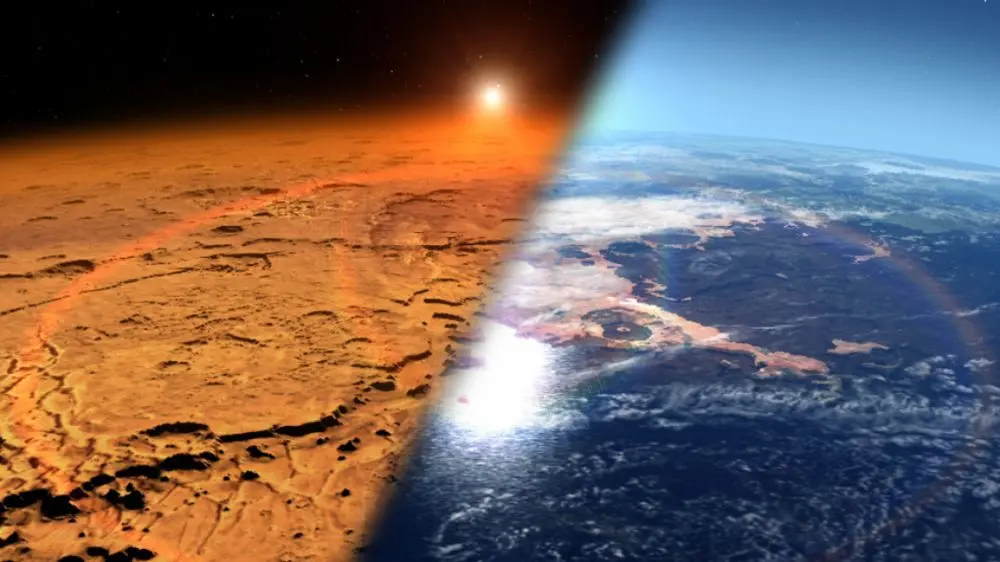
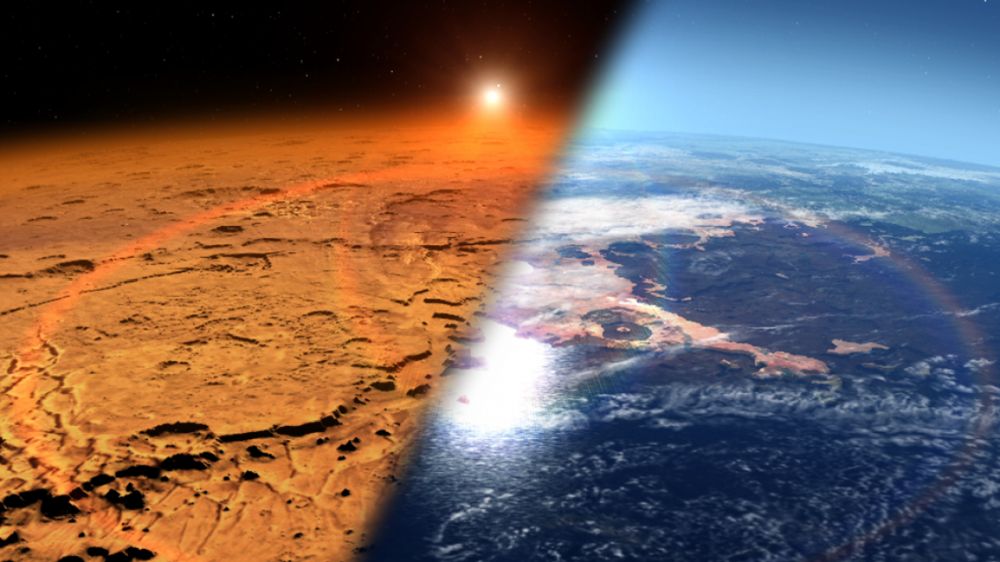
To understand the distribution of these molecules, the researchers had to look back between 3.5 and 4.1 billion years, into the Noachian and early Hesperian eras. During this time, Mars was vastly different from the frozen, arid desert we observe today. Geological evidence from various missions has confirmed that the planet possessed a thicker atmosphere, warmer temperatures, and liquid water that carved massive river valleys and pooled in vast lake beds.
The team’s simulation focused on the chemical interactions within this ancient atmosphere. They modeled a system where ultraviolet (UV) light from the Sun triggered the dissociation of water vapor and carbon dioxide. This process released reactive hydrogen and oxygen radicals. When these radicals interacted with the carbon-rich atmosphere, they formed formaldehyde. However, the molecule’s journey did not end in the air. The simulation revealed that this formaldehyde would have been scavenged by water droplets in the atmosphere and delivered to the surface through rainfall.
The researchers accounted for several variables in their atmospheric models, including varying levels of atmospheric pressure, surface temperatures, and the intensity of UV radiation. By simulating the global water cycle of the Noachian and Hesperian periods, they were able to track how the formaldehyde-laden rain would have been distributed across the Martian topography.
Geographic Hotspots: The Tharsis and Elysium Regions
The resulting map highlights significant disparities in the concentration of prebiotic delivery. While formaldehyde was distributed globally, certain regions received substantially higher amounts than the planetary average. Most notably, high-altitude and mountainous regions such as the Tharsis volcanic province and the Elysium region stood out. According to the study published in The Planetary Science Journal, these areas may have received approximately ten times the global average of formaldehyde rainfall.
The concentration of these molecules in Tharsis and Elysium is particularly intriguing to planetary scientists. These regions are known for their massive volcanoes and complex tectonic histories. The presence of high concentrations of prebiotic molecules in these areas suggests that the intersection of volcanic activity, topographic elevation, and atmospheric moisture created unique environments where the chemistry of life could have been nurtured.
"By comparing our map with findings from rovers, we can begin to test whether places that received more H₂CO were also more favorable for early life-related chemistry," noted Dr. Koyama. "If future observations confirm this relationship, our map could help identify promising targets for future Mars missions."
A Chronology of Discovery: From Viking to Perseverance
The search for life on Mars has been a central pillar of space exploration for nearly half a century. The context for Dr. Koyama’s research is built upon decades of incremental discoveries that have shifted the scientific consensus from a "dead planet" to a "once-habitable world."
- The Viking Era (1970s): The Viking 1 and 2 landers provided the first high-resolution images of the surface and conducted the first on-site biological experiments. While the results were initially interpreted as inconclusive or negative regarding current life, they revealed a surface shaped by ancient water.
- The "Follow the Water" Strategy (1990s-2000s): Missions like Mars Global Surveyor and the Spirit and Opportunity rovers confirmed the presence of minerals that only form in water, such as hematite and sulfates, proving that Mars was once wet.
- The Curiosity Rover (2012–Present): Exploring Gale Crater, Curiosity discovered complex organic molecules preserved in 3.5-billion-year-old mudstones. It also confirmed that the crater once held a long-lived lake with neutral pH—conditions suitable for life.
- The Perseverance Rover (2021–Present): Currently exploring Jezero Crater, Perseverance is specifically designed to look for biosignatures and collect samples for future return to Earth. It has confirmed that Jezero was once a river delta, a prime location for the preservation of organic matter.
Dr. Koyama’s research adds a new layer to this timeline by providing a chemical framework. While previous missions focused on finding where the water was, this new research focuses on what that water was carrying.
Collaborative Expertise and Scientific Methodology
The study was a massive collaborative effort involving institutions from across the globe. Alongside the Institute of Science Tokyo and Tohoku University, the team included researchers from the University of Tokyo’s Research Center for Advanced Science and Technology, the University of Washington’s Department of Earth and Space Sciences, and the Royal Belgian Institute for Space Aeronomy (BIRA-IASB).
This interdisciplinary approach allowed the team to integrate atmospheric physics with planetary geology. The University of Washington contributors provided expertise on the early Martian atmosphere’s composition, while the Belgian team offered insights into the photochemical processes driven by UV light. The synthesis of these fields was necessary to create a high-fidelity simulation that could account for the "washout" effect—the process by which rain cleanses the atmosphere of soluble gases like formaldehyde.
Implications for Future Exploration and Sample Return
The creation of this map has immediate implications for the strategic planning of future missions. Currently, NASA and the European Space Agency (ESA) are in the planning stages for the Mars Sample Return (MSR) campaign, which aims to bring the samples collected by Perseverance back to Earth for laboratory analysis.
The identification of formaldehyde hotspots suggests that if we want to find the most complex organic chemistry, we may need to look beyond the river deltas and lake beds that have been the primary focus of recent missions. If regions like Tharsis or Elysium were indeed "hotspots" for prebiotic delivery, they could represent the most scientifically valuable sites for future drilling missions.
Furthermore, the study provides a roadmap for "In-Situ Resource Utilization" (ISRU) for future human missions. While the study does not suggest that formaldehyde exists in large quantities on the surface today—it is a volatile molecule that would likely have been destroyed or transformed over billions of years—the geological signatures of its presence could guide explorers toward subsurface deposits of other organic materials.
Analysis: Bridging the Gap Between Chemistry and Biology
While the study is a landmark in Martian geochemistry, scientists caution that the presence of formaldehyde is only one piece of a much larger puzzle. The transition from prebiotic chemistry (molecules that could lead to life) to actual biology (self-replicating organisms) remains one of the greatest mysteries in science.
The significance of the "formaldehyde rain" model lies in its ability to demonstrate that the early Martian environment was not just habitable in terms of temperature and water, but also in terms of chemical supply. It suggests a planet that was "primed" for life. By showing that the atmosphere itself was a factory for life’s precursors and that the weather systems acted as a delivery mechanism, the research reinforces the idea that life on Earth may not be a unique fluke of chemistry, but rather a standard outcome of planetary evolution under the right conditions.
As we look toward the 2030s, with potential human footprints on the Martian horizon, the map created by Dr. Koyama and his colleagues serves as both a historical record of a lost world and a guide for the explorers of the future. The search for life on Mars is no longer just about finding water; it is about following the chemical trail left by ancient rains billions of years ago.