Clarissa Hana

Google Chrome is significantly bolstering its defenses against a growing tide of online deception, introducing a suite of advanced scam protections powered by its cutting-edge Gemini artificial intelligence. This latest evolution of Chrome’s Safe Browsing initiative, particularly within the Enhanced Protection tier, promises to make users up to ten times safer from a broad spectrum of threats, including phishing, sophisticated social engineering tactics, malicious notification abuse, and other insidious online scams. The new features aim to proactively identify and flag deceptive websites, and critically, to intercept and neutralize malicious commands that users might be tricked into executing.
At the heart of these enhanced safeguards is the strategic integration of Gemini, Google’s powerful large language model. Previously, Chrome utilized an on-device Gemini model specifically for detecting tech support scams. However, the company has now transitioned to a more robust, server-side implementation for users who opt for Enhanced Protection. This server-side approach allows for a deeper and more comprehensive analysis of web content and user interactions, leveraging the full capabilities of Gemini to discern the intent and potential maliciousness of websites.
The server-side Gemini model operates by analyzing a multitude of signals. These include identifying the brand purported to be represented on a webpage, evaluating the overall intent behind the page’s content, and assessing the probability of it being a fraudulent or deceptive site. This sophisticated AI-driven analysis is then seamlessly integrated with Safe Browsing’s existing capabilities, which include domain reputation scores and other established security indicators. This multi-layered approach ensures a more accurate and timely detection of threats.
Google has been keen to address potential privacy concerns related to server-side processing. The company emphasizes that data sharing is minimized, with page text only being analyzed when a site exhibits high-confidence indicators of being a scam. Furthermore, any page content that is transmitted off-device for analysis is processed "ephemerally." This means the data is never logged, retained, or used for model training, underscoring Google’s commitment to user privacy while enhancing security.
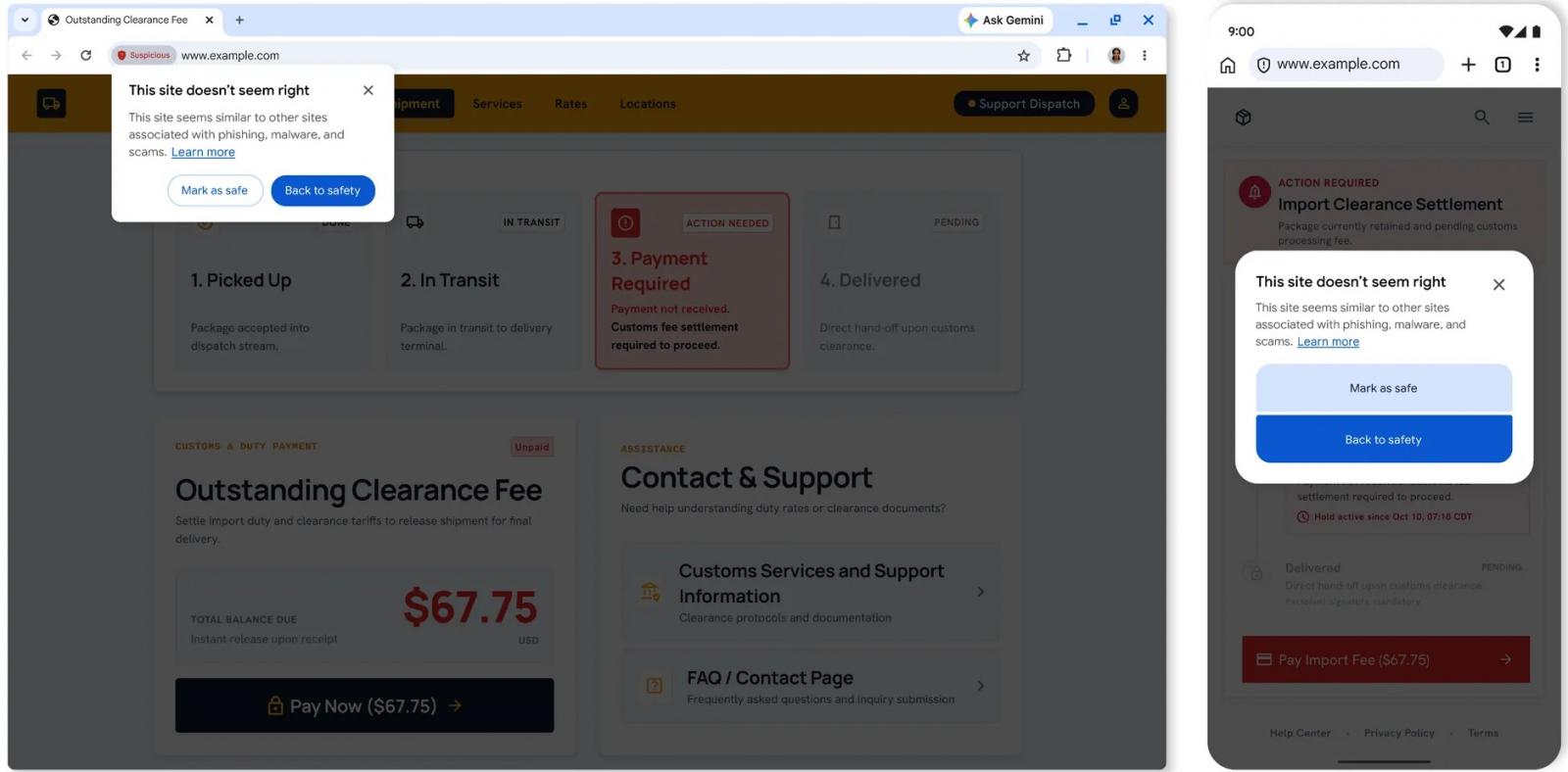
Beyond sophisticated AI-driven content analysis, Chrome is also introducing a new category of warning: "suspicious site" alerts. These warnings are designed to catch pages that exhibit deceptive patterns but have not yet met the stringent confidence threshold required for Chrome’s existing full-page red warning, which typically signifies a high-certainty threat.
"Suspicious site warnings notify users when a page exhibits deceptive patterns commonly associated with known malicious sites," Google explained in a recent blog post detailing the updates. "By tailoring the warning UI in this way, we are able to safely expand our coverage to display a higher volume of protective warnings." This nuanced approach allows Chrome to offer proactive alerts for a wider range of potentially harmful online experiences, without overwhelming users with excessive or overly alarming notifications for less severe instances.
A particularly significant advancement is Chrome’s new ability to detect and mitigate "ClickFix" attacks. These malicious schemes typically prey on user trust by tricking them into copying and executing commands, often within PowerShell or the Command Prompt, which then lead to unauthorized actions or system compromise. With the enhanced protection, if Chrome detects a user copying what it suspects to be a ClickFix script, it takes immediate action. The personally identifiable information within the clipboard payload is scrubbed, and the command is then sent to Safe Browsing for analysis. If the analysis confirms the command is dangerous, Chrome will display a warning to the user before they can proceed with its execution, effectively creating a critical checkpoint against this type of attack.
The evolution of Chrome’s scam protection measures reflects a broader trend in cybersecurity: the increasing sophistication of online threats and the corresponding need for equally advanced defensive technologies. Scammers are constantly refining their tactics, moving beyond simple phishing emails to highly targeted social engineering campaigns and complex exploit chains. The introduction of Gemini-powered detection signifies a proactive shift from reactive blocking to predictive identification of malicious intent.

Background and Chronology of Enhanced Protection
Google has been steadily developing its Safe Browsing technology for years, with a consistent focus on enhancing user safety across its product ecosystem. The initial iterations of Safe Browsing primarily relied on blacklists of known malicious websites and phishing URLs. However, as the threat landscape evolved, so did Google’s approach.
The concept of "Enhanced Protection" within Safe Browsing was introduced to provide a more robust security posture for users who opt in. This tier goes beyond standard protection by offering more proactive and comprehensive scanning, including real-time checks and advanced heuristic analysis. The integration of machine learning models has been a key component of this evolution.
The initial deployment of an on-device Gemini model for tech support scam detection represented a significant step towards leveraging AI for localized, privacy-preserving security. This allowed Chrome to analyze potential scam indicators directly on the user’s device, reducing the need to send sensitive data to servers. However, the limitations of on-device processing, particularly in terms of computational power and model complexity, became apparent as threats grew more sophisticated.
The move to a server-side Gemini model for Enhanced Protection users marks a strategic pivot. This allows Google to deploy larger, more powerful AI models capable of analyzing a wider range of complex signals and patterns. The timeline for this transition has been gradual, with ongoing research and development focused on balancing the effectiveness of server-side analysis with stringent privacy safeguards. The recent announcement signifies the maturation of this approach and its wider rollout to protect a larger user base.
Supporting Data and Industry Context
The need for enhanced scam protections is underscored by alarming statistics regarding the prevalence and impact of online fraud. According to various cybersecurity reports, the financial losses incurred by individuals and businesses due to online scams continue to escalate year over year. For instance, phishing attacks alone account for billions of dollars in losses annually, with social engineering tactics proving remarkably effective at bypassing traditional security measures.
The Cybersecurity and Infrastructure Security Agency (CISA) in the United States has repeatedly warned about the increasing sophistication of cyber threats, including those targeting everyday internet users. Their advisories often highlight the effectiveness of scams that exploit human psychology, such as urgency, fear, or greed, to manipulate individuals into divulging sensitive information or performing harmful actions.
The ClickFix attack vector, specifically targeted by Chrome’s new feature, is a growing concern within the cybersecurity community. These attacks often rely on social engineering to convince victims to execute seemingly innocuous commands that, in reality, grant attackers access to their systems or sensitive data. The ability to intercept and neutralize these commands before they are executed is a critical defensive capability.
Industry analysts have noted that while many security solutions focus on blocking known threats, there is a growing emphasis on detecting malicious intent and behavior. AI-powered solutions, like Google’s Gemini integration, are seen as crucial in this shift, enabling security systems to identify novel and evolving threats that may not yet have established signatures.
Official Responses and Broader Implications
Google’s commitment to user safety has been a recurring theme in their public communications. The latest announcement reinforces this dedication, positioning Chrome as a leading platform for web security. By offering Enhanced Protection, Google provides users with a clear choice to opt-in for a higher level of security, acknowledging that different users have varying risk appetites and security needs.
The move to server-side AI processing, while requiring careful privacy considerations, is a logical step in the ongoing arms race against cybercriminals. It allows for the continuous improvement and adaptation of defensive measures in response to emerging threats. The ephemeral processing of data is a key reassurance that Google is not compromising user privacy in its pursuit of enhanced security.
The broader implications of these advancements extend beyond individual user protection. A more secure web ecosystem benefits everyone, reducing the overall attack surface and making it more difficult for malicious actors to operate. By effectively neutralizing threats like ClickFix attacks and sophisticated phishing schemes, Chrome contributes to a safer online environment for businesses, governments, and individuals alike.
Furthermore, the introduction of "suspicious site" warnings demonstrates a more nuanced approach to user education and warning systems. Instead of a binary "safe" or "unsafe" classification, these warnings provide a more granular level of information, empowering users to make more informed decisions when encountering potentially deceptive content. This educational aspect is crucial in building digital resilience among internet users.
In conclusion, Google Chrome’s integration of Gemini-powered Enhanced Protection represents a significant leap forward in its ongoing mission to safeguard users from the ever-evolving landscape of online threats. By leveraging advanced AI for both content analysis and command interception, Chrome is equipping its users with more robust defenses against sophisticated scams, phishing, and social engineering tactics, thereby fostering a safer and more trustworthy internet experience.