Lina Irawan
The traditional landscape of network security has long been defined by a persistent and dangerous structural vulnerability: the detection gap. For decades, Intrusion Detection Systems (IDS) have relied on the precision of signature-based matching to identify malicious activity. While highly effective at identifying known exploits with minimal false positives, this model is inherently reactive. A signature written for a specific vulnerability, such as CVE-2024-12345, provides robust coverage for that exact exploit, yet it remains fundamentally blind to modified payloads or novel delivery routes that bypass the specific parameters of the rule. This limitation, often referred to as "the specificity trap," has created a window of exposure that attackers routinely exploit during the days or weeks it takes for researchers to reverse-engineer new threats and distribute updated rules.
To address this structural deficiency, the cybersecurity industry is currently undergoing a dual transformation. In March 2024, Cisco Talos introduced SnortML, a machine learning-based detection engine integrated directly into the Snort 3 architecture. Simultaneously, the rise of "agentic AI" in security operations has begun to redefine how organizations investigate and respond to the alerts generated at the network perimeter. Together, these technologies represent a shift from static pattern matching to dynamic, context-aware defense.

The Technical Mechanics of SnortML and Local Inference
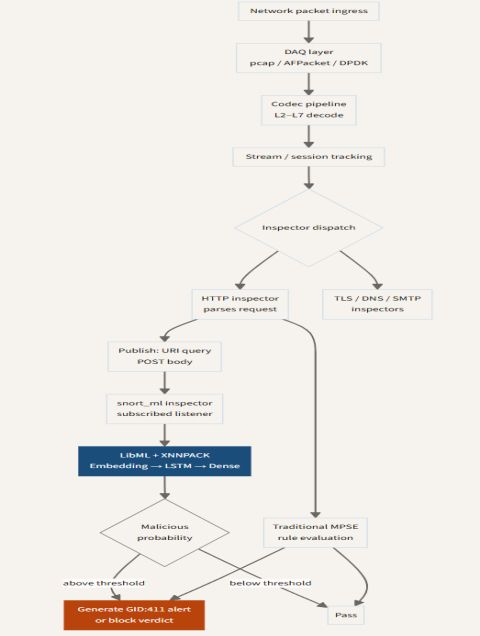
SnortML represents a departure from traditional cloud-based security services. Unlike reputation-based systems that require external lookups, SnortML performs inference entirely on the local device. This architecture ensures that the detection process remains within the standard processing pipeline, maintaining data privacy and minimizing latency. The system operates through two primary components: the snort_ml_engine and the snort_ml inspector.
The engine module is responsible for loading pre-trained TensorFlow models into memory during the system startup phase. The inspector then utilizes Snort 3’s internal publish/subscribe interface to ingest data from existing service inspectors. For example, when an HTTP inspector completes the parsing of a request, it publishes the URI query string and POST body to an internal event bus. The SnortML inspector subscribes to this data, passing it through a classifier to generate a probability score—a float value representing the likelihood that the content contains an exploit attempt.
The underlying model architecture employs a Long Short-Term Memory (LSTM) network preceded by an embedding layer. This design allows the system to analyze raw byte values as learned vector representations, capturing the "shape" of an attack rather than just its specific characters. By treating bytes as tokens—analogous to word embeddings in natural language processing—the model can recognize the temporal structure of SQL injection or Cross-Site Scripting (XSS) patterns. This allows it to flag malicious activity even if the specific syntax has never been documented in a traditional signature database.
Chronology of Development and Performance Benchmarks
The rollout of machine learning capabilities within the Snort ecosystem has followed a rigorous developmental timeline. Following the initial March 2024 launch, which focused primarily on SQL injection detection, Cisco expanded SnortML’s coverage in late 2025 to include XSS and command injection attack classes. These updates are delivered through the Lightweight Security Package (LSP) system, ensuring that the machine learning models are updated alongside traditional rule sets without requiring separate administrative workflows.
Performance has remained a critical metric for adoption. To maintain the high throughput required of modern firewalls, SnortML utilizes the XNNPACK library for hardware-accelerated matrix operations. On a standard 4.7 GHz AMD processor, a single classification pass is completed in approximately 350 microseconds. To further optimize performance, the system employs adaptive model selection. Depending on the length of the query string, SnortML automatically selects between models calibrated for 256, 512, or 1024-byte inputs. This ensures that shorter, simpler queries do not consume the computational resources required for complex, high-volume payloads.
The Rise of Agentic AI in Security Operations
While SnortML operates at the "wire level," a second layer of defense is emerging at the orchestration level: agentic AI. Unlike conventional machine learning models that provide a static score for a single input, or Security Orchestration, Automation, and Response (SOAR) playbooks that follow rigid, pre-defined branches, AI agents are designed to maintain state across multi-step investigations.
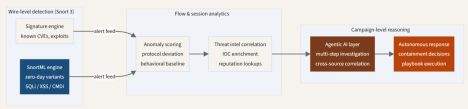
An AI agent has the autonomy to decide which tools to call and which data sources to query based on its findings. If a SnortML alert flags a suspicious HTTP request, an agent can independently query a SIEM for related events, check the source IP against global threat intelligence platforms, and pull recent activity logs for the associated user from an identity provider. This capability is becoming an operational necessity; a 2025 industry survey revealed that the global cybersecurity workforce gap has reached four million unfilled positions, leaving 82% of SOC analysts concerned that they are missing critical threats due to sheer alert volume.
The commercial sector has responded rapidly to this demand. In April 2025, IBM launched its Autonomous Threat Operations Machine (ATOM), a multi-agent framework designed to automate the investigation and remediation of security incidents. This was followed in August 2025 by Trend Micro’s Agentic SIEM, which focuses on autonomous correlation across disparate security layers. These platforms do not replace human analysts but rather serve as an "enrichment tier" that reduces the time required for triage from hours to seconds.
Structural Integration: From Capture to Response
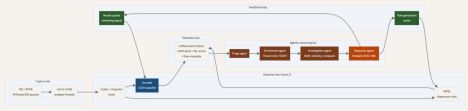
The integration of SnortML with agentic AI creates a four-tier architecture for modern network defense:
- The Capture Tier: Wire-level packet acquisition occurs through the Data Acquisition (DAQ) layer, utilizing high-speed technologies like AFPacket RSS or DPDK to feed Snort’s analyzer threads.
- The Detection Tier: Traditional signatures (Hyperscan engine) and SnortML (LSTM classifier) run in parallel. This parallel execution is a deliberate design choice; signatures provide a low-noise floor for known threats, while ML catches novel variants.
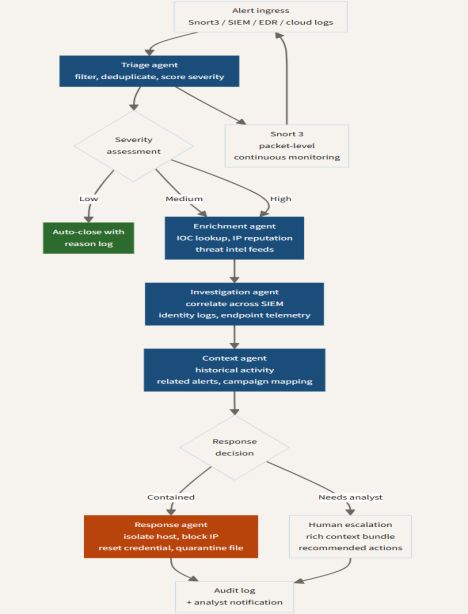
- The Reasoning Tier: An agentic framework receives the unified event stream. Specialized agents handle deduplication, enrichment, and deep correlation across endpoint telemetry and identity logs.
- The Response Tier: Based on the agent’s findings, a response is initiated. This may include automated containment for high-confidence threats or the presentation of a "context bundle" to a human analyst for final approval.
This architecture addresses a significant limitation of per-packet detection: the lack of historical context. While SnortML can identify a single malicious parameter, it cannot see the relationship between a probe request, an enumeration attempt, and a final exploit occurring over a twenty-minute window. The agentic layer fills this gap by holding context across time and multiple observation points.
Implications for the Future of Cyber Defense
The transition toward a hybrid detection model has profound implications for the economics of cyber warfare. By automating the identification of zero-day variants and the subsequent investigation process, organizations can significantly increase the cost for attackers, who can no longer rely on simple obfuscation techniques to bypass defenses.
However, this new paradigm also introduces new risks, specifically in the realm of "feedback security." As organizations move toward closed-loop systems—where confirmed attacks are automatically used to retrain machine learning models—the risk of data poisoning increases. An adversary could theoretically craft traffic patterns designed to fool an investigation agent into confirming a false positive, thereby corrupting the training data and degrading the model’s accuracy over time. Recent research, such as the work by Singh et al. (2025) on Byzantine-resilient federated learning, highlights the need for anomaly detection not just on live traffic, but on the retraining pipelines themselves.
Furthermore, the industry faces a challenge regarding explainability. When a neural network flags a payload with a 0.98 probability score, human analysts often require "attribution"—an understanding of exactly which bytes or patterns triggered the alert. While techniques such as Integrated Gradients can provide byte-level importance scores, these features have yet to be standardized in production IDS outputs.
Conclusion and Operational Recommendations
For organizations deploying Snort 3 and SnortML today, the transition should be managed through a phased approach. Security experts recommend an initial "passive" deployment phase where SnortML is set to alert-only mode. This allows administrators to baseline the model’s performance against legitimate, application-specific traffic, which may occasionally use unusual encoding that resembles attack syntax.
The objective of modern network defense is not the total replacement of human judgment, but the radical augmentation of it. By positioning SnortML as a high-fidelity sensor and agentic AI as an autonomous investigator, the security industry is moving toward a model where the "detection gap" is no longer a static window of vulnerability, but a narrowing sliver of space that is increasingly difficult for attackers to navigate. The path forward lies in the refinement of the "plumbing" between these layers—ensuring that the intelligence gathered at the wire level flows seamlessly into the reasoning systems that protect the modern enterprise.