admin
admin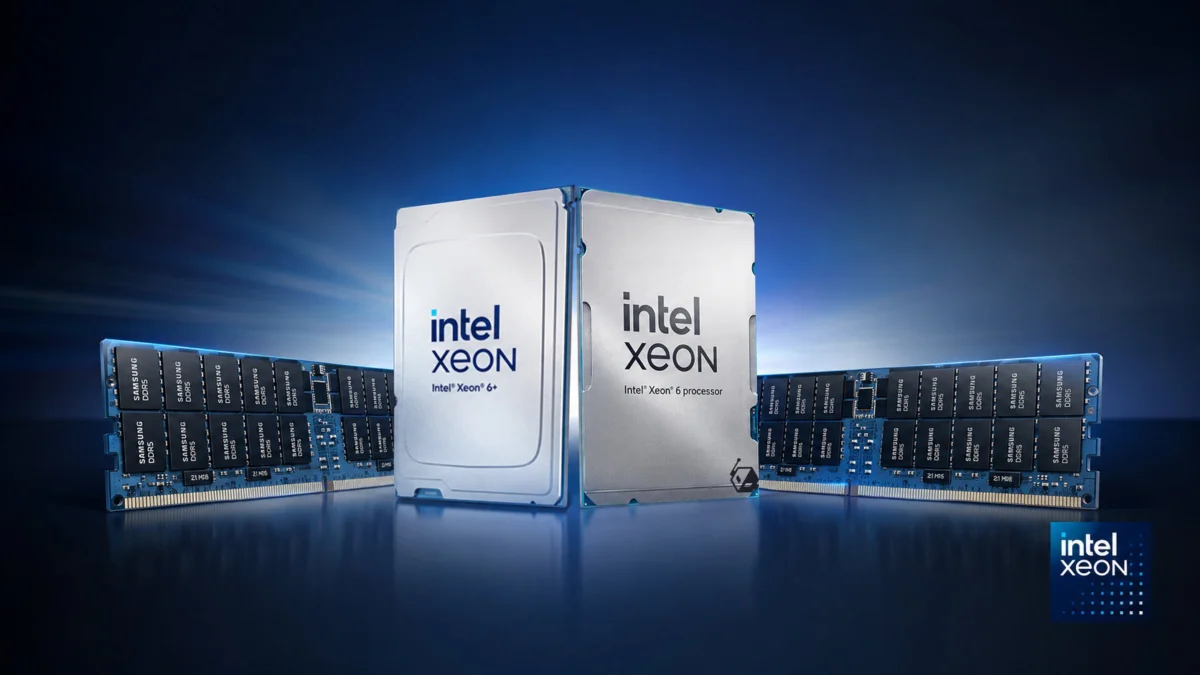
Intel Corporation has officially announced a significant advancement in data center architecture, becoming the first industry player to support 8000 MT/s DDR5 RDIMM (Registered Dual Inline Memory Module) on its latest Xeon 6 platform. This development is part of a broader strategic initiative to address the burgeoning demands of high-end artificial intelligence (AI) and "Agentic AI" workloads, which require unprecedented levels of data throughput. In addition to the immediate rollout of 8000 MT/s support, Intel confirmed that its second-generation Multiplexed Rank Dual Inline Memory Module (MRDIMM) technology, capable of reaching speeds up to 8800 MT/s, is slated for integration into select Xeon 6 stock-keeping units (SKUs) to further enhance bandwidth for data-intensive enterprise applications.
The Evolution of Memory Bandwidth in the AI Era
The rapid scaling of AI models and the shift toward autonomous AI agents have fundamentally altered the requirements for server-side hardware. In modern data centers, the host central processing unit (CPU) is no longer merely a general-purpose calculator; it serves as the critical coordinator for massive AI models, dense GPU configurations, and complex data pipelines. As these workloads grow in complexity, memory performance has transitioned from a secondary specification to a primary determinant of total system efficiency.
Intel’s move to 8000 MT/s RDIMMs addresses a critical bottleneck: the "memory wall." This phenomenon occurs when the processing power of the CPU and AI accelerators outpaces the ability of the system memory to feed them data. By increasing the speed of the memory interface, Intel aims to ensure that high-performance silicon remains utilized, reducing the idle cycles that lead to performance degradation and increased operational costs in hyperscale environments.
Technical Specifications and Performance Metrics
The transition to 8000 MT/s RDIMM represents a 25% increase in memory speed compared to the current industry standard of 6400 MT/s modules. Beyond raw speed, the new implementation offers a 6% reduction in latency, a factor crucial for real-time analytics and high-frequency trading applications. Intel’s internal measurements suggest that the shift to 8000 MT/s delivers up to 20% more total memory bandwidth, providing a significant buffer for bandwidth-sensitive applications.
According to Srini Krishna, an Intel Fellow within the Data Center Group, the performance gains are measurable across a diverse array of enterprise workloads. While general-purpose applications may see a performance uptick of 3% to 6%, memory-bandwidth-sensitive tasks—such as large-scale scientific simulations and AI inference—are expected to see even more substantial improvements. The objective is to create a balanced system where the CPU, memory, and storage operate in a synchronized, high-velocity loop.
Supported Platforms: Granite Rapids and Clearwater Forest
Intel has identified specific families within the Xeon 6 portfolio that will benefit from this memory enhancement. The Xeon 6700P, based on the "Granite Rapids" architecture featuring Performance-cores (P-cores), and the Xeon 6+ "Clearwater Forest" series will be the primary recipients of 1DPC (one DIMM per channel) 8000 MT/s RDIMM functionality.

Granite Rapids is specifically engineered for compute-heavy tasks that demand high per-core performance, while Clearwater Forest represents Intel’s next-generation E-core (Efficiency-core) strategy, built on the Intel 18A process node. The inclusion of high-speed memory support across both P-core and E-core architectures indicates Intel’s commitment to providing high bandwidth regardless of whether the customer prioritizes raw compute power or energy efficiency.
The Rise of MRDIMM Technology
While 8000 MT/s RDIMMs represent the immediate future, Intel is simultaneously laying the groundwork for Gen 2 MRDIMMs. Multiplexed Rank Dual Inline Memory Modules are a sophisticated solution designed to bypass the physical limitations of traditional DDR5. By multiplexing signals across multiple ranks of memory, MRDIMMs can effectively double the bandwidth available to the CPU without requiring a fundamental redesign of the memory controller’s physical pins.
Intel’s roadmap indicates that 2nd Gen MRDIMMs are already in production and will target the Xeon 6900P "Granite Rapids" platform. These modules are expected to hit 8800 MT/s by the first quarter of 2027. This technology is specifically tailored for high-core-count platforms, ranging from 72 to 128 cores, where the demand for data per core is at its highest. Target sectors include High-Performance Computing (HPC), advanced data analytics, and large-scale AI training.
Chronology and Implementation Timeline
The rollout of these memory enhancements is structured to allow data center operators to transition smoothly. The implementation of 8000 MT/s support will be facilitated through a Universal Platform Link Release (UPLR) and a subsequent BIOS update for existing Xeon 6 systems. Intel has targeted the August to September window of this year for broad production availability.
Looking further ahead, the trajectory for MRDIMM technology is aggressive:
- 2024 (Q3/Q4): Deployment of 8000 MT/s RDIMM support via BIOS updates.
- 2027 (Q1): Integration of 8800 MT/s Gen 2 MRDIMMs on Xeon 6900P platforms.
- 2028: Expected scaling of MRDIMM speeds to 12,800 MT/s.
- 2029–2030: Anticipated arrival of MRDIMM speeds reaching 17,600 MT/s.
This roadmap suggests that Intel intends to extend the lifecycle of DDR5 technology well into the next decade, providing a performance bridge until DDR6 memory reaches maturity and mass-market viability.
Industry Context and Competitive Landscape
Intel’s announcement comes at a pivotal time in the semiconductor industry. The competition with AMD’s EPYC "Turin" processors has forced both companies to innovate rapidly in the memory subsystem space. While AMD has also made strides in DDR5 support, Intel’s early move to 8000 MT/s and the formalized commitment to the MRDIMM roadmap signal a desire to reclaim leadership in the data center platform ecosystem.

The strategic importance of memory speed is also a response to the rise of High Bandwidth Memory (HBM) used in specialized AI accelerators like the NVIDIA H100 or Intel’s own Gaudi 3. By bringing higher speeds to standard system memory, Intel is making the general-purpose CPU more competitive for AI tasks that do not necessarily require the extreme cost and complexity of HBM-equipped systems.
Broader Implications for Data Center Infrastructure
The shift toward 8000 MT/s and 8800 MT/s memory has several downstream implications for data center operators. First, the increase in memory speed necessitates more robust thermal management and power delivery systems. Faster memory modules typically consume more power and generate more heat, requiring server OEMs (Original Equipment Manufacturers) to refine their chassis designs and cooling solutions.
Second, the move toward MRDIMM technology represents a shift in how infrastructure is procured. Organizations will increasingly need to view memory as a strategic investment rather than a commodity component. As Srini Krishna noted, those who treat memory as a strategic infrastructure decision will be better positioned to extract value from their AI investments.
Finally, this development supports the "balanced system" philosophy. In the past, data centers often over-provisioned CPU cores while under-provisioning memory bandwidth, leading to underutilized silicon. The Xeon 6 platform’s new memory capabilities allow for better alignment between compute and data delivery, potentially lowering the Total Cost of Ownership (TCO) by allowing fewer, more efficient servers to handle larger workloads.
Future Outlook: Toward DDR6 and Beyond
As the industry looks toward 2030, the convergence of high-speed DDR5, MRDIMMs, and the eventual arrival of DDR6 will define the next generation of computing. Intel’s roadmap indicates that DDR5 still has significant "headroom" for growth. By achieving speeds of up to 17,600 MT/s through MRDIMM technology, Intel is effectively providing DDR6-class bandwidth on a DDR5 foundation.
This strategy allows the ecosystem—including memory manufacturers like Micron, SK Hynix, and Samsung—to refine current manufacturing processes rather than forcing a premature and expensive transition to a new memory standard. It provides a stable path for enterprise customers to scale their AI and HPC capabilities while maintaining compatibility with the broader Xeon 6 ecosystem.
In conclusion, Intel’s support for 8000 MT/s DDR5 RDIMMs and the roadmap for 8800 MT/s MRDIMMs mark a turning point in server architecture. By prioritizing the speed at which data moves between the memory and the processor, Intel is addressing the most pressing challenge of the modern AI era: ensuring that the world’s most powerful CPUs are never left waiting for the data they need to function. As production availability nears in the coming months, the industry will be watching closely to see how these improvements translate into real-world efficiency gains for the world’s largest hyperscalers and enterprise data centers.