Sonny Valindra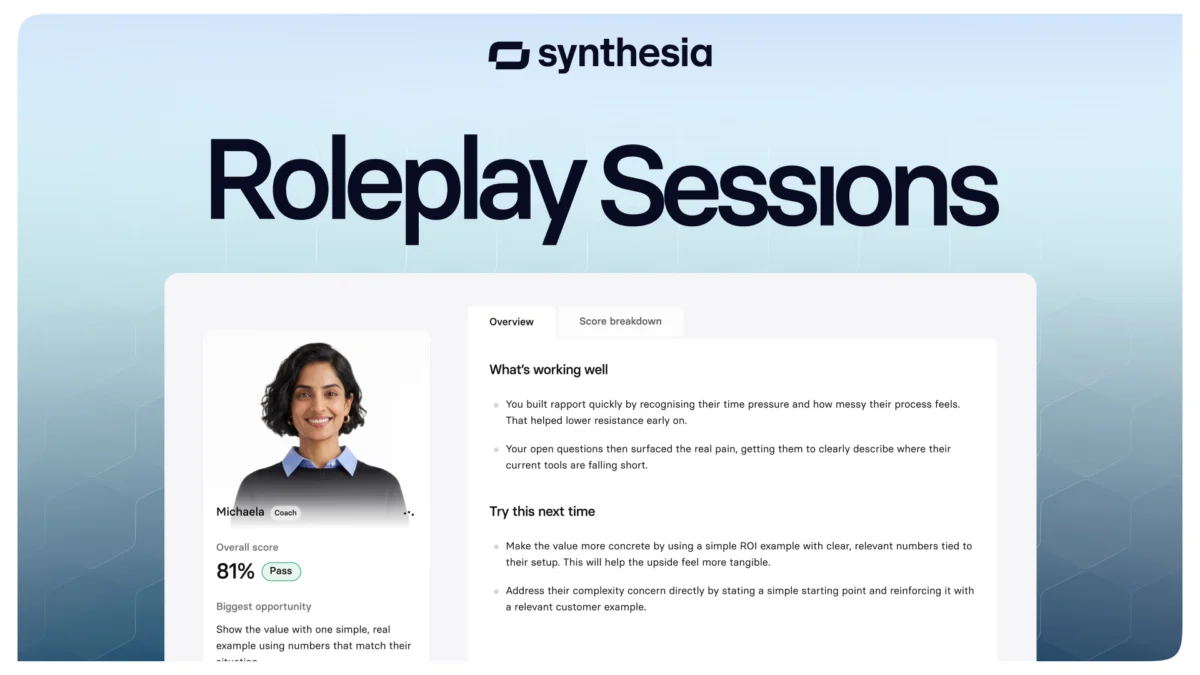
Synthesia, a prominent player in the generative AI video landscape, is shifting its strategic focus from content creation to demonstrable impact with the launch of its new interactive training product, Roleplay Sessions. This evolution signifies a broader trend within enterprise AI, where the emphasis is increasingly moving beyond mere content generation to proving tangible business outcomes and skill development.
A New Frontier in Enterprise AI Training
For years, Synthesia has been recognized for its ability to empower enterprises to produce interactive training videos at a fraction of the traditional cost and time. Their core offering allowed businesses to swiftly create engaging educational materials. However, the company’s latest initiative, Roleplay Sessions, launched on Wednesday, represents a significant pivot. Instead of solely focusing on the creation of training content, Synthesia is now betting on its capacity to measure and improve employee performance through interactive simulations.
Roleplay Sessions enables employees to engage in high-stakes conversational practice with AI-powered avatars. These avatars are designed to simulate realistic interactions, responding dynamically, challenging the user, and ultimately providing a scored evaluation against predefined rubrics. The initial rollout targets critical business scenarios such as sales pitches, performance reviews, and handling customer complaints, areas where effective communication and nuanced responses are paramount.
This new product is the first release under Synthesia’s broader "Sessions" platform, a strategic expansion that the company intends to broaden into other areas. Future applications are expected to include simulated job interviews and candidate screening, offering a comprehensive suite of tools for talent development and assessment.
The Imperative for Measurable AI ROI
The timing of Synthesia’s strategic shift is particularly salient. As enterprises globally grapple with the escalating costs and practical applications of artificial intelligence, a growing demand for verifiable return on investment (ROI) is emerging. Companies are scrutinizing their AI expenditures, seeking solutions that not only offer technological sophistication but also deliver quantifiable improvements in efficiency, productivity, and employee capabilities.
Synthesia’s pivot is underpinned by a foundational argument rooted in learning science. The company cites a meta-analysis of learning research, which suggests that much of existing corporate training, including, by implication, its own initial video-centric offerings, falls short of fundamentally altering employee behavior. While traditional methods effectively inform and demonstrate, genuine learning and behavioral change are most effectively driven through active practice coupled with constructive feedback.
Victor Riparbelli, CEO and co-founder of Synthesia, articulated this rationale in a conversation with TechCrunch. "Video performs way better than text or sending out a document," Riparbelli stated. "But for most things, we learn the best by actually practicing something rather than just reading it." This insight highlights a critical gap in traditional training methodologies, a gap that Synthesia aims to fill with its interactive, practice-based approach.
Building a Defensible Moat in AI
Synthesia’s move into performance measurement also serves to fortify its competitive position within the AI market. While the company possesses proprietary technologies for avatar and voice generation, the underlying reasoning capabilities are, in many cases, powered by third-party large language models, such as those from OpenAI. By layering its unique interactive simulation, rubric-based scoring, and comprehensive performance analytics onto these foundational AI models, Synthesia is strategically repositioning itself. It is evolving from being perceived solely as an AI avatar company to a robust performance management platform with a sophisticated video interface.
This strategic refinement is crucial in a market where the differentiation between AI content generation tools is rapidly diminishing. The ability to demonstrate concrete performance improvements offers a more sustainable and defensible competitive advantage.
"From a managerial executive layer, we’re seeing huge interest in mapping out the talent in their company in a way that’s been really difficult to do before," Riparbelli elaborated. "If you have your entire sales team practice with an AI role player, you can get very granular data on how your sales force is doing overall." This capability offers unprecedented insights into workforce strengths and weaknesses, enabling targeted development and strategic talent management.
Early Adopters and Key Use Cases
The efficacy of Roleplay Sessions is already being tested by a select group of early adopters. Synthesia has confirmed that scaled commercial rollouts are underway with prominent organizations, including a European company among the top three by market capitalization, a Fortune 100 company within the top five, and a leading global recruitment firm. These early partnerships provide valuable real-world validation for the product’s capabilities.
The most popular applications emerging from these early implementations revolve around the training of sales teams and leadership. This includes simulating scenarios for product sales pitches and practicing how to navigate challenging conversations. Riparbelli highlighted that a significant portion of these use cases fall under the umbrella of soft skills development, an area where interactive practice is particularly impactful.
Similar to Synthesia’s established video creation product, Roleplay Sessions offers flexibility for enterprise clients. Companies can opt to build their own training programs directly on the platform, leveraging its tools and functionalities. Alternatively, they can engage Synthesia’s consulting services to develop bespoke solutions, which can be integrated with existing company training materials and contextual data to ensure maximum relevance and impact.
Future Expansion and the Next Phase of AI Adoption
While Roleplay Sessions is currently positioned as an enterprise-grade solution, Synthesia has ambitious plans for broader accessibility. The company aims to extend its offerings to small businesses, prosumers, and potentially educational institutions in the coming months. This expansion will be facilitated by the ongoing decrease in inference costs associated with AI models, making advanced AI training tools more economically viable for a wider market.
Riparbelli expressed his conviction that products like Roleplay Sessions represent the vanguard of the next phase of enterprise AI adoption. This next wave, he believes, will be characterized by a decisive shift away from superficial social media demonstrations of AI capabilities towards a rigorous focus on generating measurable business outcomes. The true value of AI, in this evolving paradigm, will be judged not by its novelty or aesthetic appeal, but by its concrete contribution to organizational success.
Background and Evolution of Synthesia
Founded in 2017, Synthesia emerged from the burgeoning field of generative AI with a clear mission: to democratize video creation for businesses. Their initial platform leveraged AI to generate realistic synthetic presenters, enabling companies to produce high-quality training, marketing, and internal communication videos with unprecedented speed and cost-efficiency. This innovation quickly positioned Synthesia as a leader in the AI video space, attracting significant investment and achieving a valuation of $1 billion in early 2022, followed by a further valuation of $4 billion in January 2026.
The company’s early success was built on the premise that visual and auditory content is significantly more engaging and effective than static text or documents for conveying information and fostering understanding. Their technology allowed for the creation of personalized videos at scale, catering to the diverse needs of global enterprises.
However, the rapid advancement of AI technology and the increasing sophistication of enterprise demands have necessitated a strategic evolution. As the market for AI content generation becomes more crowded, the ability to demonstrate tangible improvements in human performance, rather than just content output, offers a more profound and sustainable value proposition. The launch of Roleplay Sessions marks a significant step in this strategic reorientation, moving Synthesia beyond its foundational strength in content creation to address the critical need for measurable skill development and performance enhancement within organizations. This pivot reflects a maturing AI market, where the focus is increasingly on practical application and demonstrable ROI.