Vera Intan Clara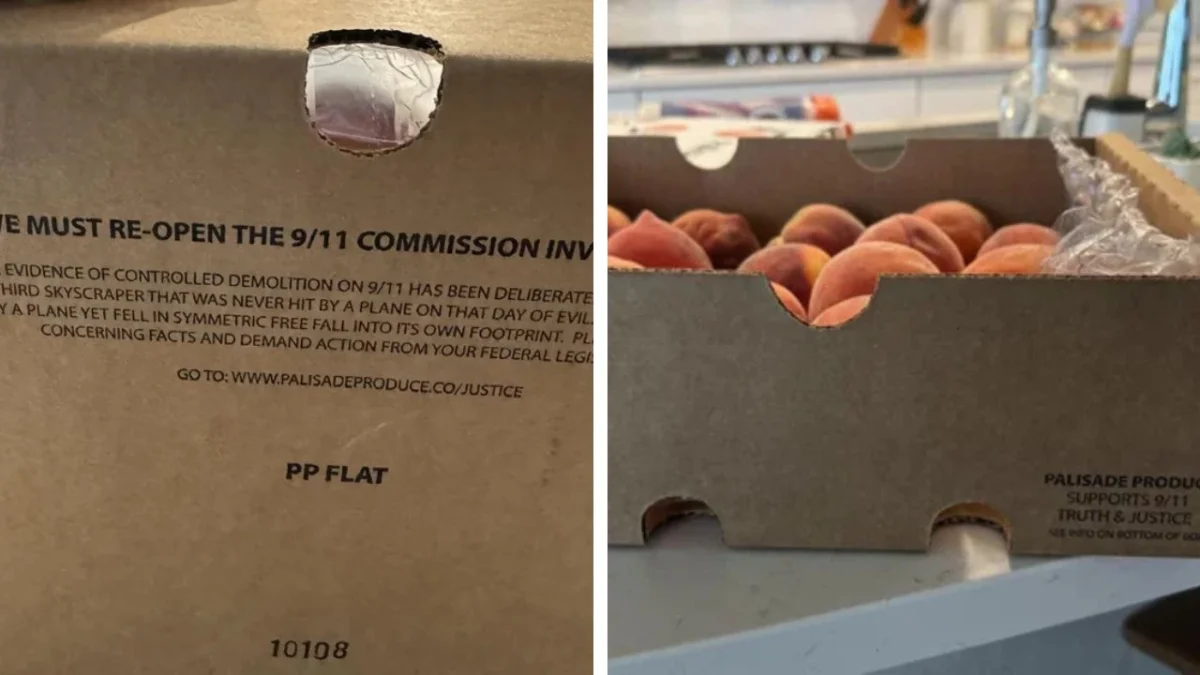
A recent post on the popular social media platform Reddit, specifically within the r/mildlyinteresting community, has drawn considerable attention to an unexpected and controversial message discovered on the underside of a cardboard box of peaches. The Reddit user who shared the image reported stumbling upon detailed 9/11 conspiracy messaging, prompting widespread discussion about the intersection of commerce, personal beliefs, and public communication. The original poster stated that the fruit was purchased from a roadside stand and that the provocative text was only noticed upon closer examination of the packaging.
The Redditor’s post, which quickly gained traction, articulated the surprise of the discovery: "This box of peaches I bought from a roadside stand has 9/11 conspiracy theories printed on the bottom. FWIW I am not usually one to check out the bottom of fruit boxes." The user further clarified that a small, seemingly innocuous note on the side of the box had initially piqued their curiosity, leading them to turn the box over and uncover the extensive printed message. This unusual find has ignited conversations across the internet, delving into the nature of commercial packaging, the dissemination of information, and the persistent shadows cast by the September 11, 2001, attacks.
Unpacking the Message: The Claims on the Box
The text emblazoned in capital letters on the bottom of the peach box was not subtle in its intent. It began with a direct and urgent call to action: "WE MUST RE-OPEN THE 9/11 COMMISSION INVESTIGATION." This bold statement served as the preamble to a series of claims challenging the official narrative of the 9/11 attacks. The message asserted that "irrefutable evidence of controlled demolition on 9/11 has been suppressed," a claim central to many 9/11 conspiracy theories. It further argued that "terrorists destroyed a third skyscraper that was never hit by a plane on that day," explicitly referencing World Trade Center 7 (WTC 7).
The printed statement went on to elaborate on the WTC 7 claim, contending that the building "was not hit by a plane yet fell in symmetric free fall into its own footprint." This specific detail is a common point of contention among those who question the official findings. The message concluded by urging readers to "educate themselves about what it described as suppressed facts" and to "demand action from federal legislators." To facilitate further engagement, the box directed customers to a specific URL: "GO TO: WWW.PALISADEPRODUCE.CO/JUSTICE," suggesting a dedicated online portal for information related to these claims. The directness and specific nature of the messaging on what would typically be an unassuming fruit container have made the discovery particularly noteworthy.
The Lingering Shadows of 9/11: A Brief Context on Conspiracy Theories
The attacks of September 11, 2001, represent one of the most significant and traumatic events in modern American history. The official narrative, supported by extensive investigations by the 9/11 Commission and the National Institute of Standards and Technology (NIST), attributes the collapse of the World Trade Center Twin Towers and 7 World Trade Center (WTC 7) to structural failure caused by aircraft impacts and subsequent intense fires. The Pentagon was struck by American Airlines Flight 77, and United Airlines Flight 93 crashed in Shanksville, Pennsylvania, after passengers and crew fought back against the hijackers.
However, almost immediately after the attacks, alternative theories began to emerge, collectively known as "9/11 conspiracy theories" or "9/11 Truth Movement." These theories posit that the attacks were either an inside job orchestrated by elements within the U.S. government, or that government officials had foreknowledge and deliberately allowed the attacks to happen. Central to many of these theories are challenges to the official explanations for the collapse of the World Trade Center buildings, particularly the Twin Towers and WTC 7.
The claims printed on the peach box—specifically "controlled demolition" and the collapse of a "third skyscraper that was never hit by a plane"—are mainstays of this movement. Proponents of the controlled demolition theory argue that the buildings could not have collapsed solely due to plane impacts and fires, suggesting that explosives were pre-planted and detonated to bring them down. This theory often cites the speed and symmetry of the collapses as evidence. Despite overwhelming scientific and engineering consensus to the contrary, these narratives persist within certain segments of the population. Polls over the years have shown varying levels of public skepticism towards the official 9/11 narrative, though generally a minority. For instance, a 2011 poll by Reuters/Ipsos found that 15% of Americans believed "something else" besides Al-Qaeda was responsible for the attacks, and a similar percentage in other polls expressed doubts about the government’s full disclosure.
World Trade Center 7: The Epicenter of a Key Debate
The collapse of 7 World Trade Center (WTC 7) on September 11, 2001, is a particularly potent focal point for 9/11 conspiracy theories, as highlighted by the messaging on the peach box. WTC 7, a 47-story skyscraper located across Vesey Street from the main World Trade Center complex, collapsed at 5:20 PM EST, nearly seven hours after the Twin Towers. Unlike the Twin Towers, WTC 7 was not directly hit by an aircraft. Its collapse, which appeared symmetrical and rapid, fueled claims of controlled demolition among skeptics. The peach box message directly echoed these sentiments, stating WTC 7 "was not hit by a plane yet fell in symmetric free fall into its own footprint."
The National Institute of Standards and Technology (NIST) conducted an extensive investigation into the collapse of WTC 7, publishing its final report in November 2008. NIST concluded that the collapse was primarily caused by uncontrolled fires, which were ignited by debris from the collapse of the North Tower. These fires burned for hours on multiple floors, causing critical structural elements, particularly long-span steel trusses, to expand and buckle. This led to a progressive collapse initiated by the failure of a key column. NIST found no evidence of explosives or pre-set charges. The agency meticulously modeled the collapse sequence, demonstrating how thermal expansion and weakening of steel could lead to the observed structural failure. The appearance of "free fall" was addressed by NIST, which stated that for a short period (approximately 2.25 seconds), the building’s façade fell at free fall acceleration, but the overall collapse was not a true free fall and was consistent with the structural failures caused by fire.
Official Inquiries and Scientific Consensus: The NIST Findings
The comprehensive investigations into the 9/11 attacks were multifaceted, involving various government agencies and expert panels. The 9/11 Commission, formally known as the National Commission on Terrorist Attacks Upon the United States, was established in late 2002 to prepare a full and complete account of the circumstances surrounding the attacks. Its final report, released in July 2004, concluded that Al-Qaeda, led by Osama bin Laden, was responsible for the attacks, and detailed the failures in intelligence and security that allowed them to occur. The report provided a detailed narrative of the hijackings and impacts, and generally accepted the engineering conclusions regarding the collapses.
The engineering aspects, particularly the structural failures of the World Trade Center towers, fell under the purview of the National Institute of Standards and Technology (NIST). NIST launched a multi-year, highly detailed investigation into the collapses of the Twin Towers and WTC 7. Their findings, published in comprehensive reports between 2005 and 2008, represent the scientific and engineering consensus on the events. For the Twin Towers, NIST concluded that the impacts of the planes severed structural columns and dislodged fireproofing, while the ensuing jet fuel fires weakened the remaining steel structures, leading to the progressive failure of floors and ultimately the entire towers. For WTC 7, as previously mentioned, NIST definitively concluded that it collapsed due to uncontrolled fires ignited by debris from the North Tower, which weakened the building’s unique structural system. These reports have been peer-reviewed and are widely accepted within the scientific and engineering communities. Despite the rigor and transparency of these investigations, a determined minority continues to challenge their conclusions, often citing selective evidence or misinterpretations of scientific principles.
A Timeline of 9/11 Investigations and Related Events
To understand the context of the claims on the peach box, a brief timeline of official investigations and key events related to the 9/11 attacks and subsequent debates is crucial:
- September 11, 2001: Al-Qaeda terrorists hijack four commercial airplanes. Two crash into the World Trade Center Twin Towers in New York City, causing both to collapse. One crashes into the Pentagon in Arlington, Virginia. One crashes in a field in Shanksville, Pennsylvania, after passengers fight back. 7 World Trade Center (WTC 7) collapses later in the day.
- February 2002: The Congressional Joint Inquiry into the 9/11 attacks begins, jointly led by the Senate Select Committee on Intelligence and the House Permanent Select Committee on Intelligence.
- July 2003: The Joint Inquiry issues its final report, highlighting intelligence failures.
- November 2002: The National Commission on Terrorist Attacks Upon the United States (the 9/11 Commission) is established to provide a full account of the attacks.
- July 22, 2004: The 9/11 Commission releases its final report, detailing the attacks, identifying Al-Qaeda as responsible, and making recommendations for preventing future terrorism.
- August 2005: NIST releases its final report on the collapse of the World Trade Center Twin Towers (NCSTAR 1-6), concluding that fire and structural damage from the aircraft impacts caused the collapses.
- November 2008: NIST releases its final report on the collapse of 7 World Trade Center (NCSTAR 1A), concluding that uncontrolled fires, initiated by debris from the North Tower, caused the building to collapse.
- Ongoing: Various groups continue to promote alternative theories about 9/11, often citing discrepancies or perceived flaws in the official reports. The discovery of the peach box messaging represents a recent instance of such advocacy manifesting in a public, commercial space.
Online Reactions and Ethical Debates: The Reddit Thread’s Insights
The Reddit thread quickly became a forum for a variety of reactions, from amusement to concern, and sparked broader ethical discussions. One particularly insightful comment touched upon the perceived boundaries of business communication: "When I had a business I had a simple rule which served me well: 3 topics are off limits for both internal and external communications: sex, religion, and politics (unless you’re actually in one of those 3 industries.)" This Redditor’s perspective highlights a widely held belief among many business professionals that controversial, non-commercial topics should be kept separate from brand messaging to maintain neutrality and appeal to the broadest possible customer base. Introducing highly divisive subjects like 9/11 conspiracy theories risks alienating customers who hold differing views or who simply prefer their commercial transactions to be free of political or ideological statements.
Another Reddit user responded with a humorous comparison to their own website layout, stating, "Reminds me of my own site. 3D Printing Service Design Service About The Team Hulk Hogan Reptilian Investigation Contact Us." This comment underscored the bizarre and often incongruous nature of the peach box’s messaging, likening it to an unprofessional or eccentric website design where unrelated and sensational topics are mixed with legitimate business services. It implicitly criticizes the lack of focus and potentially distracting nature of such packaging.
A different commenter focused on the practical implications for consumer experience, expressing concern "about how much easier it is to know where to immediately go on their website for 9/11 truther info than it is to know where to immediately go to see the selection of fruit they have to offer (presumably it’s ‘wholesale,’ but maybe it’s ‘about’…)." This observation points to a potential misprioritization by the business owner, where the advocacy message appears to overshadow or even detract from the primary commercial purpose of selling peaches. For a consumer, clarity regarding product information is usually paramount, and its obfuscation by controversial content can be frustrating.
The Business Owner’s Alleged Background: Unverified Claims
Adding another layer to the discussion, one Redditor claimed to recognize the business owner behind the packaging. The user wrote, "I know the owner, he’s been a weird creep his entire life. He was arrested on a ton of gun charges like 10 years ago, he’s also run for office a time or two." While these claims provide a potential glimpse into the individual’s history and motivations, it is crucial to note that they remain unverified. As the original source article stated, The Daily Dot could not independently verify the background of the business owner, the specific claims on the packaging, or the identity of the original poster. Such unverified claims, though part of the online discussion, must be treated with caution and are not presented as factual in this report. However, if true, such a background could suggest a pattern of unconventional behavior or a strong inclination towards expressing personal views, potentially including political or conspiratorial ones, through various means.
Implications for Commerce, Communication, and Consumer Trust
The incident of the peach box messaging carries several broader implications for commerce, communication, and consumer trust in the digital age.
Brand Reputation and Consumer Trust: For a business, product packaging is often the first point of physical interaction with a customer. It conveys brand identity, product information, and sometimes, values. Using this prime real estate for highly controversial political or conspiracy-related messaging can be a double-edged sword. While it might appeal to a niche audience who shares those beliefs, it risks alienating a much larger segment of consumers who may find such messaging inappropriate, offensive, or simply distracting from the product itself. In an era where consumers increasingly scrutinize brands’ ethical stances and communication strategies, such a move could significantly impact sales and long-term brand reputation.
The Blurring Lines of Commercial and Personal Expression: This incident highlights the ongoing tension between a business owner’s right to freedom of expression and the expectations placed on commercial entities. While individuals are generally free to voice their opinions, leveraging a commercial product for non-commercial, controversial advocacy blurs the lines. It raises questions about whether consumers implicitly endorse such messages when purchasing a product, or if businesses have a responsibility to keep their commercial activities distinct from their personal or political stances.
The Virality of the Unusual: The fact that this discovery rapidly gained traction on Reddit underscores the power of social media in amplifying unusual or controversial content. A seemingly obscure message on a fruit box, once photographed and shared online, can quickly reach a global audience, sparking widespread discussion and debate. This amplification effect means that businesses must be increasingly aware that any message they put out, no matter how minor or obscure its placement, can potentially become a major talking point.
The Enduring Challenge of Misinformation
Beyond the commercial implications, this event also serves as a reminder of the enduring challenge of misinformation and conspiracy theories. Despite extensive official investigations and scientific consensus, narratives that question established facts persist and find new avenues for dissemination. The peach box is a physical manifestation of this phenomenon, bringing what might typically be confined to online forums or niche publications into the everyday consumer experience. The call to "re-open the 9/11 Commission investigation" and the specific claims about WTC 7 demonstrate the deep-seated nature of these beliefs and the continued efforts by some to challenge the historical record.
Conclusion
The discovery of 9/11 conspiracy messaging on a peach box from a roadside stand is more than just a peculiar anecdote. It is a microcosm of broader societal trends: the persistence of misinformation, the evolving ethics of commercial communication, and the powerful, unpredictable nature of online discourse. While the specific intent of the business owner remains open to interpretation, the incident has undoubtedly sparked a necessary conversation about where the lines are drawn when it comes to expressing controversial views through commercial channels. As consumers increasingly navigate a landscape saturated with information, both factual and speculative, the unexpected appearance of such messages in everyday contexts serves as a potent reminder of the ongoing need for critical thinking and discerning engagement with the information we encounter.