Lina Irawan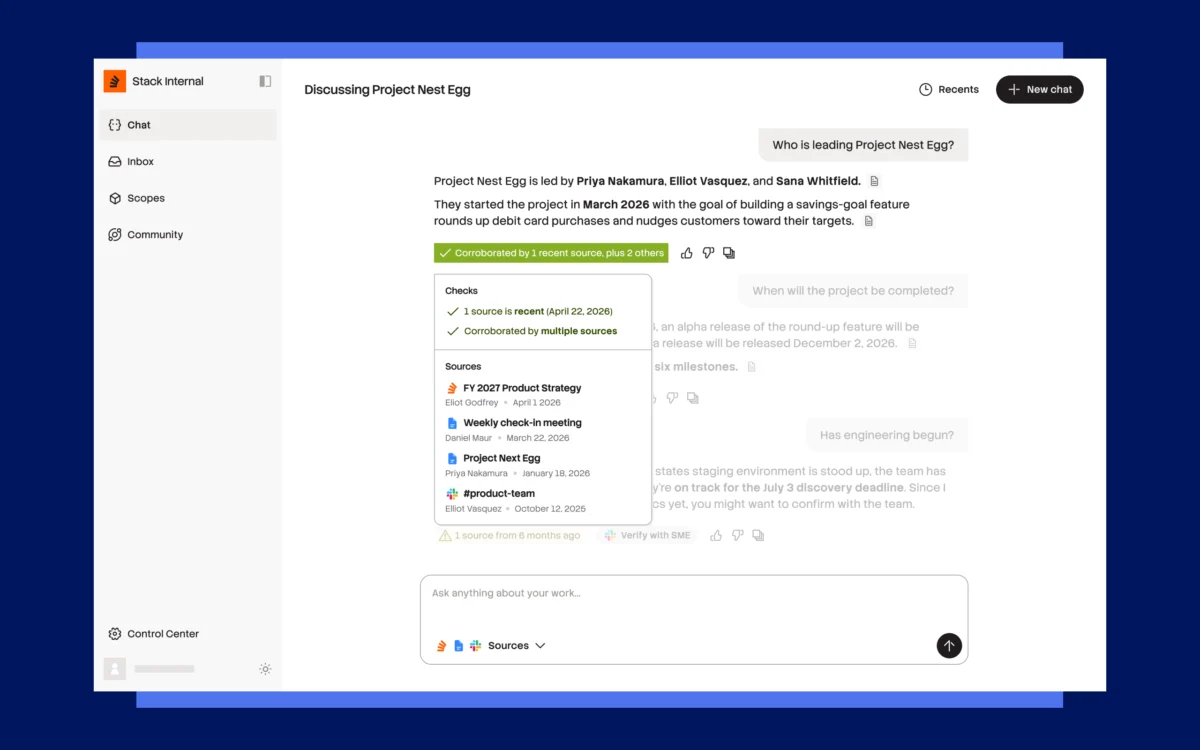
The landscape of corporate knowledge management is undergoing a fundamental shift as organizations transition from human-centric workflows to hybrid environments populated by both human teams and autonomous AI agents. On July 30, 2026, Stack Overflow announced a significant overhaul of its enterprise offering, launching the new Stack Internal platform. This AI-native infrastructure is designed to solve one of the most pressing challenges in the modern enterprise: the proliferation of "stale" or "hallucinated" data that hampers the productivity of AI agents and human employees alike. By transforming fragmented discussions and documentation into what the company calls "decision-grade knowledge," the platform aims to provide a durable, validated layer of context that persists even as underlying AI models and software tools evolve.
The Challenge of Knowledge Fragmentation in the AI Era
For decades, organizations have struggled with the "silo effect," where critical information is trapped within specific departments or individual minds. However, the rapid adoption of generative AI and large language models (LLMs) has exacerbated this issue. While AI tools allow teams to move faster, they also contribute to a massive accumulation of data across various surfaces, including Slack conversations, Google Docs, coding environments, and private sessions.
Industry data suggests that the average enterprise now uses over 300 different SaaS applications, leading to a fragmented "digital exhaust" that is difficult to index and even harder to validate. When AI agents are introduced into these environments, they often retrieve information that is outdated or contradictory. Because these agents operate with a high degree of mathematical confidence, they can execute historical mistakes at a speed that exceeds human oversight capabilities. This necessitates a "human-in-the-loop" requirement for every transaction, which ultimately negates the efficiency gains promised by AI and increases "token spend"—the operational cost of processing data through LLMs.
Core Capabilities of the New Stack Internal Platform
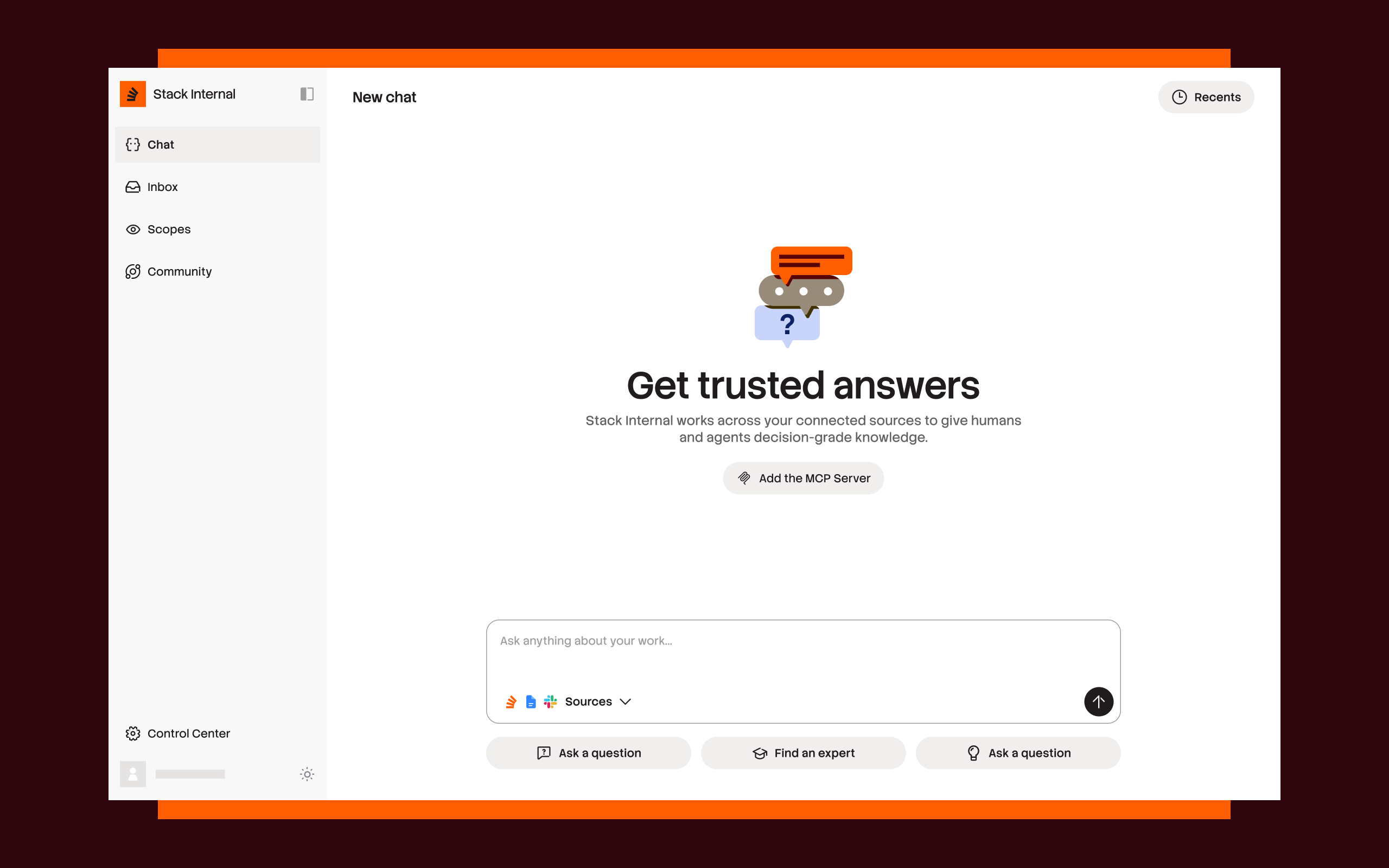
The July 2026 release of Stack Internal introduces a suite of capabilities focused on the ingestion, evaluation, and delivery of trusted knowledge. Unlike traditional search engines that prioritize keyword relevance, Stack Internal is engineered to determine the reliability and authority of information before it is served to a user or an agent.
Automatic Ingestion and "Decision-Grade" Knowledge
One of the primary features of the new platform is its automatic ingestion engine. This system breaks down raw data from distributed tools and converts it into stored, durable knowledge. At launch, the platform includes dedicated connectors for the Stack Internal community, Google Docs, and Slack.
The system does not merely aggregate data; it "slices" and evaluates information for trust. This process involves identifying the most current version of a document or the most accurate solution in a technical discussion. By doing so, the platform creates "decision-grade knowledge"—information that is verified to the point that an organization can confidently base operational decisions upon it without secondary manual verification.
Transparency Through Confidence Labels and Provenance
To address the issue of AI "hallucinations," the new platform introduces a chat interface equipped with response-level confidence labels. When a user or agent queries the system, the platform provides a clear indication of how much the information can be trusted based on its source and age.
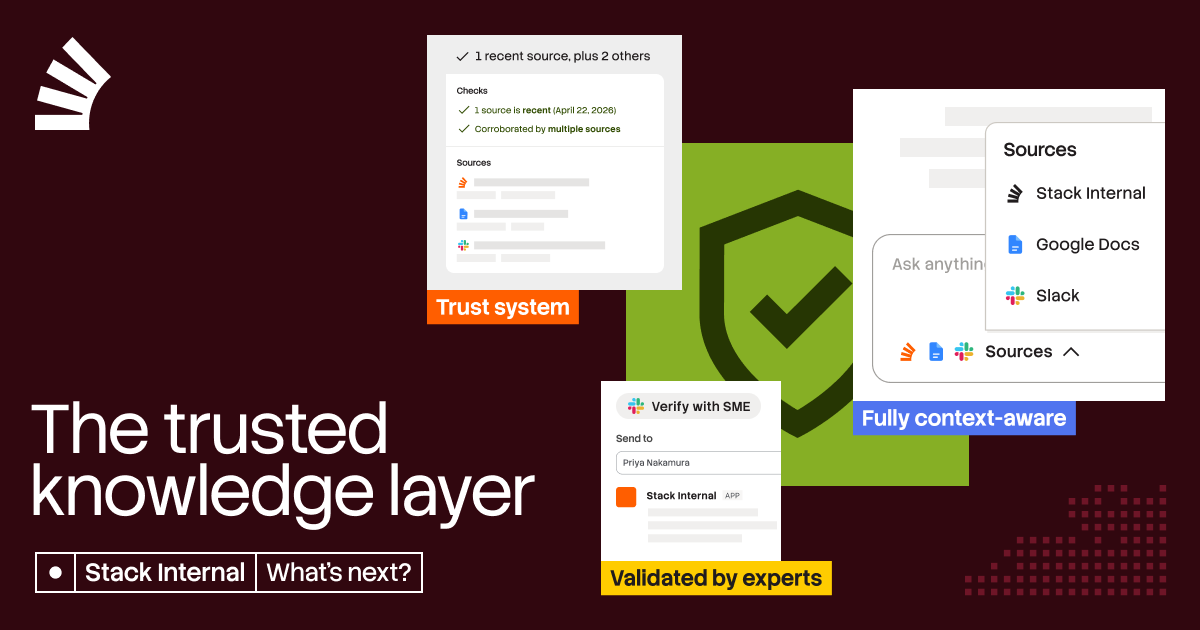
Accompanying these labels are "provenance cards." These digital citations provide a clear audit trail, showing exactly where a piece of information originated, who verified it, and when it was last updated. This transparency is critical for compliance-heavy industries such as finance, healthcare, and software engineering, where the "black box" nature of standard AI responses often poses a significant risk.
Security and Governance: Agents as First-Class Citizens
As AI agents take on more autonomous roles—such as writing code, managing deployments, or handling customer queries—the need for robust security boundaries has become paramount. Stack Internal treats AI agents as "first-class citizens," meaning they are subject to the same permission-aware access controls as human employees.
The platform utilizes identity-aware data boundaries to ensure that agents only access information they are authorized to see. This mitigates the risk of data leakage, where an agent might inadvertently expose sensitive corporate information or PII (Personally Identifiable Information) while answering a query. By integrating these permissions into the knowledge layer itself, Stack Internal ensures that security is not an afterthought but a foundational component of the AI workflow.
Technical Integration and Developer Productivity
For engineering leaders, the update provides enhanced visibility into how internal knowledge is being consumed. The introduction of Swagger API (v3) endpoints allows organizations to query precise metrics on internal API usage.
This enables leaders to:
- Monitor high-traffic dependencies by breaking down call volumes by specific internal applications.
- Compare adoption rates between legacy (v2) and current (v3) API versions.
- Identify knowledge gaps where high-volume queries are returning low-confidence results.
Furthermore, the platform supports Model Context Protocol (MCP) server integrations. This allows for the retrieval of context directly within the flow of work, whether that be in a terminal, an IDE, or a project management tool. When the platform detects a gap in existing knowledge, it is designed to automatically route questions to domain experts for verification—a feature intended to ensure the "source of truth" remains living and relevant.
The Economic Impact: Reducing the "AI Tax"
The financial implications of fragmented data are significant. When AI agents operate on low-quality data, the resulting errors require human intervention, which costs time and salary resources. Additionally, every time an agent is forced to re-process large volumes of irrelevant data to find a correct answer, the organization incurs higher API costs from LLM providers.
Stack Overflow’s analysis suggests that by providing a validated knowledge layer, organizations can create a "virtuous cycle." As teams work and contribute to the platform, the organizational memory becomes more valuable. This reduces the need for human oversight and lowers token consumption, effectively maximizing the return on AI investment (ROI).
Chronology and Development Roadmap
The development of the new Stack Internal platform follows several years of Stack Overflow’s transition from a public Q&A site to an enterprise-focused "knowledge infrastructure" provider.
- Pre-2024: Stack Overflow for Teams focused primarily on human-to-human knowledge sharing.
- 2024-2025: Initial AI integrations were introduced, focusing on search summarization.
- July 30, 2026: Launch of the AI-native Stack Internal platform, introducing automatic ingestion, agent-specific permissions, and the v3 API.
- Late 2026 (Planned): The company expects to release "decay detection," a feature that will automatically flag information that has become obsolete based on changes in the organization’s codebase or documentation.
- 2027 (Planned): Expansion of connectors to include a wider array of project management and CRM tools, alongside machine-facing trust scores for fully autonomous agent decision-making.
Analysis of Broader Industry Implications
The move by Stack Overflow reflects a broader trend in the technology sector: the shift from "Generative AI" to "Reliable AI." While the first wave of AI adoption was characterized by the novelty of content generation, the current phase is focused on accuracy and utility.
Industry analysts note that for AI to move from a "copilot" (assisting humans) to an "agent" (acting on behalf of humans), the underlying data must be beyond reproach. Systems like Stack Internal represent a move toward "Knowledge-as-a-Service," where the value lies not in the AI model itself—which is becoming a commodity—but in the proprietary, validated data that feeds it.
Furthermore, by integrating Slack and Google Docs into a unified knowledge layer, Stack Overflow is positioning itself as a central nervous system for enterprise data. This puts it in direct competition with traditional knowledge management systems and even the native search capabilities of the platforms it integrates with. The success of this strategy will likely depend on the platform’s ability to maintain "trust" as the volume of AI-generated content continues to grow exponentially.
Availability and Implementation
As of July 30, 2026, current Stack Internal customers are eligible to begin testing these new capabilities through a free trial period. Administrators can activate the features via the Stack Internal support portal or by coordinating with their account representatives. For organizations not currently utilizing the platform, Stack Overflow has opened inquiries for expert consultations to demonstrate how the "knowledge layer" can be integrated into existing infrastructure.
This release marks a critical step for Stack Overflow as it seeks to remain the primary destination for technical knowledge in an age where that knowledge is increasingly consumed by machines rather than humans. By focusing on the "trust" and "provenance" of data, the company is betting that the future of AI depends less on the complexity of the algorithms and more on the quality of the facts they are given.