admin
admin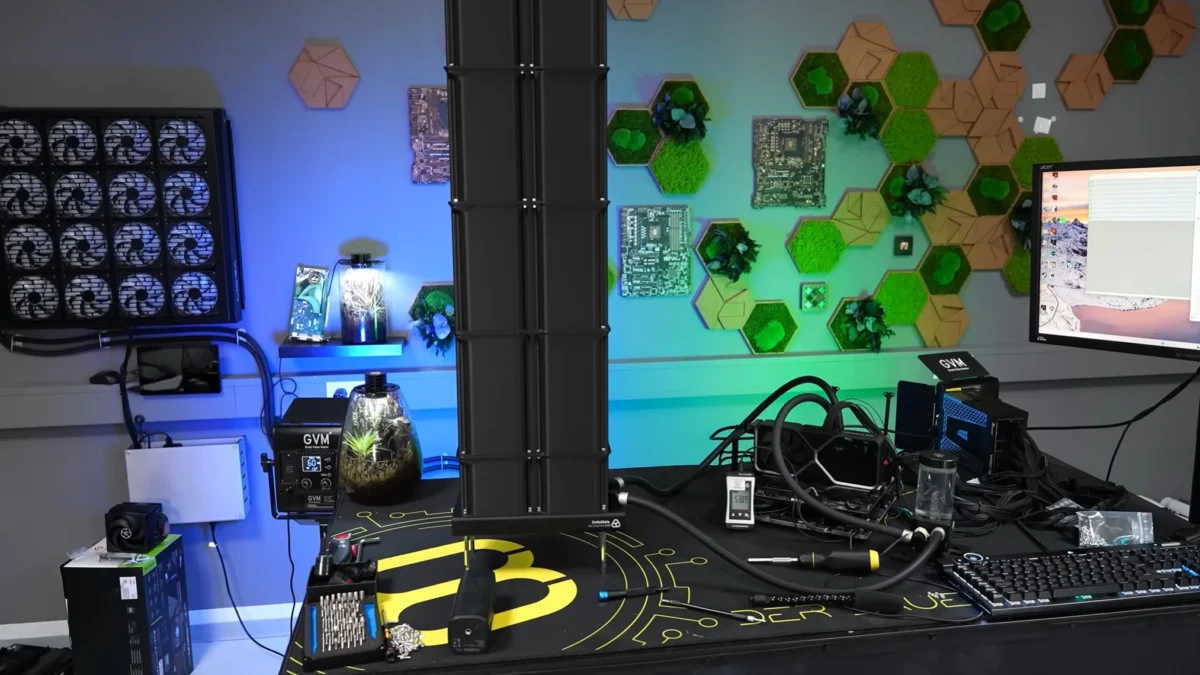
The AMD Ryzen 7 9800X3D has established itself as a dominant force in the gaming CPU market, leveraging its innovative 3D V-Cache technology to provide unmatched frame rates and low-latency performance. However, this performance comes with a significant thermal trade-off. The physical architecture of the 3D V-Cache effectively acts as a thermal insulator, or a "thermal blanket," which traps heat within the silicon layers. While traditional air and liquid cooling solutions are generally sufficient for standard operation, enthusiasts and engineers continue to seek more efficient ways to manage the high heat density of Zen 5-based processors. In a recent experimental breakthrough, renowned hardware overclocker and YouTuber Roman "der8auer" Hartung demonstrated a novel approach to passive cooling by utilizing a 3D-printed chimney structure that utilizes the "stack effect" to reduce operating temperatures by a staggering 19°C.
The Thermal Challenge of 3D V-Cache Architecture
To understand the significance of this experiment, one must first examine the internal structure of the Ryzen 7 9800X3D. Unlike the previous generation Ryzen 7 7800X3D, where the L3 V-Cache was stacked on top of the Core Complex Die (CCD), AMD inverted the design for the 9000 series. In the 9800X3D, the CCD sits on top of the V-Cache, placing the heat-generating cores closer to the Integrated Heat Spreader (IHS). While this change significantly improved thermal transfer compared to its predecessor, the chip still exhibits high concentrated heat loads during intensive tasks.
Under a sustained 100W power draw, which is common during heavy gaming or productivity workloads, the Ryzen 7 9800X3D can quickly reach its thermal throttling limits if the cooling solution is inadequate. Standard liquid cooling relies on high-static-pressure fans to force air through the fins of a radiator to dissipate heat. However, der8auer’s experiment sought to eliminate the reliance on mechanical fans, instead turning to the laws of thermodynamics and fluid dynamics to achieve cooling through natural convection.

The Physics of the Stack Effect
The core principle behind this experiment is the "stack effect," also known as the chimney effect. This physical phenomenon occurs when there is a difference between the indoor and outdoor air density resulting from temperature and moisture differences. In the context of a computer cooling system, the air inside a vertical enclosure is heated by the radiator. Because warm air is less dense than cool air, it naturally rises.
As the warm air escapes through the top of the vertical column, it creates a pressure differential—a zone of low pressure at the base of the chimney. This low pressure acts as a vacuum, drawing in cooler ambient air from the bottom to replace the rising warm air. The effectiveness of this natural draft is directly proportional to the height of the chimney and the temperature difference between the air inside the stack and the air outside. By increasing the height of the chimney, the velocity of the airflow increases, thereby enhancing the cooling capacity of the system without the need for moving parts.
Experimental Methodology and Setup
The experimental setup began with a standard 240mm radiator connected to a water-cooling loop attached to the Ryzen 7 9800X3D. However, rather than mounting the radiator inside a traditional PC chassis with fans, der8auer placed the radiator horizontally on a test bench. To facilitate the stack effect, he designed and 3D-printed modular chimney segments. These segments were engineered to fit perfectly over the radiator, creating an airtight seal that forced all rising air through the vertical column.
The experiment was conducted in stages to measure the correlation between chimney height and thermal performance:

- The Baseline: The CPU was tested with the radiator alone, with no fans and no chimney. In this state, the 9800X3D quickly reached a peak temperature of approximately 90°C under a 100W load, hovering near the point of thermal throttling.
- The 20cm Chimney: Upon attaching a single 3D-printed segment standing 20cm tall, a measurable difference was observed. The natural draft began to pull air through the radiator fins, resulting in a slight but notable decrease in temperature.
- The 110cm Chimney: The experiment reached its peak when der8auer stacked multiple 3D-printed enclosures to reach a total height of 110cm—nearly reaching the ceiling of his laboratory. At this height, the pressure differential became so significant that the cooling performance rivaled some active cooling solutions.
Quantitative Results and Validation
The data collected during the 110cm chimney test revealed a dramatic shift in the thermal profile of the Ryzen 7 9800X3D. The CPU temperature dropped from the 90°C baseline to just 71°C. This 19°C reduction represents a massive gain in thermal headroom, especially for a passive cooling system drawing 100W of power.
To validate that the airflow was indeed being generated by the stack effect and not by ambient room currents, der8auer utilized a fog gun. By releasing a dense fog near the base of the chimney, he was able to visually demonstrate the "suction" effect. The fog was rapidly drawn into the bottom of the 3D-printed structure, accelerated through the radiator, and expelled out of the top of the 110cm stack. This visual confirmation proved that the chimney was functioning as a self-sustaining air pump, driven entirely by the waste heat of the processor itself.
Practical Limitations and Consumer Reality
While the results of the 19°C drop are impressive from an engineering standpoint, the practical applications for the average consumer remain limited. The primary obstacle is the sheer physical scale of the cooling apparatus. A 110cm (approximately 43 inches) chimney is impossible to fit inside any standard ATX, E-ATX, or Small Form Factor (SFF) computer case.
Furthermore, the setup requires the radiator to be oriented horizontally at the base of the chimney, which is contrary to how most modern PC cases are designed. Users wishing to replicate these results would need to operate their systems on an open-air test bench, essentially sacrificing the protection and aesthetic of a traditional case for the sake of experimental passive cooling. There is also the issue of "startup" heat; the stack effect requires the air to be warm before the draft begins, meaning temperatures might spike momentarily before the airflow stabilizes.

Broader Implications for the Cooling Industry
Despite the lack of immediate consumer viability, der8auer’s experiment offers valuable insights for the future of industrial and data center cooling. As modern processors and AI accelerators continue to push TDP (Thermal Design Power) limits higher, the energy cost of running thousands of cooling fans in a data center becomes a significant operational expense.
The principles demonstrated here—modular 3D-printed venting and the utilization of natural convection—could potentially be scaled for server rack designs. By designing server rooms to act as large-scale chimneys, operators could theoretically reduce their reliance on active cooling, leading to substantial energy savings and a reduced carbon footprint. In the enthusiast space, this experiment might inspire case manufacturers to experiment with "chimney-style" chassis designs that are taller and thinner, optimizing for natural airflow even when fans are running at low RPMs to maintain silence.
Conclusion and Future Outlook
The Ryzen 7 9800X3D remains one of the most thermally challenging CPUs to cool due to its high-density 3D V-Cache. However, Roman "der8auer" Hartung has proven that unconventional thinking and basic physics can overcome even the most stubborn thermal barriers. Achieving a 19°C temperature drop without the use of a single fan is a testament to the potential of passive cooling when aided by geometric optimization.
As 3D printing technology becomes more accessible and materials become more heat-resistant, the boundary between "experimental" and "practical" cooling may begin to blur. While we may not see 4-foot chimneys protruding from home gaming rigs anytime soon, the data gleaned from this experiment reinforces the importance of airflow dynamics in hardware design. For now, the 9800X3D chimney remains a fascinating proof-of-concept, highlighting the lengths to which the PC master race will go to shave a few degrees off their vitals.