Sisilia Frederika
The James Webb Space Telescope (JWST) has fundamentally altered the scientific understanding of the early universe by identifying a burgeoning population of mysterious celestial objects officially categorized as Little Red Dots (LRDs). Since their initial discovery in early 2024, more than 300 of these enigmatic sources have been cataloged across various deep-sky surveys. These objects, characterized by their compact nature and distinctively red hue in infrared spectra, appear to have flourished during a critical epoch of cosmic history—between 600 million and 1.6 billion years after the Big Bang. The emergence of LRDs presents a significant challenge to standard cosmological models, as they suggest the presence of massive structures and high-energy processes occurring much earlier than previously thought possible.
The Nature of the Little Red Dot Phenomenon
Little Red Dots are not merely aesthetic anomalies in the JWST’s deep-field imagery; they represent a significant missing link in the chronology of the universe. Observations indicate that these objects are extremely distant, existing at high redshifts where the light has been stretched into the infrared part of the spectrum by the expansion of the universe. Their compact size—often appearing as point-like sources rather than extended galaxies—combined with their intense infrared brightness, has led to a variety of scientific hypotheses regarding their true identity.
The primary theory currently held by the astronomical community is that LRDs are early Active Galactic Nuclei (AGN). These are the luminous cores of infant galaxies, powered by the accretion of matter into supermassive black holes. However, the presence of supermassive black holes so soon after the Big Bang creates a "conundrum of growth." Standard models of black hole evolution suggest that reaching masses of millions or billions of suns requires billions of years of steady consumption. If LRDs are indeed early AGN, scientists must recalibrate their understanding of how black holes form, perhaps suggesting they began as "heavy seeds" rather than the remnants of the first stars.
Alternative theories suggest that LRDs could be colossal "monster" stars. These hypothetical supermassive stars, potentially possessing masses up to a million times that of the Sun, would represent the first generation of stellar life in the cosmos. Such stars would have extremely short lifespans, ending in violent supernovae that seed the surrounding space with heavy elements. Another possibility being explored is that these objects are ancient, ultra-dense globular clusters. In this scenario, the clusters would be dominated by a single, central supermassive star or a collection of rapidly merging stellar-mass black holes.
Chronology of Discovery and the RUBIES Survey
The investigation into LRDs has been accelerated by the Red Unknowns: Bright Infrared Extragalactic Survey (RUBIES), a dedicated JWST program designed to probe the high-redshift universe. The timeline of discovery began shortly after JWST became fully operational, as its Near-Infrared Camera (NIRCam) and Near-Infrared Spectrograph (NIRSpec) began capturing data that the older Hubble Space Telescope could not detect.
In early 2024, the first significant clusters of LRDs were identified in the CEERS (Cosmic Evolution Early Release Science) and JADES (JWST Advanced Deep Extragalactic Survey) fields. By mid-2024, the count had surpassed 300 distinct objects. The data suggested a rapid rise in the population of these dots starting around 600 million years post-Big Bang, followed by a sharp decline approximately one billion years later. This timeframe coincides with the Epoch of Reionization, a period when the first stars and galaxies began to ionize the neutral hydrogen gas that filled the early universe.
The most recent breakthrough occurred with the identification of a specific target named Pseudo-LRD-NOM. Led by Dutch astronomer Karina Caputi and an international team of researchers, this study utilized the natural magnifying power of gravitational lensing. By observing the Abell 370 galaxy cluster—located 5 billion light-years away—the team used its mass to bend and brighten the light from Pseudo-LRD-NOM, which sits far behind it at a distance of 12 billion light-years. This "cosmic magnifying glass" allowed for a detailed look at what appears to be an LRD in its earliest stages of formation.
Supporting Data: The Chemical Composition of Pseudo-LRD-NOM
The analysis of Pseudo-LRD-NOM has provided the most compelling data to date regarding the lifecycle of these objects. Spectroscopic data reveals that this source is a "starburst" galaxy caught in its first 10 million years of existence. One of the most striking findings is the galaxy’s "metal-poor" status. In astronomy, "metals" refer to any element heavier than hydrogen and helium. The lack of metal lines in its spectrum suggests that Pseudo-LRD-NOM is composed of pristine gas that has not yet been processed through multiple generations of stars.
Despite its chemical youth, Pseudo-LRD-NOM is forming stars at an extraordinary rate. This starburst activity is a hallmark of early galactic evolution. Furthermore, the data suggests the presence of a central black hole that may have formed even before the surrounding galaxy reached its current size. This supports the "black hole first" hypothesis, where massive gravitational wells serve as the anchors around which the first galaxies assemble.
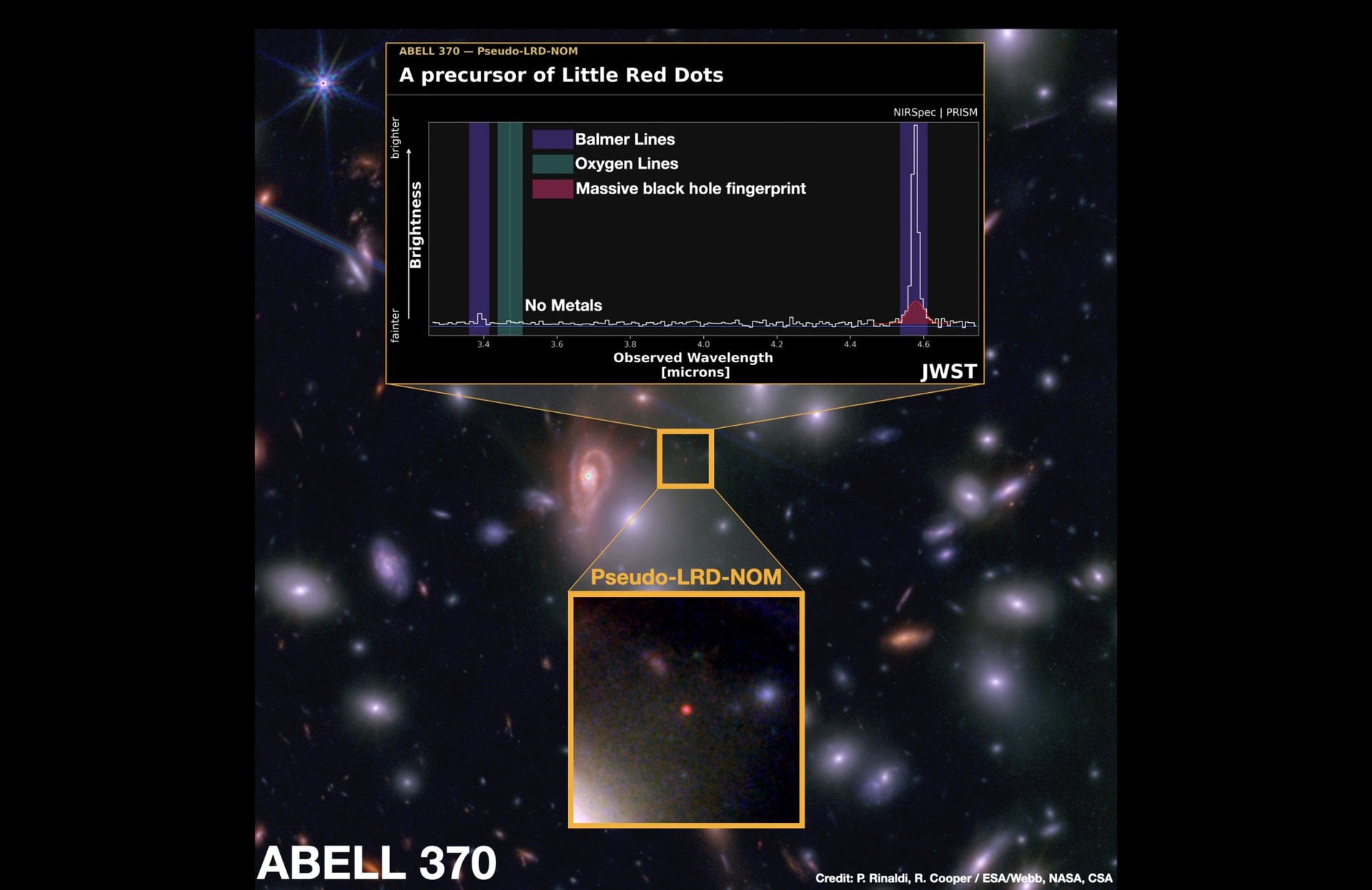
The RUBIES survey data also indicates that many LRDs are surrounded by "dense cocoons" of ionized gas. This ionized hydrogen (H-alpha) emission is a key indicator of either intense star formation or an actively feeding black hole. The density of these cocoons suggests an environment of extreme pressure and heat, which would explain why these objects appear so small and intensely red—the surrounding dust and gas scatter shorter wavelengths of light, leaving only the long-wavelength red and infrared light to reach JWST’s sensors.
Scientific Perspectives and Institutional Responses
The discovery of LRDs has prompted a wave of excitement and cautious analysis from major space agencies and research institutions. NASA and the European Space Agency (ESA) have highlighted the LRD findings as a testament to JWST’s unique capabilities. According to Dale Kocevski of Colby College, a leading researcher in the RUBIES survey, the spectroscopic data is crucial for distinguishing between star-forming regions and accreting black holes. Kocevski has noted that while many LRDs show signs of black hole activity, the diversity of the sample suggests that the early universe was a more heterogeneous environment than previously imagined.
Karina Caputi, the lead scientist behind the study of Pseudo-LRD-NOM, described the finding as a fundamental step toward understanding the "missing link" of galactic evolution. In statements released through the Netherlands Research School for Astronomy (NOVA), Caputi emphasized that finding an LRD in formation allows astronomers to observe the transition from a metal-poor gas cloud to a structured, black-hole-hosting galaxy. This transition is vital for explaining how the massive, metal-rich galaxies we see in the local universe, such as the Milky Way, came to be.
The broader scientific community has responded by calling for more "deep-drilling" spectroscopic observations. Astronomers at the Space Telescope Science Institute (STScI) have indicated that future observation cycles will likely prioritize LRDs to determine if they are a universal phase that all galaxies pass through, or if they represent a unique class of objects that only existed in the high-pressure environment of the early cosmos.
Broader Impact and Implications for Cosmology
The implications of the Little Red Dot discoveries extend far beyond the classification of new astronomical objects; they strike at the heart of how we understand the history of the universe. If LRDs are confirmed to be early supermassive black holes, it necessitates a major revision of the "Lambda-CDM" model of cosmology, which describes the evolution of the universe dominated by dark energy and cold dark matter.
The "Black Hole Growth Paradox" is perhaps the most significant implication. If black holes with masses of $10^7$ or $10^8$ solar masses existed just 600 million years after the Big Bang, they must have grown at rates exceeding the Eddington Limit (the theoretical maximum rate at which a black hole can consume matter), or they must have formed from the direct collapse of massive gas clouds rather than from the deaths of individual stars. This "Direct Collapse Black Hole" (DCBH) theory is currently gaining traction as a result of the JWST data.
Furthermore, LRDs serve as chemical laboratories. By studying these objects, astronomers can map the "Chemical Enrichment Timeline" of the universe. Because LRDs like Pseudo-LRD-NOM are metal-poor, they provide a baseline for the first production of carbon, oxygen, and iron. As these objects evolve and eventually explode as supernovae or merge with other galaxies, they distribute these elements into the intergalactic medium. This process eventually created the heavy elements necessary for the formation of planets and, ultimately, life.
The discovery also sheds light on the role of dark matter. The rapid formation of starburst galaxies and black holes within LRDs suggests that dark matter halos in the early universe were exceptionally efficient at trapping gas and fostering high-density environments. This provides new constraints for physicists trying to model the properties of dark matter itself.
Future Research and Conclusion
As JWST continues its mission, the study of Little Red Dots will transition from discovery to characterization. Upcoming observations will focus on the environments surrounding LRDs to see if they reside in "overdense" regions of the universe—areas that would eventually become massive galaxy clusters. Astronomers also hope to use the Mid-Infrared Instrument (MIRI) to peer through the thick dust cocoons of these objects to see the "engines" inside with even greater clarity.
The mystery of the Little Red Dots highlights a transformative era in astronomy. What were once mere points of light in a telescope’s view are now being revealed as the chaotic, high-energy birthplaces of the modern universe. Whether they are the seeds of supermassive black holes or the final gasps of monster stars, LRDs are the keys to unlocking the first billion years of cosmic time. The data gathered by Karina Caputi, the RUBIES team, and the global scientific community ensures that the story of the early universe is being rewritten, one red dot at a time. Through the lens of JWST, the "Cosmic Dawn" is no longer a theoretical epoch but a visible, vibrant reality that continues to challenge and inspire the boundaries of human knowledge.