Clarissa Hana
OpenAI has announced significant price reductions for two of its advanced GPT-5.6 models, Luna and Terra, aiming to enhance accessibility and efficiency for developers and businesses leveraging its artificial intelligence capabilities. The company has slashed the API price for GPT-5.6 Luna by an impressive 80% and for GPT-5.6 Terra by 20%. These adjustments are a direct result of internal optimizations and model advancements, underscoring OpenAI’s commitment to making its cutting-edge AI more cost-effective.
The updated pricing structure for GPT-5.6 Luna now stands at $0.20 per million input tokens and $1.20 per million output tokens, a substantial decrease from the previous rates of $1 and $6, respectively. Similarly, GPT-5.6 Terra’s pricing has been revised downwards, with input tokens now costing $2 per million, down from $2.50, and output tokens priced at $12 per million, a reduction from $15. These reductions are expected to dramatically lower the operational costs for a wide range of AI-powered applications and services.
In addition to the price cuts, OpenAI has also introduced a new "Fast mode" for its GPT-5.6 Sol model. This enhanced processing option offers up to 2.5 times greater speed compared to the standard Sol processing, without compromising the model’s intelligence. While the standard pricing for GPT-5.6 Sol remains unchanged for now, the Fast mode is available at twice the standard API price. This premium speed is specifically targeted at time-sensitive applications such as complex coding tasks, advanced research endeavors, and agentic workloads where rapid response times are critical. For most other use cases, the standard GPT-5.6 Sol is deemed more than sufficient.
Background and Context of the AI Model Pricing Adjustments
The recent announcements from OpenAI are part of a broader trend within the artificial intelligence industry to optimize both performance and cost. As AI models become more sophisticated and widely adopted, the economics of their deployment become a crucial factor for widespread integration. OpenAI’s decision to reduce prices for its GPT-5.6 models reflects a mature stage of development where efficiency gains can be translated into tangible cost benefits for users.
The GPT-5.6 family of models represents a significant leap forward in natural language processing and understanding. These models are trained on vast datasets and are capable of performing a wide array of complex tasks, from generating human-like text and translating languages to writing code and answering questions in an informative way. The continuous refinement of these models, as evidenced by the efficiency gains leading to price reductions, highlights OpenAI’s ongoing investment in research and development.

The timing of these announcements also comes at a point where AI adoption is accelerating across various sectors, including technology, finance, healthcare, and creative industries. Businesses are increasingly looking to integrate AI into their workflows to automate tasks, enhance customer service, and drive innovation. The cost of accessing these powerful AI tools is a direct determinant of how quickly and widely they can be adopted. Therefore, significant price reductions can act as a catalyst for further adoption and market growth.
Chronology of OpenAI’s Pricing and Performance Enhancements
While the specific date of the initial release of GPT-5.6 models is not provided, the recent price adjustments and the introduction of GPT-5.6 Sol’s Fast mode mark a significant evolutionary step. These updates are built upon the foundational improvements in the GPT-5.6 architecture, particularly the advancements in GPT-5.6 Sol, which the company states have enabled the efficiency gains for Luna and Terra.
The development trajectory of large language models (LLMs) like GPT-5.6 typically involves iterative improvements in model architecture, training methodologies, and hardware optimization. These advancements often lead to better performance metrics, such as higher accuracy, faster inference times, and reduced computational resource requirements. OpenAI’s strategy appears to be one of passing these efficiency dividends onto its user base, thereby fostering a more competitive and accessible AI ecosystem.
The communication of these changes via platforms like X (formerly Twitter) signifies a direct engagement with the developer community, which relies heavily on API access to integrate AI capabilities into their own products and services. The transparency in detailing the price changes and their implications for usage quotas further demonstrates a commitment to user support and clarity.
Detailed Breakdown of Pricing and Usage Implications
The drastic reduction in pricing for GPT-5.6 Luna, an 80% decrease, is particularly noteworthy. This model, now costing $0.20 per million input tokens and $1.20 per million output tokens, becomes significantly more attractive for applications that require high volumes of text processing or generation. For context, if a user previously spent $100 on Luna for a specific task, they could now achieve the same output for just $20, or conversely, perform six times the amount of work for the same cost.

GPT-5.6 Terra’s 20% price reduction, bringing input tokens to $2 per million and output tokens to $12 per million, also represents a substantial cost saving for users of this particular model. While the percentage decrease is smaller than that for Luna, the overall price point remains competitive for specific use cases where Terra’s capabilities are best suited.
OpenAI’s announcement also clarified how these new prices affect usage calculations for tools like Codex and ChatGPT Work. For instance, if new tasks are executed using these models, they will now consume fewer tokens from a customer’s allocated quota. This means that users can accomplish more tasks within their existing budgets or quotas, effectively extending the value of their subscriptions. This is a crucial consideration for businesses that operate on predefined usage limits.
Furthermore, the upgrade of the Auto-review feature in the ChatGPT app and Codex CLI from GPT-5.4 to GPT-5.6 Luna is expected to yield substantial cost savings, estimated to be around tenfold. This internal application of the cost-optimized model demonstrates its efficacy and the company’s confidence in its performance and affordability.
GPT-5.6 Sol: Balancing Speed and Cost
The introduction of GPT-5.6 Sol’s Fast mode presents a new tier of service for users who prioritize speed above all else. The ability to process information up to 2.5 times faster without sacrificing intelligence is a significant technological achievement. However, this enhanced performance comes at a premium, doubling the standard API price. This pricing strategy is designed to appeal to a niche market segment that requires immediate or near-instantaneous AI processing, such as real-time fraud detection, high-frequency trading algorithms, or complex simulation environments.
The company explicitly states that for general use cases, the standard GPT-5.6 Sol or other models like Luna and Terra are more appropriate. This positioning helps manage customer expectations and ensures that users select the most cost-effective solution for their specific needs. The fact that GPT-5.6 Sol’s recent improvements have enabled these efficiency gains across the board highlights the interconnectedness of OpenAI’s model development efforts.
Performance Benchmarks and Competitive Landscape
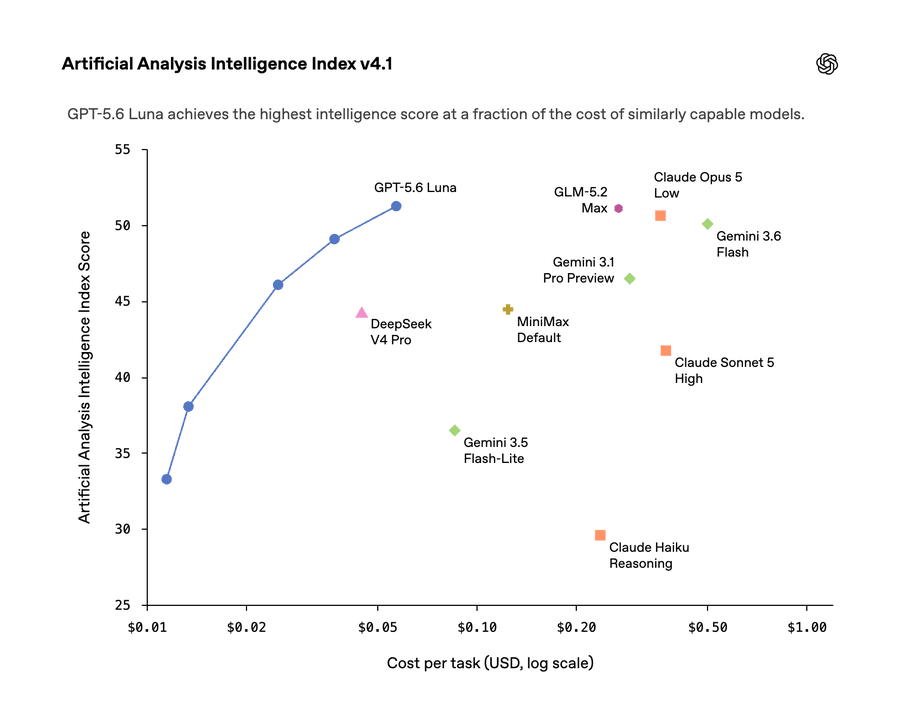
OpenAI’s internal test results, which place Luna at the top of its intelligence index among compared models despite its significantly lower cost per task, are a strong indicator of the value proposition offered by the new pricing structure. This suggests that users can achieve high levels of performance and intelligence at a fraction of the previous cost.
The competitive landscape for AI models is rapidly evolving, with numerous companies offering a variety of LLMs with different capabilities and pricing tiers. OpenAI’s proactive approach to cost optimization and performance enhancement positions it to remain a leading provider in this dynamic market. By making its advanced models more affordable, OpenAI aims to democratize access to cutting-edge AI, enabling a broader range of individuals and organizations to innovate and build new applications.
Broader Implications and Future Outlook
The price reductions and performance enhancements announced by OpenAI have several key implications:
- Increased Adoption: Lower costs are a significant driver for adoption. Businesses that may have been hesitant due to prohibitive pricing are now more likely to explore and integrate GPT-5.6 models into their operations.
- Innovation Acceleration: With reduced operational costs, developers can allocate more resources to innovation and experimentation, leading to the development of novel AI-powered products and services.
- Competitive Pressure: These moves by OpenAI will likely put pressure on other AI providers to re-evaluate their own pricing and performance strategies to remain competitive.
- Democratization of AI: By making advanced AI more accessible, OpenAI is contributing to the broader democratization of artificial intelligence, allowing smaller businesses and individual developers to leverage powerful tools previously only accessible to large corporations.
- Focus on Efficiency: The emphasis on efficiency gains suggests a continued industry-wide focus on optimizing AI models for both performance and sustainability, reducing the computational footprint of AI.
Looking ahead, it is probable that OpenAI will continue to refine its models and pricing strategies. The introduction of specialized processing modes, like the Fast mode for Sol, could become a more common feature, allowing users to tailor their AI experience to specific needs and budgets. The company’s commitment to research and development, coupled with its strategic approach to cost management, suggests a future where advanced AI capabilities become increasingly integrated into everyday life and business operations. The ongoing quest for more efficient and cost-effective AI solutions remains a central theme in the technological advancements of the 21st century.