Sisilia Frederika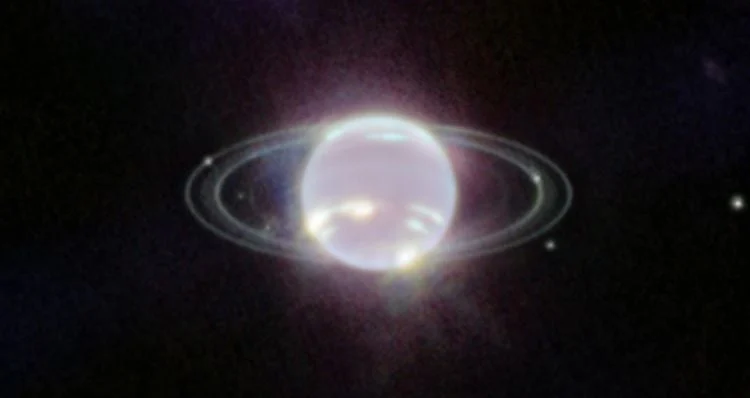
The cosmic history of the eighth planet from the sun has long been defined by a singular act of gravitational theft, but new data from the James Webb Space Telescope (JWST) suggests that the arrival of the moon Triton was even more destructive than previously imagined. A research team led by the California Institute of Technology (Caltech) has provided evidence that Neptune’s current inner moons—Proteus, Larissa, and Galatea—along with its delicate ring system, are not original features of the planet. Instead, they appear to be the "second-generation" debris of a former moon system that was utterly obliterated when Triton, a massive interloper from the Kuiper Belt, was violently captured by Neptune’s gravity billions of years ago.
The study, recently published in the journal Science Advances, utilizes high-resolution infrared spectroscopy to analyze the chemical composition of Neptune’s smaller satellites. The findings indicate a profound lack of water ice on these bodies, a discovery that contradicts the typical composition of objects in the outer solar system. This chemical signature, combined with the presence of magnesium-rich clay minerals, suggests that these moons were once part of the hot, pressurized interiors of much larger, differentiated worlds that were shattered during Triton’s orbital stabilization.
The Triton Interruption: A System-Wide Cataclysm
To understand the current state of Neptune’s environment, astronomers must look back to the early history of the solar system, a period characterized by the migration of giant planets. According to the widely accepted "Nice model" of solar system evolution, the gas and ice giants underwent significant orbital shifts, which sent smaller icy bodies scattering. It was during this chaotic era that Triton, a dwarf planet-sized object originating from the Kuiper Belt, was likely snared by Neptune’s gravity.
Triton is a statistical anomaly in the solar system. It comprises more than 99.5 percent of the total mass orbiting Neptune, leaving a mere 0.5 percent to be shared among the other 15 known moons. Furthermore, Triton orbits Neptune in a retrograde direction—opposite to the planet’s rotation—and at a high inclination. This "backward" orbit is a "smoking gun" for capture, as moons that form in situ from a planet’s proto-satellite disk almost universally orbit in the same direction as the planet’s rotation.
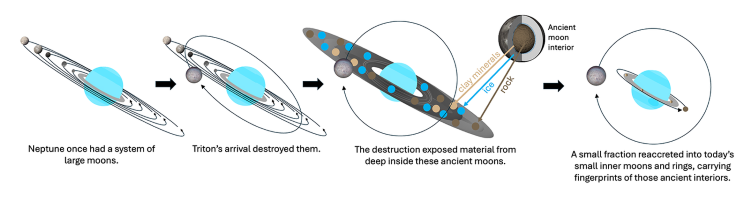
When Triton was first captured, its orbit would have been highly eccentric, or "egg-shaped." As it swung wildly around Neptune, its massive gravity would have acted like a cosmic wrecking ball, crossing the paths of Neptune’s original, prograde moons. Dr. Ryleigh Davis, the lead author of the Caltech study, explains that if Neptune once possessed a stable, satellite system similar to that of Uranus today, the introduction of Triton would have been a death sentence for those original worlds. The resulting gravitational perturbations likely led to high-speed collisions, tearing the original moons into a disk of rubble and dust.
Chemical Fingerprints of a Shattered Past
The breakthrough in this research came via the Near-Infrared Spectrograph (NIRSpec) instrument onboard the James Webb Space Telescope. By observing Neptune’s inner system in wavelengths of light invisible to the human eye, the Caltech-led team was able to identify the mineralogical makeup of the rings and the moons Proteus, Larissa, and Galatea.
Proteus, the largest of the inner moons with a diameter of approximately 420 kilometers (261 miles), was found to have a surface significantly different from what researchers expected. While most objects at such extreme distances from the sun are dominated by surface water ice, the JWST data showed that Proteus, Larissa, and Galatea are largely devoid of it. Instead, Larissa and Galatea, along with the rings themselves, showed clear signatures of phyllosilicates—water-rich clay minerals containing magnesium.
The presence of these clays is highly significant. Clays typically form when liquid water interacts with rock over long periods, a process known as aqueous alteration. For this to occur, the material must have been located inside a body large enough to generate internal heat, such as a large moon or a dwarf planet. The fact that these small, frozen fragments now possess these minerals suggests they were once part of the deep, warm interiors of larger parent bodies that were subsequently pulverized.
"We are essentially looking at the ‘fingerprints’ of a catastrophe," said Dr. Davis. "These small moons aren’t original building blocks; they are the re-accreted remains of a system that was ground to dust. The absence of water ice on their surfaces today suggests that the heat generated during the collisions or the subsequent orbital evolution may have driven off the volatiles, leaving behind the denser, mineral-rich cores."
A Timeline of Discovery: Mapping the Neptunian System
The quest to understand Neptune’s moons has been a multi-generational effort, spanning nearly two centuries of astronomical advancement. The timeline of discovery highlights how our understanding of the planet has shifted from a lonely blue orb to a complex, violent system.
- September 1846: Neptune is discovered by Urbain Le Verrier, John Couch Adams, and Johann Gottfried Galle, based on mathematical predictions.
- October 1846: Just seventeen days after the planet’s discovery, William Lassell discovers Triton, noting its immense size and unusual orbit.
- 1949: Gerard Kuiper discovers Nereid, a small moon with a highly eccentric orbit, further hinting at a disturbed system.
- 1981: Larissa is briefly spotted during a stellar occultation, though its existence remains unconfirmed for several years.
- 1989: NASA’s Voyager 2 spacecraft performs its historic flyby. It confirms the existence of Larissa and discovers five additional moons: Naiad, Thalassa, Despina, Galatea, and Proteus. Voyager 2 also provides the first clear images of Neptune’s "clumpy" ring system.
- 2002–2003: Ground-based surveys using large telescopes identify five more small, irregular moons: Halimede, Sao, Laomedeia, Psamathe, and Neso.
- 2013: The moon Hippocamp is discovered in archival Hubble Space Telescope images, located remarkably close to the larger moon Proteus.
- 2021–2024: Advanced surveys and JWST observations identify S/2021 N 1 and provide the spectral data necessary for the Caltech study, bringing the total moon count to 16.
Comparative Planetology: The Uranian Model
To reconstruct what Neptune’s original moon system might have looked like, researchers often point to its "twin," Uranus. Unlike Neptune, Uranus has not captured a massive Kuiper Belt Object in a retrograde orbit. Consequently, Uranus possesses a "clean" and orderly system of five major moons—Miranda, Ariel, Umbriel, Titania, and Oberon—that orbit in the planet’s equatorial plane.
Astronomers believe that before Triton’s arrival, Neptune likely boasted a similar family of icy worlds. When Triton was captured, its orbital energy had to be dissipated through tidal interactions with these original moons. This process likely forced the original satellites into crossing orbits, leading to a period of "giant impacts" that reduced the original moons to a debris disk. Over millions of years, this debris began to clump together again—a process called accretion—forming the small, oddly shaped inner moons we see today.
The Caltech study notes that Proteus likely formed from a different section of this debris disk than Larissa and Galatea. While Larissa and Galatea share the magnesium-rich clay signature, Proteus does not, indicating that the debris disk was not chemically homogeneous. This suggests that the parent bodies were diverse in composition, perhaps representing a mix of original Neptunian satellites and fragments of other captured objects that did not survive the transition.
Implications for Outer Solar System Evolution
The findings from the JWST data have implications that reach far beyond Neptune. They provide a case study in how the capture of a large body can completely reset a planetary system. This "system-wide reboot" is a phenomenon that may be common in other star systems, particularly those where gas giants have migrated significantly.
Furthermore, the study highlights the power of the James Webb Space Telescope to conduct "archaeology" in our own solar system. By identifying the chemical composition of small, dim objects in the outer reaches, scientists can piece together events that occurred four billion years ago. The presence of phyllosilicates on such small bodies challenges previous models of how moons in the outer solar system maintain their surfaces and suggests that the history of "aqueous alteration" is more widespread than once thought.
The research also raises new questions about the rings of Neptune. Unlike the bright, icy rings of Saturn, Neptune’s rings are dark and dusty. The Caltech team’s conclusion that the rings share a similar origin with the inner moons suggests they are simply the finest particles of the original "great smash-up," prevented from accreting into larger moons by Neptune’s Roche limit—the distance within which a planet’s tidal forces are too strong for a moon to hold itself together by gravity.
Future Exploration and the Search for Answers
As the scientific community digests these findings, the call for a dedicated mission to the Neptunian system is growing louder. While Voyager 2 provided a fleeting glimpse in 1989, and JWST offers powerful remote sensing, a dedicated orbiter—often referred to as a "Neptune Odyssey"—would be required to map the isotopic ratios of these moons and confirm the "second-generation" theory.
Understanding the destruction of Neptune’s original moons provides a vital window into the early solar system’s "Wild West" era. It reminds us that the current stability of our planetary neighborhood is the result of a violent and chaotic past. For now, Proteus, Larissa, and Galatea stand as silent, shattered monuments to the worlds that used to be, before a giant from the Kuiper Belt claimed Neptune for itself.
The Caltech study serves as a reminder that in the field of planetary science, even the smallest moons can tell the biggest stories. As researchers continue to analyze JWST data, the focus remains on the "fingerprints" left behind by cosmic collisions, ensuring that the history of our solar system is never truly lost to time.