Sisilia Frederika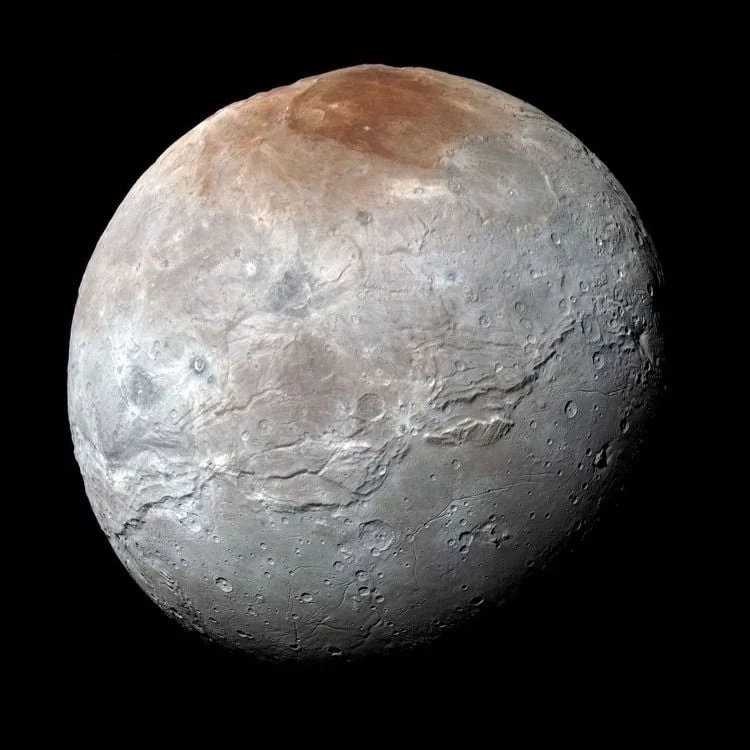
The icy frontier of our solar system has long remained one of the most enigmatic regions for planetary scientists, but new research into Pluto’s largest moon, Charon, is providing unprecedented clarity regarding the formation of outer solar system bodies. A comprehensive study led by researchers from the University of California, Los Angeles (UCLA), recently published in Nature Communications, suggests that Charon’s distinctive surface features are the result of a dramatic "despinning" process that occurred early in its history. By utilizing Charon as a celestial testbed, scientists are gaining critical insights into the thermal and mechanical evolution of icy moons, potentially rewriting the chronological narrative of the Kuiper Belt.
Charon occupies a unique position in the solar system due to its size relative to its parent body. While most moons are significantly smaller than the planets they orbit, Charon possesses half the diameter of Pluto and approximately one-eighth of its mass. This unique ratio creates a binary system dynamic where the two bodies are mutually tidally locked, always facing each other as they orbit a common center of gravity. Despite its significance, Charon remained largely a mystery until NASA’s New Horizons spacecraft conducted its historic flyby in July 2015. The data retrieved during that brief encounter continues to serve as the foundation for modern Plutonian science, allowing researchers to model the moon’s ancient past with high-fidelity simulations.
The Science of Despinning: Decelerating through Time
The central focus of the UCLA study is the hypothesis of "despinning," a process where a planetary body’s rotation slows down over time due to tidal interactions. Since the 1970s, astronomers have theorized that Charon once rotated much faster than it does today. The recent computer modeling conducted by the UCLA team has finally provided quantitative support for this long-standing idea. According to the study, Charon’s initial rotation period may have been as brief as 14.3 hours. In contrast, its current rotation period is approximately 6.4 Earth days (153.3 hours). This represents a tenfold deceleration over its evolutionary lifespan.
This rapid slowing of rotation creates immense centrifugal stresses within a moon’s crust. As the rotation slows, the equatorial bulge that formed during the high-speed phase begins to collapse, leading to global contraction and tectonic fracturing. The researchers applied structural geology techniques—traditionally used to study rock formations on Earth—to the icy shell of Charon. This interdisciplinary approach allowed them to quantify the strain and stress required to produce the specific fault patterns observed by the New Horizons cameras.
The modeling suggests that during this period of intense despinning, Charon’s ice shell was likely between 30 and 36 kilometers (18 to 22 miles) thick. This relatively thin shell, compared to the moon’s overall radius of 606 kilometers, would have been highly susceptible to the tectonic forces generated by the change in rotational velocity. The distribution of these tectonic "provinces" provides a roadmap of the moon’s internal cooling and the eventual solidification of its subsurface.
A Tale of Two Hemispheres: Oz Terra and Vulcan Planitia
One of the most striking revelations from the New Horizons mission was the stark geologic dichotomy between Charon’s northern and southern hemispheres. The northern region, known as Oz Terra, is characterized by rugged, mountainous terrain and deeply fractured canyons. Conversely, the southern region, Vulcan Planitia, is a vast, relatively smooth plain.
The UCLA study specifically targeted Oz Terra to determine if its fractured landscape could be explained by despinning. The simulations indicated that the stresses of deceleration were sufficient to create the massive faults and ridges seen in the north. This finding is significant because it separates the tectonic evolution of the moon from later events, such as cryovolcanism. While Vulcan Planitia is believed to have been resurfaced by "ice volcanoes" or the eruption of a subsurface ammonia-water ocean, the fractures in Oz Terra appear to be older, predating these resurfacing events.
The study notes that the distribution of tectonic provinces on Charon suggests that despinning was accompanied by a period of global contraction. This supports what scientists call a "cold start" for Charon. In a cold-start scenario, the moon formed from the accumulation of icy debris without enough initial heat to completely melt its interior. As the moon’s interior slowly warmed due to radioactive decay and then cooled, the resulting contraction and expansion, combined with the despinning forces, carved the landscape we see today.
Chronology of Discovery and Exploration
The journey to understanding Charon has been one of patience and technological leaps. The moon was discovered on June 22, 1978, by American astronomer James W. Christy at the United States Naval Observatory. While examining highly magnified images of Pluto, Christy noticed a periodic "elongation" or "bump" on the planet’s disk. This discovery was quickly confirmed by the International Astronomical Union, and the moon was named after the ferryman of the dead in Greek mythology—a fitting companion for Pluto, the god of the underworld.
For nearly four decades, Charon remained a blurry speck in even the most powerful telescopes. It was not until the launch of New Horizons in 2006 and its subsequent arrival in the Pluto system in 2015 that Charon was revealed as a world in its own right. The spacecraft’s Long Range Reconnaissance Imager (LORRI) captured high-resolution images of a giant canyon system—Serenity Chasma—which is four times longer than the Grand Canyon and, in some places, twice as deep.
The current study represents the third phase of Charon’s exploration: the analytical phase. By combining 1970s-era hypotheses with 2015-era data and 2024-era computational modeling, researchers are finally closing the loop on the moon’s origins. This timeline underscores the value of long-term data preservation; the information gathered in a few hours of a flyby can fuel scientific breakthroughs for decades.
Broader Implications for the Outer Solar System
The findings regarding Charon have implications that extend far beyond the Pluto system. Charon is now being utilized as a "testbed" for the study of other icy moons orbiting the gas giants. Moons such as Jupiter’s Europa, Saturn’s Enceladus, and Neptune’s Triton share similar compositions of ice and rock. By understanding how despinning and global contraction affected Charon—a body that has remained relatively undisturbed by external gravitational "pumping" compared to Jupiter’s moons—scientists can better isolate the variables that drive planetary evolution.
For instance, the "cold start" model confirmed for Charon provides a baseline for comparing the thermal histories of other Kuiper Belt Objects (KBOs). If other large KBOs show similar tectonic patterns, it may suggest that a "cold start" was the norm for bodies forming at the edge of the solar nebula. Furthermore, the adaptation of terrestrial structural geology to an icy moon environment provides a new toolkit for future missions, such as the upcoming Europa Clipper and the Jupiter Icy Moons Explorer (JUICE).
The UCLA team’s work also sheds light on the potential for ancient subsurface oceans. If despinning occurred early and was followed by cryovolcanic activity, it implies that Charon once held enough internal heat to maintain liquid water (likely mixed with ammonia acting as an antifreeze). While Charon is likely frozen solid today, its surface remains a "fossilized" record of the period when it was a geologically active world.
Future Research and Unanswered Questions
Despite the breakthroughs presented in the UCLA study, many questions remain. The researchers acknowledged that while their work provides a plausible explanation for the tectonic patterns in the northern highlands, further studies are required to achieve a comprehensive understanding of the crust’s thermal-mechanical evolution. Future models will need to account for the specific chemistry of the ice, as the presence of methane, nitrogen, or ammonia can significantly alter the way ice fractures under stress.
There is also the matter of the "Mordor Macula," the mysterious dark red cap at Charon’s north pole. While not the primary focus of the despinning study, the relationship between the moon’s tectonic history and its ability to trap gases from Pluto’s atmosphere remains a subject of intense interest. Scientists believe the red coloring comes from tholins—organic macromolecules produced by the ultraviolet irradiation of methane. How the moon’s rugged northern topography influences the settlement of these materials is a potential avenue for future research.
As the scientific community continues to analyze the New Horizons dataset, the importance of Charon as a window into the past cannot be overstated. It is a world that has preserved the scars of its birth and its subsequent slowing, offering a rare, undisturbed look at the processes that shaped the outer solar system. The transition from a 14-hour day to a 153-hour day was not merely a change in time, but a violent geologic transformation that defined a moon.
In the coming years, as telescopes like the James Webb Space Telescope (JWST) continue to peer into the Kuiper Belt and as new missions are proposed to the ice giants Uranus and Neptune, the lessons learned from Charon will be vital. The study of this "underappreciated" moon has proven that even a quick flyby can change our understanding of the cosmos, provided we have the scientific ingenuity to listen to what the data is telling us. For now, Charon remains a silent, icy sentinel, its fractured surface a testament to a dynamic and turbulent youth.