Sisilia Frederika
For decades, the prevailing scientific consensus regarding Jupiter’s massive magnetosphere—the largest structure in the solar system—was that its equatorial current sheet, or magnetodisk, behaved like a relatively stable, albeit oscillating, celestial record player. However, groundbreaking research led by an international team from Shandong University, utilizing data from NASA’s Juno spacecraft, has fundamentally overturned this model. The study, published in the prestigious journal Science China Earth Sciences, demonstrates that Jupiter’s magnetodisk is not a smooth, uniform disk but a highly dynamic, "crumpled" environment characterized by wave-like ripples and complex magnetic disturbances. This discovery marks a significant leap in our understanding of how gas giants interact with their moons and the plasma environments they create, suggesting that the Jovian magnetosphere is far more chaotic and energetic than previously imagined.
The Jovian Magnetodisk: A Legacy of Volcanism and Rotation
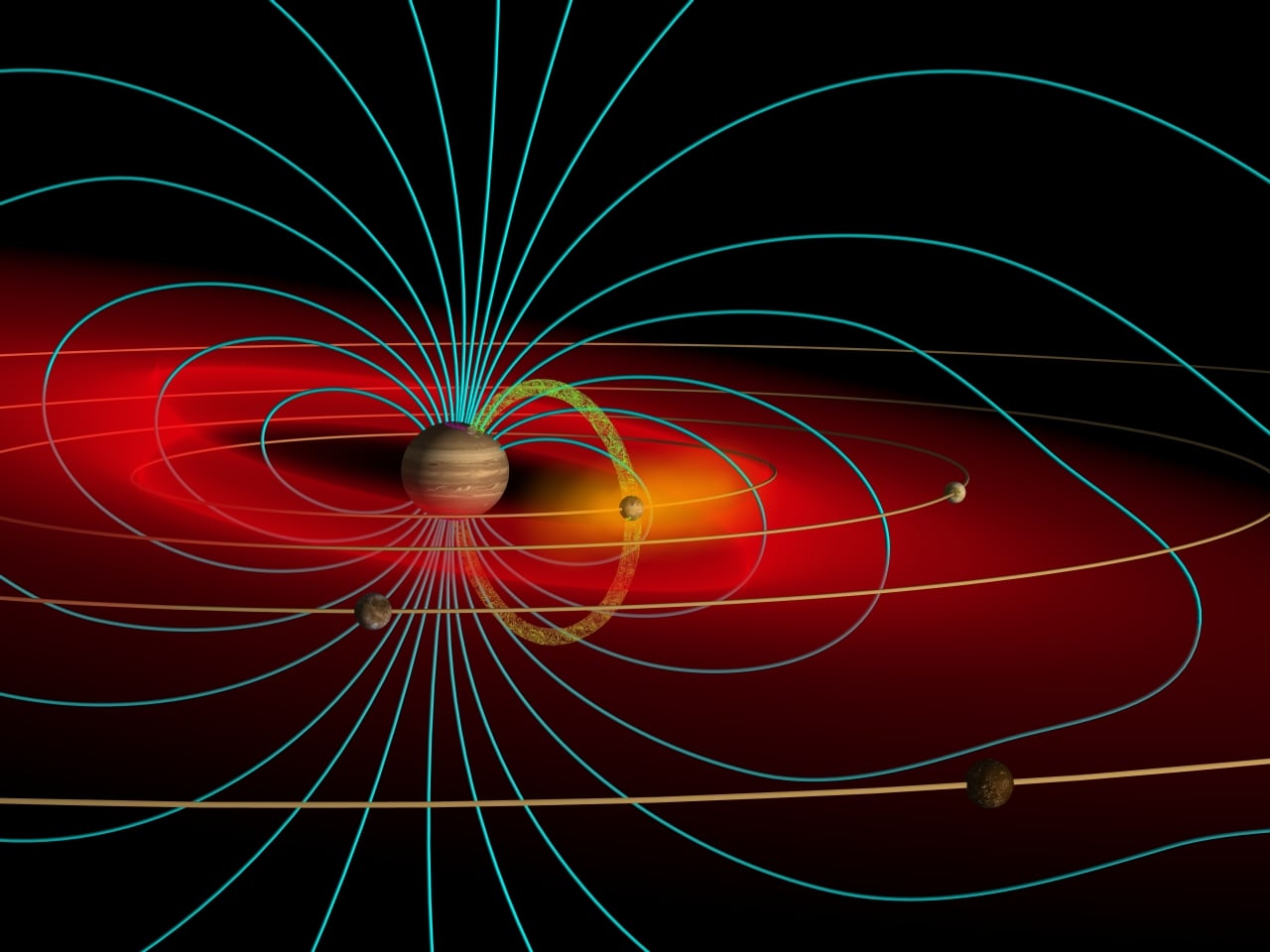
To understand the significance of the "crumpling" discovery, one must first look at the unique mechanics of the Jovian system. Unlike Earth’s magnetosphere, which is primarily shaped by the solar wind, Jupiter’s magnetosphere is internally driven. The primary engine for this system is the moon Io, the most volcanically active body in the solar system. Io constantly spews sulfur dioxide and other volcanic materials into space at a rate of approximately one ton per second. This material becomes ionized, forming a dense ring of plasma known as the Io Plasma Torus.
Because Jupiter rotates at an incredible speed—completing a full revolution in just under 10 hours—the planet’s powerful magnetic field catches this plasma and flings it outward via centrifugal force. This process stretches the magnetic field lines away from the planet, creating a flattened, disk-like structure known as the magnetodisk. This magnetodisk contains a "current sheet," a thin layer where the magnetic field reverses direction and where the bulk of the plasma resides. Historically, scientists used the "pancake" model to describe this: a smooth sheet that wobbled up and down relative to the spacecraft as the planet’s magnetic tilt rotated, much like a spinning, slightly off-center coin.
Analyzing the Juno Mission Data: From Smoothness to Turbulence
The Juno probe, which arrived at Jupiter in July 2016, was designed specifically to probe these deep mysteries. While previous missions like Galileo provided a foundational understanding, Juno’s polar orbit and advanced suite of Magnetometer (MAG) and Jovian Auroral Distributions Experiment (JADE) instruments have provided unprecedented resolution.
The research team, led by scientists at Shandong University, analyzed multiple orbits where Juno crossed the magnetodisk. Under the traditional model, a spacecraft in a stable orbit would be expected to cross the current sheet twice per Jovian rotation (every 9.9 hours) as the "wobble" passed through the probe’s position. However, the data revealed a much more complex reality. During periods of high magnetic activity, Juno detected "repeated crossings" of the current sheet in rapid succession.
These signatures were accompanied by intense bursts of energized electrons and ions. By calculating the orientation and timing of these crossings, the researchers determined that the current sheet was not simply rising and falling in a predictable manner. Instead, it was vibrating with ripples that lasted anywhere from a few minutes to over an hour. The sheet was essentially "crumpling" into a wave-like structure, a phenomenon driven by localized magnetic reconnection events.
The Mechanism of Magnetic Reconnection
Magnetic reconnection is a fundamental process in plasma physics where magnetic field lines from different domains collide, break, and reconfigure, releasing vast amounts of stored magnetic energy into kinetic and thermal energy. On Earth, this process occurs primarily in the "magnetotail" (the part of the magnetosphere stretched away from the sun) and is the primary driver of the aurora borealis.
The Shandong University study reveals that in Jupiter’s magnetodisk, small-scale reconnection sites are ubiquitous, spanning as much as 100 degrees of longitude. These reconnection events act as "pinches" or disruptions that break the magnetic field lines within the disk. When these lines break and snap back, they push the plasma and the current sheet away from their equilibrium positions.
Because Jupiter is rotating so rapidly, these disruptions do not remain localized. Instead, the entire rippled structure is carried around the planet at high velocities. This creates a "kink wave" effect. Unlike Earth, where these waves typically move away from the reconnection site in a linear fashion, the Jovian waves are integrated into the rotation of the magnetodisk itself, leading to a complex, rotating, rippled surface that Juno must navigate.
Chronology of Jovian Magnetospheric Exploration
The path to this discovery has been paved by over 50 years of robotic exploration:
- 1955: Astronomers first detect radio bursts from Jupiter, providing the first hint of its powerful magnetic field.
- 1973–1974: Pioneers 10 and 11 perform the first flybys, confirming the existence of a massive magnetosphere and the presence of a flattened plasma disk.
- 1979: Voyagers 1 and 2 discover Io’s volcanoes and the plasma torus, identifying the source of the magnetodisk’s material.
- 1995–2003: The Galileo mission provides the first long-term study of the Jovian system, observing the magnetosphere from within. Galileo noted some "flapping" of the current sheet but lacked the temporal resolution to define the wave-like crumpling.
- 2011–2016: NASA’s Juno mission is launched and arrives at Jupiter, beginning its primary mission to map the gravity and magnetic fields.
- 2021–Present: Juno enters its extended mission phase. With its orbit gradually shifting, the probe has been able to spend more time in the regions where the magnetodisk is most active, leading directly to the Shandong University findings.
Supporting Data and Technical Findings
The study’s conclusions are supported by a rigorous analysis of Juno’s magnetic field vectors. When Juno crosses a stable current sheet, the radial component of the magnetic field typically flips sign cleanly. However, the Shandong team observed "tri-polar" and "quad-polar" signatures, indicating that the sheet was folding back on itself or undulating so rapidly that the spacecraft was passing through multiple layers of the same wave.
Furthermore, the team measured the plasma pressure and found that during these reconnection events, the plasma beta (the ratio of plasma pressure to magnetic pressure) fluctuated wildly. This suggests that the "crumpling" is not just a geometric change but a fundamental shift in the energy balance of the region. The energetic particle bursts detected—specifically electrons accelerated to hundreds of kilo-electron volts (keV)—provide a direct link between the physical "crumpling" of the sheet and the acceleration of particles that eventually contribute to Jupiter’s powerful X-ray and ultraviolet auroras.
Broader Implications for Planetary Science
The discovery that the magnetodisk is a rippled, dynamic environment has profound implications for our understanding of the Jovian system’s "global circuit."
1. Particle Transport and Io’s Legacy
The volcanic particles from Io must travel from the inner magnetosphere to the outer edges before they are eventually lost to space or recycled. A "crumpled" magnetodisk provides a much more efficient mechanism for transporting these particles than a smooth disk. The ripples and reconnection sites act as "turbulent mixers," accelerating the diffusion of sulfur and oxygen ions throughout the system.
2. Ionosphere-Magnetosphere Coupling
Jupiter’s ionosphere (its upper atmosphere) is connected to the magnetodisk via magnetic field lines. This connection creates a giant electrical circuit. If the magnetodisk is rippling and crumpling, it sends "Alfven waves" (magnetic waves) back down the field lines to the planet. This likely explains the highly structured and flickering nature of Jupiter’s polar auroras, which have long puzzled scientists with their complexity compared to Earth’s more uniform auroral ovals.
3. Comparison with Earth and Saturn
This research highlights the uniqueness of Jupiter. While Earth’s magnetosphere is a "closed" system dominated by external solar pressure, and Saturn’s is a hybrid system with a weaker plasma source (Enceladus), Jupiter is an "open" powerhouse of internal rotation. The findings suggest that any rapidly rotating planet with an internal plasma source—including many exoplanets—likely possesses a crumpled magnetodisk rather than a smooth one.
Scientific Reactions and the Future of the Mission
While NASA has not issued a formal "press release" response to the Shandong study, members of the Juno science team have long noted the "noisy" nature of the magnetospheric data. This study provides the theoretical and analytical framework to turn that "noise" into a breakthrough discovery. Dr. Scott Bolton, Juno’s Principal Investigator (not directly involved in this specific study), has frequently emphasized that Juno’s mission is to "rewrite the textbooks on Jupiter," and this finding does exactly that.
The international community sees this as a crucial step in preparing for future missions. The European Space Agency’s (ESA) JUICE (JUpiter ICy moons Explorer) and NASA’s Europa Clipper are both currently en route to the Jovian system. Understanding the turbulence and "crumpling" of the magnetodisk is vital for these missions, as their trajectories will take them through these high-energy zones. Knowing that the environment is more dynamic than once thought allows engineers to better predict the radiation and plasma environments their spacecraft will encounter.
Juno’s extended mission is currently scheduled to continue until September 2028, or until the spacecraft succumbs to the intense radiation environment. As its orbit continues to evolve, it will provide even more "slices" through the magnetodisk at different latitudes and longitudes. Scientists expect that as Juno moves closer to the planet’s poles and different segments of the current sheet, they will be able to map the "crumpling" in three dimensions, finally providing a complete map of the most volatile and massive magnetic structure in our planetary neighborhood.