Sisilia Frederika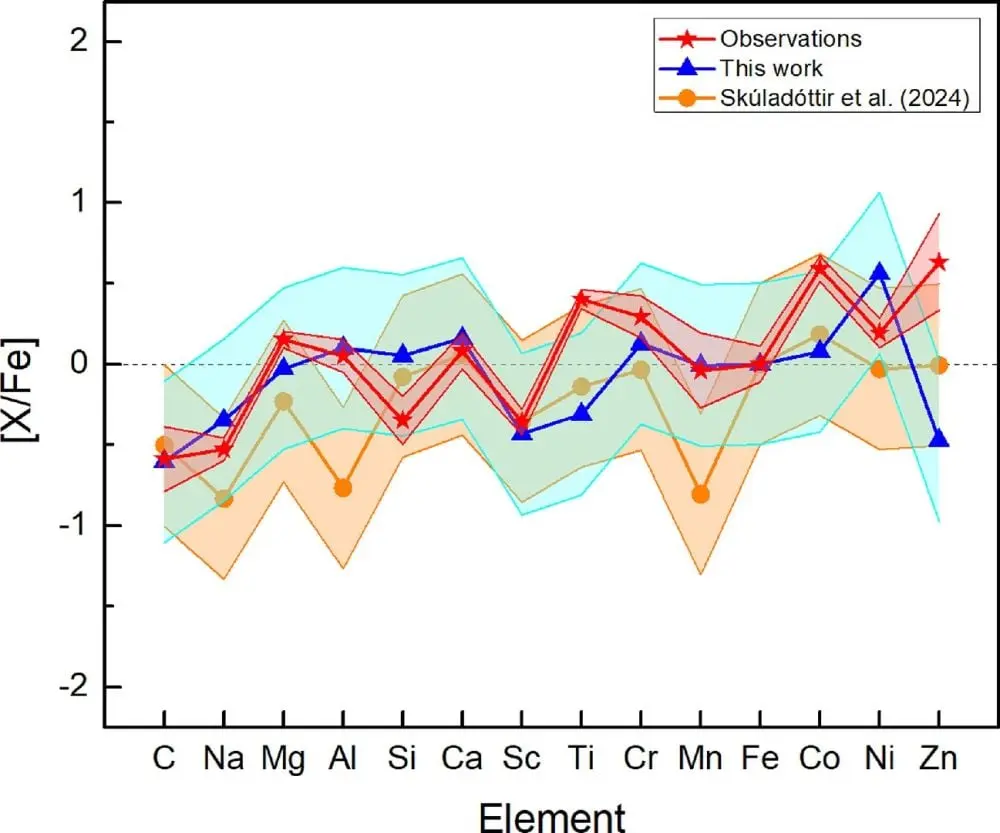
The scientific consensus regarding the most violent explosions in the cosmos has been upended by a new study suggesting that "hypernovae"—ultra-luminous, high-energy events previously thought to mark the deaths of massive stars—may not exist at all. For decades, astrophysicists have relied on the hypernova hypothesis to explain the unique chemical signatures of some of the oldest stars in the Milky Way and its neighboring galaxies. However, research led by Anmol Aggarwal and Ralph Schönrich of the Mullard Space Science Laboratory at University College London (UCL) indicates that these "fossil stars" were likely forged by much more common, less energetic phenomena. By accounting for the uneven way material is ejected during a standard supernova, the researchers found that the evidence for hypernovae effectively evaporates.
The Anatomy of Stellar Death and the Hypernova Hypothesis
To understand the magnitude of this shift, one must first look at the standard lifecycle of massive stars. Stars significantly larger than our Sun—typically those with at least eight times its mass—conclude their lives in core-collapse supernovae (CCSNe). As these stars exhaust their nuclear fuel, they can no longer support their own gravity. The core collapses into a neutron star or a black hole, triggering a shockwave that blows the outer layers of the star into space. These events are responsible for roughly 70% of all supernovae observed in the universe.
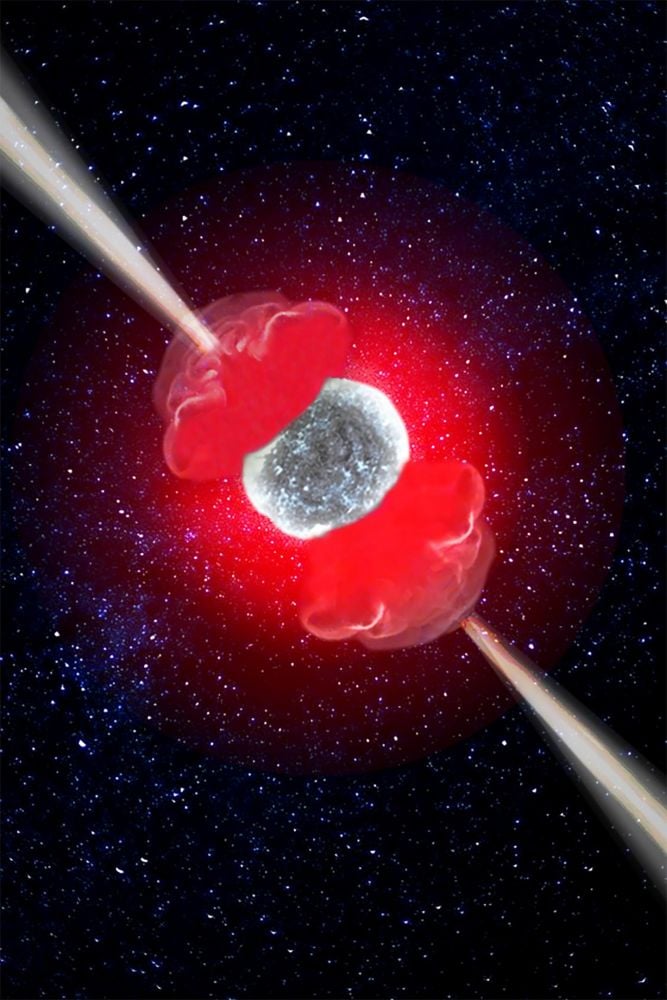
Within this category, the hypernova (HN) was categorized as the "extreme" outlier. Theoretically occurring only in stars with more than 30 solar masses, a hypernova was defined by an explosion energy of approximately $10^52$ ergs—ten times the kinetic energy of a standard core-collapse supernova ($10^51$ ergs). These events were thought to be so luminous and powerful that they could be seen across vast reaches of the observable universe. More importantly, they were believed to be the primary engines for creating specific ratios of "astronomical metals"—elements heavier than hydrogen and helium—that then seeded the next generation of stars.
The evidence for hypernovae has always been indirect. Because these explosions are rare, astronomers looked for their "fingerprints" in metal-poor stars. These stars, found in the Milky Way’s halo and in satellite galaxies like the Sculptor dwarf spheroidal galaxy, are considered cosmic fossils. Formed shortly after the Big Bang, they contain very few heavy elements. If a metal-poor star showed a strange chemical composition that didn’t match the predicted output of a normal supernova, scientists assumed it must have been "polluted" by a hypernova.
The Flaw of Uniform Mixing
The cornerstone of the UCL research, published in two separate papers in the Monthly Notices of the Royal Astronomical Society, is the challenge to a long-held assumption in stellar modeling: the "uniform mixing" hypothesis. For years, when astronomers compared the chemical abundances of metal-poor stars to theoretical models, they assumed that the material ejected from a supernova mixed perfectly and evenly with the surrounding interstellar gas before a new star formed.
"If we look at a supernova today, the star’s materials are not spread evenly," explained Anmol Aggarwal in a statement accompanying the research. "Oxygen might predominantly fly in one direction, sulphur in another. New stars might form from a mix of pieces of the supernova, not its overall mix of elements."
By developing new mathematical models that account for "mixing stochasticity"—the random, uneven distribution of elements during an explosion—Aggarwal and his team found that the "unusual" chemical ratios previously attributed to hypernovae could be perfectly explained by standard, lower-energy supernovae. The study suggests that the metal-poor stars in the Milky Way’s halo did not inherit a perfectly blended "soup" of hypernova debris; instead, they formed from specific "clumps" of ejecta from ordinary stellar deaths.
Deconstructing the Evidence: A Two-Part Analysis
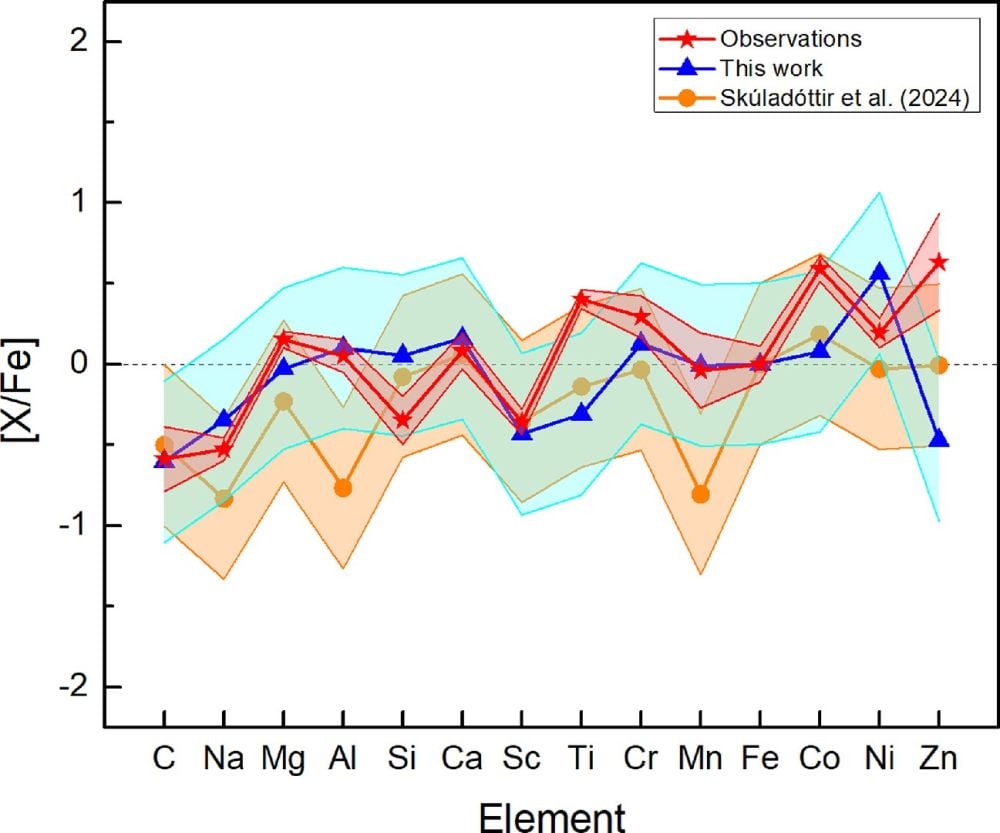
The researchers divided their investigation into two papers to address different types of "hypernova evidence." The first paper re-examined three specific stars, including one in the Sculptor dwarf galaxy, that were previously cited as the strongest proof of hypernova existence. These stars were noted for having abnormal ratios of elements like zinc and manganese.
Previous models suggested that only a high-energy $10^52$ erg explosion could produce the yields observed in these stars. However, the UCL team’s re-analysis showed that when the models allowed for inhomogeneous distribution—meaning different layers of the progenitor star were ejected with different efficiencies—the "standard" $10^51$ erg supernova provided a much tighter fit to the observational data.
The second paper focused on a particularly enigmatic red giant star in the Milky Way’s halo. This star possesses a chemical makeup that includes heavy "r-process" elements like silver and uranium. Because standard supernovae struggle to produce these elements in large quantities, previous researchers argued that a "magnetorotational hypernova"—a hypernova driven by intense magnetic fields—was the only possible source.
Furthermore, earlier studies argued against a neutron star merger (NSM) as the source. In standard models of the Milky Way’s history, the interstellar medium was thought to have been enriched with metals so quickly that there wouldn’t have been enough time for two neutron stars to form and collide before this metal-poor red giant was born.
The UCL team countered this by analyzing the star’s trajectory. They discovered that the red giant is traveling at an extremely high velocity and in a "retrograde" motion, meaning it orbits the center of the galaxy in the opposite direction of most other stars. This suggests the star did not originate in the Milky Way at all. Instead, it likely formed in a small dwarf galaxy that was later swallowed by the Milky Way. In such low-mass environments, star formation happens much more slowly, providing ample time for neutron star mergers to occur and enrich the gas. The UCL model showed that a combination of a standard supernova and a neutron star merger explained the red giant’s chemistry far better than a hypernova model.
Chronology of the Hypernova Debate
The concept of the hypernova gained prominence in the late 1990s, particularly following the observation of SN 1998bw, which was associated with a gamma-ray burst (GRB). For nearly three decades, the link between GRBs and hyper-energetic supernovae solidified the hypernova as a staple of astrophysical theory.
However, the "missing link" has always been the chemical record. While we see bright explosions today, the long-term chemical evolution of the galaxy has been harder to reconcile. By 2010, several surveys of metal-poor stars began flagging "outliers" that didn’t fit core-collapse models. By 2020, the hypernova had become the "default" explanation for any star that looked chemically "weird."
The 2026 papers from Aggarwal and Schönrich represent a critical pivot point in this timeline. By applying more sophisticated fluid dynamics and stochastic modeling to the problem, they have effectively moved the goalposts. If the "fossil record" of hypernovae in ancient stars can be explained by ordinary means, then the physical necessity for hypernovae in the early universe diminishes significantly.
Broader Implications for Galactic Evolution
The disappearance of the hypernova from the "menu" of stellar deaths has profound implications for how we understand the early universe. Metal-poor stars are the closest thing astronomers have to a direct window into the "Cosmic Dawn"—the era when the first stars (Population III stars) began to shine.
If hypernovae are not responsible for the chemical enrichment of these stars, then the "First Stars" may have been less massive or their explosions less energetic than previously hypothesized. This changes our calculations for how much light and heat were pumped into the early universe, affecting our models of "reionization"—the process that made the universe transparent to light.
Furthermore, the research emphasizes the importance of "incomplete mixing" in galactic chemical evolution (GCE). For decades, GCE models have treated galaxies like "well-stirred pots." The UCL study proves that the "pot" is actually quite lumpy. This will require a complete overhaul of how we track the history of elements like carbon, oxygen, and iron across billions of years.
Conclusion: The Scientific Method in Action
The work of Aggarwal and Schönrich serves as a reminder of the self-correcting nature of science. The hypernova was a convenient and exciting explanation for a complex problem, but as mathematical tools have become more refined, the "exotic" has given way to the "ordinary."
"We still don’t know how well the supernova material gets mixed before it forms new stars," Ralph Schönrich noted. "Our research suggests some mixing goes on, but incomplete mixing."
While the researchers do not entirely rule out the possibility of extremely energetic events, they have successfully demonstrated that such events are no longer required to explain the observed universe. The burden of proof has now shifted back to those who argue for the hypernova’s existence. For now, the most powerful explosions in the universe appear to have been replaced by the subtle, messy reality of standard stellar deaths and the slow, complex merging of galaxies.