Sonny Valindra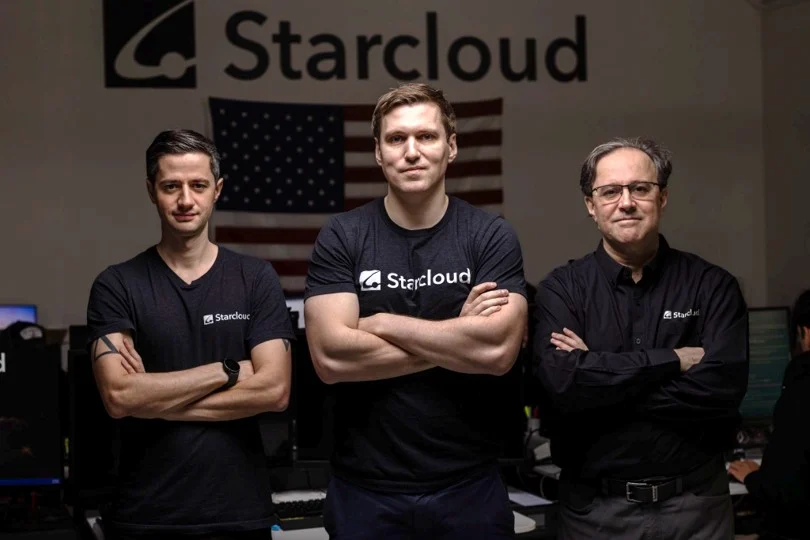
Starcloud, a pioneering startup focused on developing satellites capable of performing artificial intelligence (AI) inference directly in orbit, has announced a significant $250 million extension to its Series A funding round, bringing the total capital raised in this round to an impressive $420 million and valuing the company at $2.3 billion. This substantial financial infusion, originally announced with a $170 million Series A in March, underscores growing investor confidence in Starcloud’s ambitious vision to establish a distributed network of orbital data centers.
The newly secured capital is earmarked for aggressive expansion, including the establishment of a larger manufacturing facility. Crucially, it will accelerate the development of Starcloud’s flagship orbital data center spacecraft, the Starcloud-3. This advanced platform is designed to leverage the capabilities of SpaceX’s forthcoming Starship rocket, a move that highlights Starcloud’s strategic alignment with next-generation launch technologies.
Strategic Capitalization Amidst Launch Market Constraints
CEO Philip Johnston articulated a clear strategic imperative behind this aggressive fundraising: proactively securing launch capacity in an increasingly constrained market. Johnston expressed foresight regarding the escalating demand for space transportation, stating, "We can see what’s coming – we’re going to need to book an enormous amount of launch." This proactive approach is exemplified by Starcloud’s filing with the Federal Communications Commission (FCC) for permission to operate an astonishing 88,000 spacecraft. This number suggests a long-term vision for a vast constellation of orbital processing units.
"As soon as we can, we want to get under contract with things like Starship," Johnston emphasized. "One of the biggest costs is now on securing your launch capacity… launch is pretty constrained right now because [SpaceX’s] Falcon 9 program is scheduled to end in 2028." This statement points to a critical juncture in the commercial space industry, where the phasing out of established launch vehicles necessitates a pivot to newer, albeit less proven, systems.
Launch costs have consistently been identified as one of the most significant hurdles for orbital data center startups. The sheer expense and limited availability of launch services have prompted some companies, such as Cowboy Space, to pursue vertical integration by developing their own rocket capabilities after raising $275 million. Starcloud’s strategy, however, focuses on securing partnerships and pre-emptively booking capacity with major launch providers.
Navigating a Shifting Launch Landscape
The commercial space launch market is undergoing a period of significant transition. SpaceX, the dominant player with its reliable Falcon 9 rocket, is preparing to retire the vehicle in 2028. This transition to the larger, more powerful, but still under development, Starship rocket presents both an opportunity and a challenge for satellite operators. While Starship promises a dramatic reduction in per-kilogram launch costs and significantly increased payload capacity, its operational readiness and flight cadence remain subject to ongoing testing and development.
Adding to the complexity, competing next-generation launch vehicles are not yet flying with the regularity needed to meet projected demand. Blue Origin’s New Glenn and United Launch Alliance’s (ULA) Vulcan Centaur rockets are still in their early stages of operation. Similarly, new entrants like Rocket Lab’s Neutron are yet to make their inaugural flights. This dynamic environment makes long-term launch planning a critical, and indeed challenging, endeavor for companies like Starcloud that require frequent and substantial access to space.
Near-Term Deployments and Future Ambitions
Despite the focus on Starship, Starcloud’s immediate deployment plans involve two of its new generation of 8 kW compute satellites, designated Starcloud-2. These satellites are slated for launch on rideshare missions in 2027. Their primary function will be to perform orbital inference tasks for a range of customers, including U.S. government agencies. This initial deployment is crucial for validating Starcloud’s technology and operational model in a real-world orbital environment.
To support its growing fleet and future missions, Starcloud is actively exploring various launch acquisition strategies. This includes considering a dedicated Falcon 9 launch for a larger payload of spacecraft and signing contracts with multiple launch providers to diversify its access to space. This multi-pronged approach aims to mitigate the risks associated with reliance on any single launch vehicle or provider.
Ultimately, Starcloud’s long-term vision is intrinsically tied to the success of SpaceX’s Starship. The company believes that Starship’s ability to significantly reduce launch costs and increase payload capacity is the key enabler for building an orbital inference layer that can economically compete with terrestrial data centers. CEO Philip Johnston has expressed consistent confidence in SpaceX’s trajectory, particularly regarding the rapid and frequent reuse of its most powerful rocket.
Recent statements from SpaceX CEO Elon Musk indicate that the company is refining its Starship reusability strategy. A planned attempt to catch a returning Starship rocket has been postponed for several months, with the first vehicle re-flight anticipated by the end of the year or early 2027. While this represents a slight delay in a key technological demonstration, Johnston remains optimistic about the overarching progress. "Obviously if we can’t book any SpaceX launch capacity in 2029, that will be challenging for us," he acknowledged, underscoring the critical need for predictable and accessible launch services in the coming years.
Key Investor Support and Technological Edge
The $250 million funding extension was spearheaded by Manhattan West Ventures, with significant participation from industry giants Nvidia and Cisco. A source close to the deal revealed that Nvidia alone contributed $25 million, signaling strong strategic alignment. Other notable investors in this round include Benchmark, EQT, Soma, NFX, 776, Cedar Capital, Goanna Capital, and Standard Capital.
The investment from Nvidia is particularly noteworthy and serves as a powerful endorsement of Starcloud’s technological prowess. Starcloud claims to be the sole entity currently operating a Nvidia H100 terrestrial data center GPU in orbit and is the first to have trained an AI model using this powerful hardware in space. This distinguishes Starcloud from most other space GPU providers, which typically focus on edge processing capabilities rather than full-fledged data center-grade AI inference.
Starcloud is actively sharing its operational data and learnings from its orbital GPU deployments with Nvidia. This collaboration is instrumental in the chipmaker’s development of its first purpose-built GPU for space, the Vera Rubin Space-1 chip. "The reason they’ve chosen to do this investment now is because of all of this data that we got from Starcloud One," Johnston explained. "They, more than any other VC, did way more technical duty on this than anybody else." This deep technical due diligence highlights the unique value Starcloud brings to the nascent space compute sector.
Developing Next-Generation Space Compute Hardware
While the Nvidia Vera Rubin Space-1 chip is still in its design phase, Starcloud aims to deploy it into orbit by late 2028. The company’s engineers are meticulously addressing key design challenges inherent in space-based computing. These include optimizing the relationship between chip operating temperatures and the size of necessary radiators for heat dissipation, meticulously planning radiation shielding to protect sensitive components, and developing robust ruggedization techniques to ensure the chips can withstand the extreme forces experienced during rocket launches.
Operational Expansion and Industry Proximity
Starcloud, currently a team of 25 employees, is in the process of scaling its operations. The company is establishing production lines at a new 100,000-square-foot facility located in Woodinville, Washington. This strategic location places Starcloud in close proximity to other major players in the aerospace industry, including SpaceX and Amazon, which also operate satellite manufacturing facilities in the region. This geographical advantage can foster collaboration, facilitate supply chain efficiencies, and provide access to a skilled aerospace workforce.
The company’s trajectory, marked by substantial funding and strategic partnerships, positions it as a key contender in the rapidly evolving field of orbital AI and space-based computing. As the demand for in-space data processing grows, driven by applications in Earth observation, telecommunications, and national security, Starcloud’s ability to deliver high-performance computing directly from orbit could revolutionize how data is processed and utilized, creating a new paradigm for the space economy. The successful development and deployment of its orbital data centers, coupled with reliable access to launch, will be critical determinants of its future success.