Sisilia Frederika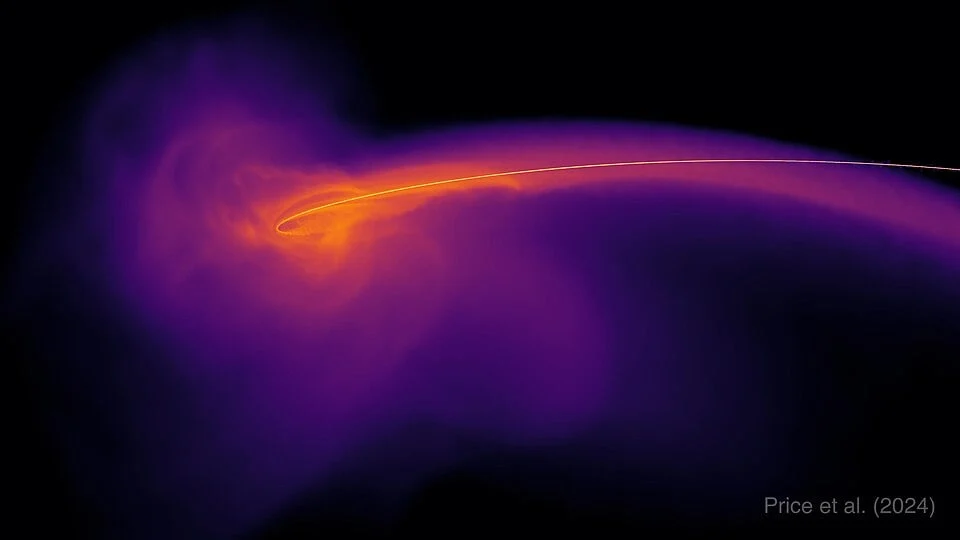
The cosmos is often characterized by its vast, silent stretches of emptiness, yet within these voids, cataclysmic events occasionally unfold that challenge our fundamental understanding of galactic architecture. In a groundbreaking discovery, a team of astrophysicists from the University of North Carolina at Chapel Hill (UNC-Chapel Hill) has identified a rare "tidal disruption event" (TDE) occurring far from the traditional hunting grounds of the galactic center. This event, cataloged as TDE 2025abcr, represents a significant milestone in observational astronomy, as it provides the first optical evidence of a supermassive black hole operating in the "off-nuclear" outskirts of a host galaxy. This discovery not only confirms the existence of "wandering" black holes but also suggests that the population of these invisible giants may be far larger and more widely distributed than previously estimated.
The Mechanics of Spaghettification: A Stellar Demise
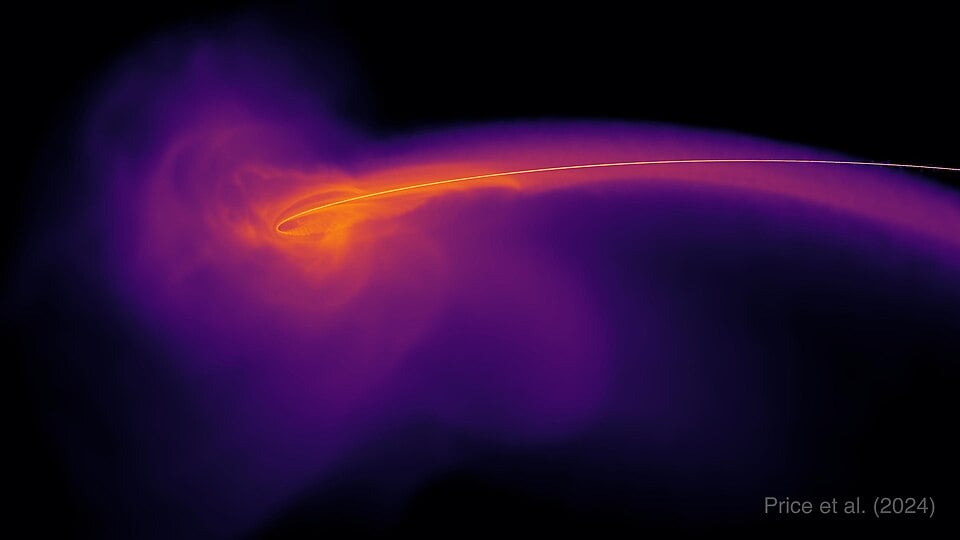
A tidal disruption event is one of the most violent phenomena in the known universe. It occurs when a star wanders too close to the event horizon of a supermassive black hole. As the star approaches, it crosses a theoretical boundary known as the tidal radius. At this point, the gravitational pull on the side of the star nearest to the black hole becomes significantly stronger than the pull on the far side. This immense differential in gravitational force—known as tidal force—eventually overcomes the star’s own self-gravity, which holds its gases together.
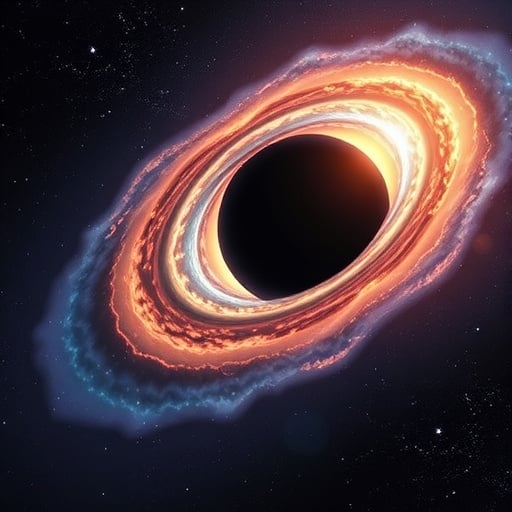
The result is a process colloquially and scientifically referred to as "spaghettification." The star is not simply swallowed whole; rather, it is stretched and elongated into a thin, strand-like stream of stellar debris. Approximately half of the star’s mass is ejected away from the system at high velocities, while the remaining half is captured by the black hole’s gravity. This captured material begins to orbit the black hole, forming a rapidly rotating accretion disk. Within this disk, internal friction and intense magnetic fields heat the gas to millions of degrees, causing it to emit a brilliant flare of electromagnetic radiation. These flares can outshine the combined light of all the stars in the host galaxy for weeks or months, providing astronomers with a brief window to study an otherwise invisible object.
While TDEs are spectacular, they are exceedingly rare. Statistical models suggest that a typical galaxy might experience such an event only once every 10,000 to 100,000 years. Because of this rarity, most historical searches for TDEs have focused exclusively on the dense cores of galaxies, where the concentration of stars and the presence of a central supermassive black hole make the likelihood of a collision highest.
The Discovery of TDE 2025abcr: A Paradigm Shift in Observation
The identification of TDE 2025abcr began not with a telescope, but with an algorithm. Akash Anumarlapudi, a researcher at UNC-Chapel Hill, utilized an advanced artificial intelligence (AI) classification program designed to sift through massive amounts of astronomical data. Unlike traditional software, which is programmed to look for flares specifically in galactic nuclei, this AI was adapted to identify TDE signatures regardless of their location within a galaxy.
By removing the "nuclear bias"—the assumption that supermassive black holes only exist at the center of galaxies—the team was able to flag TDE 2025abcr as a candidate for further study. Once the AI identified the flare, the team secured observation time on the Southern Astrophysical Research (SOAR) Telescope. Located on the summit of Cerro Pachón in the Chilean Andes, the 4.1-meter SOAR telescope is uniquely equipped to provide high-resolution optical data of transient events in the southern sky.
The subsequent observations revealed a startling reality: the event was occurring approximately 30,000 light-years away from the center of its host galaxy. To put this into perspective, our own Sun is situated roughly 26,000 light-years from the Milky Way’s center, nestled in the Orion Arm. TDE 2025abcr occurred in a region of its galaxy comparable to our own solar neighborhood—a place where supermassive black holes are traditionally not expected to reside.
Technical Data and Astrophysical Implications
The data gathered by the UNC-Chapel Hill team, led by astrophysics PhD student Jonathan Carney, provides a detailed profile of both the event and the invisible predator behind it. The black hole responsible for TDE 2025abcr is estimated to possess a mass approximately one million times that of our Sun. While this is smaller than the four-million-solar-mass black hole at the center of the Milky Way (Sagittarius A*), it is still classified as a supermassive black hole.
The location of this event, referred to as an "off-nuclear" or "offset" TDE, raises profound questions about galactic evolution. According to the study, TDE 2025abcr is the most offset optical tidal disruption event ever recorded. "Almost every tidal disruption event we’ve ever observed has occurred at the center of a galaxy," Carney noted in a statement. The discovery of a million-solar-mass object tens of thousands of light-years from the core suggests the presence of a "wandering" black hole.
There are several theoretical frameworks that explain how a supermassive black hole might end up in the galactic suburbs:
- Galaxy Mergers: When two galaxies collide and eventually merge, their respective central black holes begin a complex gravitational dance. If the merger is asymmetrical, or if a third black hole is involved, gravitational interactions can "kick" one of the black holes out of the center.
- Gravitational Wave Recoil: During the final stages of a black hole merger, the emission of gravitational waves can be anisotropic (stronger in one direction). This creates a recoil effect, similar to the kickback of a fired gun, which can propel the resulting merged black hole out of the galactic nucleus at speeds of hundreds or even thousands of kilometers per second.
- Dwarf Galaxy Accretion: Large galaxies often grow by consuming smaller dwarf galaxies. If the dwarf galaxy had its own intermediate or supermassive black hole, that black hole might remain in the outskirts of the larger host galaxy long after the dwarf galaxy itself has been shredded and absorbed.
The Role of Multi-Wavelength Astronomy
While the discovery of TDE 2025abcr was made primarily through optical observations, the scientific community emphasizes the importance of multi-wavelength data in understanding these events. Historically, TDEs have been detected using X-ray telescopes, which capture the high-energy radiation from the innermost part of the accretion disk, and radio telescopes, which detect the synchrotron radiation produced when a relativistic jet of material is launched from the black hole’s poles.
The fact that TDE 2025abcr was visible in the optical spectrum is particularly significant. Optical light is often easier to monitor over long periods from ground-based observatories like SOAR. The light curve—the graph of how the event’s brightness changes over time—allows astronomers to calculate the mass of the black hole and the type of star that was destroyed. In this case, the sheer luminosity of the flare provided the necessary evidence to confirm that the object was indeed a supermassive black hole rather than a smaller, stellar-mass black hole or a supernova.
Future Outlook: The Era of the Vera C. Rubin Observatory
The discovery of TDE 2025abcr is viewed by many in the astronomical community as a "proof of concept" for the future of sky surveys. For decades, wandering black holes were purely theoretical constructs, nearly impossible to find because they do not emit light unless they are actively feeding. TDEs act as a "cosmic flare," momentarily illuminating these dark giants.
The upcoming Vera C. Rubin Observatory, currently under construction in Chile, is expected to revolutionize this field. The Rubin Observatory will conduct the Legacy Survey of Space and Time (LSST), a ten-year mission to photograph the entire available sky every few nights. This high-frequency "movie" of the universe will likely detect thousands of TDEs every year.
By applying the AI classification techniques developed by the UNC-Chapel Hill team to the massive data stream from the Rubin Observatory, astronomers hope to map the population of wandering black holes across the local universe. This will provide critical data for cosmologists studying how galaxies grow and how black holes interact over billions of years.
Conclusion and Scientific Significance
The identification of TDE 2025abcr represents a triumph of modern astrophysical techniques, combining high-level computational AI with traditional ground-based spectroscopy. It serves as a reminder that the universe is far more dynamic and less orderly than our initial models suggested. The presence of a million-solar-mass black hole in the outskirts of a galaxy suggests that the "empty" space between stars may be populated by invisible, massive remnants of ancient galactic collisions.
As researchers continue to analyze the data from TDE 2025abcr, the focus shifts to the broader implications for physics. These events provide a natural laboratory for testing the laws of gravity and fluid dynamics under extreme conditions that could never be replicated on Earth. By watching a star get torn apart 30,000 light-years away, scientists are gaining a clearer picture of the invisible forces that shape the evolution of the cosmos. The "hapless star" involved in TDE 2025abcr may have met a violent end, but its final moments have illuminated a previously hidden corner of the universe, paving the way for a new era of discovery in the study of black hole dynamics.