Sisilia Frederika
Lunar meteorites, the displaced fragments of the lunar surface that have been cast into space by cosmic impacts only to be captured by Earth’s gravity, represent one of the most significant yet underutilized resources in modern planetary science. These stones, which have survived a harrowing journey through the vacuum of space and the incinerating friction of Earth’s thick atmosphere, arrive on our planet as unassuming, often charred rocks. However, to the scientific community, they are far more than mere curiosities; they are a precious window into the earliest formation of the Moon and, by extension, the early history of the Earth-Moon system. While human and robotic missions have successfully returned hundreds of kilograms of lunar material, these samples are limited by their specific geographic points of origin. In contrast, lunar meteorites provide a randomized, and thus more representative, sampling of the Moon’s entire crust, including the mysterious far side that remained hidden from humanity until the mid-20th century.
The scientific value of lunar meteorites often surpasses that of the samples returned by spacecraft because of their diverse origins. While missions like Apollo and Chang’e were precision-targeted to specific landing sites, meteorites are thought to originate from across the entire lunar surface. This randomness acts as a corrective lens for planetary geologists, offering a broader context that targeted missions cannot provide. Despite their importance, they remain exceedingly rare. To date, only 835 lunar meteorites have been officially verified and classified, representing a mere 0.7% of the total number of meteorites discovered on Earth. This scarcity underscores the immense difficulty in both their arrival on Earth and their subsequent identification among the millions of terrestrial rocks and more common asteroidal meteorites.
A Chronology of Lunar Sample Acquisition
The history of lunar sample collection is divided between intentional human effort and the fortuitous discovery of natural arrivals. The era of direct sample return began with the United States’ Apollo program. Between 1969 and 1972, six Apollo landings (11, 12, 14, 15, 16, and 17) successfully brought back approximately 382 kilograms (842 pounds) of lunar rocks, core samples, pebbles, sand, and dust. Following closely, the Soviet Union’s Luna program utilized robotic landers—Luna 16, 20, and 24—to return about 300 grams of material during the 1970s. For decades, these collections formed the basis of our understanding of lunar geology.
The timeline of lunar meteorite discovery began much later. While meteorites have fallen to Earth for eons, the first samples recognized as originating from the Moon were not identified until the late 20th century. In 1979, the Japanese meteorite-hunting program recovered two stones in Antarctica, designated Yamato-791197 and Yamato-793169. It was not until subsequent chemical analysis compared these stones to the Apollo samples that their lunar origin was confirmed. This discovery opened a new frontier in lunar science, proving that the Moon was effectively "delivering" samples to Earth free of charge.
In the 21st century, China has emerged as a major player in lunar sample return. The Chang’e 5 mission in 2020 and the historic Chang’e 6 mission in 2024—the latter of which targeted the lunar far side—collectively returned approximately 3.7 kilograms of material. While these missions provide the most pristine, "in-situ" samples with known geographic context, they still only represent tiny pinpricks on the lunar map.
The Geochemical Paradox of the Apollo Sites
One of the most significant revelations in recent lunar science is the realization that the Apollo missions, while monumental achievements, provided a skewed view of the Moon’s composition. Randy Korotev, Research Professor Emeritus in the Department of Earth, Environmental, and Planetary Science at Washington University in St. Louis, has noted that our understanding of the Moon would be fundamentally different if we had prioritized the study of meteorites before human landings.
At the time of the Apollo program, landing sites were chosen primarily for safety and gray-scale photographic appeal rather than mineralogical diversity. Researchers now recognize that five of the six Apollo landing sites, as well as the Chang’e 5 site, were located within or near a geochemically anomalous region of the lunar near side known as the Procellarum KREEP Terrane (PKT). The acronym KREEP stands for Potassium (K), Rare Earth Elements (REE), and Phosphorus (P). This region is characterized by high concentrations of heat-producing elements, which contributed to prolonged volcanic activity in that area compared to the rest of the Moon.
Because the Apollo missions focused so heavily on the PKT, early lunar models were heavily influenced by this geochemically atypical region. Missions 14 through 17, in particular, sampled areas near the Imbrium Basin, a massive dark lava plain in the northwestern quadrant of the Moon that is heavily enriched with KREEP materials. This "anomalous view" meant that for decades, scientists were attempting to extrapolate the history of the entire Moon based on samples from its most unusual province. Lunar meteorites, which fall randomly from all over the Moon, do not show this same enrichment, suggesting that the majority of the lunar crust is far more "ordinary" than the Apollo samples led us to believe.
The Mechanics of Lunar Delivery
The process by which a piece of the Moon reaches Earth is a testament to the violent nature of the solar system. When an asteroid or comet strikes the Moon at high velocity, the impact ejects surface material into space. Because the Moon has no atmosphere and relatively low gravity, some of this debris reaches escape velocity.
According to data from the Vernadsky Institute in Moscow, it is estimated that several tens to a few hundred kilograms of lunar rocks strike Earth’s surface annually. However, the journey is rarely direct. Once ejected, these rocks enter orbit. Some remain in Earth’s orbit for a few years to tens of thousands of years before finally being pulled into the atmosphere. Others enter solar orbit and may travel through the inner solar system for tens of millions of years before eventually crossing paths with Earth.
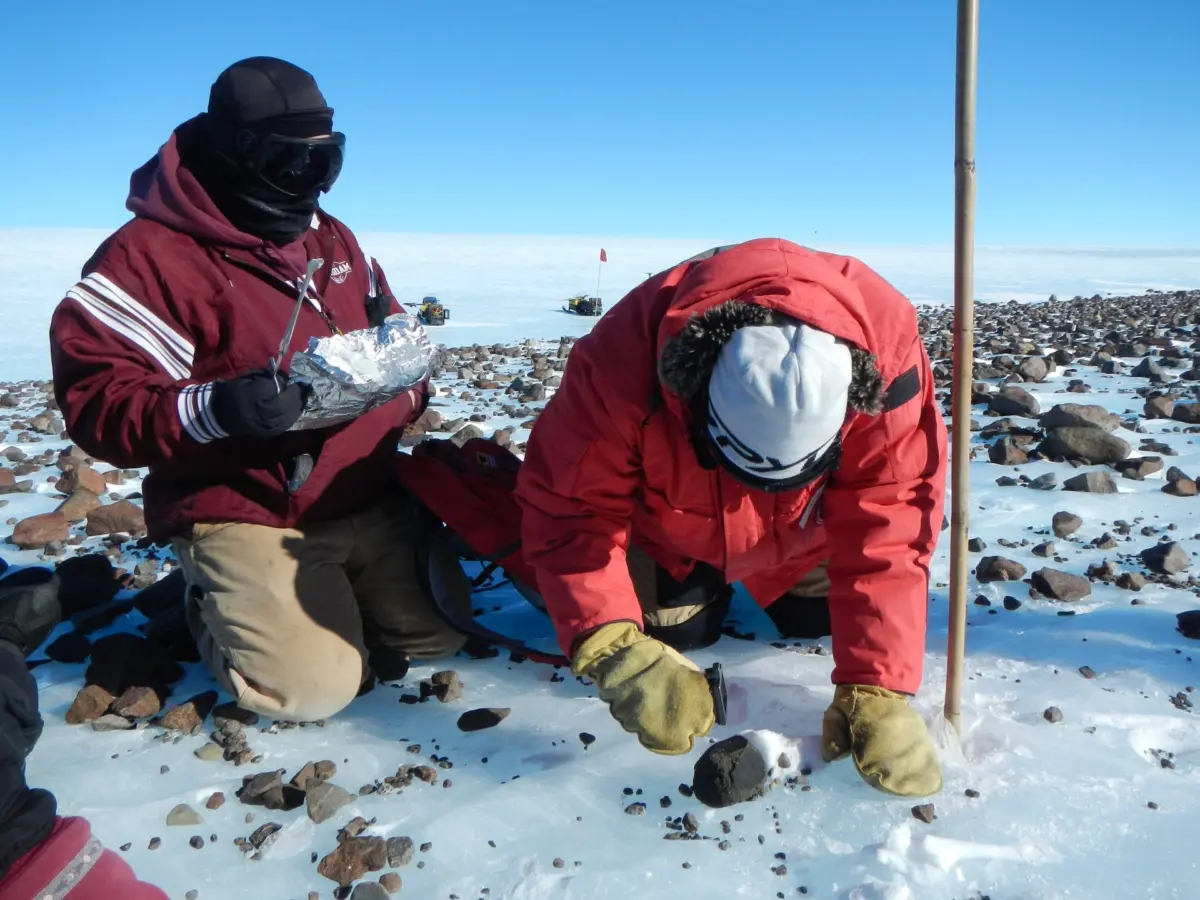
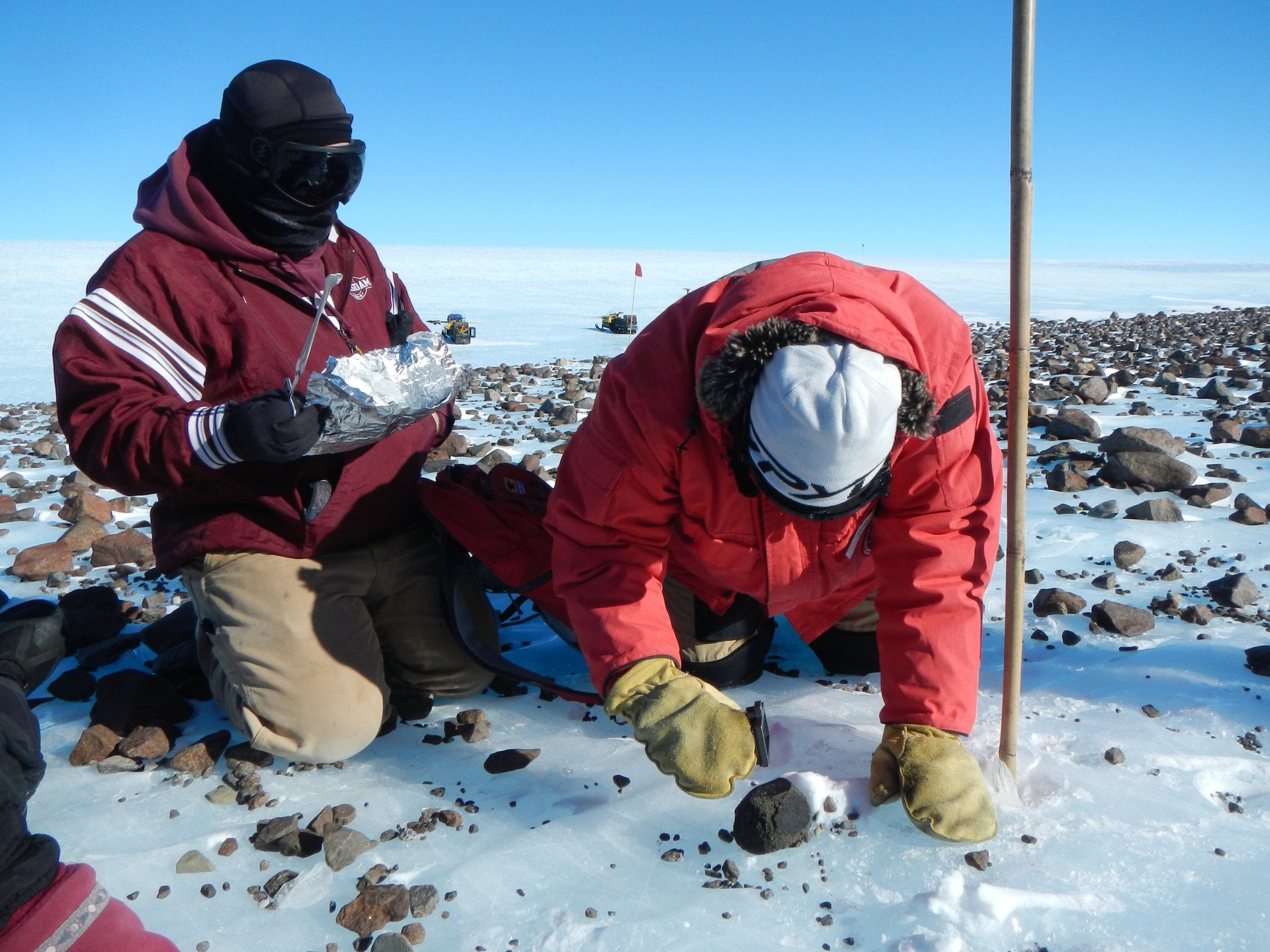
Finding these rocks on Earth requires specific environmental conditions. Most lunar meteorites are recovered from "cold" or "hot" deserts—Antarctica, Oman, and the Sahara in Northwest Africa. These regions are ideal because they are barren wastelands with low rates of terrestrial erosion and vegetation. In Antarctica, the movement of ice sheets can concentrate meteorites in specific "blue ice" areas, while in the Sahara, the dark fusion crust of a meteorite stands out against the pale desert sands.
Testing the Lunar Magma Ocean Hypothesis
The study of lunar meteorites is essential for validating the Lunar Magma Ocean (LMO) hypothesis. This theory suggests that shortly after its formation approximately 4.5 billion years ago, the Moon was covered by a global ocean of molten rock several hundred kilometers deep. As this ocean cooled, minerals crystallized and either sank or floated, creating the Moon’s layered structure: a dense mantle and a lighter, feldspar-rich crust (the lunar highlands).
Katherine Joy, a professor of lunar and planetary science at the University of Manchester, emphasizes that meteorites are the primary tool for testing this model across the entire lunar globe. Because meteorites likely include fragments of the ancient crust from the lunar far side—areas never visited by the Apollo astronauts—they allow scientists to determine if the LMO cooled uniformly or if regional variations occurred. By analyzing the chemistry and radioactive ages of these "random" samples, researchers can piece together a more accurate timeline of the Moon’s solidification.
Future Implications and Remaining Puzzles
Despite the wealth of data provided by meteorites, a significant "puzzle piece" remains missing: geographic context. As Professor Joy notes, each stone tells a story of the Moon’s past, but not knowing the exact crater or region it originated from limits its scientific utility. This is why the synergy between meteorite study and robotic sample return is so vital.
The ultimate goal for many planetary scientists is to identify a meteorite that originated from a truly unique magmatic region, such as Aristarchus, or one that contains significant portions of the lunar mantle. The mantle, located beneath the crust, holds the secrets to the Moon’s internal thermal history and its original bulk composition. To date, most samples—both returned and meteoritic—are crustal in nature.
As international space agencies look toward the Artemis program and the establishment of a permanent lunar base, the role of the lunar meteorite remains as important as ever. These "free" samples continue to challenge our assumptions, forcing scientists to reconcile the data from the geochemically rich Apollo sites with the more stoic, depleted nature of the rest of the lunar surface. By bridging the gap between the targeted "dots" on the map provided by spacecraft and the "global" data provided by meteorites, humanity is finally beginning to see the Moon not just as a silver disk in the sky, but as a complex, heterogeneous world with a violent and storied past.