Clarissa Hana
Researchers have identified a novel method to circumvent recent security measures designed to protect against Spectre v2 speculative execution side-channel attacks. This breakthrough, dubbed TONTOU (Time-of-Neutralization to Time-of-Use), allows for the extraction of sensitive data, including hashed passwords, from Linux systems. The exploit targets a critical timing window that exists between the moment a processor’s branch predictor is neutralized and when it is subsequently used, enabling attackers to re-poison the predictor with malicious instructions. This discovery poses a significant threat, as it undermines defenses implemented by both Intel and AMD processors that rely on isolating or sanitizing branch predictors.
The Mechanics of TONTOU: Exploiting the Microarchitectural Window
Spectre v2, also known as Branch Target Injection (BTI), is a sophisticated variant of the Spectre vulnerability class that exploits how modern processors manage execution flow. Processors employ branch prediction to anticipate the most probable path of execution and speculative execution to pre-emptively run instructions along this predicted path. This optimization significantly boosts performance but introduces potential vulnerabilities. Spectre v2 specifically targets the processor’s indirect branch predictor, a component that determines the destination of branches where the target address is not explicitly coded but is determined at runtime.
An attacker can manipulate this indirect branch predictor, causing the processor to speculatively execute instructions at an address chosen by the attacker, rather than the intended legitimate instruction. This speculative execution can inadvertently leak sensitive data residing in memory, as the processor briefly accesses and processes this information before realizing the misprediction.
To combat Spectre v2, manufacturers introduced "neutralization-based mitigations." For Intel processors, this often involves Enhanced Indirect Branch Restricted Speculation (eIBRS), while AMD utilizes Safe RET (Return Stack Buffer). These mechanisms aim to sanitize or isolate the branch predictor state, preventing an attacker from injecting malicious targets. The fundamental assumption behind these defenses is that a sufficient time gap exists between the sanitization process and the actual use of the branch predictor by a legitimate instruction, rendering any attempt to re-poison the predictor during this interval futile.
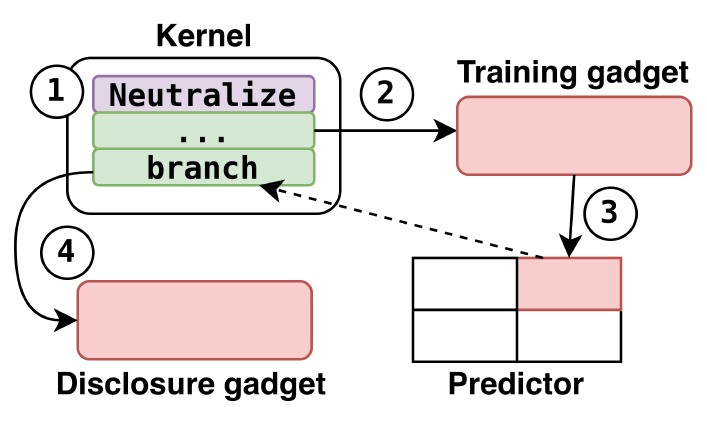
The TONTOU attack, however, shatters this assumption. Researchers Daniël Trujillo, a PhD student, and Associate Professor Mengjia Yan from the MIT Computer Science and Artificial Intelligence Laboratory (CSAIL), have devised a method to exploit the very temporal gap that neutralization-based mitigations create. They have demonstrated that it is possible to re-poison the CPU’s microarchitectural state after it has been cleaned but before it is utilized by a legitimate branch. This "Time-of-Neutralization to Time-of-Use" (TONTOU) window, as they term it, becomes a critical vulnerability.
"An attacker without any special access to read arbitrary memory from the system, including sensitive data such as hashed passwords," Trujillo explained to BleepingComputer, highlighting the potent implications of this attack.

The Interrupt Injection Primitive: A Gateway to Data Exfiltration
The core of the TONTOU attack relies on a carefully orchestrated "Interrupt Injection" technique. Unprivileged user programs, typically confined to their own memory spaces and with limited system privileges, can be manipulated to schedule timer interrupts. These interrupts can be timed to occur precisely during kernel execution.
"Therefore, we can force the kernel to be redirected to the interrupt handler and use this handler to poison microarchitectural states within the post-neutralization window," the researchers detailed in their paper. This means that by triggering a hardware interrupt at the opportune moment, the attacker can divert the CPU’s execution flow into a controlled interrupt handler. This handler then becomes the vehicle to manipulate the processor’s internal state, specifically targeting the indirect branch predictor.
The researchers found that interrupts occurring within this critical post-neutralization window are instrumental in poisoning the processor’s indirect branch predictor. This poisoning enables the attacker to influence the outcome of all types of indirect branches, effectively opening the door to data exfiltration.
Real-World Exploitation: Leaking Linux Password Hashes
Mengjia and Trujillo conducted their experiments assuming an attacker could execute arbitrary, unprivileged code on a target Linux machine. Their objective was to demonstrate the leakage of sensitive data directly from the kernel.
The attack was successfully tested on an AMD Zen 2 system running a Linux kernel version 6.14.0-37-generic with 16GB of RAM. This configuration was equipped with the latest Spectre v2 mitigations. The researchers meticulously executed all stages of a TONTOU attack:
- Neutralization: The system’s Spectre v2 defenses are activated, cleaning the branch predictor state.
- Redirection: An interrupt is injected, diverting the CPU’s execution to a specially crafted interrupt handler.
- Poisoning: Within the interrupt handler, the indirect branch predictor is manipulated with attacker-chosen targets.
- Use: A subsequent legitimate indirect branch instruction, executed after the poisoning, speculatively follows the attacker-influenced path, leading to data leakage.
Successfully implementing this attack requires overcoming several significant technical hurdles. These include accurately redirecting kernel control flow to the attacker-controlled interrupt handler, precisely aligning the timing of interrupts with the post-neutralization window, and ensuring the interrupt handler effectively poisons the specific branch predictor entry associated with the targeted indirect branch.
The researchers addressed these challenges through a combination of techniques. They employed "timers" to trigger hardware interrupts with a degree of predictability. Frequent injection of interrupts was used to increase the probability of hitting the narrow TONTOU window. Furthermore, they utilized both active and passive poisoning methods to ensure the branch predictor state was effectively manipulated.

On the tested AMD Zen 2 system, the TONTOU attack demonstrated a remarkable ability to leak arbitrary kernel memory at a rate of 5.47 bytes per second with an accuracy of 91.97%. Critically, this included the ability to extract the contents of /etc/shadow, a file that stores sensitive hashed passwords for user accounts on Linux systems.
Across ten separate test runs, the attack successfully located and extracted the /etc/shadow file in five instances. Each successful extraction took an average of 18 minutes to complete, underscoring the attack’s practical viability.
While the TONTOU attack is also theoretically possible on Intel processors, the researchers noted that it requires additional software dependencies, making the implementation more complex compared to the AMD environment they primarily tested.
Broader Implications and Vendor Responses
The TONTOU attack’s ability to bypass existing Spectre v2 mitigations has far-reaching implications for system security. It highlights a fundamental challenge in securing complex microarchitectural features that are essential for modern processor performance. The reliance on timing windows in security mitigations, while often effective, can create subtle vulnerabilities that are difficult to predict and defend against.
The researchers also explored the attack’s potential impact on the Return Stack Buffer (RSB), a component of the processor that tracks return addresses for function calls. Interrupt injection, they found, can enable attacker-controlled poisoning of the RSB, leading to speculative mispredictions of return targets. To enhance the reliability of RSB poisoning, which can be less consistent in passive forms, they combined interrupt injection with a previously disclosed attack called "Inception," which Daniël Trujillo also helped develop.
In response to these findings, AMD has issued an advisory (AMD-SB-7061) acknowledging the potential security issue. The company stated that the interrupt injection vulnerability "appears to be associated" with the implementation of the Safe RET mitigation on Linux. This suggests that the issue may lie not solely with the hardware design but also with the specific software implementations of the security features.
Intel has not yet released a formal statement regarding the TONTOU attack’s impact on its processors. However, given that the attack targets neutralization-based mitigations, it is likely that similar vulnerabilities could exist or be exploitable on Intel architectures with comparable defenses.
The Future of CPU Security: A Continuous Arms Race
The discovery of the TONTOU attack underscores the ongoing nature of the cybersecurity arms race. As manufacturers develop new defenses against sophisticated threats like Spectre and Meltdown, security researchers continually probe for weaknesses and novel exploitation vectors.
Daniël Trujillo and Mengjia Yan presented their groundbreaking findings at the prestigious Black Hat USA security conference today. They are scheduled to share further details of their research at the USENIX Security 2026 conference, taking place between October 27th and 29th. This public disclosure is crucial for enabling the broader security community to understand the threat, develop effective countermeasures, and patch affected systems.
The implications of TONTOU extend beyond simply leaking password hashes. Any sensitive data residing in kernel memory, including cryptographic keys, user credentials, and system configurations, could potentially be exfiltrated. This necessitates a proactive approach from both hardware manufacturers and software developers to reassess and strengthen their security postures.
For users and organizations running Linux systems, the immediate concern is the potential for compromise. While the attack requires unprivileged code execution, many systems are susceptible to such initial footholds. The long-term solution will likely involve a combination of microcode updates from CPU vendors, kernel patches from Linux distributions, and potentially a re-evaluation of how branch prediction and speculative execution are managed at a fundamental level.
The TONTOU attack serves as a stark reminder that even seemingly robust security mitigations can be bypassed through creative exploitation of intricate system behaviors. It emphasizes the critical need for continuous research, rigorous testing, and rapid dissemination of vulnerability information to stay ahead of evolving threats in the ever-changing landscape of computer security. The research by Trujillo and Yan provides invaluable insights into the vulnerabilities inherent in complex processor architectures and the ongoing challenges in securing them against advanced adversaries.