Sisilia Frederika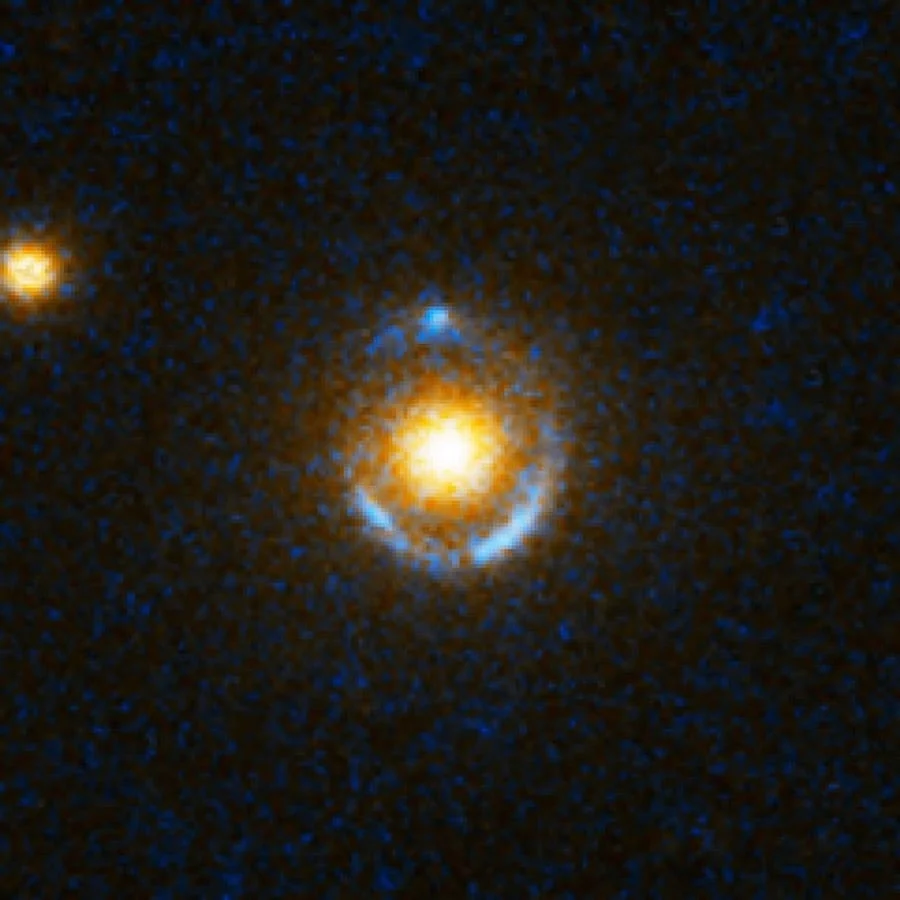
The Challenge of the Quasar Glare
Quasars, or quasi-stellar objects, represent some of the most extreme environments in the known cosmos. Located at the centers of distant galaxies, these objects are powered by supermassive black holes that are actively accreting matter from their surroundings. As gas and dust fall toward the event horizon, they form an accretion disk that reaches temperatures of millions of degrees, emitting radiation across the electromagnetic spectrum. The resulting luminosity is so intense that a single quasar can outshine its entire host galaxy by a factor of hundreds or even thousands.
For astronomers, this brilliance is a double-edged sword. While it allows quasars to be detected across billions of light-years, the "glare" from the central black hole often makes it impossible to observe the stars and structure of the surrounding galaxy. In astronomical terms, it is akin to trying to study the structural details of a lighthouse while looking directly into its focused beam from miles away. Because the host galaxy’s light is swamped by the quasar, measuring the galaxy’s mass—a critical metric for understanding its evolution—remains a profound observational challenge.
Gravitational Lensing as a Cosmic Scale
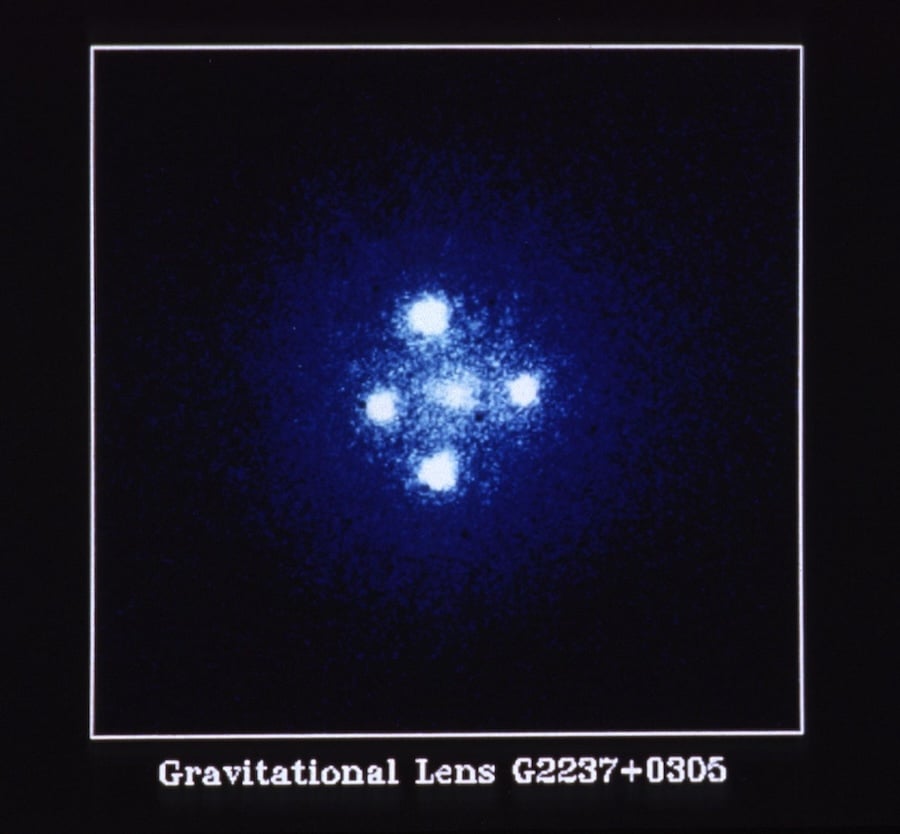
To circumvent the problem of quasar glare, the research team turned to gravitational lensing, a phenomenon predicted by Albert Einstein’s General Theory of Relativity. In this scenario, a massive object, such as a galaxy, acts as a "lens" by warping the fabric of spacetime around it. When a more distant object, such as a background galaxy, lies directly behind this foreground lens from our perspective on Earth, its light is bent and magnified as it passes through the warped space.
The degree of distortion—often appearing as arcs, rings, or multiple images—is directly proportional to the mass of the foreground object. Crucially, this effect depends only on the total mass (including dark matter) and is independent of the foreground object’s luminosity. Consequently, if a galaxy hosting a bright quasar acts as a lens for a background object, astronomers can calculate the host galaxy’s mass by analyzing the lensing pattern, regardless of how much light the quasar itself is emitting.
However, the geometric requirements for gravitational lensing are incredibly stringent. The foreground galaxy and the background source must be aligned with near-perfect precision along the observer’s line of sight. Given the vastness of space, such alignments are exceedingly rare, making the identification of "quasar-host lenses" a "needle in a haystack" search on a cosmic scale.
The Dark Energy Spectroscopic Instrument (DESI) Survey
The hunt for these rare lenses began with the Dark Energy Spectroscopic Instrument (DESI). Mounted on the 4-meter Mayall Telescope at Kitt Peak National Observatory in Arizona, DESI is designed to conduct the largest spectroscopic survey of the universe to date. Over its five-year mission, it aims to capture the spectra of approximately 40 million galaxies and quasars to map the expansion history of the universe and study the nature of dark energy.
The DESI catalogue currently contains roughly 800,000 quasar spectra. Each spectrum represents a "fingerprint" of light, breaking down the radiation into its constituent wavelengths. For a quasar-host lens, the spectrum would be a hybrid: it would contain the characteristic broad emission lines of a high-redshift quasar, superimposed with the faint, telltale signatures of a second, more distant galaxy.
Identifying these hybrid signatures manually is an impossible task. If a researcher were to spend just five minutes analyzing each of the 800,000 spectra, the process would take over seven years of continuous, 24-hour labor. To address this "big data" bottleneck, the Ohio State team turned to machine learning.
Training Neural Networks with Synthetic Data
Everett McArthur and his colleagues developed a neural network—a type of artificial intelligence designed to recognize complex patterns in data. However, neural networks require a vast amount of "training data" to learn what to look for. In the case of quasar-host lenses, there were simply not enough confirmed real-world examples to provide a robust training set.
To overcome this, the team employed a technique involving the creation of "synthetic" or mock lenses. They took genuine spectra of quasars from existing databases and mathematically combined them with genuine spectra of distant galaxies. By blending these real ingredients in various configurations, they generated thousands of simulated examples of what a quasar-host lens spectrum should look like.
This approach allowed the neural network to learn the subtle nuances of overlapping spectral lines. Once trained on these high-fidelity simulations, the AI was set loose on the 800,000 real spectra within the DESI database. The algorithm successfully narrowed the massive dataset down to a manageable shortlist of 200 candidates that exhibited the spectral characteristics of a lensing system.
From 800,000 to Seven: The Human Element
Following the AI-driven filtration, the research moved into a validation phase involving human inspection. The team of astronomers scrutinized the 200 candidates, looking for specific physical markers that the neural network might have flagged incorrectly, such as instrument noise or unusual atmospheric interference.
This rigorous vetting process eventually yielded seven high-confidence candidates. While the number seven may seem modest in the context of nearly a million initial data points, its significance cannot be overstated. Prior to this study, only a handful of such systems were known to exist. By identifying seven new candidates, the team has effectively doubled the global sample size of quasar-host lenses.
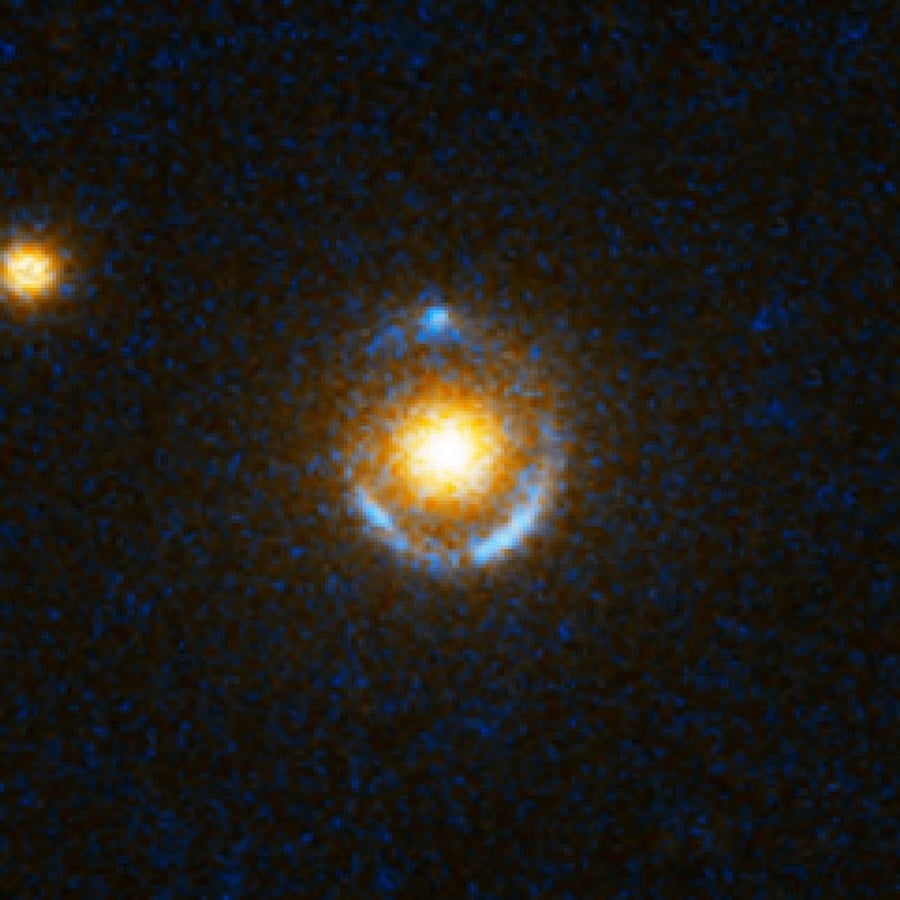
These objects are located at immense distances, with light having traveled for five to six billion years before reaching the DESI sensors. This means the team is observing these galaxies as they were when the universe was less than half its current age, providing a snapshot of a critical epoch in cosmic history.
Chronology of the Discovery and Research
The timeline of this discovery reflects the modern "survey-era" of astronomy, where progress is driven by the intersection of massive hardware projects and innovative software solutions:
- 2021: The Dark Energy Spectroscopic Instrument (DESI) begins its primary survey, systematically collecting hundreds of thousands of spectra per month.
- 2022–2023: Everett McArthur and the Ohio State team identify the need for a more efficient way to search for host-galaxy lenses. They begin developing the neural network architecture and the methodology for creating synthetic spectral blends.
- Late 2023: The neural network is deployed on the initial DESI data release, filtering through 800,000 spectra to find potential overlaps.
- Early 2024: The "Human-in-the-loop" phase begins, where the 200 candidates are manually reviewed by experts.
- Mid-2024: The team finalizes the identification of the seven most promising candidates and prepares the findings for publication, highlighting the potential for future follow-up observations.
Broader Implications for Galactic Evolution
The primary scientific value of these seven lenses lies in their ability to help astronomers test the "co-evolution" hypothesis. Observations have shown a mysterious correlation between the mass of a galaxy’s central supermassive black hole and the mass of the galaxy’s "bulge" (its central concentration of stars). Larger galaxies almost always host larger black holes, suggesting that the two grow in tandem over billions of years.
However, the mechanisms that regulate this joint growth are not fully understood. By using gravitational lensing to get an accurate mass measurement of the host galaxy while simultaneously analyzing the properties of the active quasar at its center, researchers can determine if this mass-to-mass relationship held true in the distant past. Each of the seven new lenses provides a data point for this cosmic "weighing," allowing scientists to see if black holes and galaxies were growing "in step" five billion years ago or if one preceded the other.
Future Outlook: Hubble and the Next Generation of AI
The discovery of these candidates is only the first step. To confirm the lensing effect beyond any doubt and to map the mass distribution within these galaxies, higher-resolution imaging is required. The team anticipates that follow-up observations using the Hubble Space Telescope or the James Webb Space Telescope (JWST) will be necessary. These instruments can provide the visual clarity needed to see the distorted "Einstein Rings" or arcs of light from the background galaxies that the DESI spectra suggest are there.
Furthermore, McArthur emphasizes that this technique is highly generalizable. The success of the neural network in finding these rare lenses proves that AI can be trained to find almost any specific anomaly within a vast spectroscopic library. As upcoming projects like the Vera C. Rubin Observatory and the Nancy Grace Roman Space Telescope begin to produce even larger datasets—measured in petabytes—manual inspection will become entirely obsolete.
The shift in modern astronomy is clear: the challenge is no longer just about building bigger telescopes to collect more light, but about developing smarter algorithms to find the hidden gems within the data we already possess. As McArthur notes, the most interesting questions in the field are increasingly becoming about what remains to be discovered within the vast digital archives of our current surveys. With the identification of these seven quasar lenses, the Ohio State team has provided a blueprint for the future of discovery in the era of big-data cosmology.